No sooner have we left Ponte das Tres Entraps than we find ourselves climbing very steeply up a never-ending incline. It feels as if we’ve never been this high before and driving along hairpin bends here is not for the faint-hearted. At Seia we have to stop and take a photo as we seem to be above other mountain peaks.
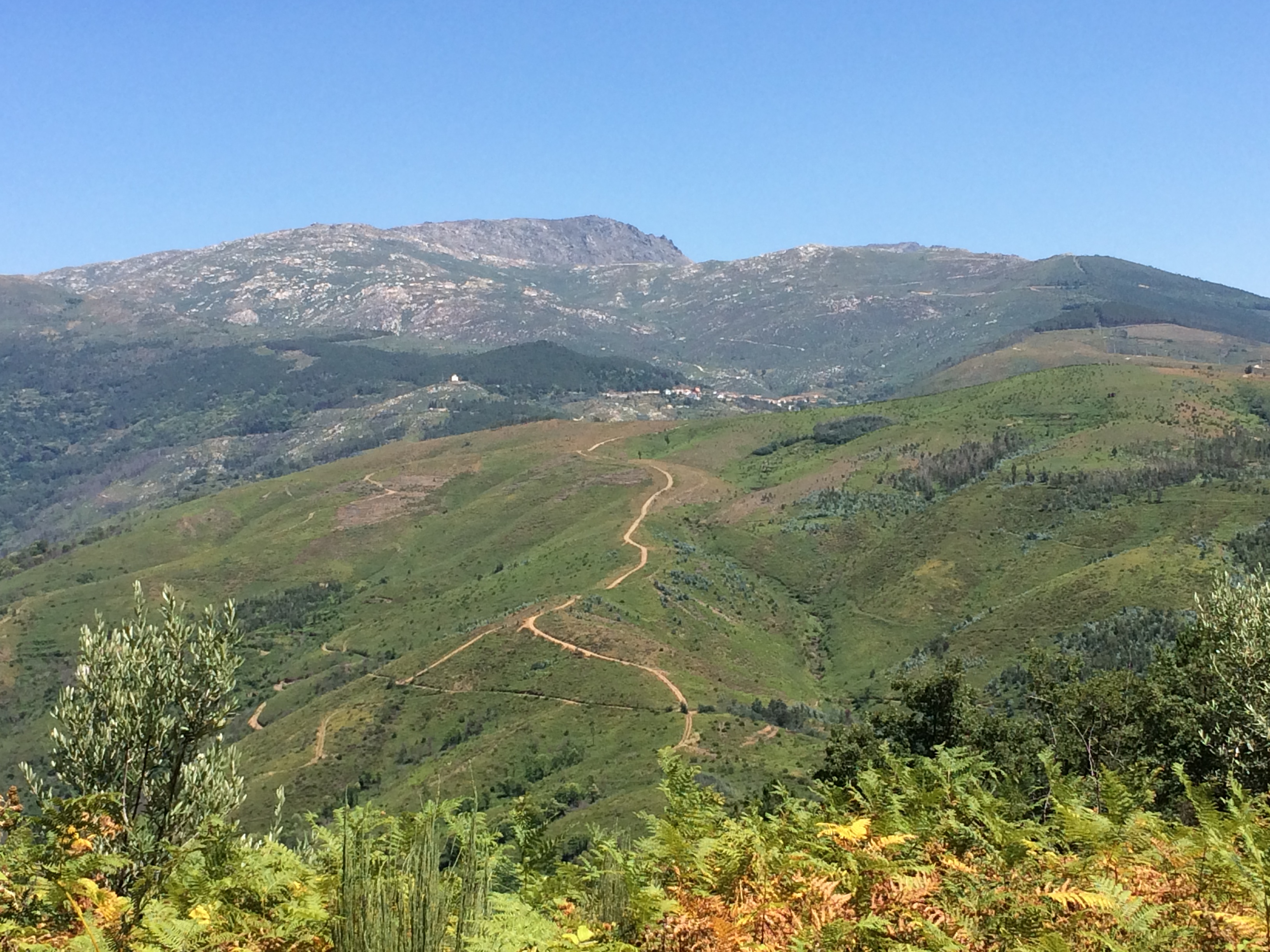
Shortly after leaving Ponte das Tres Entradas, we reach a very high point above other peaks.

The breath-taking view from Seia.
We continue travelling cross-country on ‘B’ roads until we reach the main national route just south of Viseu from which we cross the Serra do Caramulo to just north of Aveiro before turning into the coastal road to Porto.
Our campsite turns out to be in a seaside resort in Vila Nova de Gaia just south of Porto. As we arrive in the late afternoon the temperature has dropped sharply from 37 degrees on the route there to 22 degrees, and a strong wind is blowing. The sea off the seemingly endless sand and rocky beach looks rough and angry and a black flag is fluttering violently. For once, I’m not really tempted – it really is blowy and the sea looks positively suicidal. As it’s a weekend, crowds of people are making their way back home clutching rolled-up mats, umbrellas and other beach equipment. They have that determined look people have on a Bank Holiday weekend in Brighton or Littlehampton when the weather’s been a total disappointment but they’re not going to allow that to deny them their seaside fun. But as the manager of the campsite says (his name’s Nunu, another Nunu), this isn’t the Algarve, here in the north you have to be made of hardier stuff. “Is it always like this?” I ask him. “Half and half” he says, elliptically, “there’s a reason foreigners prefer the south. The beaches look good but as soon as they dip their toe in the water – ouch!” And that’s on a good day.
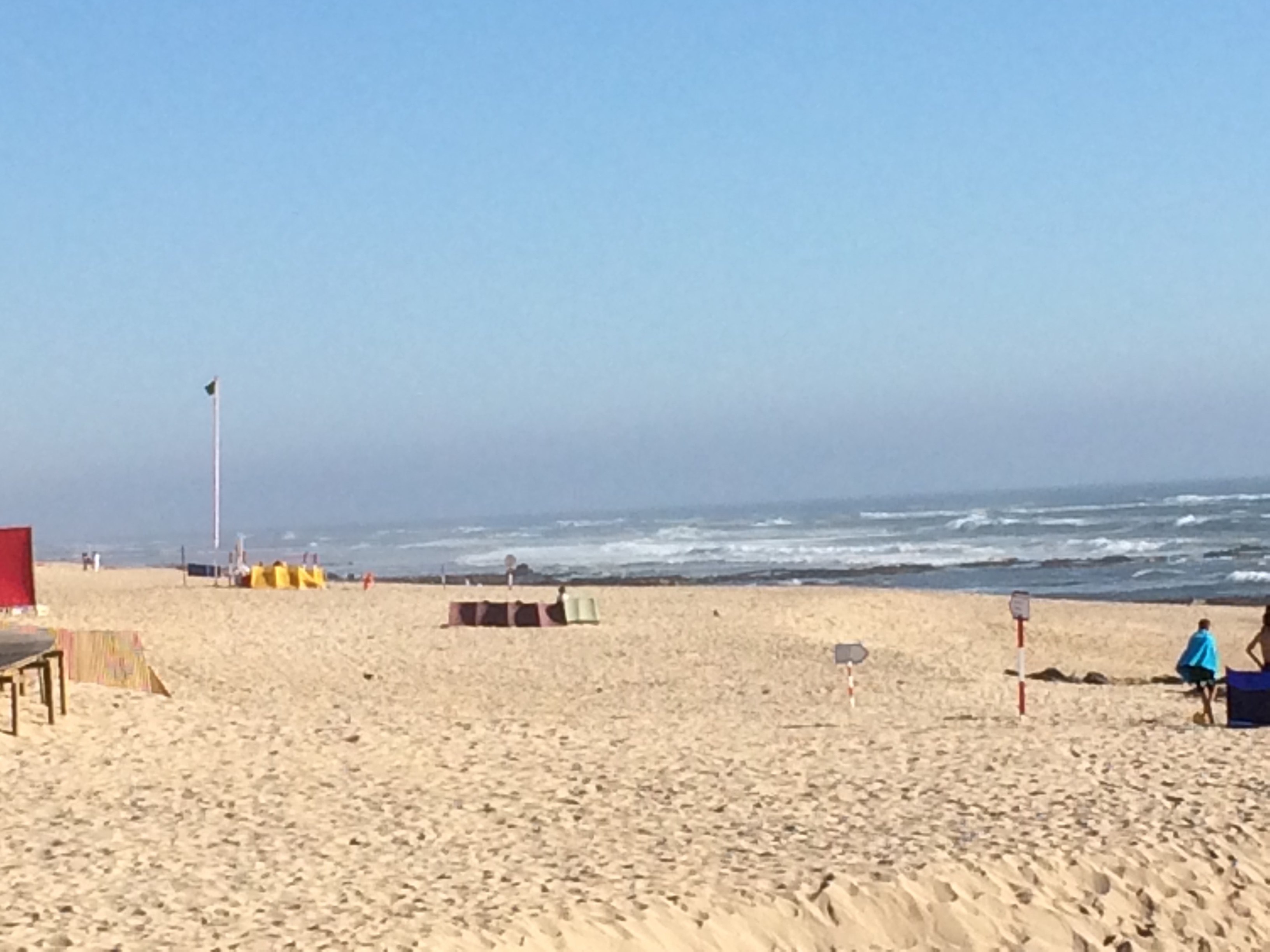
The by now deserted beach at Vila Nova de Gaia with the black flag flying.
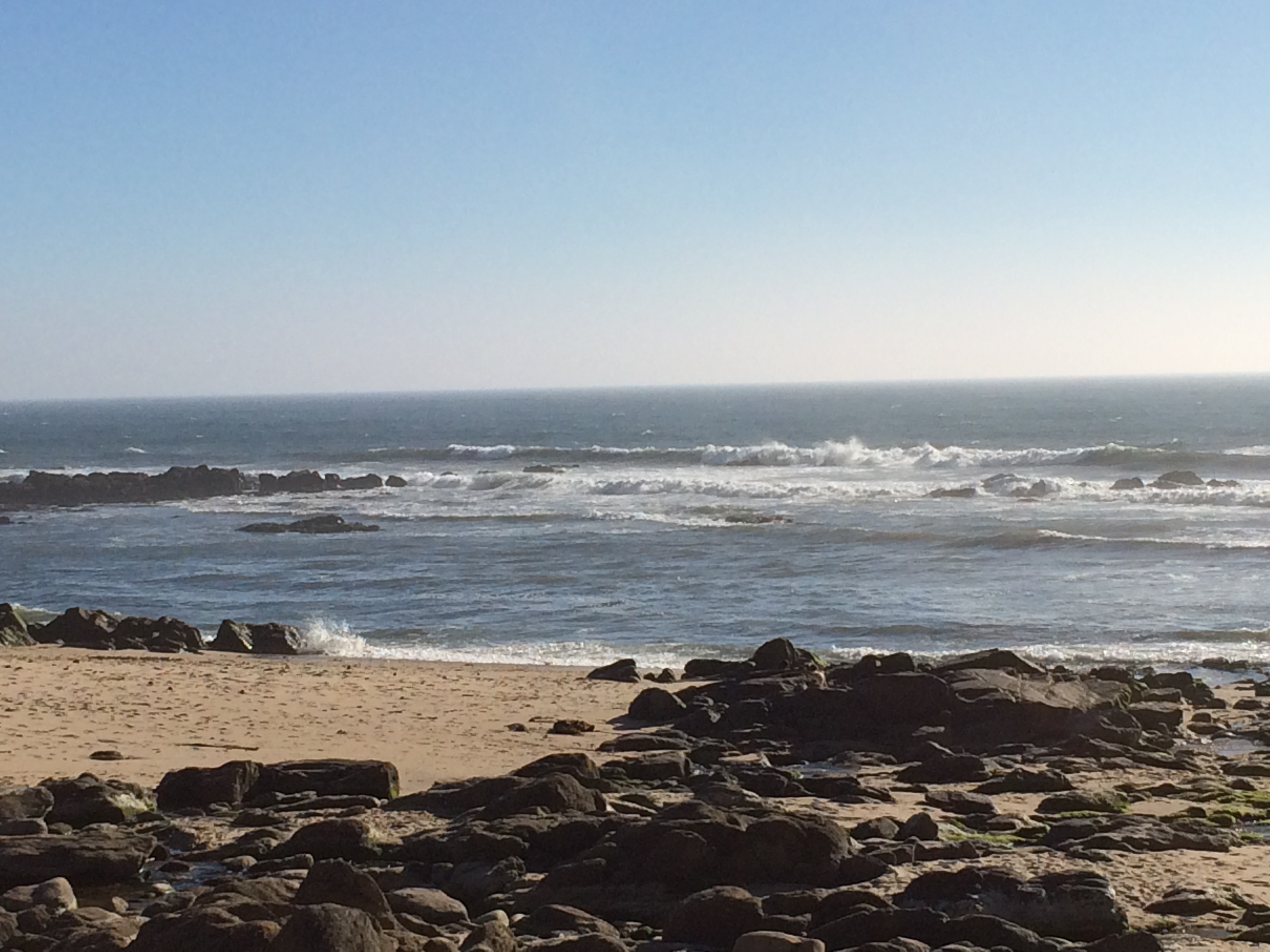
Really not very inviting at all.
The campsite is very basic and not terribly inviting either, but it’s just for the night, ready to visit Porto the next day.
A brief background note:
Porto is Portugal’s second city, with a population of c 1.5 mil. It’s located along the Douro River estuary and it’s an important city in the heavily industrialized north of the country with many large companies headquartered there. In 2014, it was elected the ‘best European destination’ by the Best European Destinations Agency. Its historical core has been designated a UNESCO World Heritage Site.
It was an outpost of the Roman Empire. Portugal’s name is derived from the Latin-Celtic name “Portus-Cale”. It came under Moorish control in 711 but was recaptured by the ruler of Galicia, Leon and the Asturias in 868.
In 1387 it was the site of the marriage between John 1 of Portugal and Philippa of Lancaster, daughter of John of Gaunt, initiating the Treaty of Windsor military alliance which NATO is based on.
In the 14th and 15th centuries, Porto was an important contributor to the ship-building effort that was vital to the success of the naval expeditions. Henry the Navigator sailed from Porto to embark on the conquest of Ceuta in Morocco which paved the way for the exploration of West Africa and initiated the Age of Discovery.
People from Porto are still referred to as ‘tripeiros’ (tripe-eaters) because at that time, higher quality cuts of meat were shipped off with the sailors leaving off-cuts for the citizens. Tripe is still a culturally important dish.
In the 18th century, via the treaty with England, the English came to dominate port wine production for a while.
In the 19th century, the 1st Duke of Wellington’s Anglo-Portuguese army pushed back Napoleon’s troops in a surprise ‘coup de main’ by crossing the river on wine barges.
The first revolt by the Republicans against the Monarchy was in Porto in 1891. This led eventually to the formation of the Republic in 1910.
By morning, the weather has improved significantly and by 10 am the whole of the promenade is a hive of sporty activity, with dozens of people jogging and cycling on their designated paths while the beach is already filling up with colorful umbrellas. People in both Portugal and Spain are generally really quite sporty. With such a rich variety of tasty food, you probably need to be. Enjoying eating is probably a great motivator to exercise, and surely that’s as good a reason as any to exercise?

The seafront at Vila Nova de Gaia is already a hive of activity with people jogging or cycling
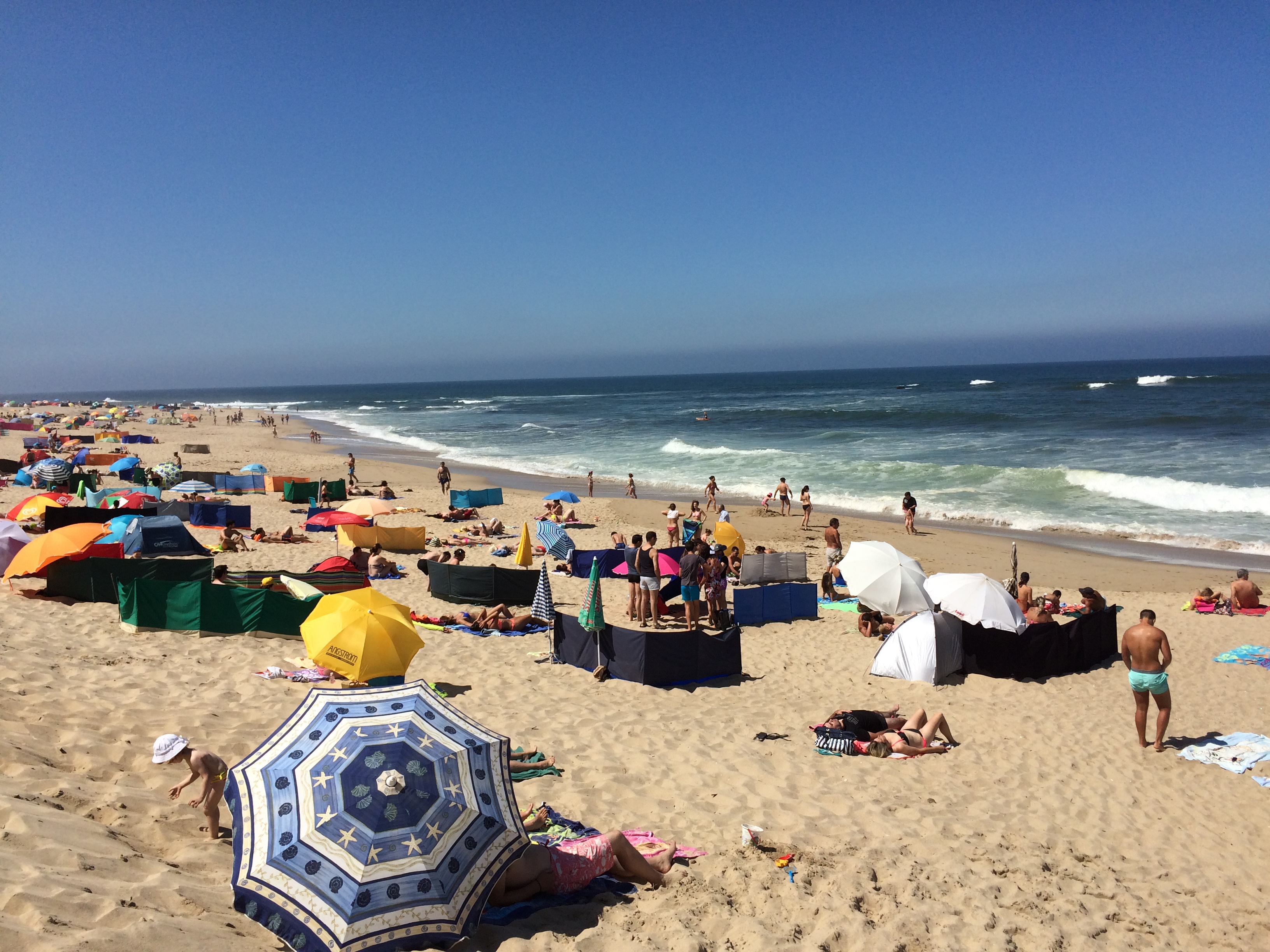
The sea has calmed down and the beach is already filling up.
We find a convenient open-air car park not far from the centre and take our bikes into town.
We chained up our bikes near the closest Tourist Information Office and and walked round the old centre in no particular order after getting a few basic recommendations.
First we saw the baroque style Igreja da Trinidade in Santo Ildefonso where a mass was being held to a surprisingly small congregation. We then walked down the Avenida dos Aliados to the Praca de Liberdade at the centre of which was a statue of Pedro IV on horseback. Across the road is the Igreja dos Congregates, built at the end of the 17th century on the site of an older chapel dedicated to St Anthony. The blue tiles however were added later in the 20th century.Turning right into the Rua dos Clerigos and at the intersection with Rua das Carmelitas, we found the famous baroque Torre dos Clerigos, built by an Italian architect in the mid-18th century and which has become Porto’s main visual icon.
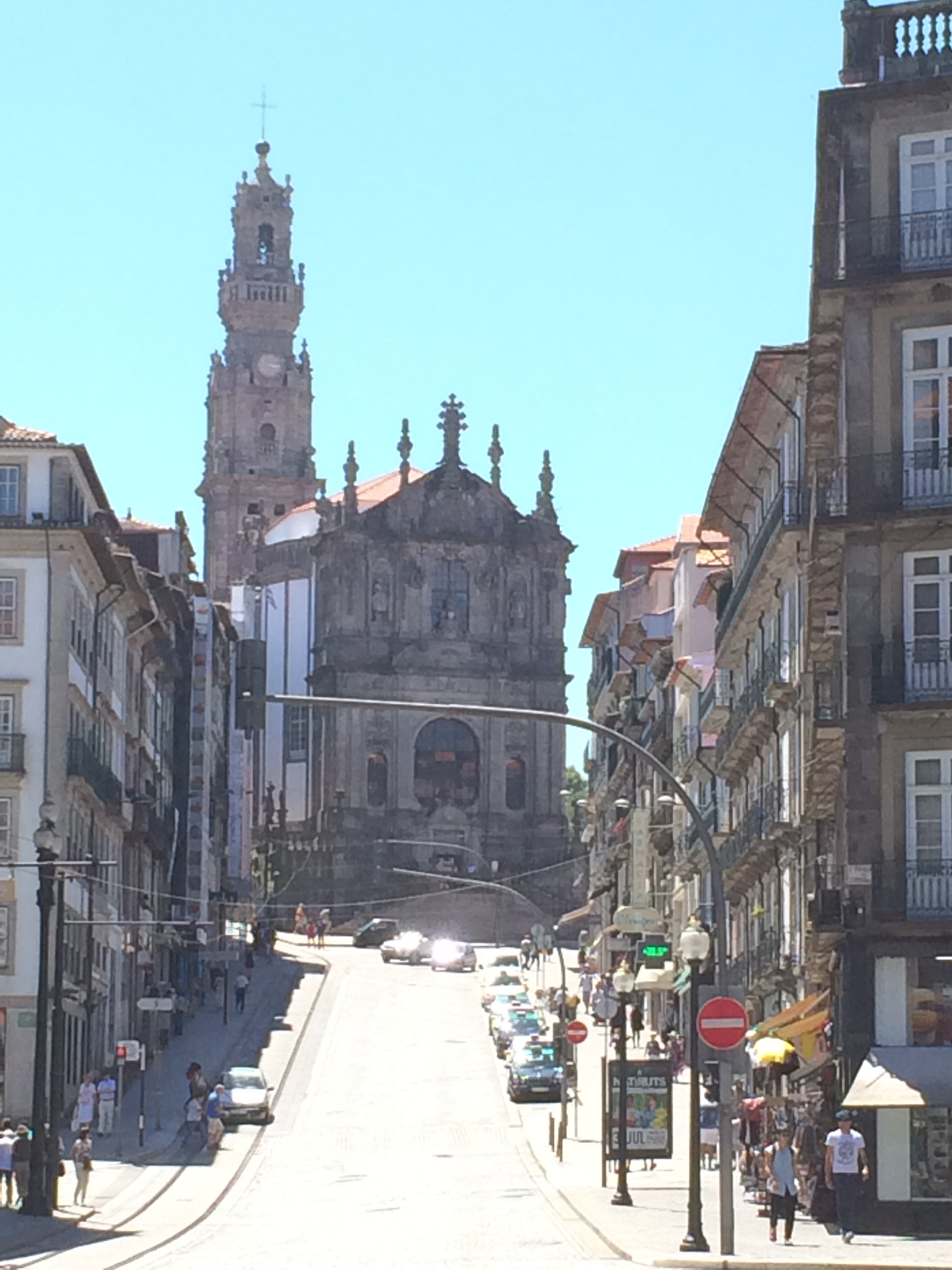
The iconic Torre dos Clerigos built in the 18th century by an Italian architect as seen from Rua dos Clerigos
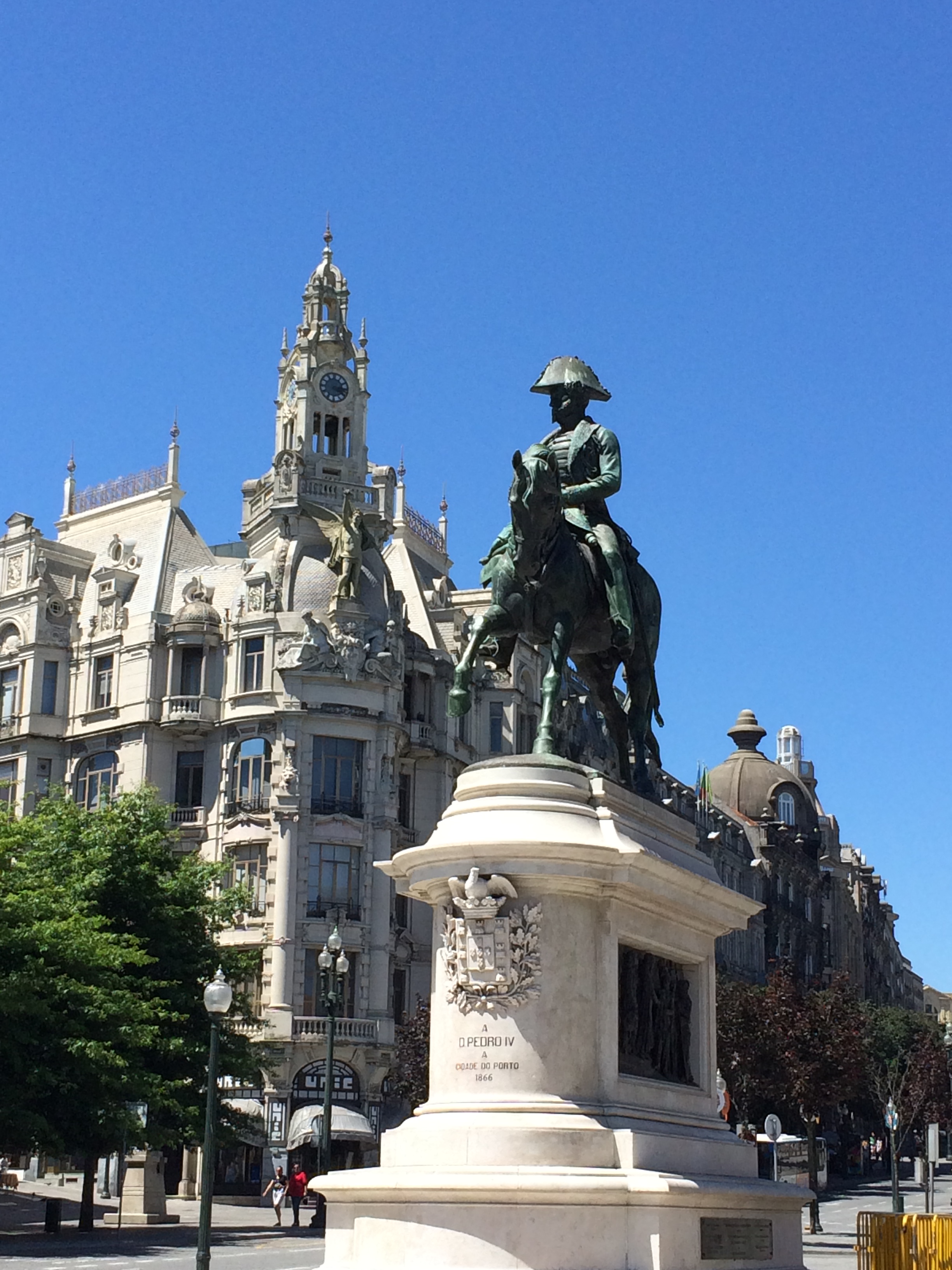
The Praca da Liberdade with statue of Pedro IV.
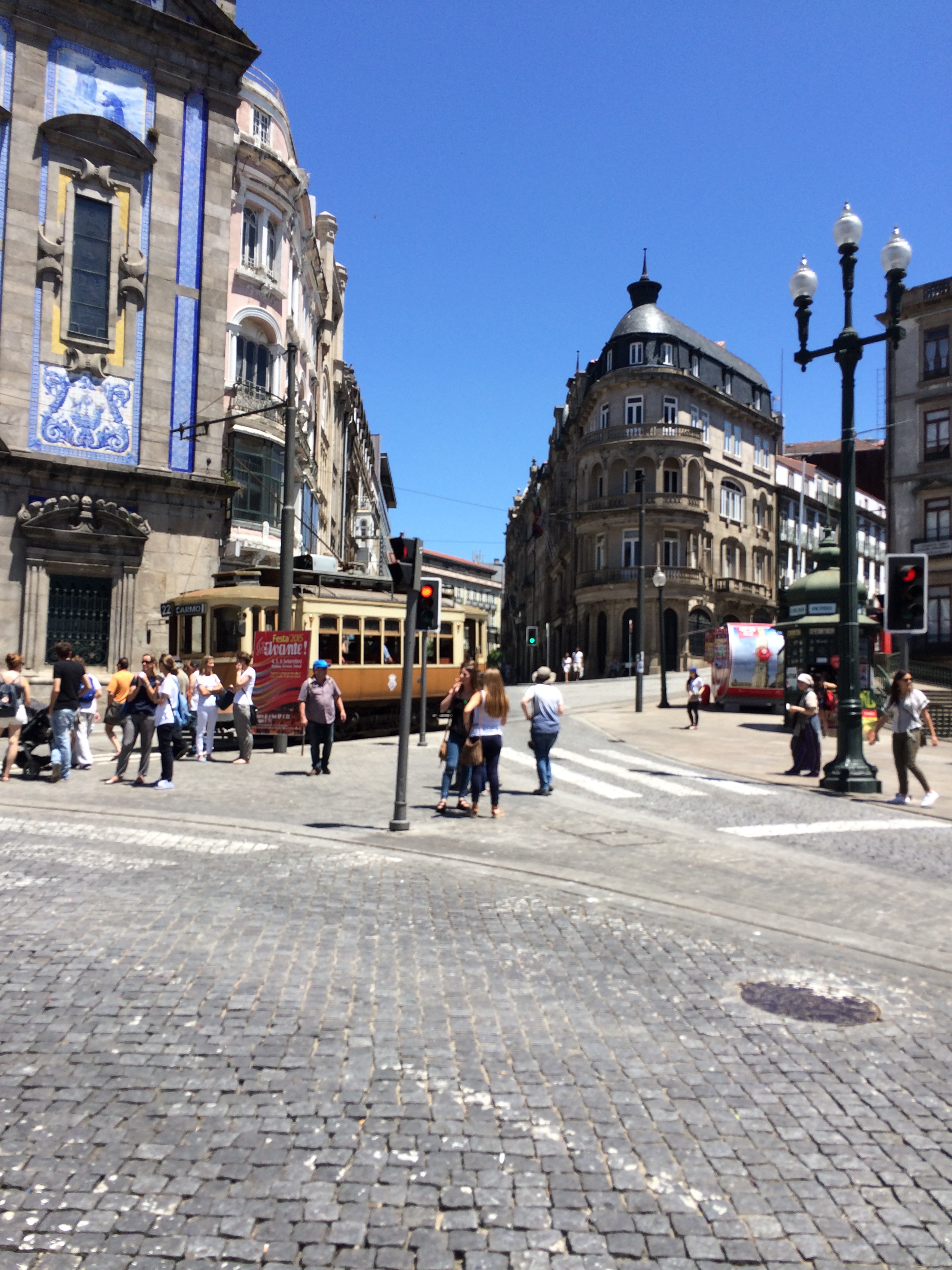
Another view of the Praca da Liberdade.
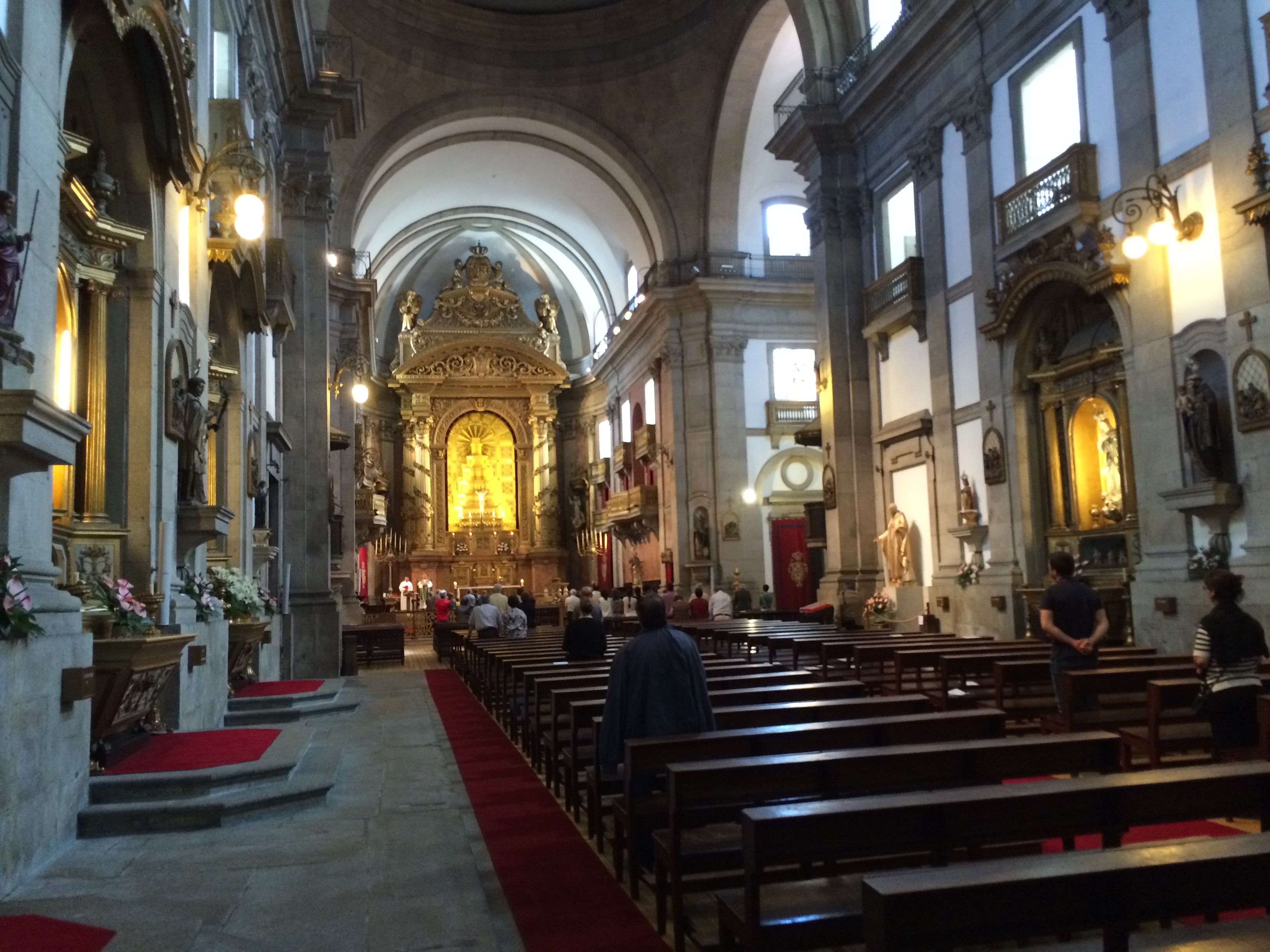
Sunday mass at the Igreja da Trindade before a surprisingly small congregation.
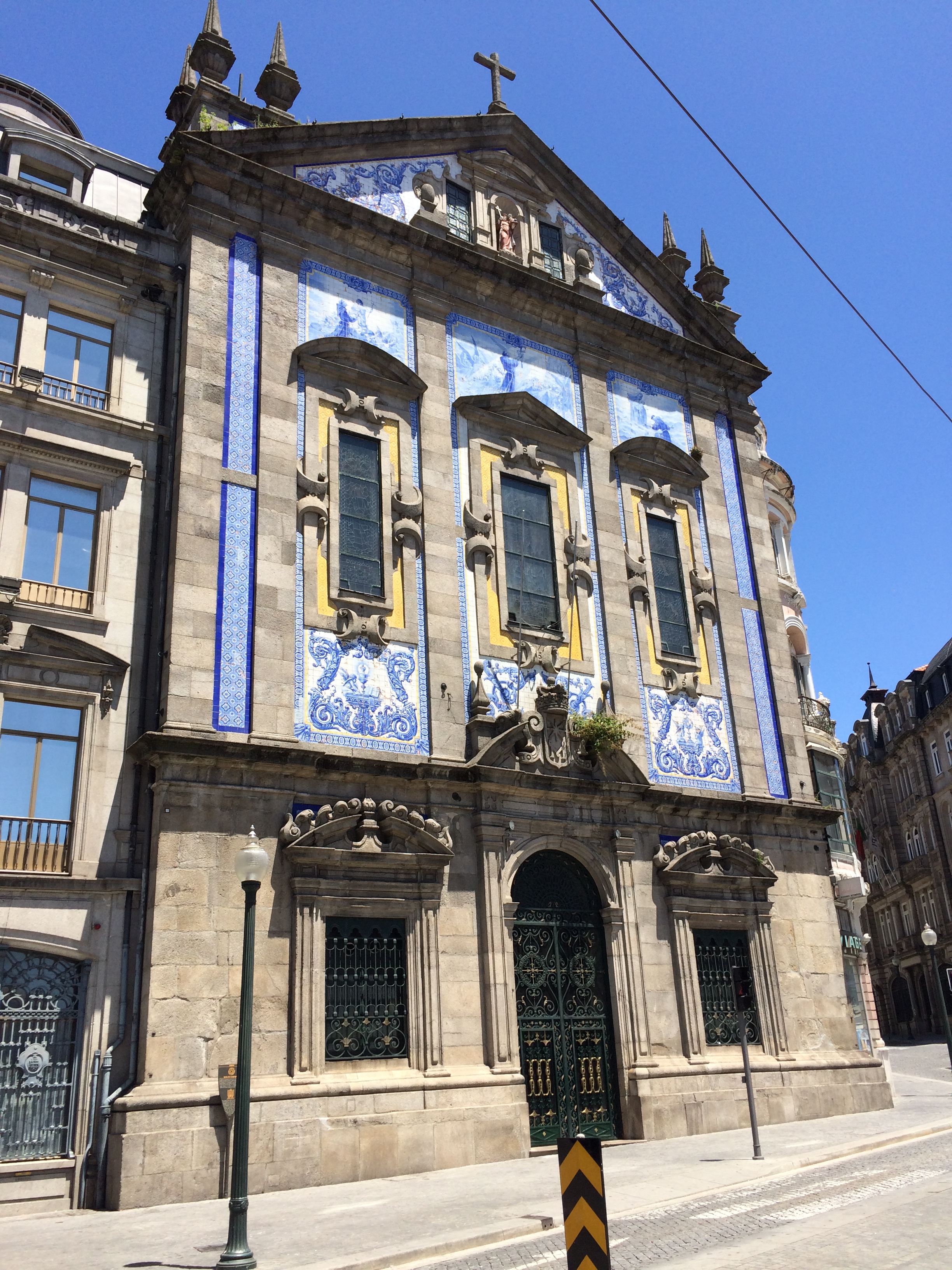
The 17th century Igreja dos Congregados with tiles added in the 20th century.
We went down further to the Sao Bento Train Station area with its typical Porto facades and narrow buildings then turned left into a poorer and more shabby quarter through the Rua do Souto before reaching the imposing 12th century Romanesque Se do Porto Cathedral located at the top of a hill. In front of the cathedral and in a heroic pose on horseback was a statue of Vimara Perez, a Spanish nobleman from the Asturias and first ruler of the ‘County of Portugal’ in the 9th century.
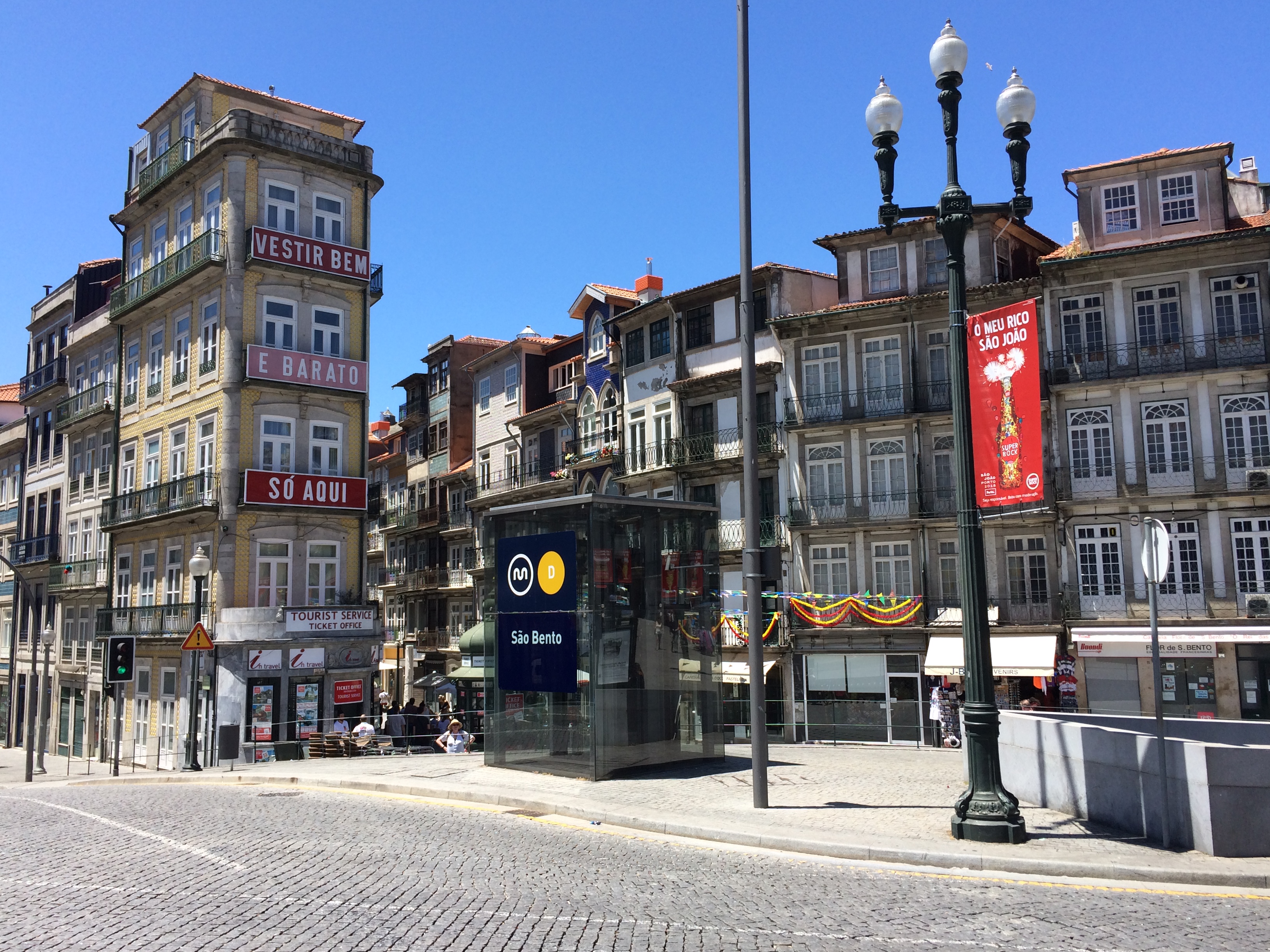
The Sao Bento Railway Station area.

The narrow streets of the poor quarter.
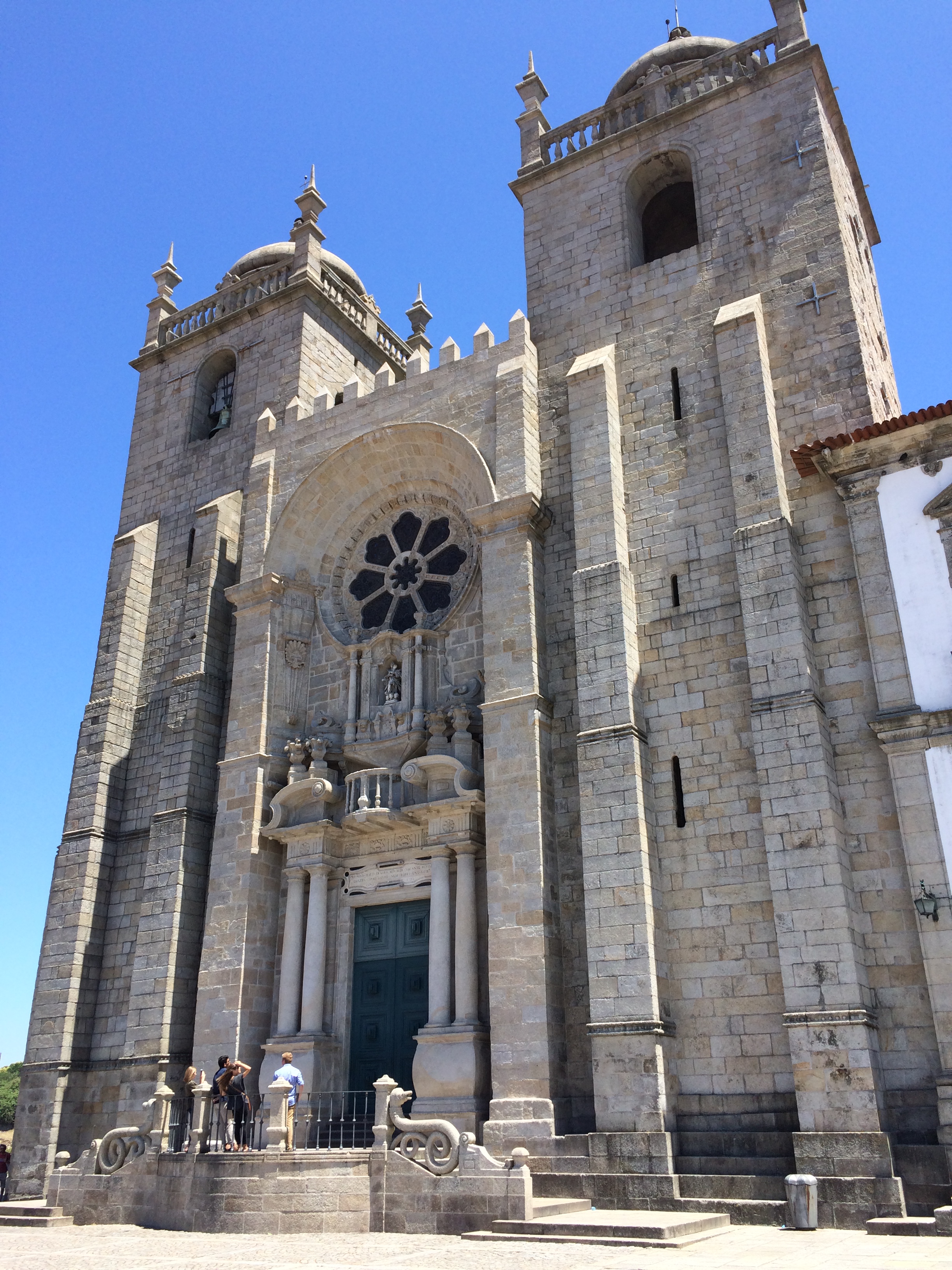
The Romanesque 12th century Se do Porto Cathedral.
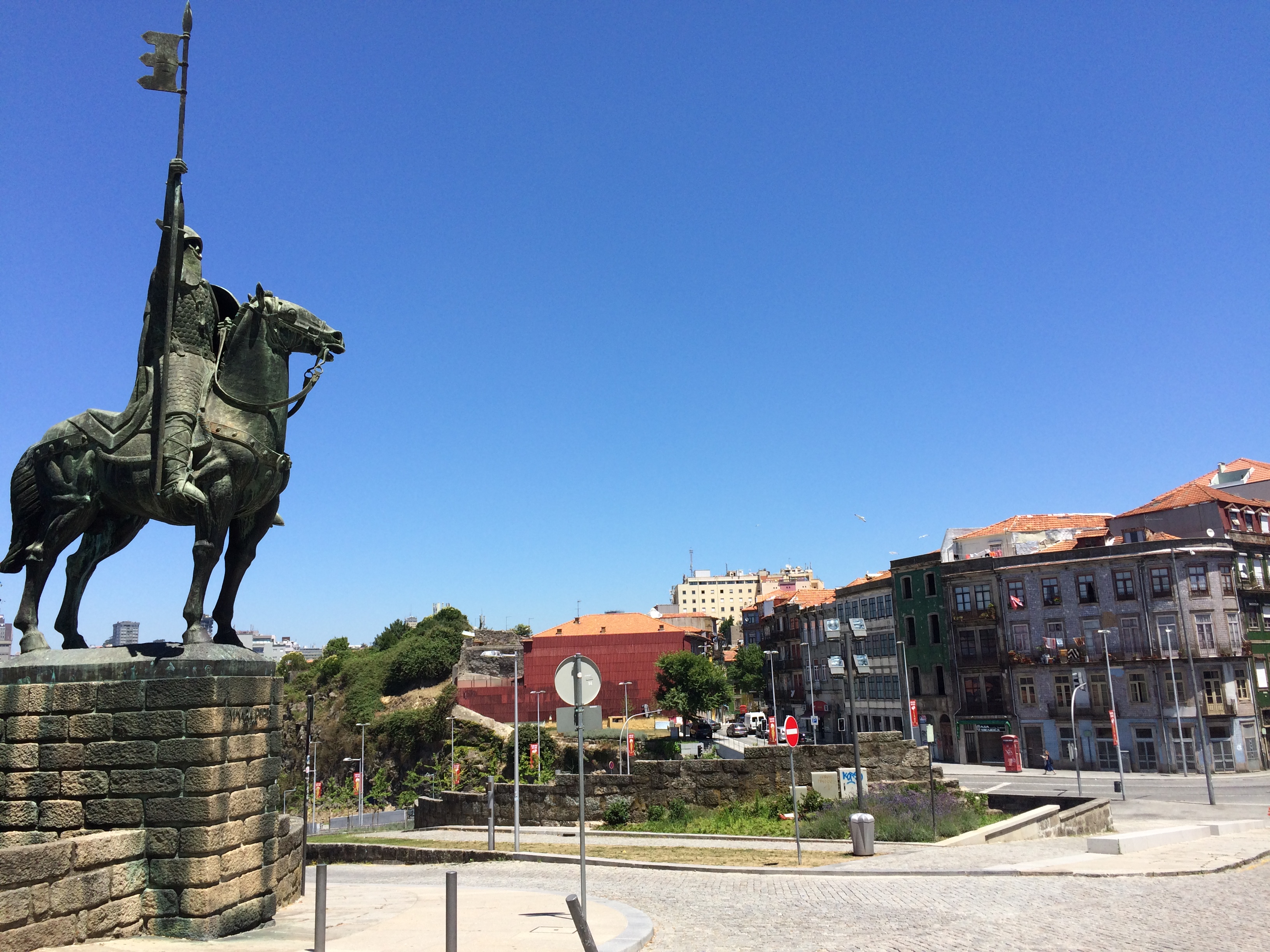
Statue of Vimara Perez, 9th century nobleman from the Kingdom of Asturias in Spain and first ruler of the ‘County of Portugal’.
We walked down the hill along the Rua de San Joao to the busy and touristy Sao Nicolau district on the bank of the estuary. Attractive boats carried tourists up and down the estuary and under the Ponte Luis I (Porto is known for its many bridges). We had been advised to look for a good place to eat on either the Rua das Flores or the Rua de Mouzinho da Silveira nearer the main square but we didn’t want a full lunch and picked a place that served smaller snacks. I was intrigued by an item on the menu called Pastel de Chavez as Chavez was the place Flavio Miguel had said down in the Algarve that ‘all the Flavios came from’. Having researched it, a more accurate explanation was that the town of Chavez had an older Roman name of the Flavian town after one of the Flavius Emperors who founded it and consequently, to this day, people who come from Chavez are nicknamed ‘Flaviensen’. As we weren’t going to have time to make a detour to visit the town, if this Pastel de Chavez actually was a Chavez speciality, the next best thing to going there I reckoned was to eat one of their pastries. When the friendly waiter Felipe confirmed that was the case, we ordered two as well as two Bolinhos de Bacalhau (cod fish cakes) and two Rissois de Leito (pork rissoles). I’m delighted to say the Pastels de Chavez (tasty mince in flaky pastry pasties) were the tastiest of the three and it left me feeling irrationally vindicated. A couple of tourists (from Florida and Toronto) even stopped to ask what the pasties were as they looked so good, which gave me an opportunity to tell them the whole story and make me feel even better! It led to a very interesting conversation with them (they were just coming to the end of a tour of Europe by train the whole way) and this wouldn’t have happened without the Chavez / Flaviensen connection!
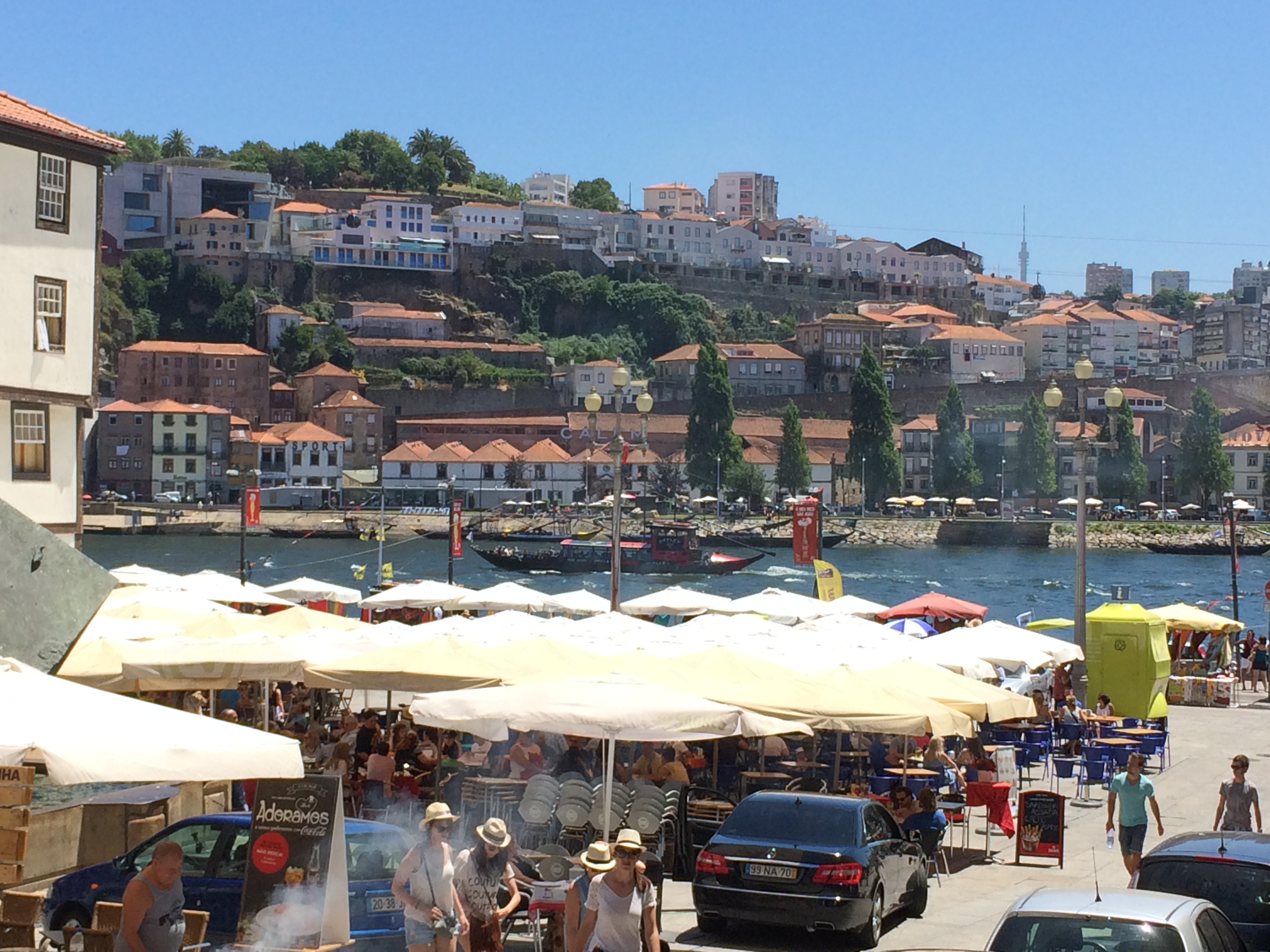
The popular Sao Nicolau district on the bank of the Douro river estuary.
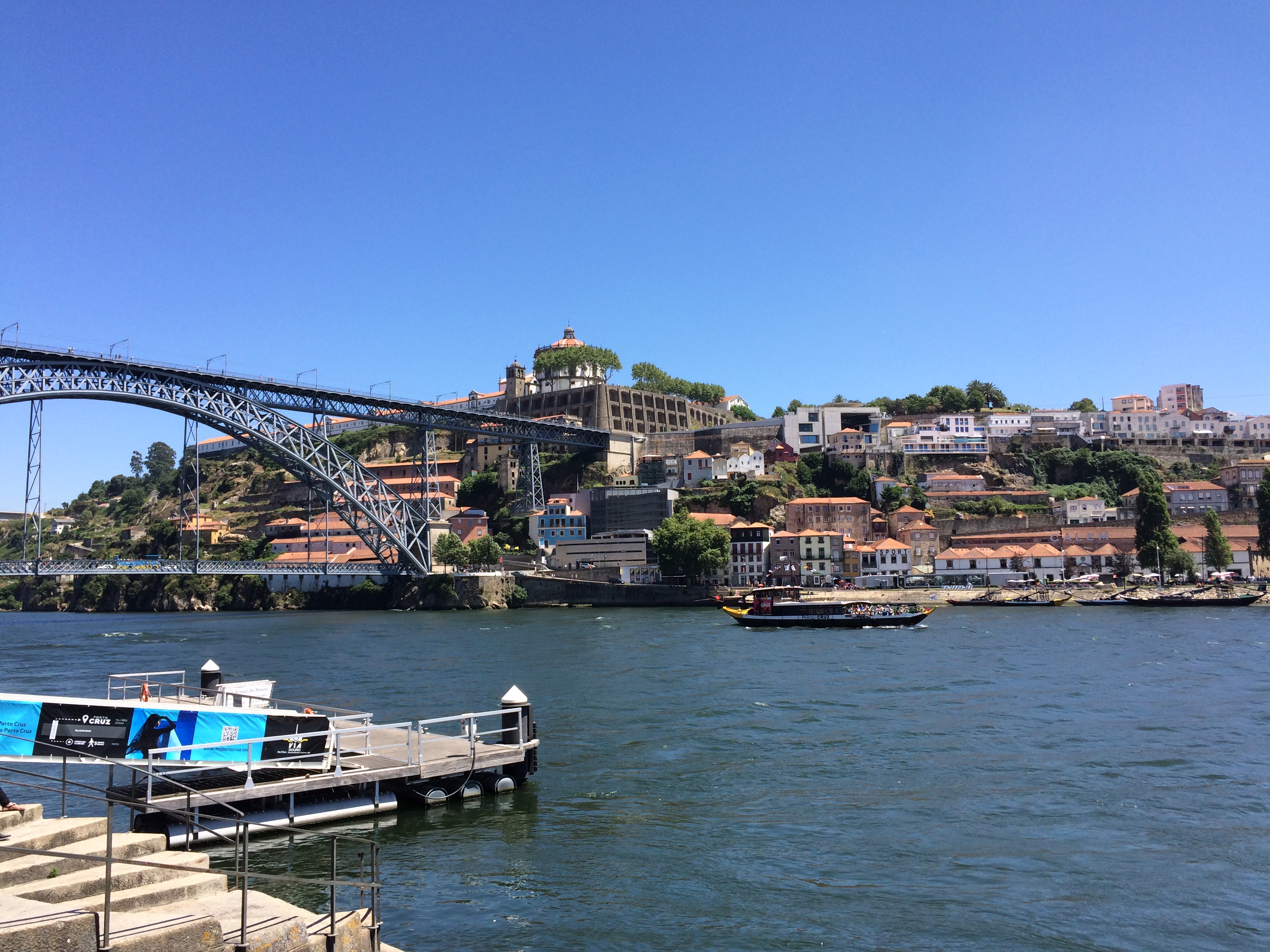
The busy estuary with Ponte Luis I bridge in the background.

The Pastels de Chavez in the foreground with, behind, the Bolinhos de Bacalhau and the Rissois de Leitas.
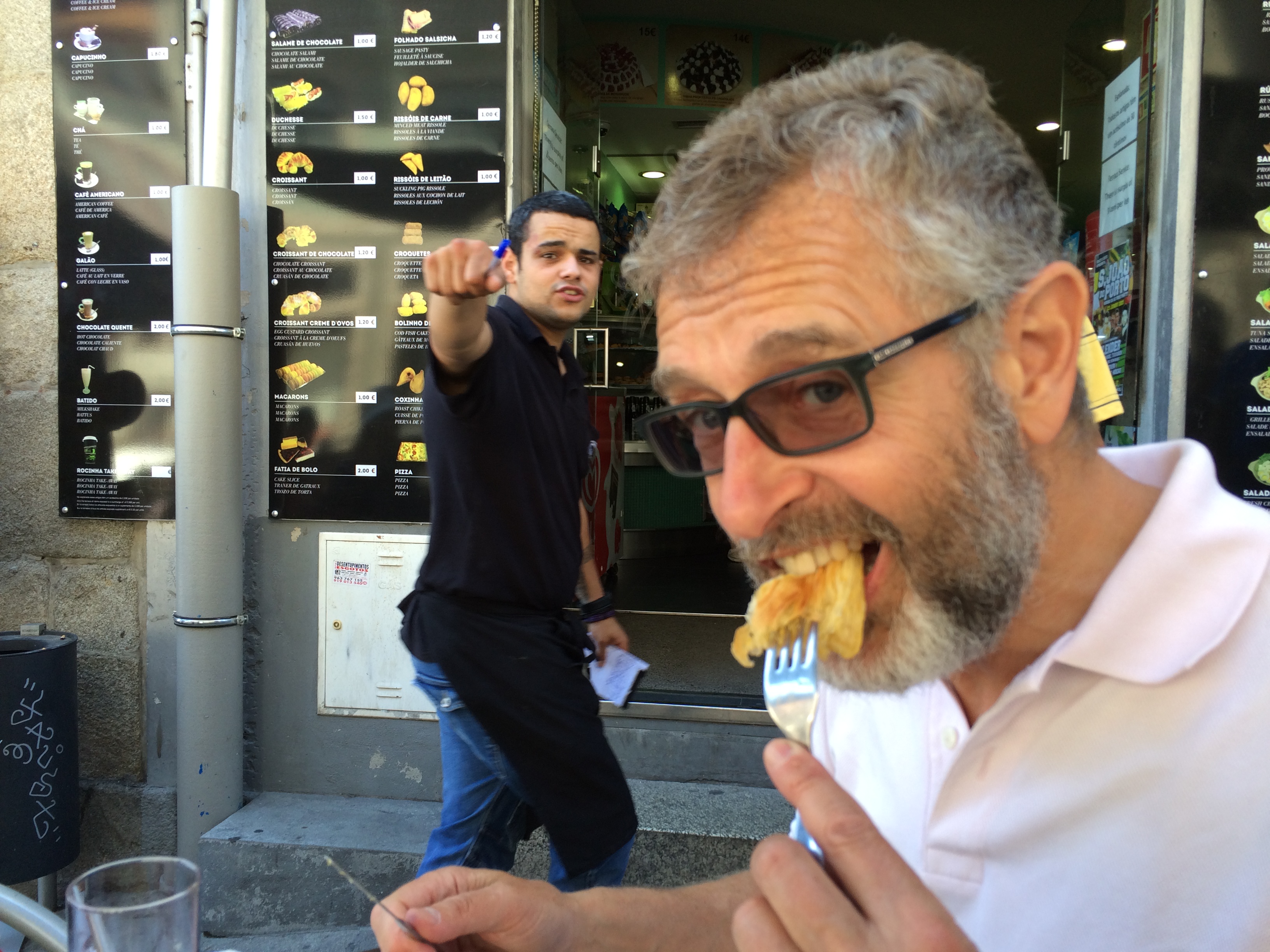
About to bite into a Pastel de Chavez (formerly known as the Flavian town).

More typical Porto picturesque houses in Sao Nicolau.

Back streets in Sao Nicolau quarter.
We start to make our way back via the Praca do Infante D Enrique where a statue has been erected to commemorate the 5th centenary of the birth of the legendary Prince Henry the Navigator. It shows him in battle dress next to a globe and symbolically pointing overseas. As I take a photo a pigeon decides to show his devotion by resting on his head (it would be unkind to put any other interpretation on this).
We then walk up the historically important Rua das Flores which in the 16th century became one of the most elegant streets in Porto, favoured by nobility and the bourgeoisie, who built grand houses along it. At the end of the street is the ornate Igreja da Misericordia built in the 16th century and distinctive for its Rococo style frontispiece added on in the 18th century. Then we continue up the Rua Ferraz and the Rua Caldeireiros.

The famous and elegant Rua das Flores.

Statue of Henry the Navigator in battle dress and symbolically pointing overseas (plus devotee on head).
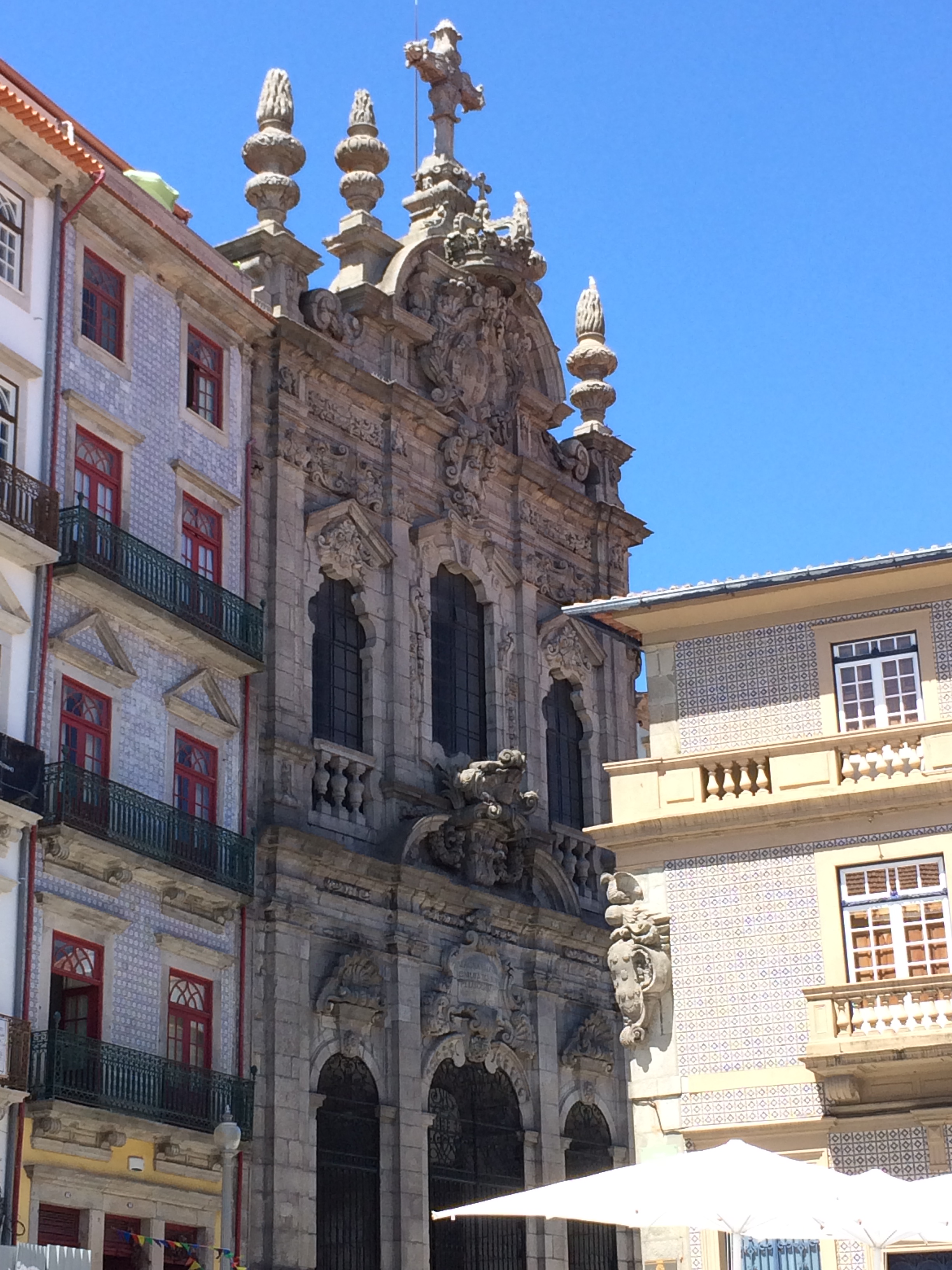
The Rococo style Igreja da Misericordia at the end of Rua das Flores.

The colourful Rua dos Caldeireiros.
Finally, we find something quite strange – a church that looks like it’s been built in two different styles, one Classic/Baroque, the other Rococo – but which in fact turns out to be two separate churches built 150 years apart, confusingly right next the each other. The first is the Igreja dos Carmelitas, built in the first half of the 17th century in a blend of Classic and Baroque styles and the second is the Igreja do Carmo, built in the second half of the 18th century in Rococo style by Silvestro Silvestri. A afternoon Sunday mass was being held in the first and this time, the church was completely full. Clearly, Classic Baroque has it against Rococo.
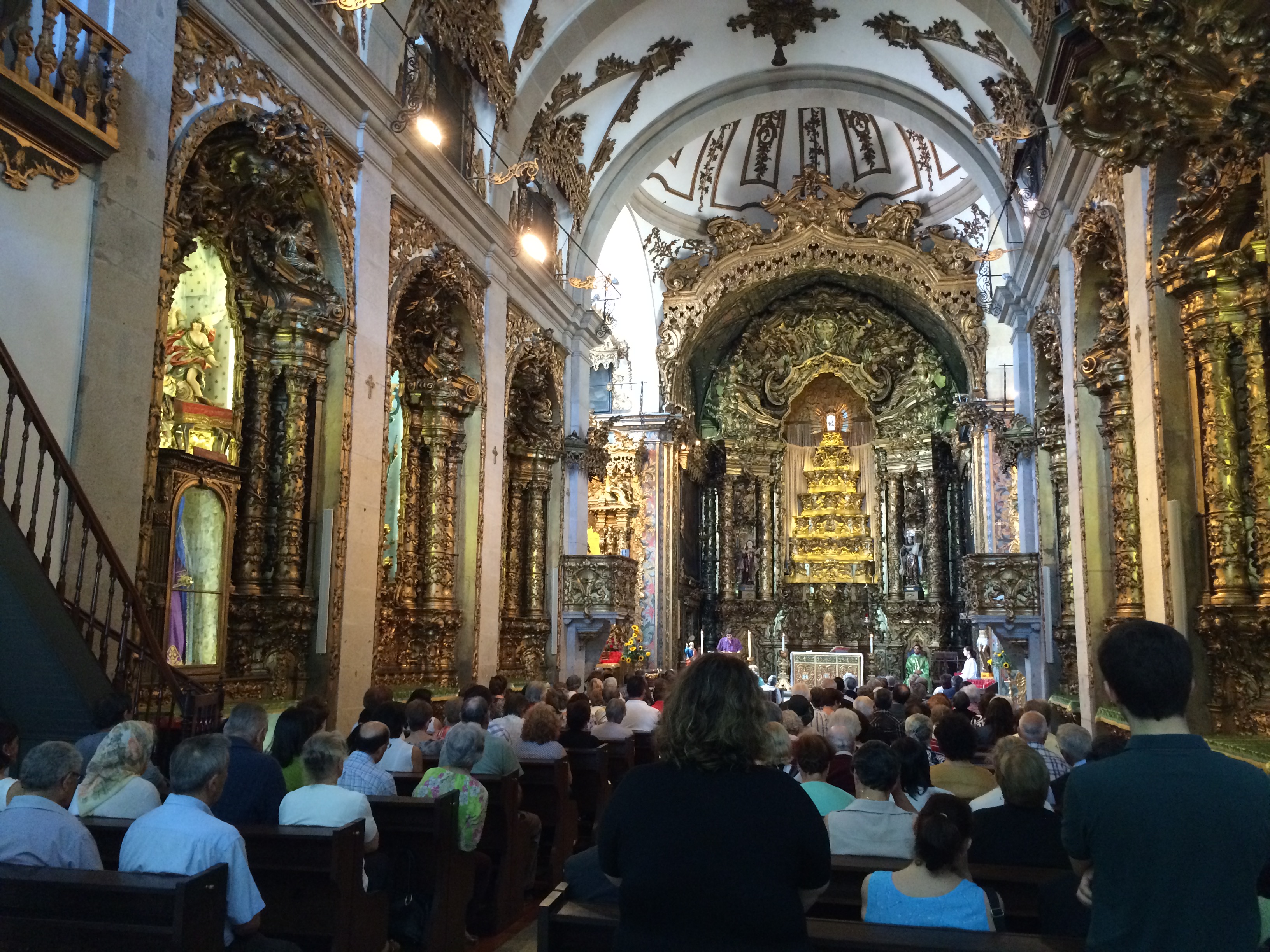
Mass to a full congregation in the clearly popular Igreja dos Carmelitas.

The Igreja da Carmelitas and the Igreja da Carmo right next to each other.
And so we cycle back to the car park, not without getting slightly lost first and set off for our final drive through Portugal (‘siempre infrent’ north, as we learnt was the Portuguese way of saying ‘straight on’) and to a place in Galicia on the sea called Sanxenco south of Santiago de Compostella.
Judith and I agree that overall Porto didn’t have the immediate appeal and excitement that we felt in Lisbon but it’s probably more a city to be savoured over a longer period to fully appreciate what it has to offer. We didn’t have time to visit the Port-selling district on the opposite bank of the estuary, but in any case, we wouldn’t have been able to buy anything to take back with us owing both to lack of space and hot temperatures we expect to experience as we enter into Juillet in France and Agosto in Italy. Peccato.
We really enjoyed Portugal and would like to say ‘Obrigadi’ for a really delightful 9 days. We will definitely be back.

 Travels with our van