Two things stood out for us during our visit to La Coruna (or A Coruna to give it its official Galician name): the Tower of Hercules and the ‘Glass City’.
As well as those, there was a fun, chance encounter with an English teacher singing the praises of Macmillan books and a regional rep working for a well-known but rival publisher to Macmillan.
We couldn’t remember who exactly had told us, if we were going to Santiago, to make sure not to miss out La Coruna, nor whether any specific reasons were offered as to why it would be interesting.
What we found was a city very unlike Santiago, built in the 19th and early 20th centuries in the modernist style rather than medieval but very distinctive nonetheless with its glass-covered balconies or “gallerias”.
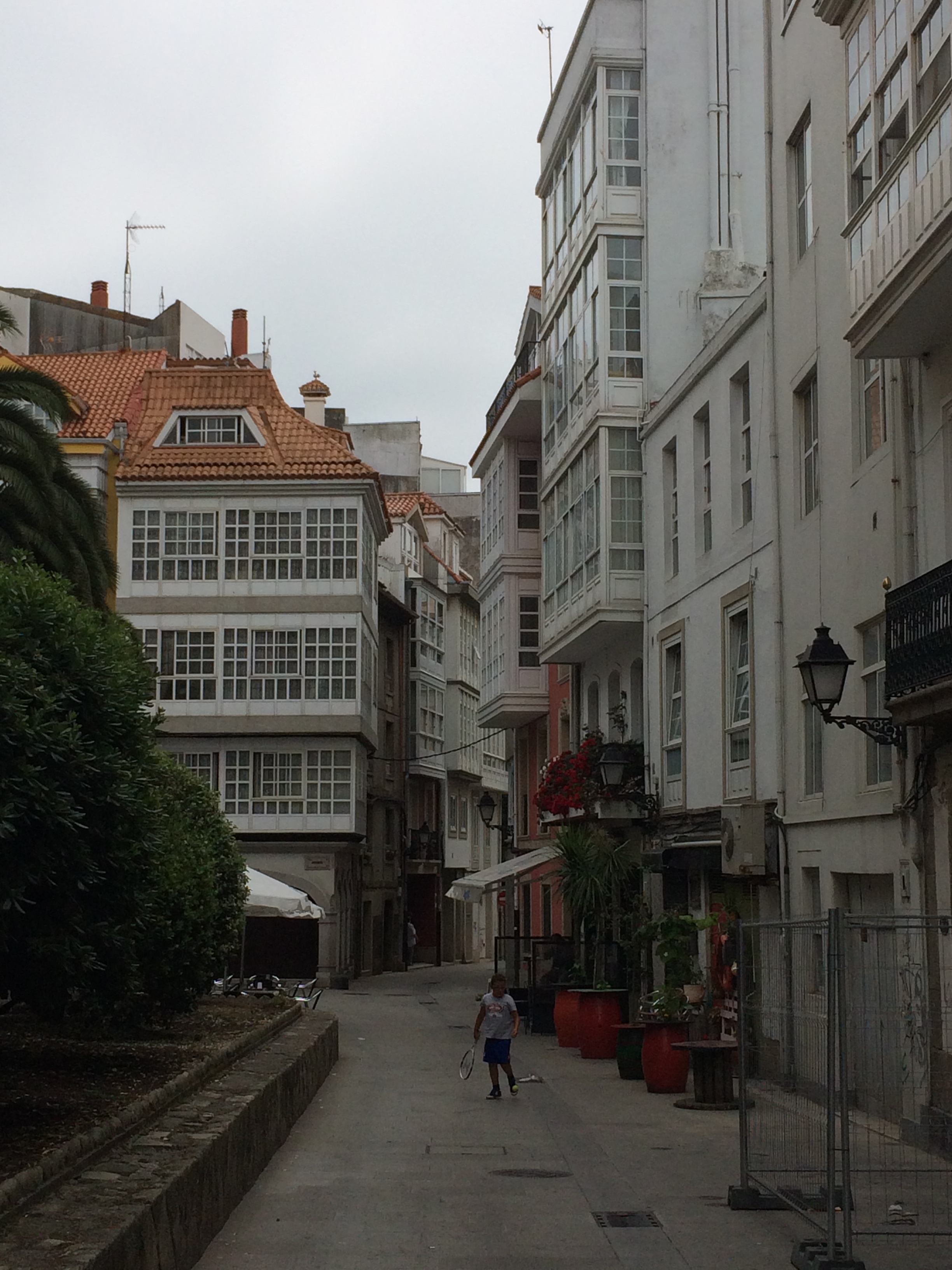
La Coruna city centre with typical buildings with glass covered balconies or “Gallerias”.
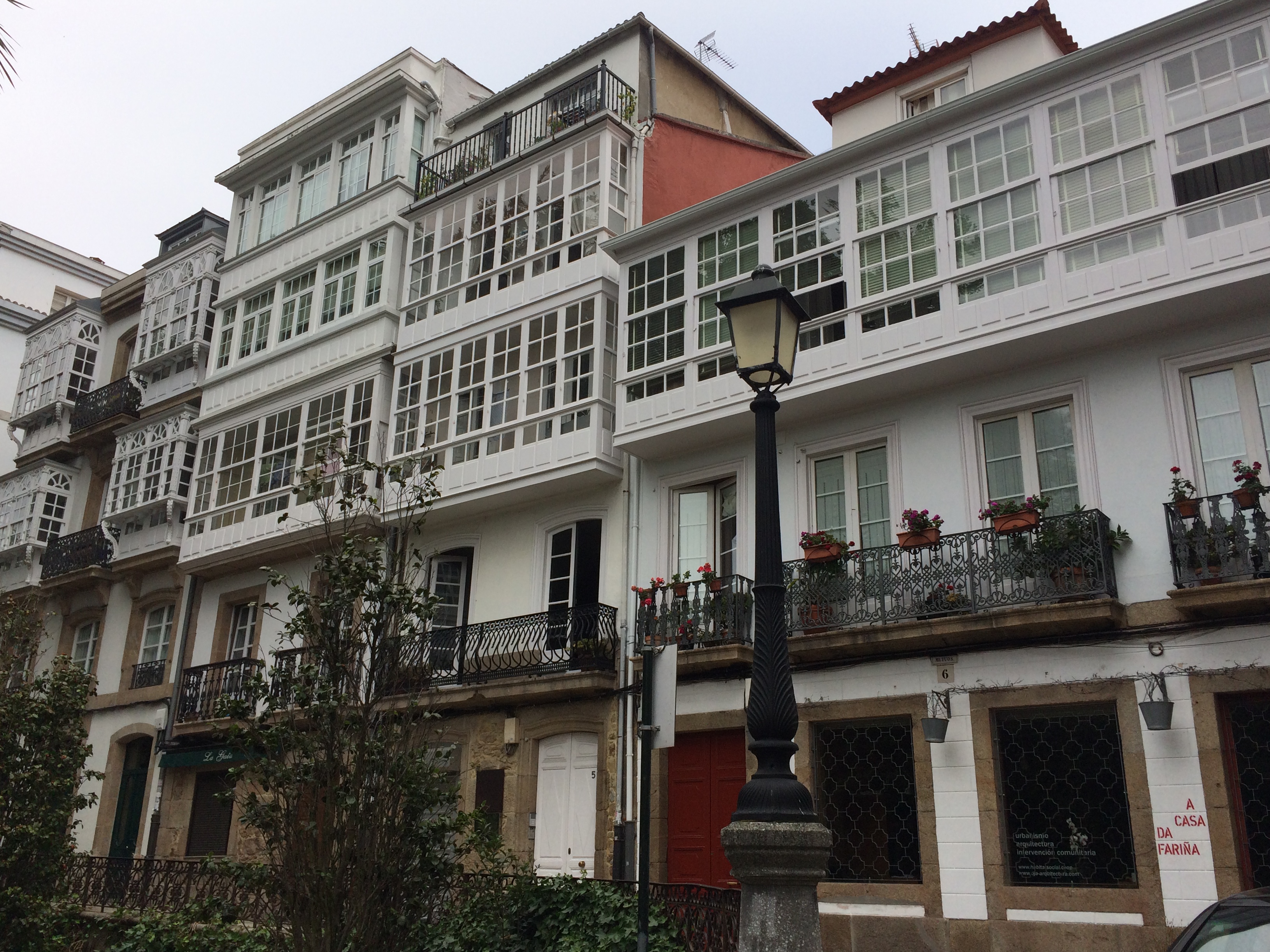
Gallerias are reminiscent of the ‘Regency’ style in England.
La Coruna is the second most important city in Galicia and a busy port and important distribution point for agricultural goods in the region. Called Brigantium by the Romans, it became important to them for maritime trade due to its strategic position. They built a lighthouse that started as an observation tower called The Tower of Hercules. The town fell into decline after the fall of the Roman Empire and Norman and Viking raids while the Muslims showed little interest in the region. It started prospering again in the 13th and 14th centuries and saw growth in fishing and mercantile business, becoming the capital of Galicia for several centuries before being replaced by Santiago.
Another interesting fact is that it was from nearby Terrol that the Spanish Armada set sail in 1588 for England and Holland.
Before the expulsion of the Jews in 1492, a thriving Jewish community created a rich artistic heritage in the city.
We started by going straight to the Tower of Hercules – no problem spotting it straight away as it rises 55 metres high overlooking the Atlantic. It is said to be modelled on the Pharos of Alexandria and is the oldest lighthouse in the world, having been in constant use since the 2nd century. We were looking at a still functioning structure that was 1900 years old! In 1788, the original 34 metres Roman structure was given a neoclassical restoration including a 21 metre fourth storey. The restoration was ordered as a way of strengthening security in the port thereby contributing to the growth and success of the city.

The 55 metre tall Tower of Hercules.

The oldest lighthouse, modeled on the Lighthouse of Alexandria, and in continuous use for 1900 years.
We paid our 6 Euros to go up the Tower. At each level were information panels telling the history of the lighthouse and the various stages of reconstruction. On the ground floor was the actual enormous stone original oil lamp showing the hole where the giant wick would have been inserted and whose flame would have been reflected by a huge curved metal mirror.

The original Roman giant stone lamp which was used in the lighthouse
The view from the top was breathtaking – it was difficult to stay up there for long without getting vertigo. Legend has it that King Breogan, the founder of the Galician Celtic nation, constructed here a tower of such height that his sons could see a distant green shore from its top. The glimpse of that distant green land lured them to sail north to Ireland. These descendants of Breogen and their followers are the Celtic descendants of the Irish people.

View from the top of the Tower of Hercules.
But the more prevalent myth, and the reason it is called the Tower of Hercules, is that it was here that Hercules slew the giant tyrant Geryon after 3 days and 3 nights of battle. Hercules then buried the head of Geryon with his weapons and ordered that a city be built on the site.
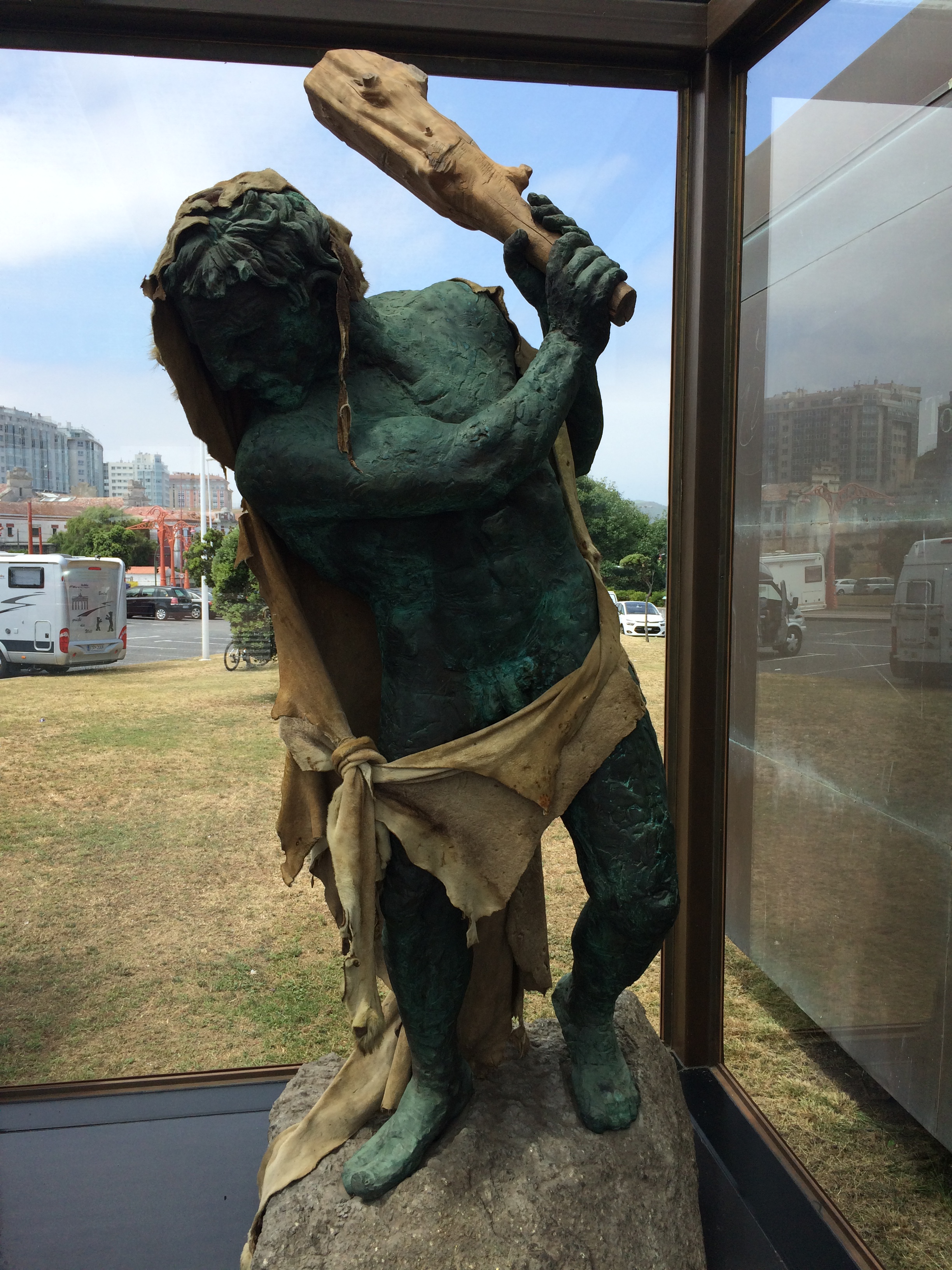
According to legend, Hercules slew the tyrant Geryon and ordered that a tower be built on the site.
Our visit to the lighthouse complete and almost recovered from our vertigo, we were discussing where exactly to go next when, not sure how or in what sequence exactly, we were suddenly engaged in lively conversation, about several things at the same time, with an extremely friendly and helpful group of people that had gathered around Brenda. First there was Sharon and friend, who were showing interest in Brenda and Judith was giving a mini-tour (it’s the only kind really with a campervan). Then Carlos the English teacher was kindly offering advice on everything local and Galician. Then Luke the publisher’s rep was called over when I asked a specific question about which town we should visit next, Gijon or Leon. Luke was the expert because they were in his territory. “So hard to say. They’re my two favourite places!” “Gijon is a carbon-copy of Coruna but better.” Carlos looks mildly hurt. “Carlos doesn’t agree because he’s from Coruna, ha ha”. “What do you think of La Coruna?” asks Carlos. “Um, we’ve only seen the lighthouse so far”.
“Ah, you like Radiohead – manic depressive music – Carlos likes Radiohead” interrupts Luke. After lots more bonhomie and laughter, a photo taken and blog details given, we left cheered up to take a quick look round the centre of town.
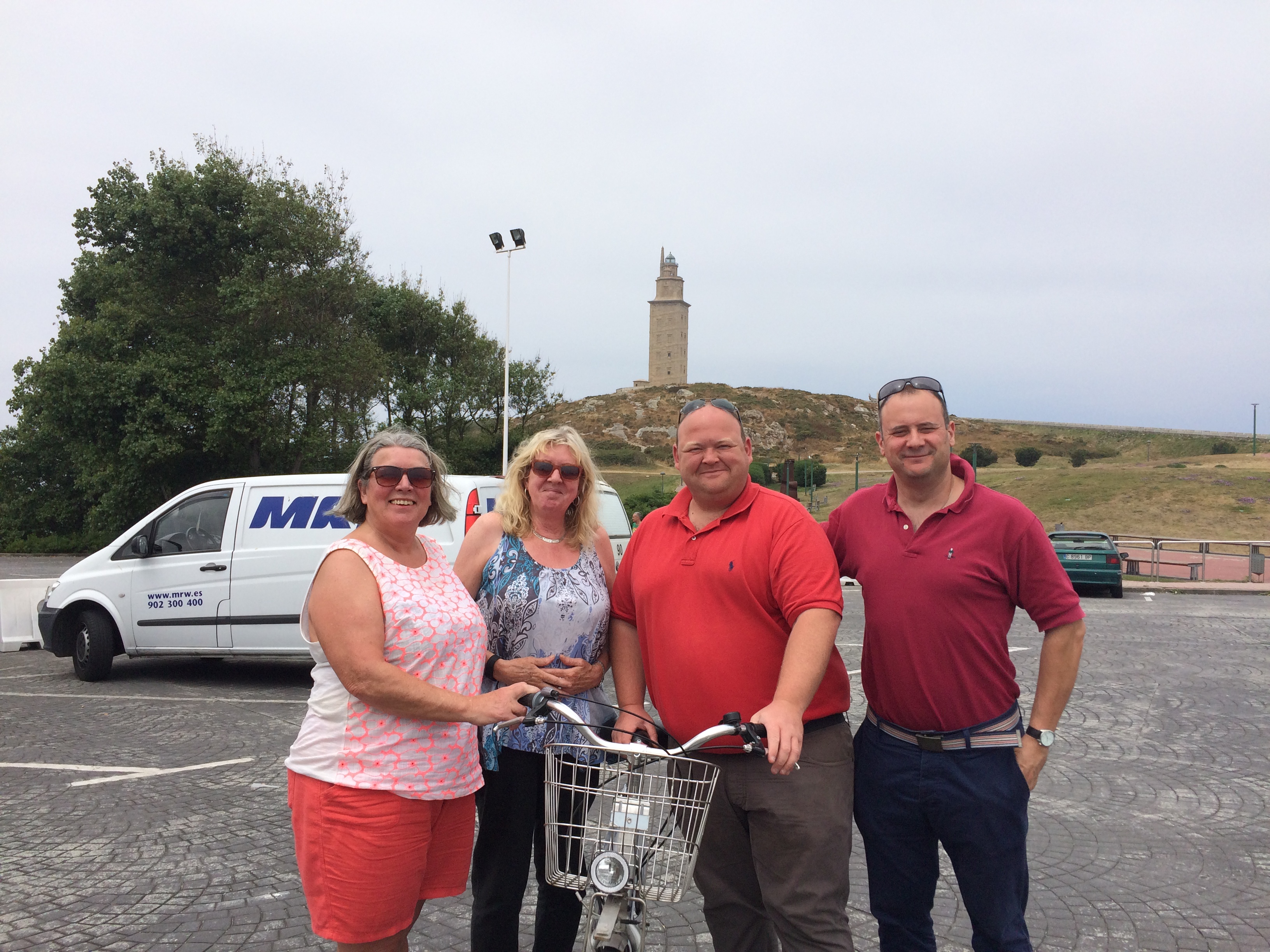
The friendly ‘locals’ Carlos, Luke and Sharon who spared no effort with their friendly advice.
Our impressions were that Coruna was not a very touristic place but relaxed with great little restaurants dotted around the place but what stood out most of all were the ‘gallerias’. A ‘galleria’ is a balcony that is enclosed in a glass frame protecting it from cold winds and making it usable all year round. The reason they’re prevalent in Coruna is first because a large part of the city is modernist and was built in the 19th and early 20th centuries and this style was popular then (it is in fact reminiscent of the ‘Regency’ style in England). And secondly it’s because the original fishermen’s houses that lined the harbour were built in this way and subsequent structures continued this style.
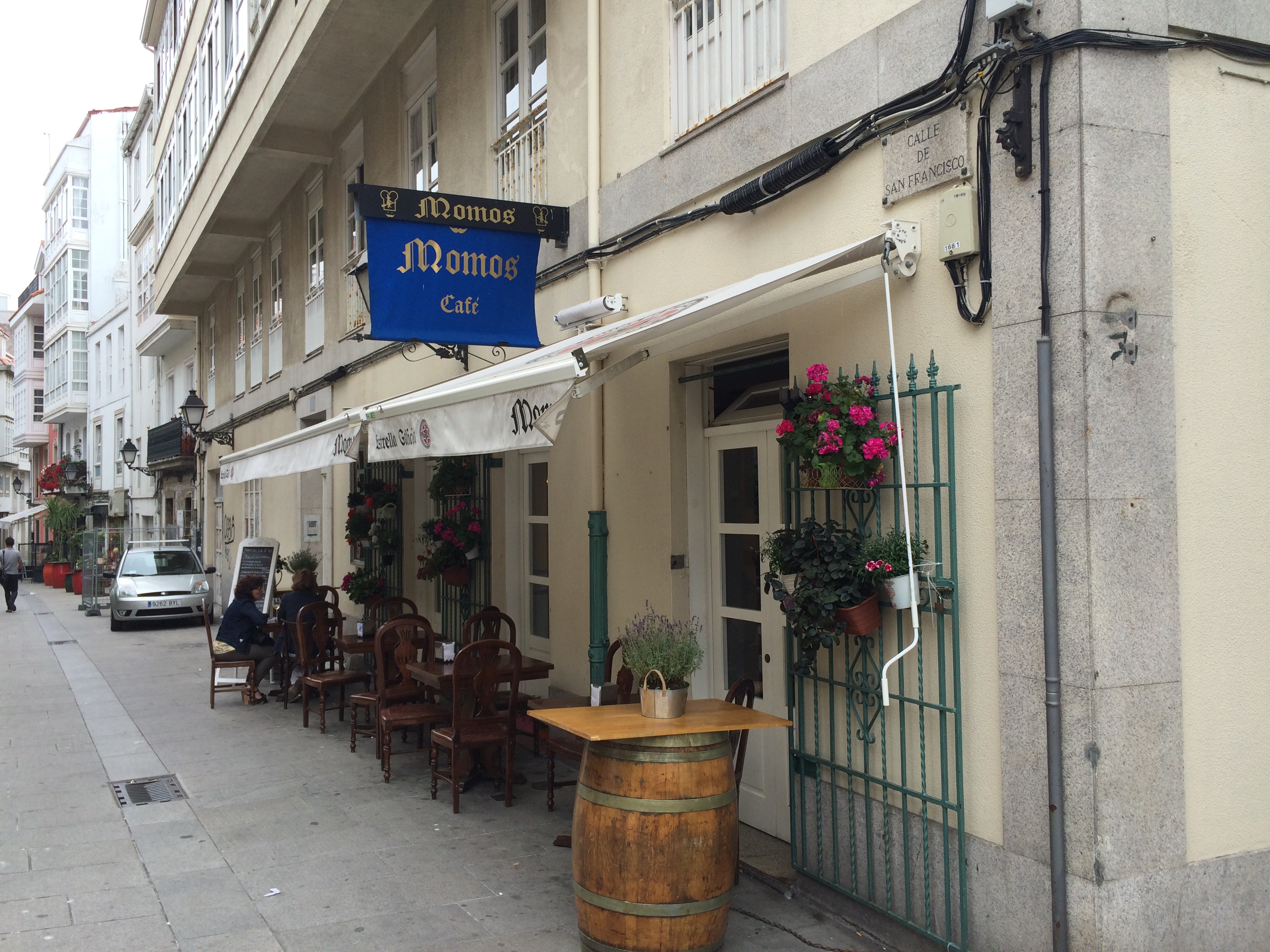
Plenty of good local gastronomy.

Typical building on the corner of the harbour front.
We spotted gallerias here and there as we walked around. But when we reached the harbour front area on Marina Avenue, we realized why Coruna was nicknamed ‘Cidade de Cristal’ (Glass City). The sky was overcast when we were there but apparently on a clear day, when the sun faces the harbour, the reflection from all the gallerias can be blinding. This area is called “Gallerias Corunesas”.
So to go back to Carlos’s and Luke’s question, the answer was of course that we left La Coruna with very pleasant memories of a relaxing half day gazing at what the Lighthouse of Alexandria could have looked like and a multitude of glass balconies, but made infinitely more pleasant by our jolly meeting with him and Luke et al at the foot of the Tower of Hercules.

 Travels with our van