As we leave Spain, a few last words about this fascinating country:
It’s a big country and it certainly does rain on the plain, as we experienced. (They could have done with some of this in southern France which has been experiencing a bit of a drought.)
Each area we visited displayed strong regional identities redolent of the time when Spain consisted of various kingdoms and principalities with each region (Basque, Aragon, Castille, Murcia, Andalusia, Galicia, the Asturias, Catalonia) proudly flying their own flag alongside the Spanish flag, celebrating their own traditions and saints’ days, showing off their own regional dishes and battling to keep alive their own language or dialect. Experts are still debating about the origin of the Basque language which bears no relation to Latin. In some cases of course there are clear aspirations for all-out independence even though they already have a form of autonomy.

The Asturian flag alongside the Spanish flag during the 3-day San Pedro celebrations in Cudillero.

An Asturian outside storeroom – many houses have them. We didn’t know what they were at first.
Having spent a lot of time in the Middle East, we were very aware of remnants of Spain’s Islamic period whether it be in place names, architecture or general culture. But we couldn’t decide whether there was perhaps just a touch of denial about this Islamic heritage considering that the Arabs occupied a large part of Spain for almost 700 years. Apart from the obvious tourist attractions of Grenada, Cordoba and Seville and the whole of Andalusia, we were surprised at the evidence of Arabic influence throughout the whole Iberian Peninsula and hadn’t appreciated how extensive, and in some cases prolonged, the Islamic presence had been. It was more evident in Aragon for instance than we had expected and finding an old long-derelict mosque in the small town of Alhama brought this home to us. Considering the importance of the ‘Reconquista’ in Spanish and Portuguese history as well as the constant reminders of this in imagery and statues in churches, that is perhaps not surprising. But it left us wondering what modern-day Spaniards and Portuguese feel was the contribution of the Islamic period to their culture and whether some of it at least was positive and enlightening. At the time, the Muslim rulers claimed to have instituted a system or at least a spirit of ‘convivenca’ but scholars are now debating to what extent this amounted to true pluralism. All interesting thoughts to ponder over as the modern world finds itself having to grapple with the vital issue of rising immigration and true religious coexistence.
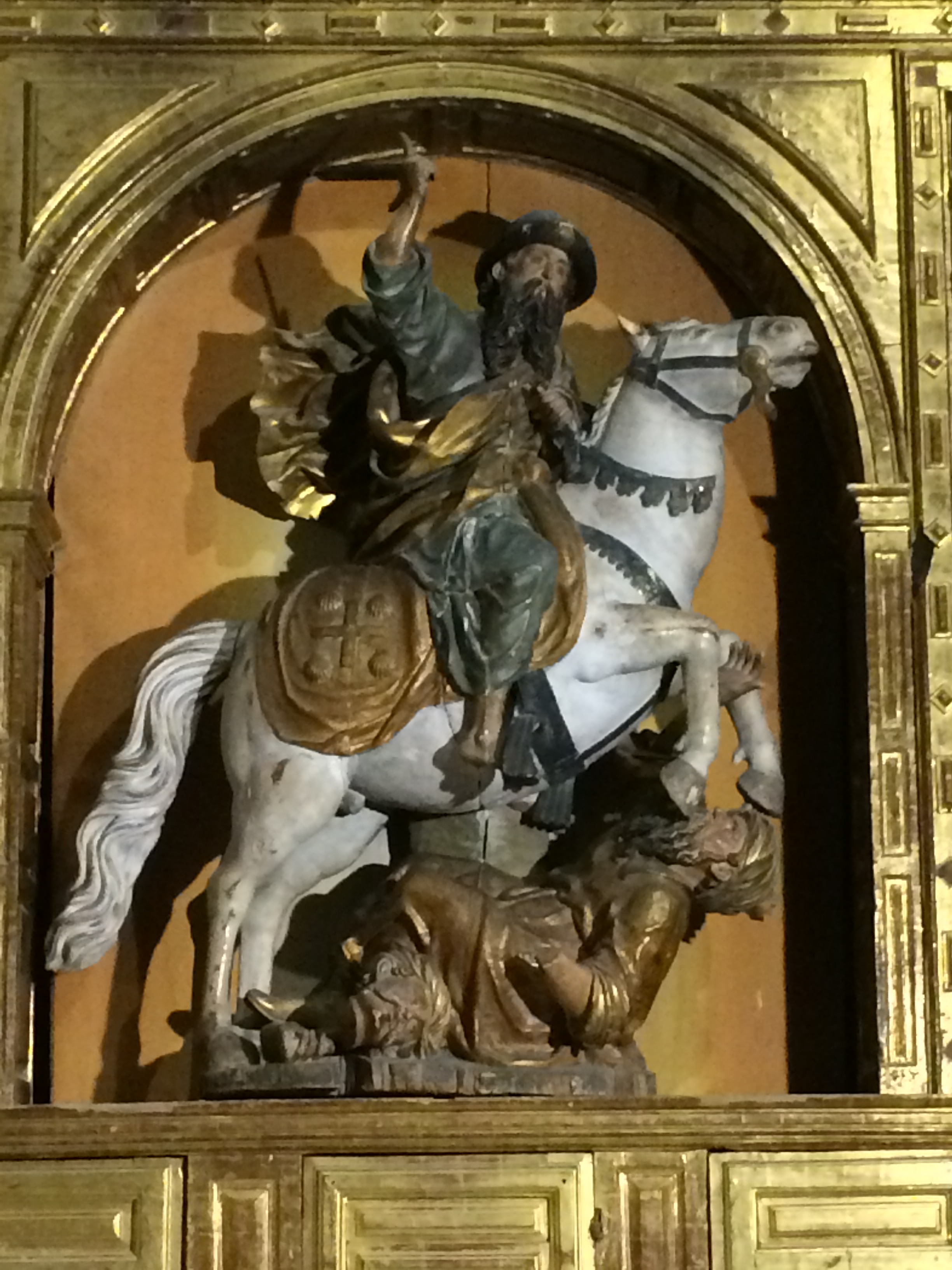
Depiction of the reconquista in a church in Catrojeriz.

Depiction of the Virgin Mary standing victorious over the head of a Saracen.
Reading Spain’s history as we travelled we were horrified at the appalling vandalism of the Napoleonic armies who sacked and pillaged their way through many parts of Spain and indeed Portugal. We asked some French people we met what they thought about that and what they thought Napoleon’s strategy was exactly. They agreed and said the only strategy was to destabilise the region as much as possible so he could install his own brothers and cousins in their place and build his own empire.
Having lived in multicultural London for many years we were surprised at how relatively few different ethnic groups there seem to be in Spain, even in the larger cities, and also slightly surprised (considering Spain is one of the largest ELT markets in the world) by the number of people who really had very little English or none at all. We’re not saying that out of any spirit of linguistic imperialism but just in the knowledge of the huge amount of ELT teaching there has been in Spain for decades.
As in Portugal, seafood is a major part of the Spanish diet as is pork. More often than we’d expected, meals come with chips. We didn’t think this was this for the English, of whom we came across very few (though admittedly we avoided the Costa del Sol). By far the majority of campers we came across were from Holland, after the Spanish that is. Some of the regional dishes like in the Asturias were very interesting, but overall we thought every day Spanish cuisine as served in most ordinary cafes and restaurants was not always terribly healthy.

Fairly typical menu in restaurants in Barcelona.
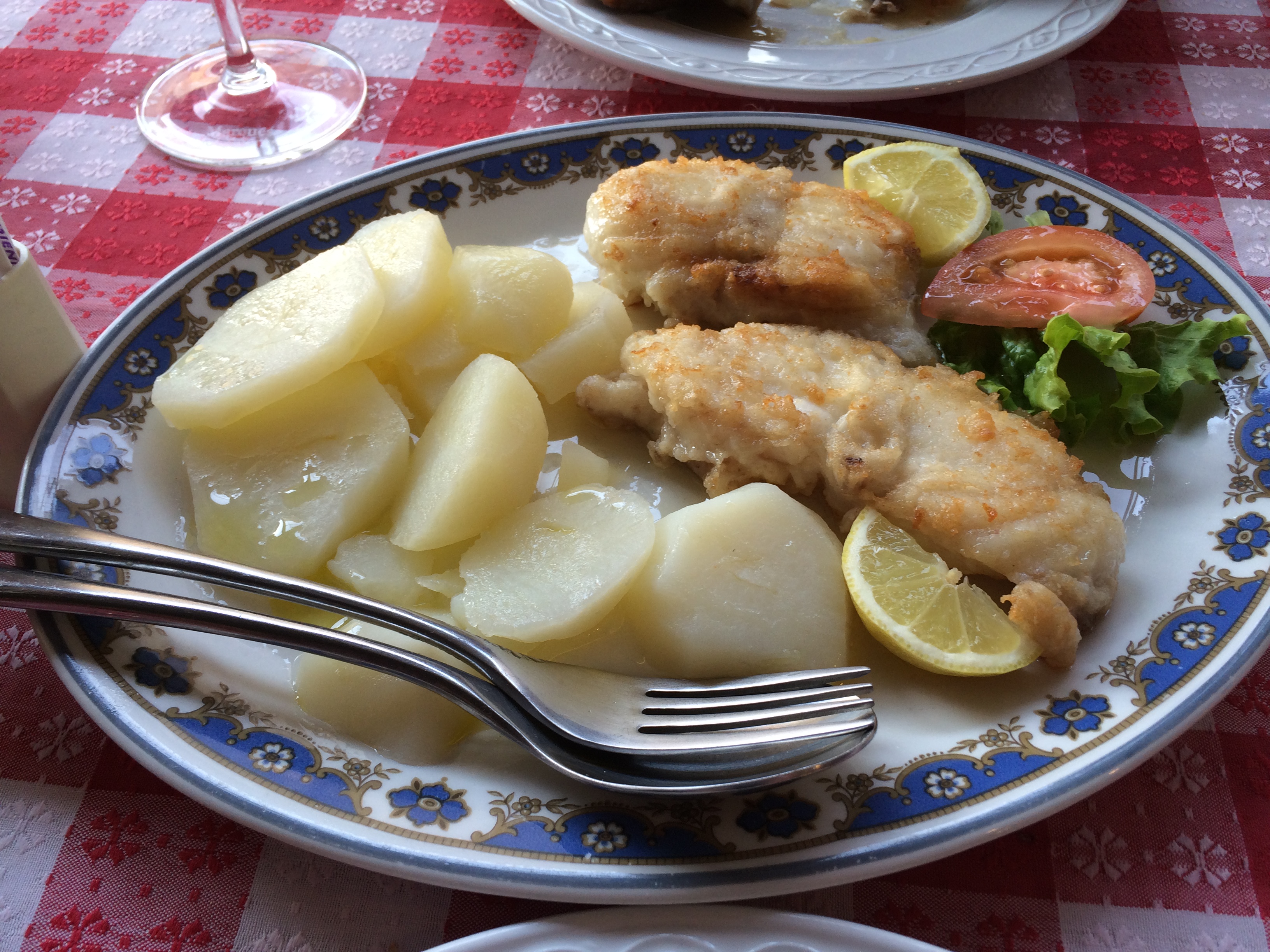
But sometimes the food can be simple and delicious as in this dish of ‘rate’ fish from Galicia.

And the size of the bread loaves in the countryside is amazing.
Also like Portugal, everywhere we travelled there was evidence of financial hardship and a failing economy, even in the more touristic areas businesses were closed/having liquidations sales or up for sale. With unemployment levels at over 20% (is this really right?) Spain is struggling yet despite this it is a vibrant, exciting, fascinating (if somewhat noisy) country and has left us with a desire to return and discover more of it charms.
Spain gives the impression of being an industrious, ‘self-contained’, ‘self-sufficient’ country, fiercely proud of its own character and traditions, including of course, bull-fighting. The proof being the giant black silhouette of the fierce Spanish bull greeting drivers at the entrance to each region (with the exception perhaps of Catalonia). It almost looks defiant – like Spain itself. “We’re big enough, strong enough, proud enough, to do como gusta a nos otros”!

 Travels with our van
I’ve enjoyed reading the travels in Spain and Portugal and look forward to Italy and Greece.
Rob Halley
LikeLike
Hi Rob, thanks very much for your comment and continuing encouragement. Your words came back to us as it has caused a bit of stress, a couple of people have commented that all it does is make them feel envious and we’ve been wondering whether it’s worth keeping going. So we’ve decided to not take it so very seriously and post shorter and less frequent posts but at least persevere, for the time being at least! (And Judith is taking the lead now with me adding and editing so that’s a relief!) Talking of which there were a few errors in the past post which I’ve now corrected (or at least think I have)! Hope your journeying is going well too. Very best wishes.
LikeLike