Monthly Archives: July 2015

3rd to 6th of June – Castrojeriz to Tarragona

Standard

From Leon we travelled to Castrojeriz near Zaragossa which was on the Camino de Santiago route and the aptly named Campsite Camino Santiago.  The Campsite was at the base of a hill on which a Knights Templar castle stood (the area is steeped in Knights Templar/Holy Grail legend).  It was a lovely family-run campsite which cooked delicious lamb joints in a traditional outside oven. After a very long and hot cycle we swam in a municipal pool close to the campsite.  We had the pool to ourselves, which was bliss, until siesta time was over and within seconds the pool was overflowing with families.

The relaxing campsite at Castrojeriz, on the Camino de Santiago trail, which was becoming a recurring theme during our tour of Spain.

The relaxing campsite at Castrojeriz, on the Camino de Santiago trail, which was becoming a recurring theme during our tour of Spain.

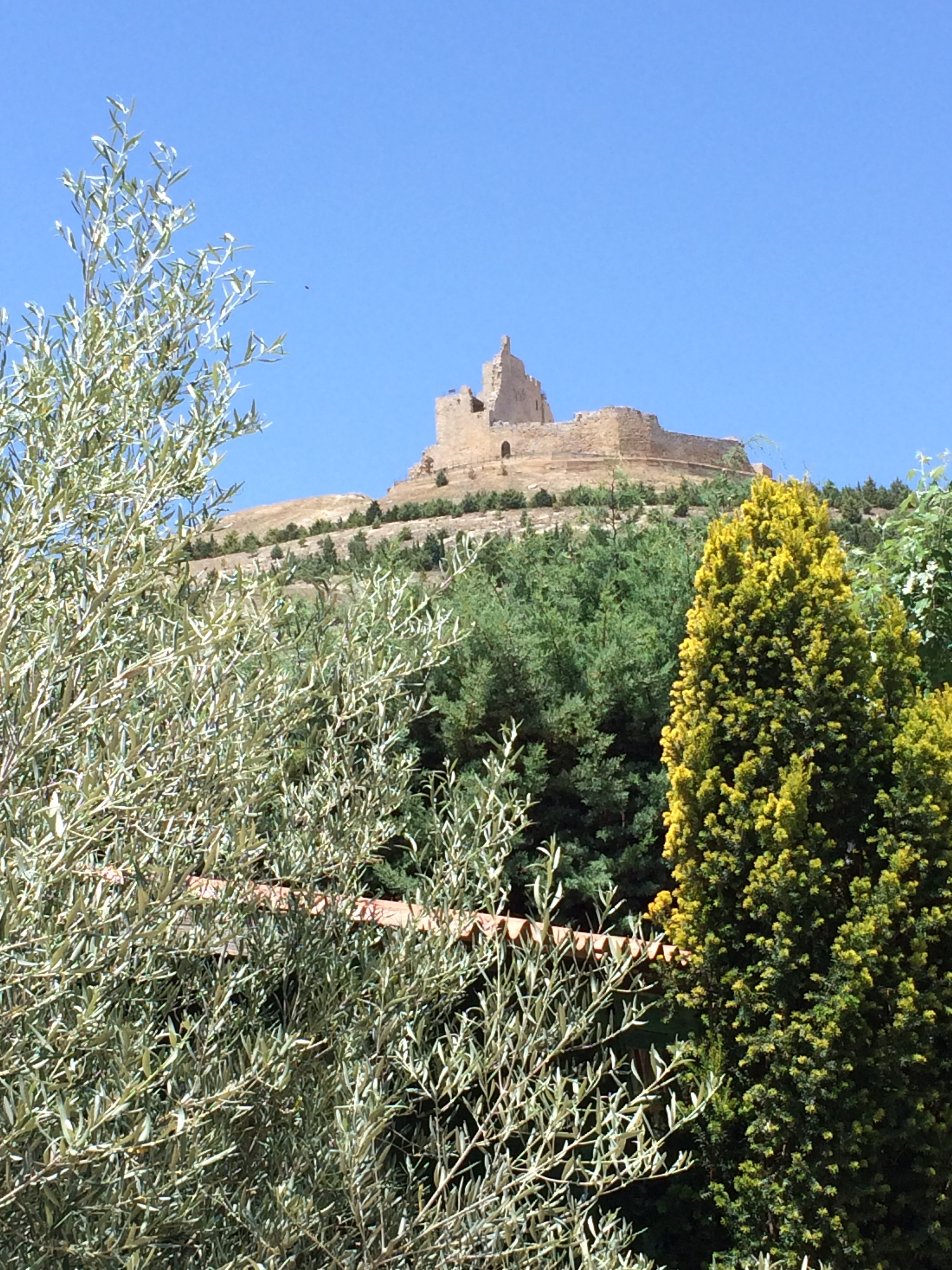
The Knights Templar castle on the hill overlooking the campsite.

The Knights Templar castle on the hill overlooking the campsite.

12K cycle ride to nearby Castrillo de Murcia.

12K cycle ride to nearby Castrillo de Murcia.

We stopped half way through our cycle ride seeking shelter from the relentless heat and sunshine and to eat our picnic at Castrillo de Murcia.  The bread van pulled up alongside and an elderly lady called Epiphania came out of her house to buy her bread and to collect her little terrier who had turned his nose up at the morsel of ham we’d offered him.  She tried to converse with us but we realized pretty soon that our problem wasn’t so much linguistic as that she was deaf as a door post.  We did succeed in speaking to a rather diminutive man (also drawn out by the bread van) called Ramon who had previously given us directions back to Castrojeriz.  Ramon was a 62 year old former nurse who had worked in San Sebastian all his life and was now retired with a reasonable state pension of 1,000 Euros a month which he felt content with.  He had never married and lived alone. He was happy to meet a fellow nurse in Judith and wasted no time to stretch his neck to kiss her.  It seemed appropriate to take a photo of the two ex-nurses together.

The sleepy village of Castrillo de Murcia.

The sleepy village of Castrillo de Murcia.
Ramon, the retired ex-nurse happy to meet another nurse.
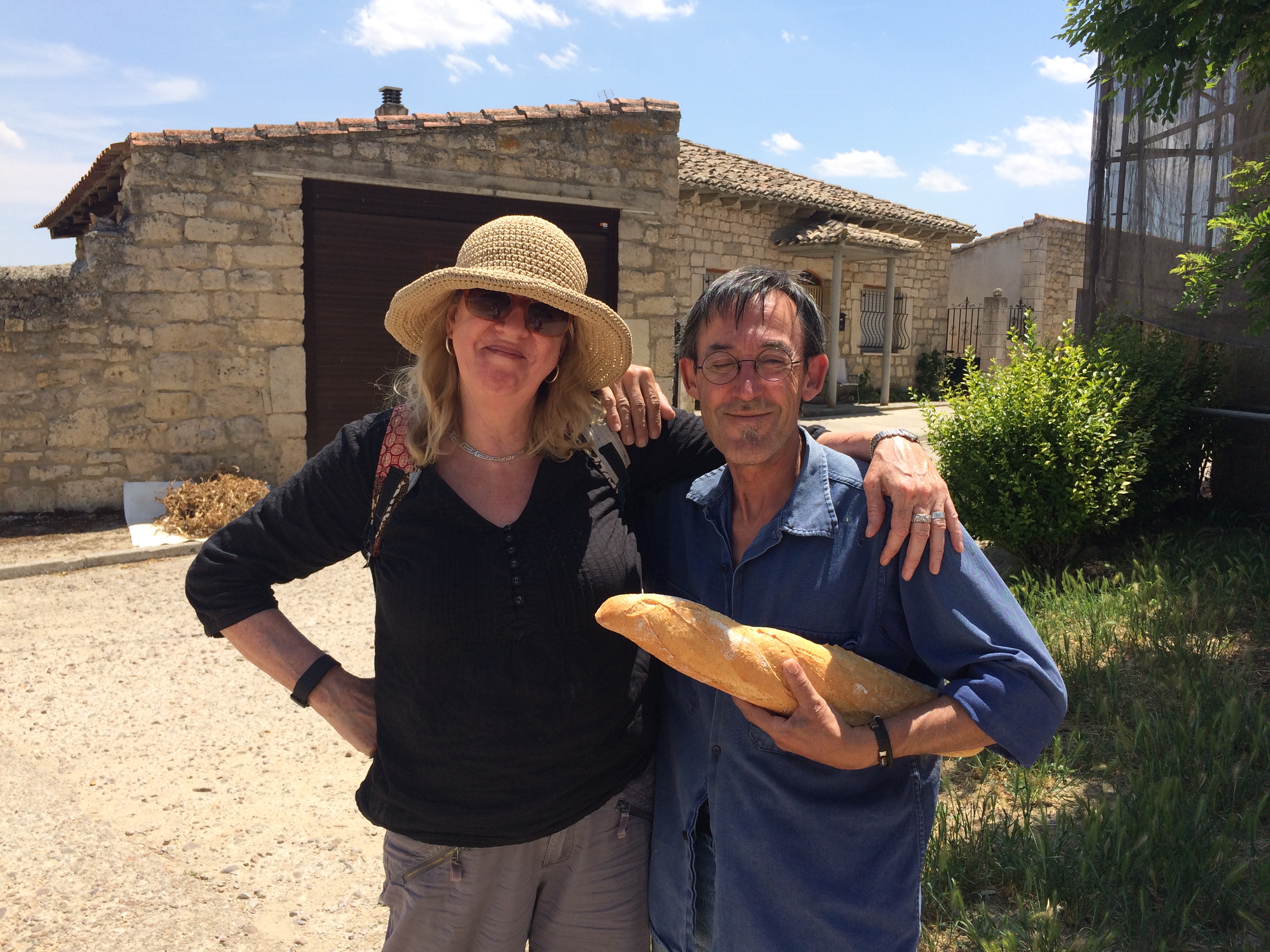
Ramon, the retired ex-nurse happy to meet another nurse.

Heavenly swim at the municipal pool after the hot cycle during the quiet siesta time.

Heavenly swim at the municipal pool after the hot cycle during the quiet siesta time.

Lamb cooked in the campsite's outside open oven.  Our first roast in a long time!
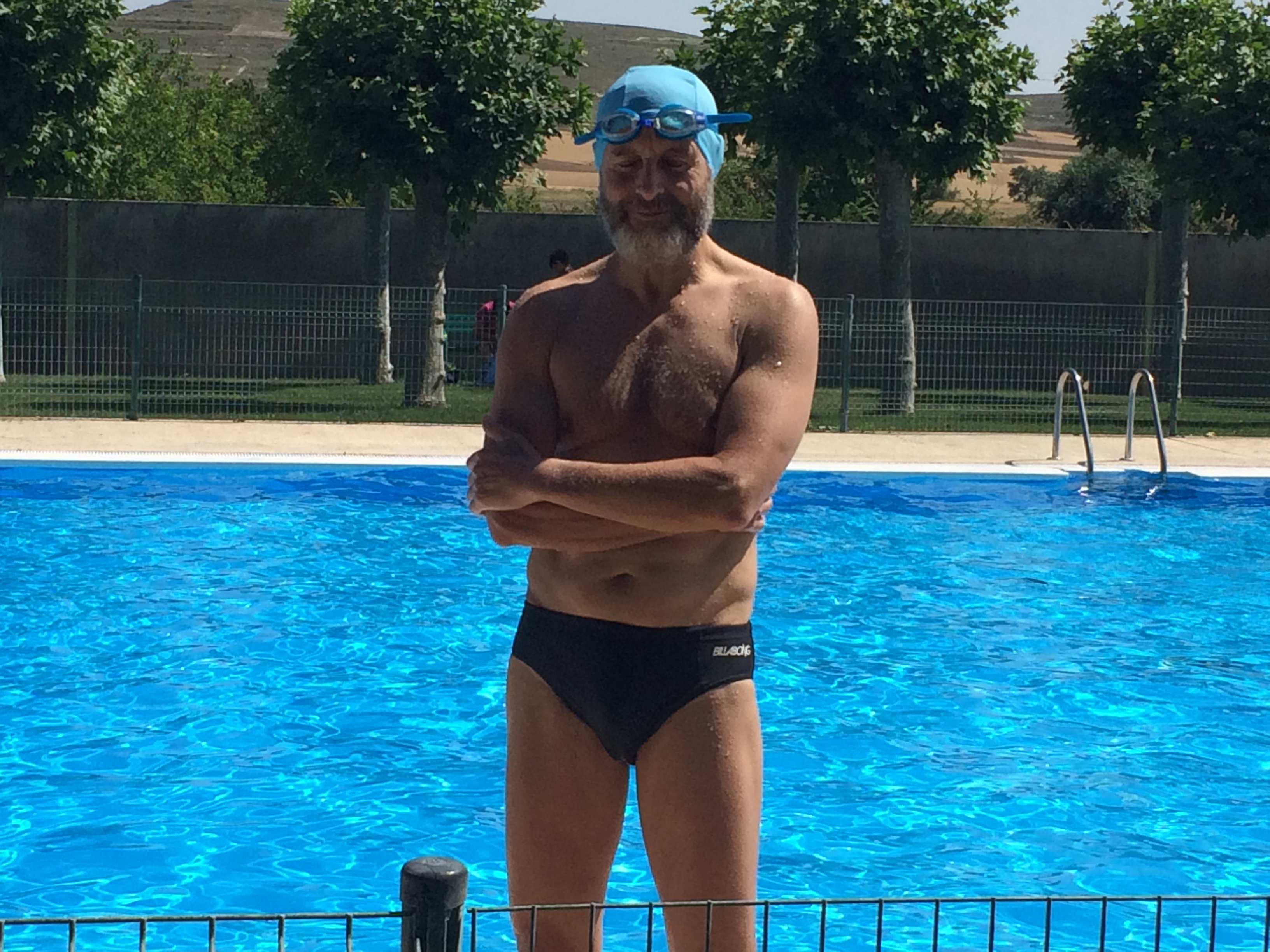
Lamb cooked in the campsite’s outside open oven. Our first roast in a long time!

A brief overnight stop in Nuevalos, where Flavio did a lake swim, and then on to the coast, desperate for a sea breeze. Spain is experiencing a heat wave with temperatures going up to 45 degrees C.  This really was quite an uncomfortable campsite, ‘terraced’ and badly designed, on top of which it was unbearably hot and sticky, obliging us to sleep with the side door open which then meant having to contend with insects and mosquitoes despite the insecticide burners.  We were glad to get away from that region of Spain that seemed to be experiencing the highest temperatures and head for the coast.  We decided that in terms of both topography and weather, we were less keen on Aragon than other regions.

On the way to Nuevalos, we passed Mahamud and Alhama and came across this old abandoned mosque which has clearly been derelict for centuries.

On the way to Nuevalos, we passed Mahamud and Alhama and came across this old abandoned mosque which has clearly been derelict for centuries.

An interesting detail of the long-derelict mosque at Alhama de Aragon.

An interesting detail of the long-derelict mosque at Alhama de Aragon.

The lake in Nuevalos.  We were also told there were spectacular waterfalls nearby but we were eager to get to escape to the coast.

The lake at Nuevalos. We were also told there were spectacular waterfalls nearby but the temperatures were unbearable and we were eager to get to escape to the coast.

As we leave Nuevalos, we spot two local young women taking photos of each other draped over their car - each to his own!

As we leave Nuevalos, we spot two local young women taking photos of each other draped over their car in the scorching temperatures – each to his own we thought!
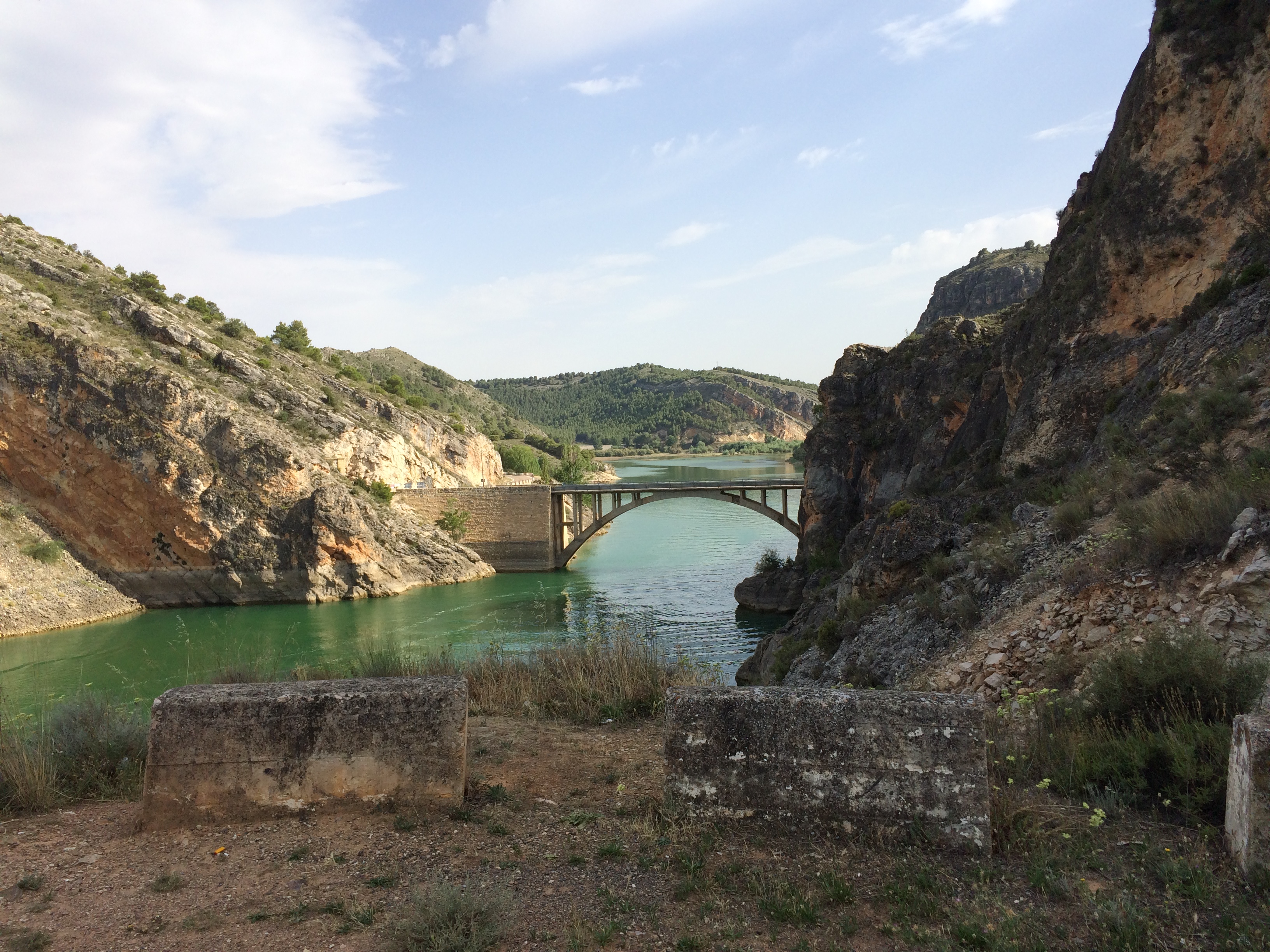
We stayed at a comfortable and well-run campsite just outside Taragona (Camping Las Palmeras) and managed to secure a pitch opposite the sea.  Two days were spent cooling down in the sea with a brief foray into Taragona although we both felt we’d reached critical mass with medieval quarters and cathedrals in such unforgiving temperatures. Flavio found that he could be in the sea within 5 mins of waking up in the morning and that was an excellent way to start the day.  There were a few jelly fish but the water was clear enough to see them in good time and avoid them.

The Spanish have taken camping to the next level. Apart from a caravan with awning they have a kitchen tent with stove and fridge freezer, a dining/sitting room tent with flat screen TV, a bathroom tent and other tents with no known purpose.  It seems it’s normal for families to stay in one place all summer with the menfolk leaving their families on Sunday evenings to travel to work, returning the following Friday.

The coast at last - and our breezy campsite right by the sea!

The coast at last – and our breezy campsite right by the sea -the Camping Las Palmeras!

We were now in Catalonia where memories of Franco’s dictatorship are strong, with many tents and   buildings flying the Catalonian independence flag.  We did see some Spanish graffiti warning the Catalans that the Spanish were coming which seemed a little incomprehensible to us as most of the people at the campsite were Spanish.

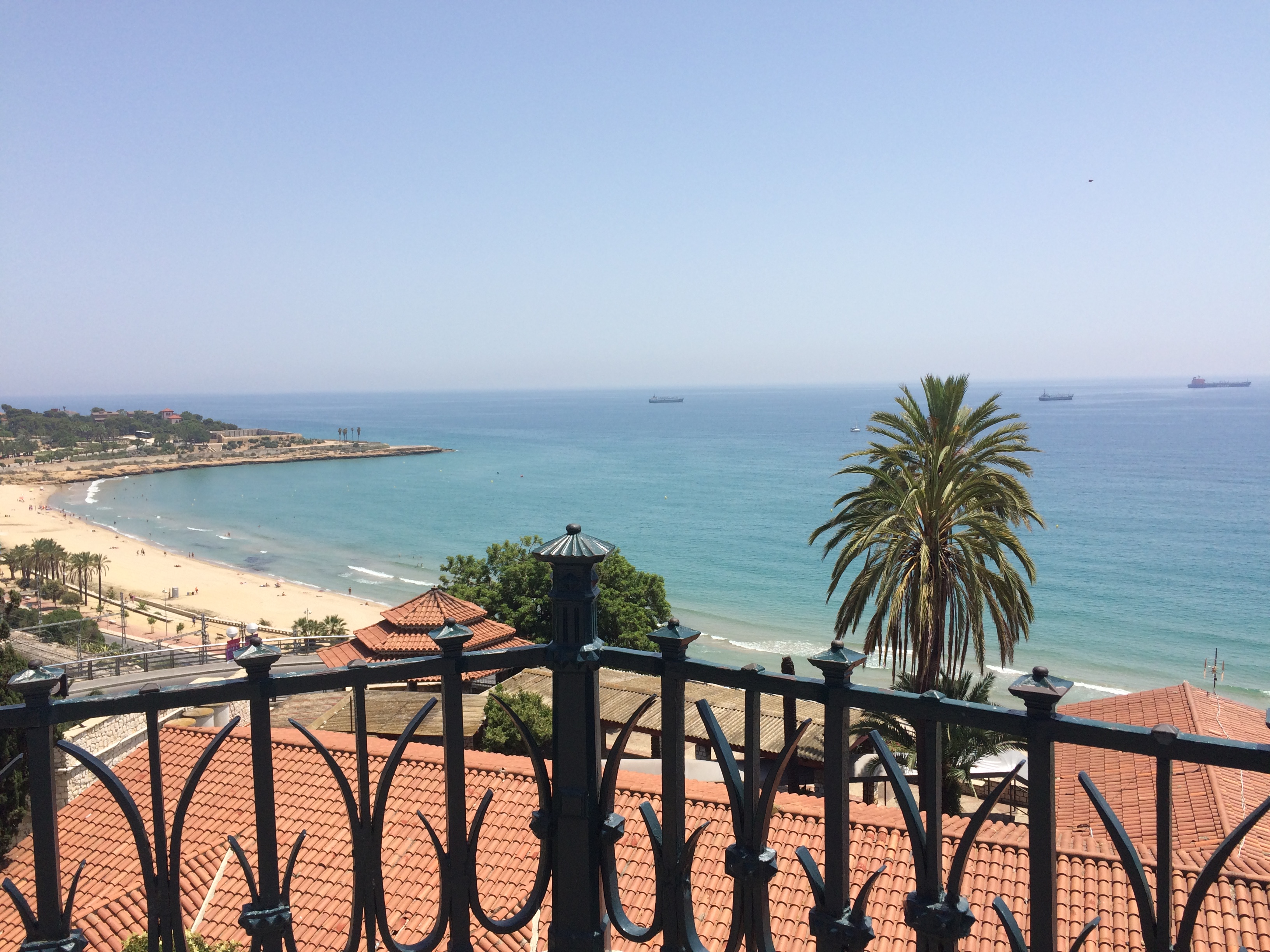
We spent half a day in Tarragona itself, easily accessible from the campsite on the No 12 bus. The first thing that struck us was the stunning view of the sea from a broad balcony at the end of the main boulevard (the Carrer del Comte de Rius).  Tarragona was an important city for the Romans and there are consequently several places of interest dating back to Roman times, like the amphitheater, the Bera Arch and the Scipio Tower.  Not much however is left of the medieval city following its wholesale sacking at the hands of General Suchet’s French and Italian troops in June 1811, after which the city went down from 12,000 to a mere 300 inhabitants and fell into decline.

Much of medieval Tarragona was destroyed during the 3-day 'free sacking' of the city by French and Italian troops in 1811. The last stand by the locals was on the Cathedral steps.

Much of medieval Tarragona was destroyed during the 3-day ‘free sacking’ of the city by French and Italian troops in 1811. The last stand by the locals was on the Cathedral steps.

One of the best things about Tarragona is the wonderful seafront on a slight hill.  In the foreground is the Roman amphitheater.

One of the best things about Tarragona is the wonderful seafront on a slight hill. In the foreground is the Roman amphitheater.

After the sacking ordered by General Suchet, the population of the city dwindled from 12,000 to just 300.

After the sacking ordered by General Suchet in 1811, the population of the city plummeted from 12,000 to just 300.
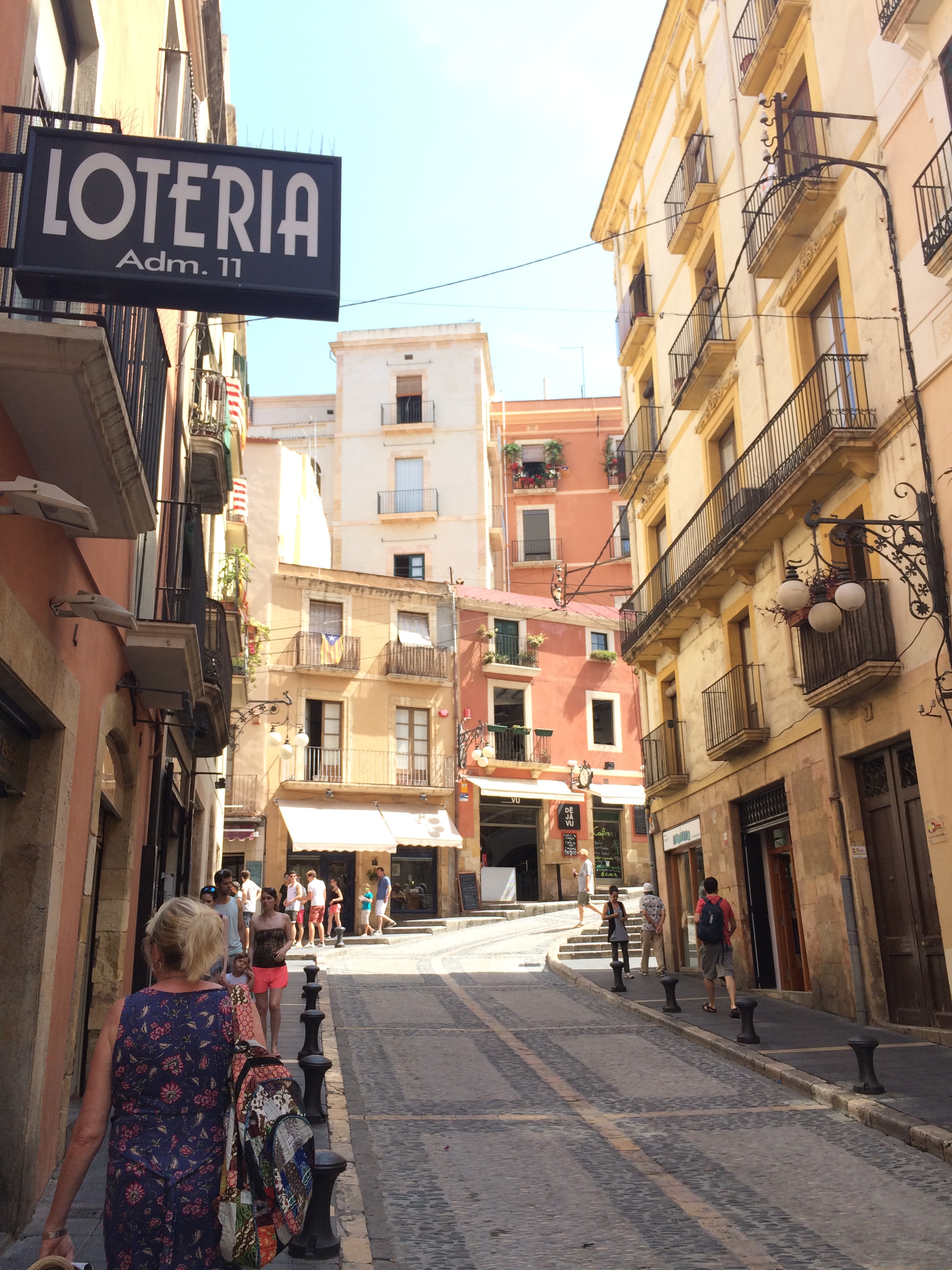
Tarragona is a very pleasant town to spend a day in.
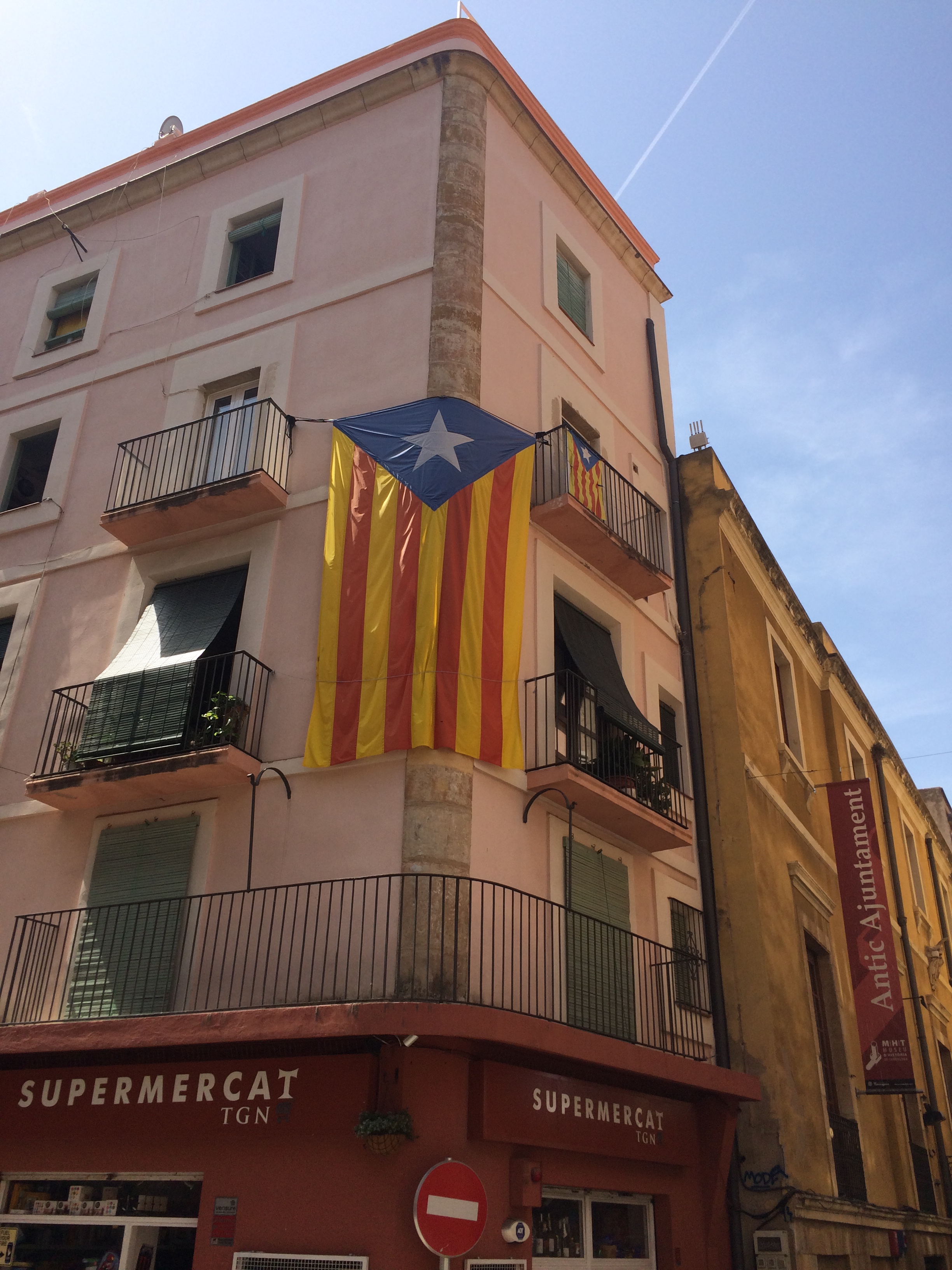
Tarragona is a very pleasant town to spend a day in.

Now Tarragona is a centre of Catalonian independence (thought we did see some Real Madrid shirts for sale!)

Now Tarragona is a centre of Catalonian independence (though we did see some Real Madrid shirts for sale!)
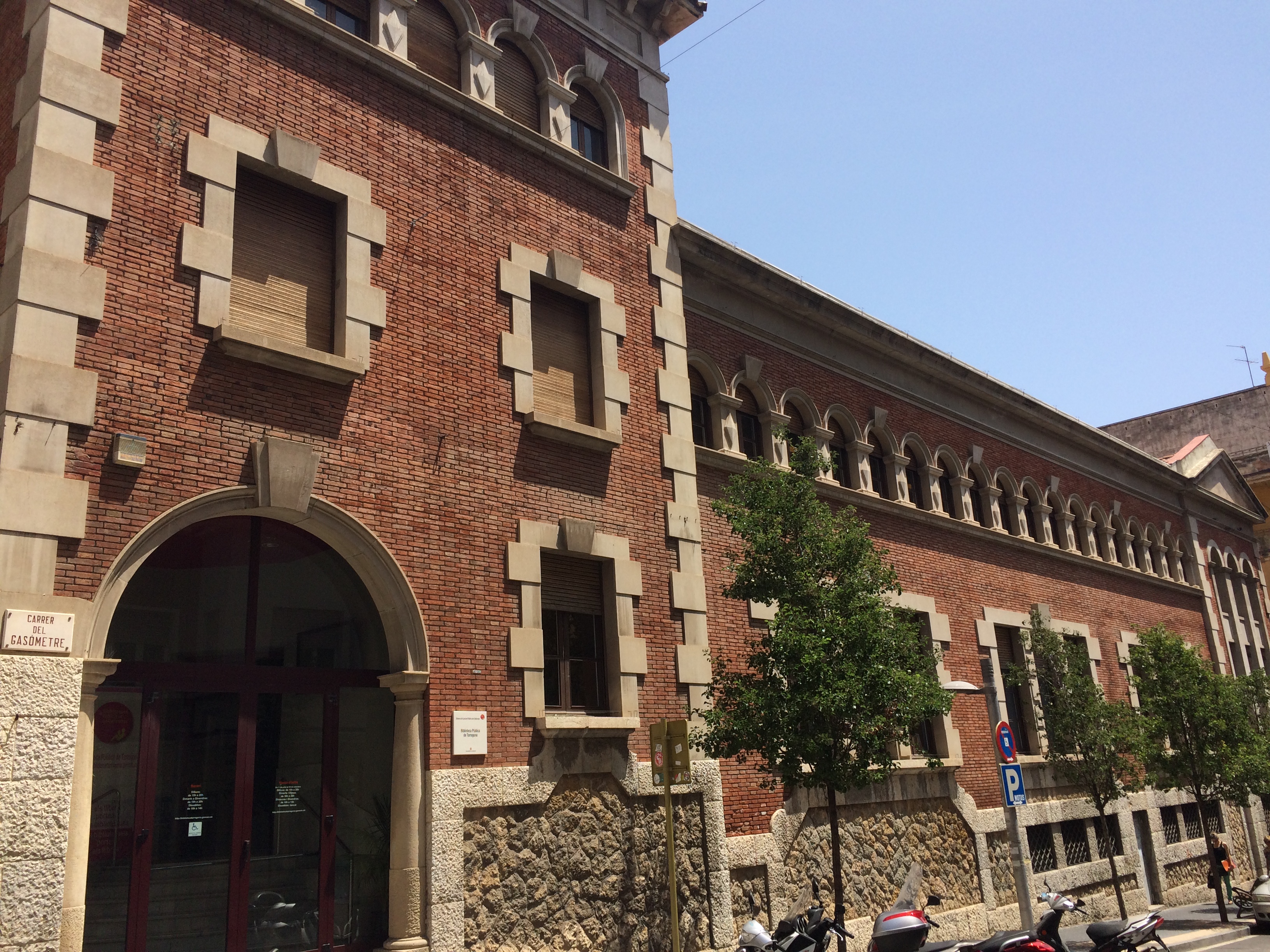
Tarragona's public library - the architecture reminded us of the College Saint Marc in Alexandria.

Tarragona’s public library – the architecture reminded us of the College Saint Marc in Alexandria.

Apart from visiting Taragona and swimming we were following what was happening in Greece.  The ‘No vote’ was a victory for democracy but one can’t help being anxious at the hurt the Greek people are experiencing.
IMG_3725

3r July – the ‘Kingdom of Leon’

Standard
Entrance to the 'Reino de Leon' (Kingdom of Leon).

Entrance to the ‘Reino de Leon’ (Kingdom of Leon).

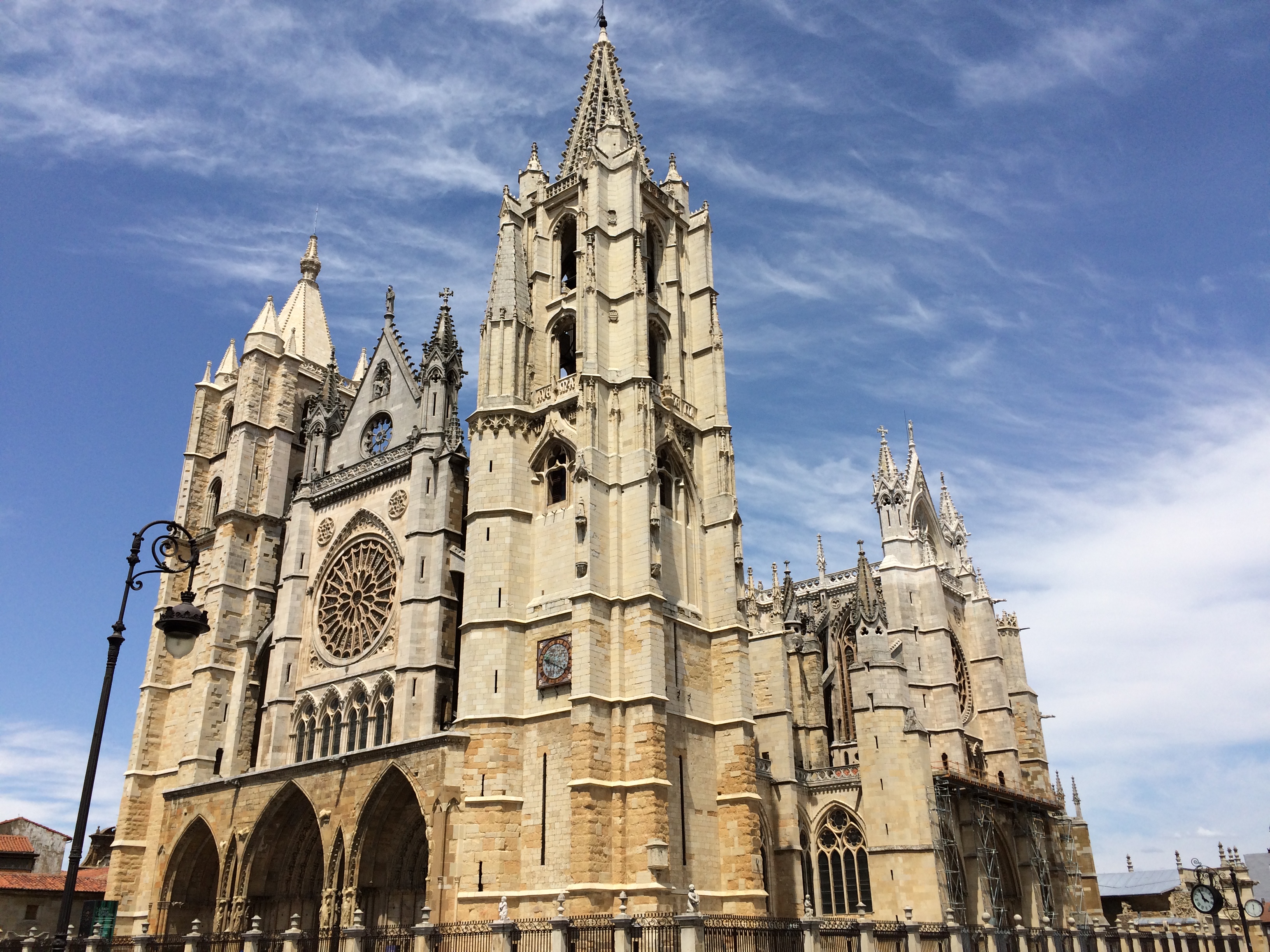
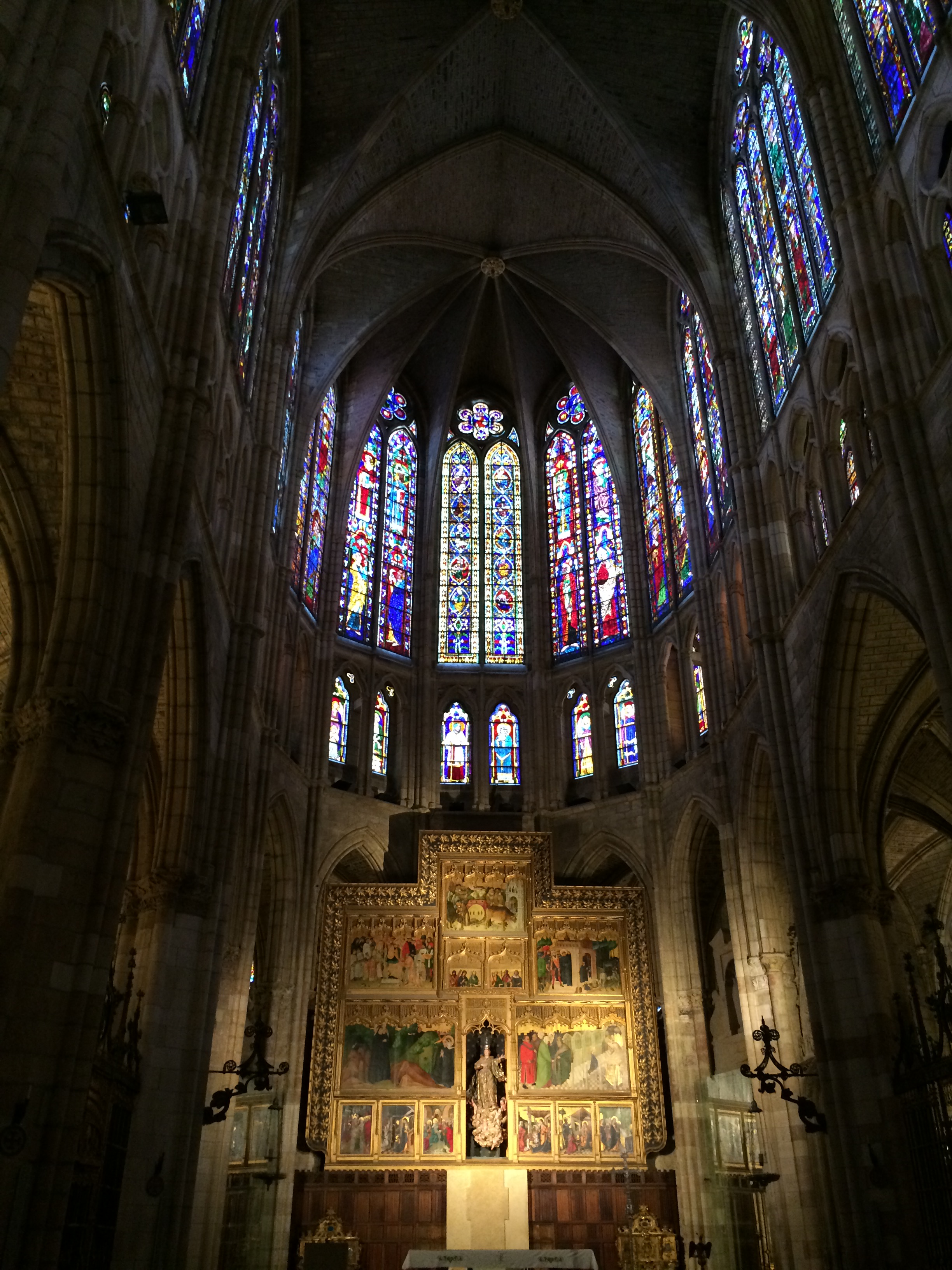
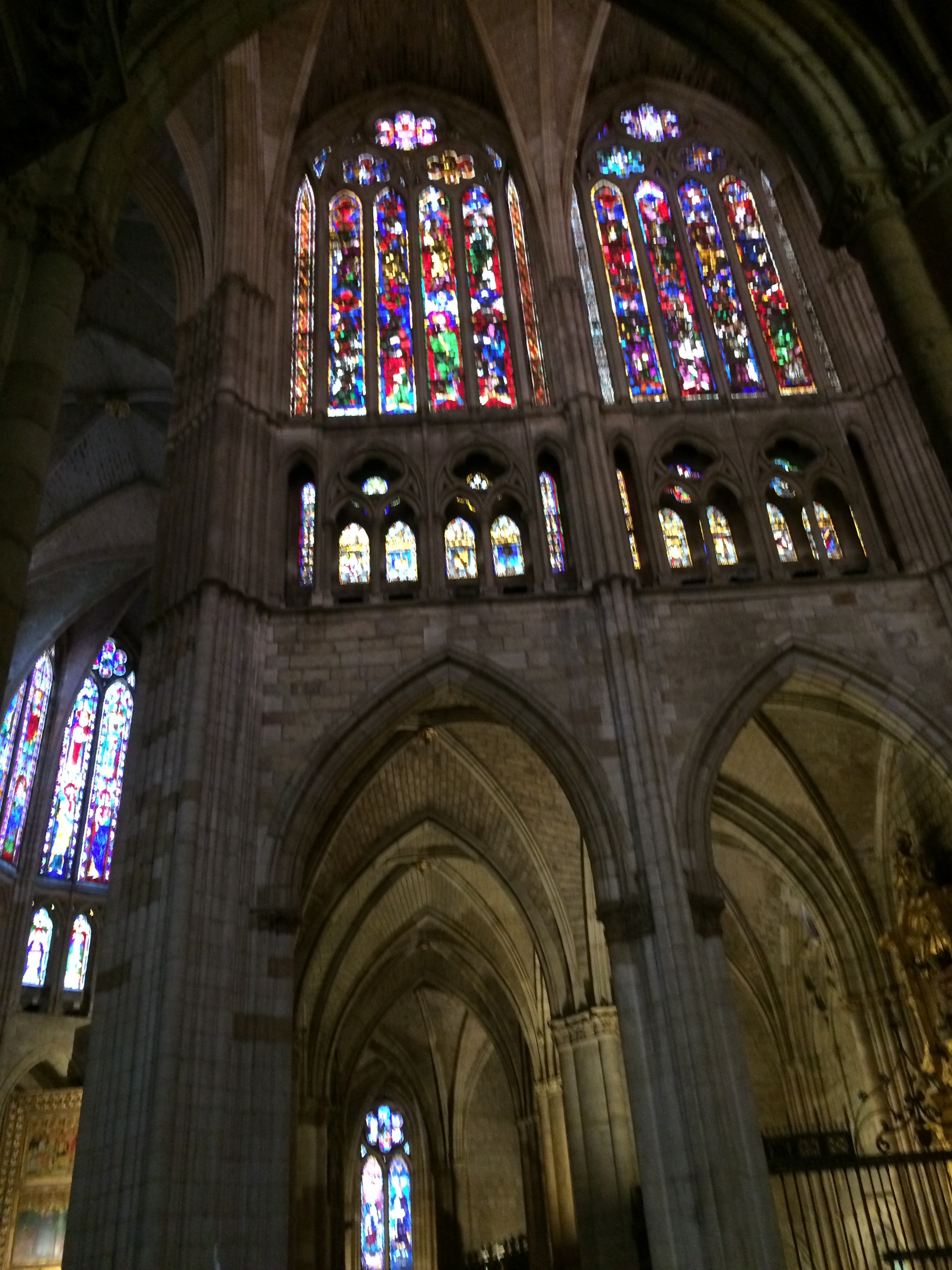
We set off for the city of Leon, to see the legendary Kings of Leon, one of Judith’s favourite bands!  Leon is in an area called the Asturias. Leon is a beautiful city with perhaps one of the most incredible medieval cathedrals we’ve seen so far.  An audio provided on entering was surprisingly informative and sensitive and we were really taken by the narrative – Leon, a city of just 5000 citizens at the time, who built something so incredibly beautiful which would get them nearer to the divine.  The cathedral was built with webbed arches, a revolutionary architectural development at the time which allowed the cathedral to have more windows, allowing more light into the building. This was the ‘classic Gothic’ style, distinctive from the older and gloomier Romanesque cathedrals which had to have stronger walls and smaller windows. Whether you’re religious or not, the stained glass windows in Leon Cathedral make you gasp in wonderment.
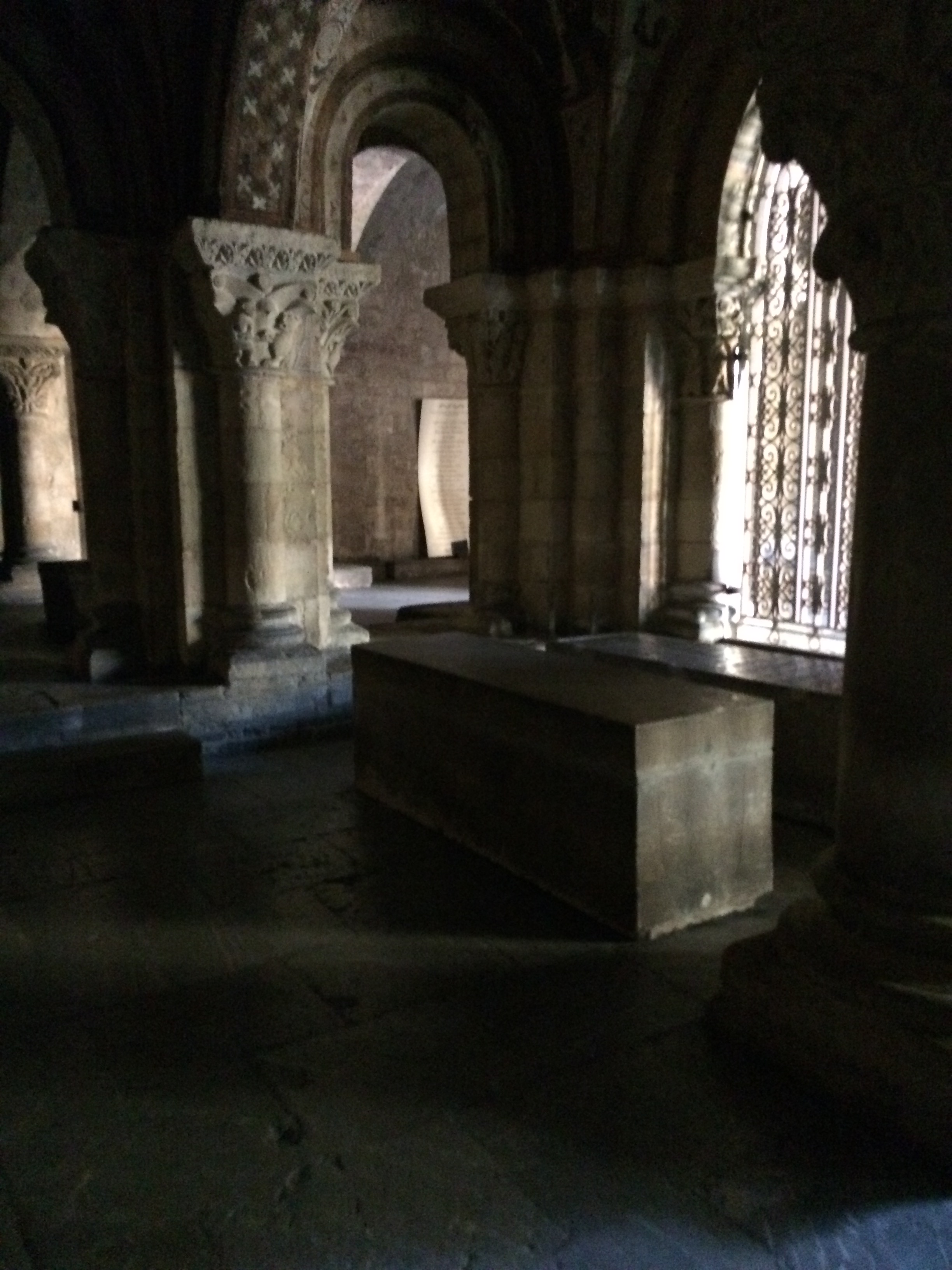
Next stop was the Basilica and the pantheon of the Kings.  23 kings and queens of Leon were interred here.  Their original resting places had been desecrated by France’s napoleonic army, and whatever remains were found were laid to rest here. None of the sarcophagi had identifying markers, just ‘Reis des Leon’.  Entering Leon the road sign said ‘Reino des Leon’ or ‘Kingdom of Leon’, a reference to the fact that Leon was a separate Kingdom on the Iberian peninsula.  Photography was strictly forbidden which is why only two photographs are displayed below😉

IMG_3580

The 'webbed arch' design meant bigger windows letting in more light in an attempt to 'recreate the divine'.

The ‘webbed arch’ design meant bigger windows letting in more light in an attempt to ‘recreate the divine’.

Leon Cathedral was an incredible achievement for a city of just 5000 people at the time.

Leon Cathedral was an incredible achievement for a city of just 5000 people at the time.

The alter-piece in Leon Cathedral.

The alter-piece in Leon Cathedral.

The Pantheon of Kings, where 23 kings and queens of Leon are interred.

The Pantheon of Kings, where 23 kings and queens of Leon are interred.

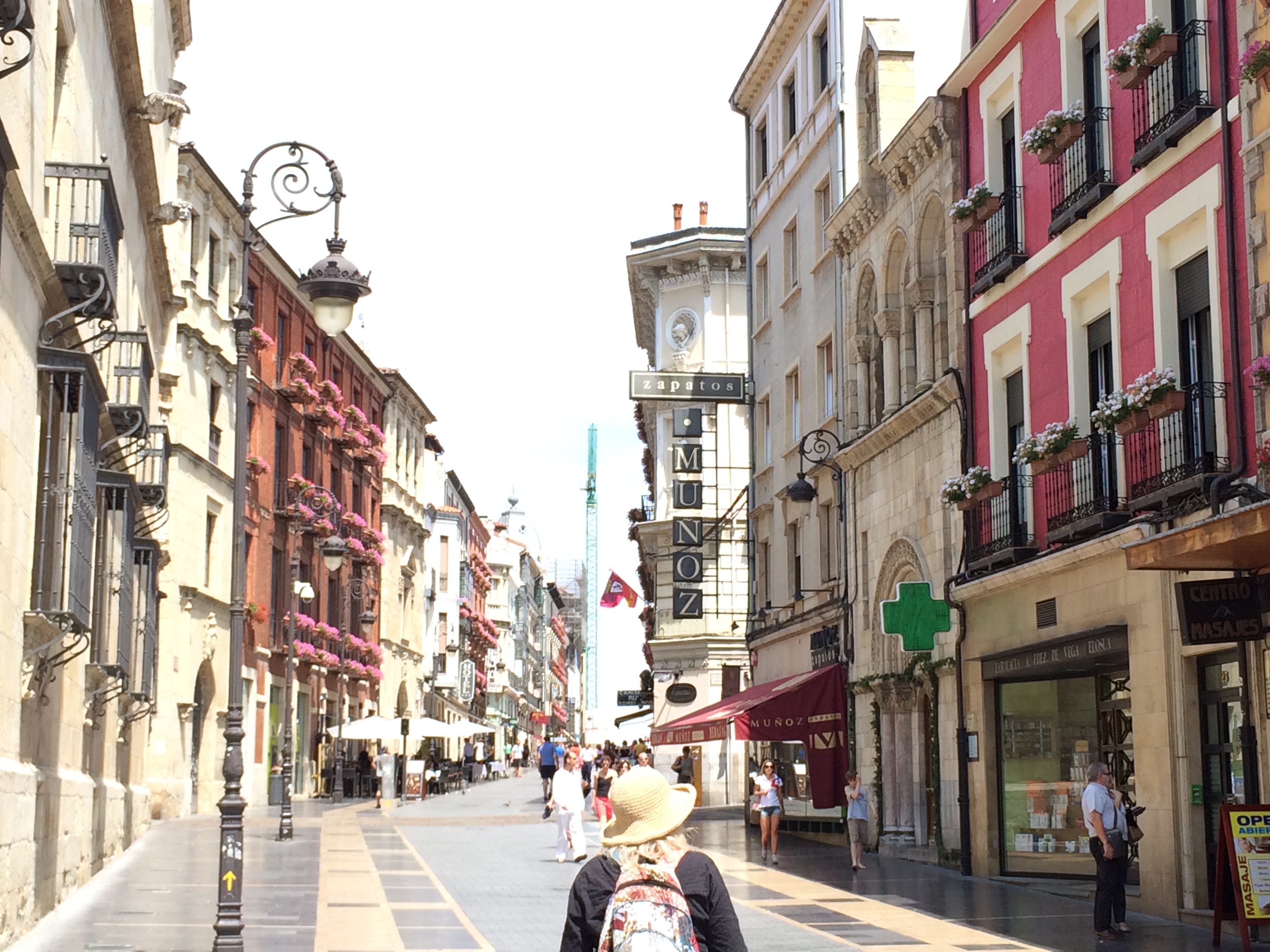
Strolling through the charming pedestrianised streets of Leon.

Strolling through the charming pedestrianised streets of Leon.

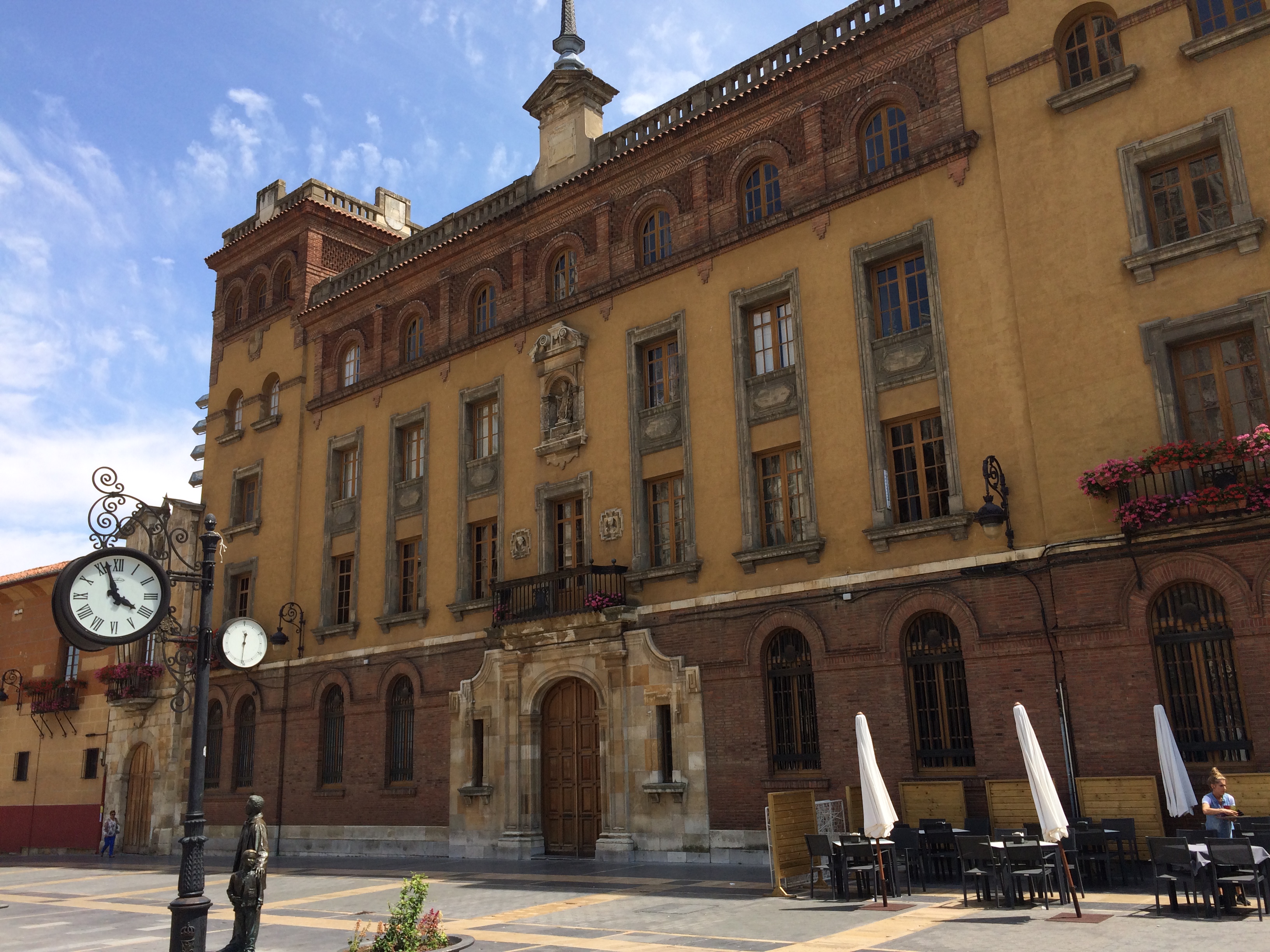
The central plaza in front of the cathedral. Leon is a lovely and relaxing compact little city.

The central plaza in front of the cathedral. Leon is a lovely and relaxing compact little city.

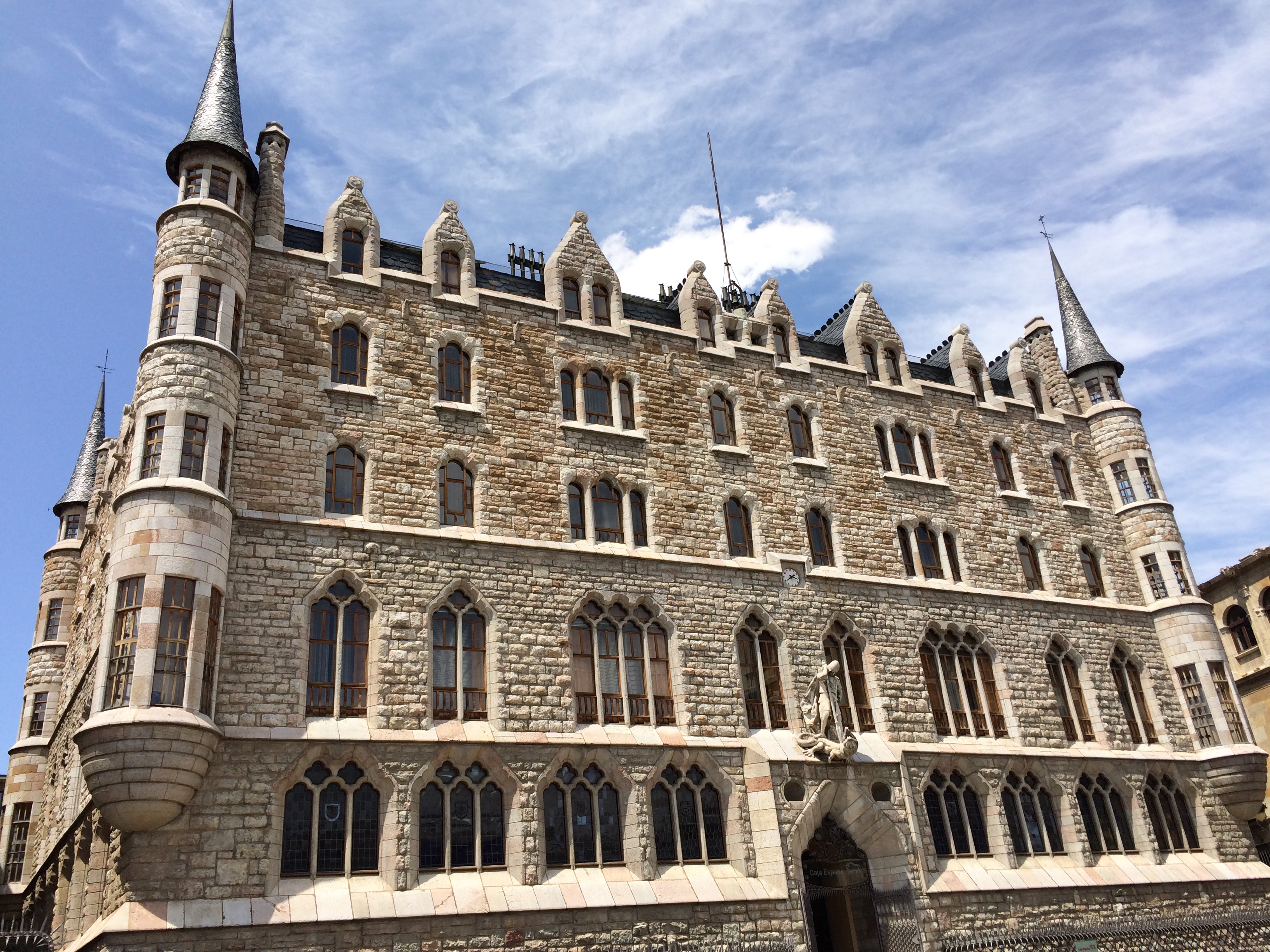
The Casa Botines, designed by Antonio Gaudi.

The Casa Botines, designed by Antonio Gaudi.

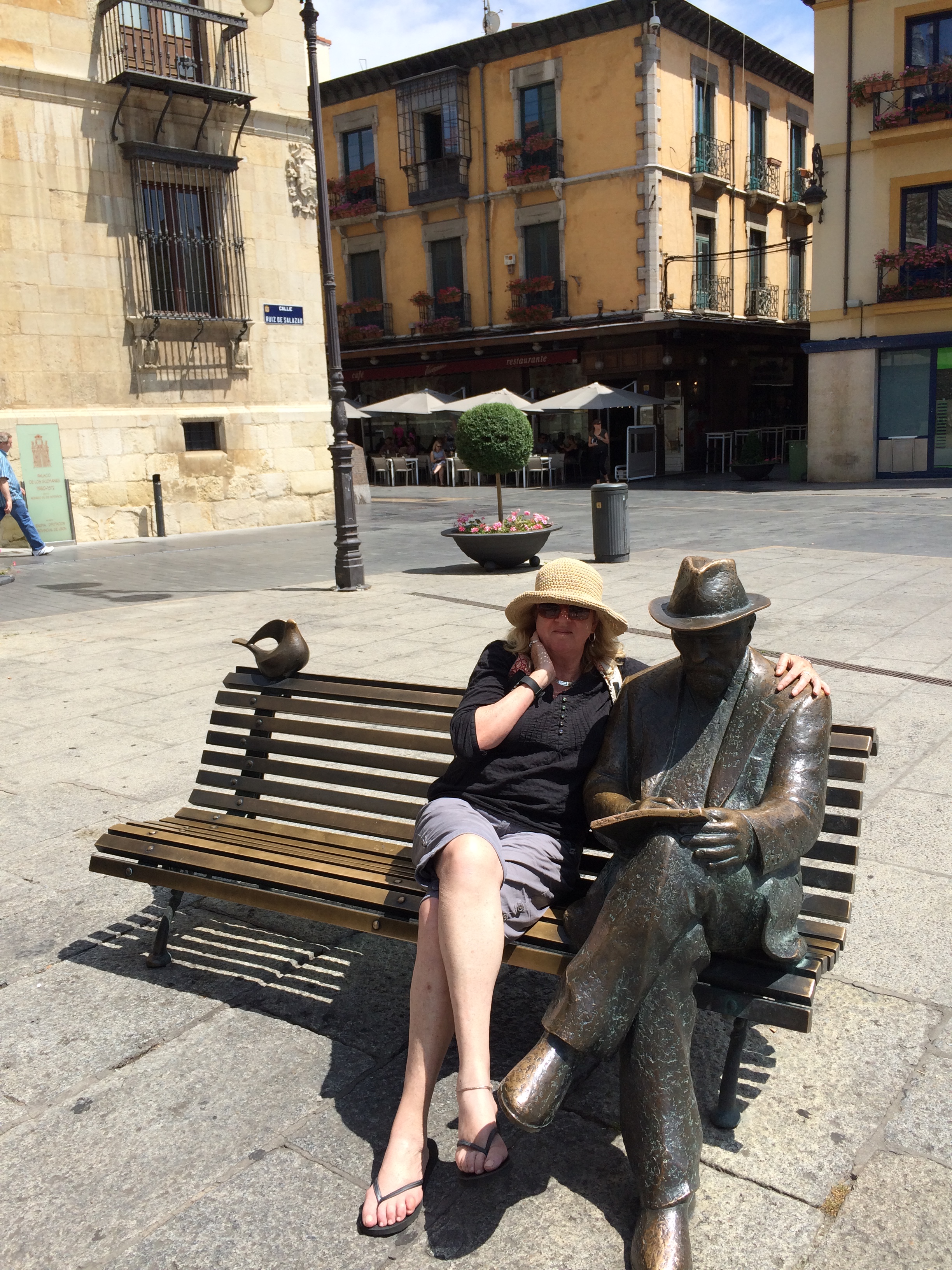
Judith relaxing with Antonio Gaudi in front of the Casa Botines.

Judith relaxing with Antonio Gaudi in front of the Casa Botines.

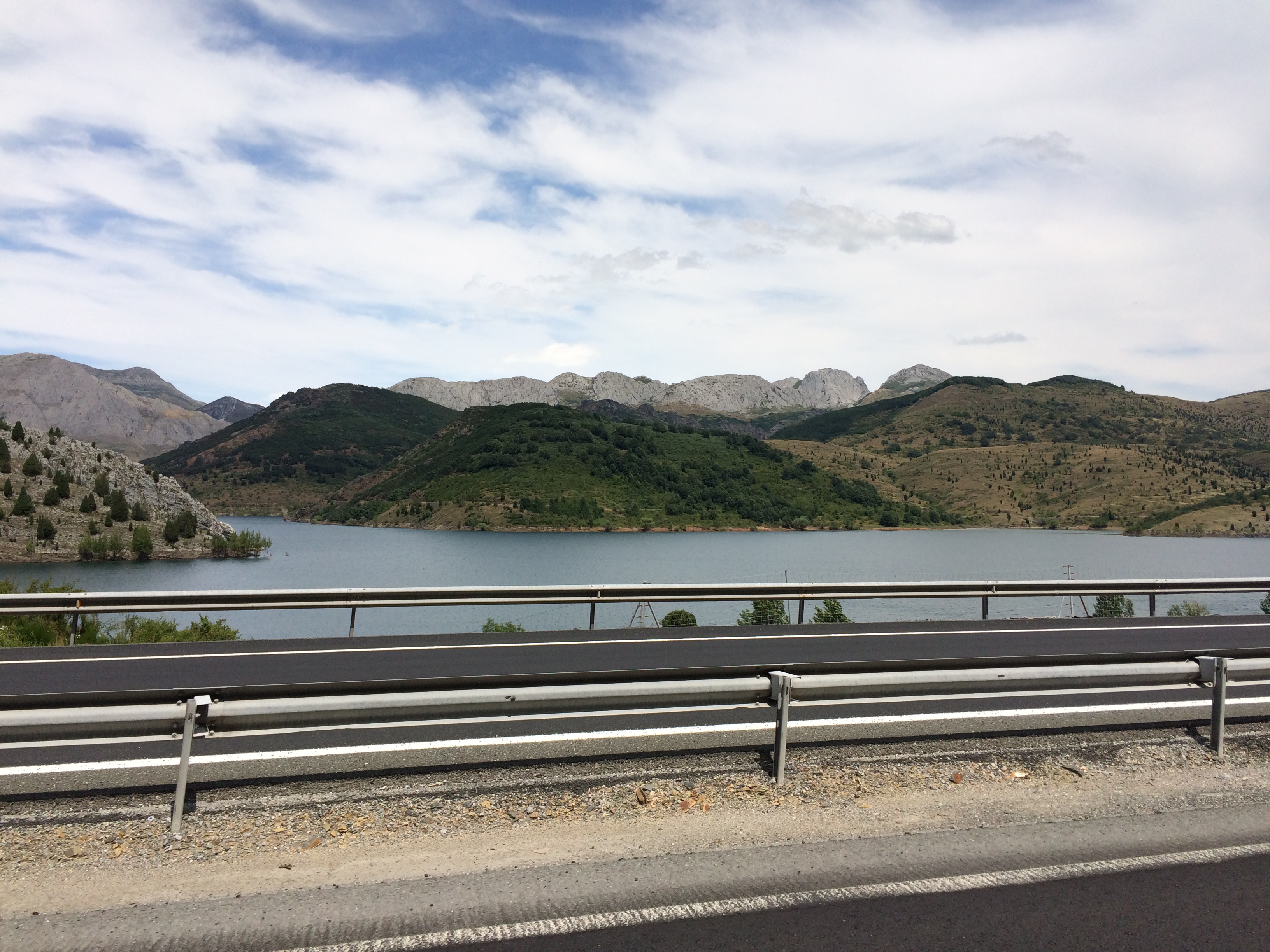
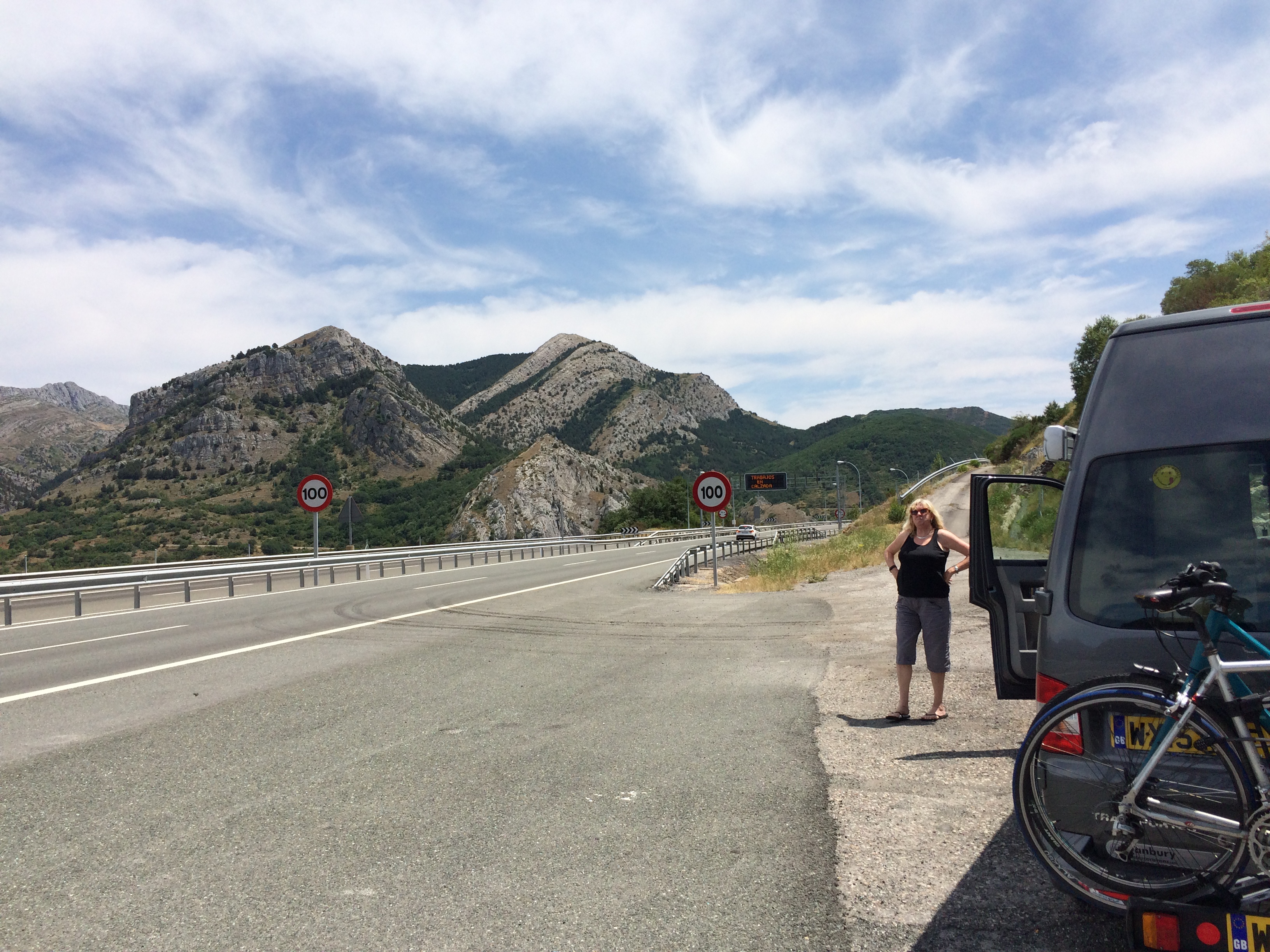
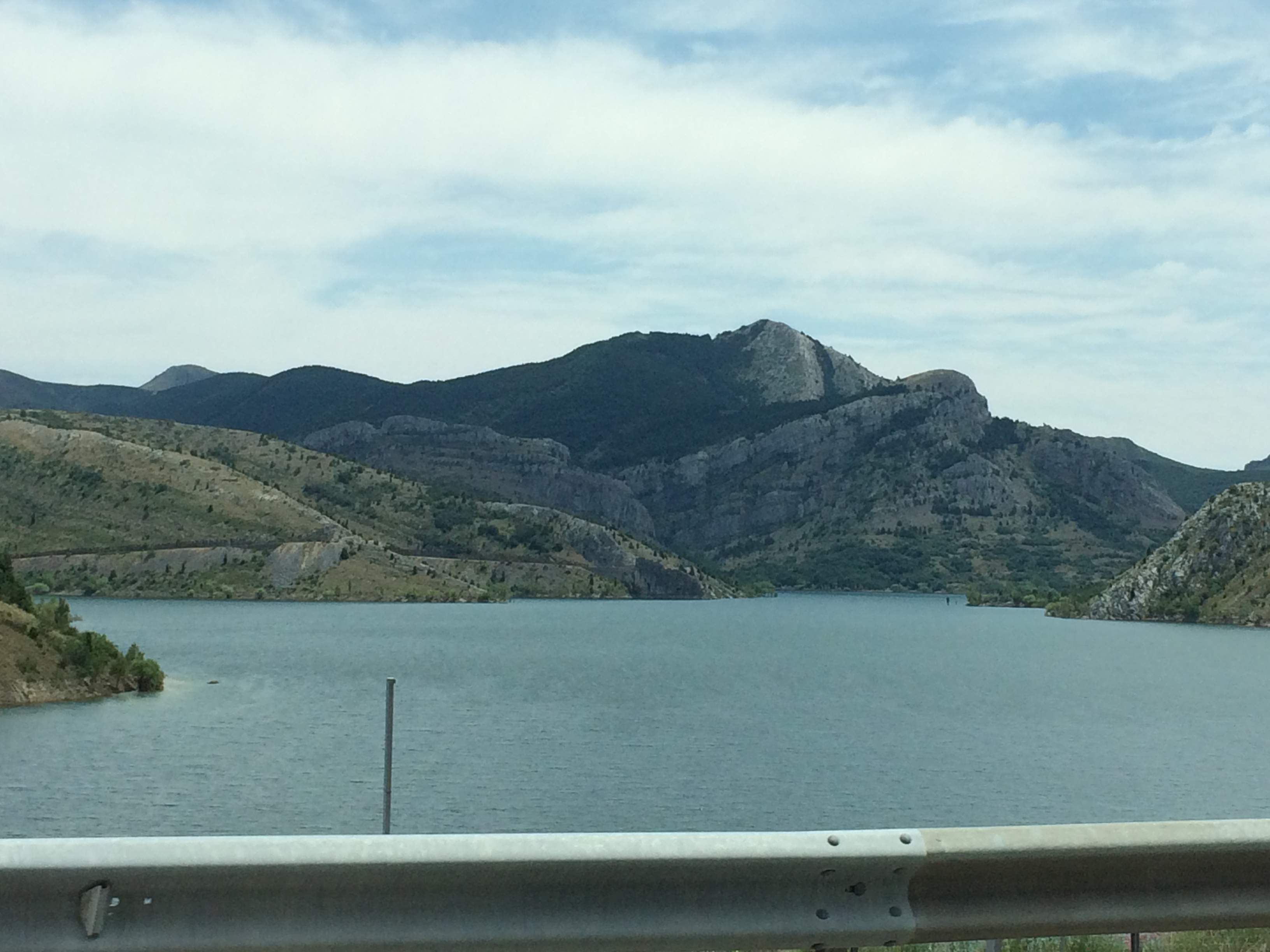
On the way to Leon, we crossed a stupendous area of outstanding beauty called the Sena de Luna (Lunar Scene) and Los Barrios.  The highway through this area of mountains and lakes must have been a major and costly undertaking.  Much of the road wasn’t yet recognized by our TomTom so it must have been completed only recently.  The scenery was Lake District meets Jurassic Park with stunning hills descending straight into perfect calm and blue lakes.  Flavio found the temptation to go down for a swim almost impossible to resist but access from the highway was impossible.
Los Barrios - stunning.
Los Barrios – stunning.

Access to the lakes was impossible from the superhighway.

Access to the lakes was impossible from the superhighway.

IMG_3554

30th June to 2nd July – Cudillero

Standard
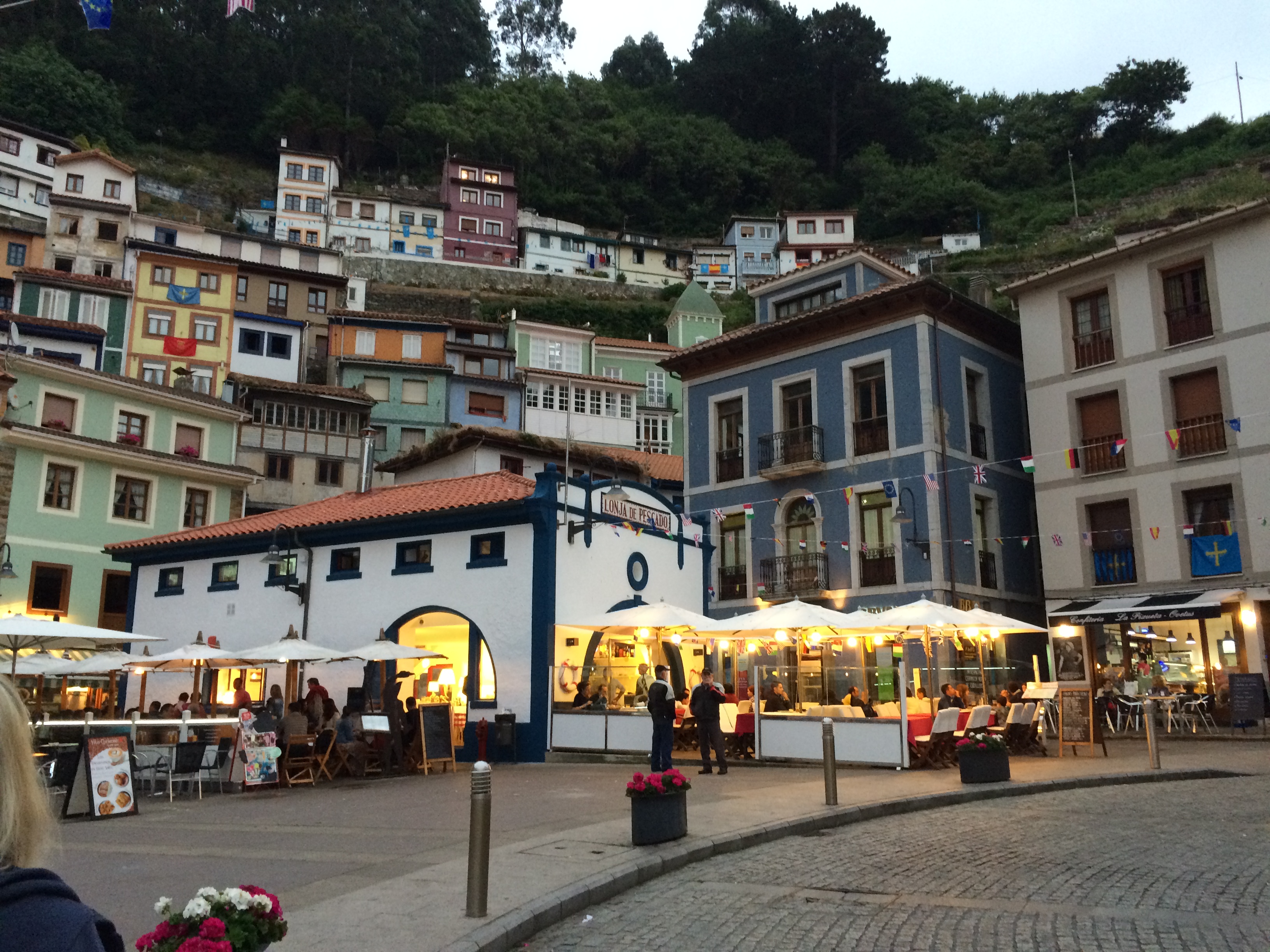
The fishing village of Cudillero.

The fishing village of Cudillero.

Stayed two nights in a lovely little campsite near Cudillero along the north coast.  We were now in the Asturias. The village, a small fishing port a 6 kilometre walk away , seemed very lively.  The streets were full of people singing and dancing in national costume in celebration of the feast of San Pedro (St Peter), the saint of ‘el pueblo’ i.e. the local saint.   We agreed we couldn’t think of a better way to celebrate a saint’s day…..so naturally, we joined in.

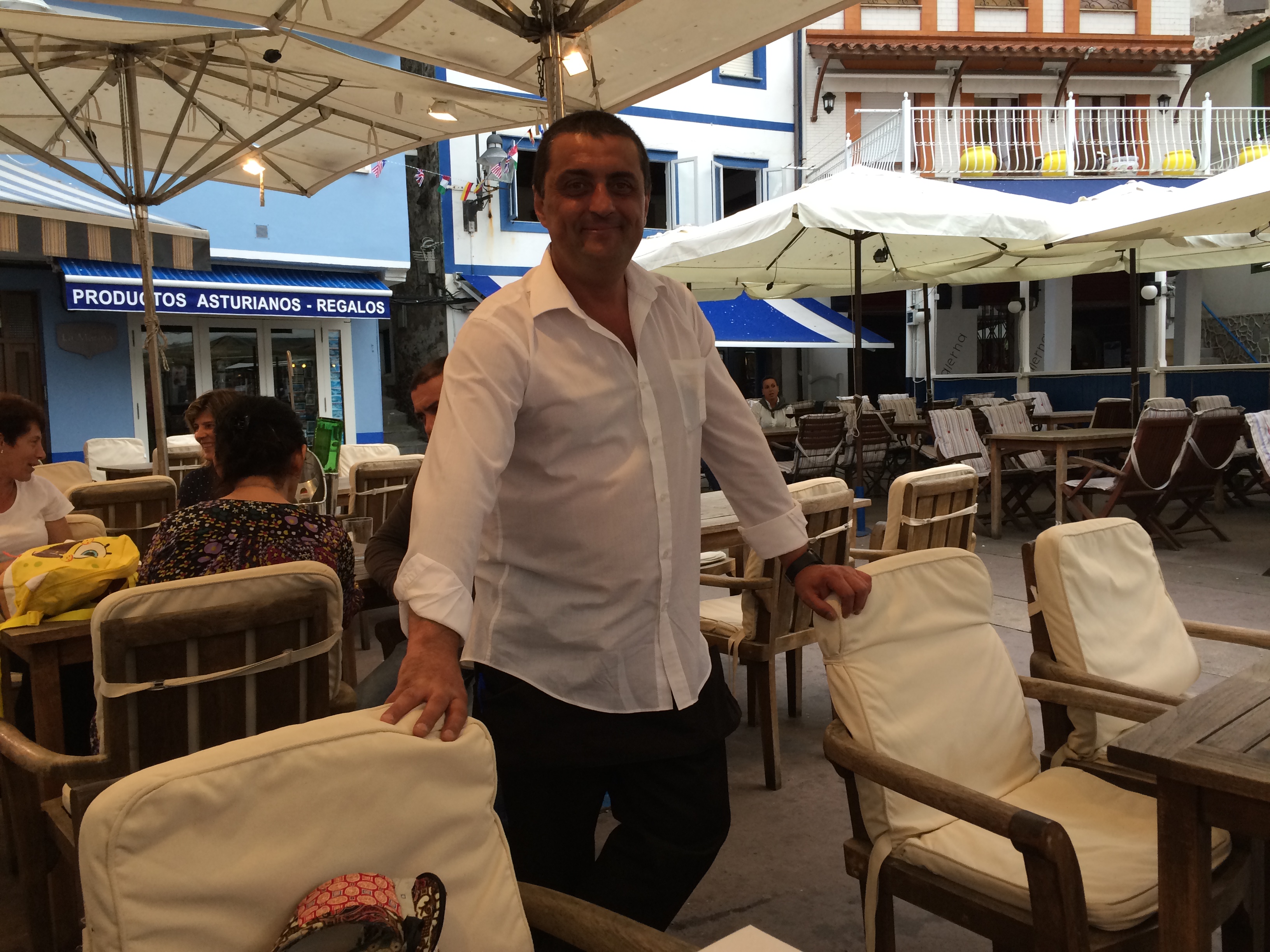
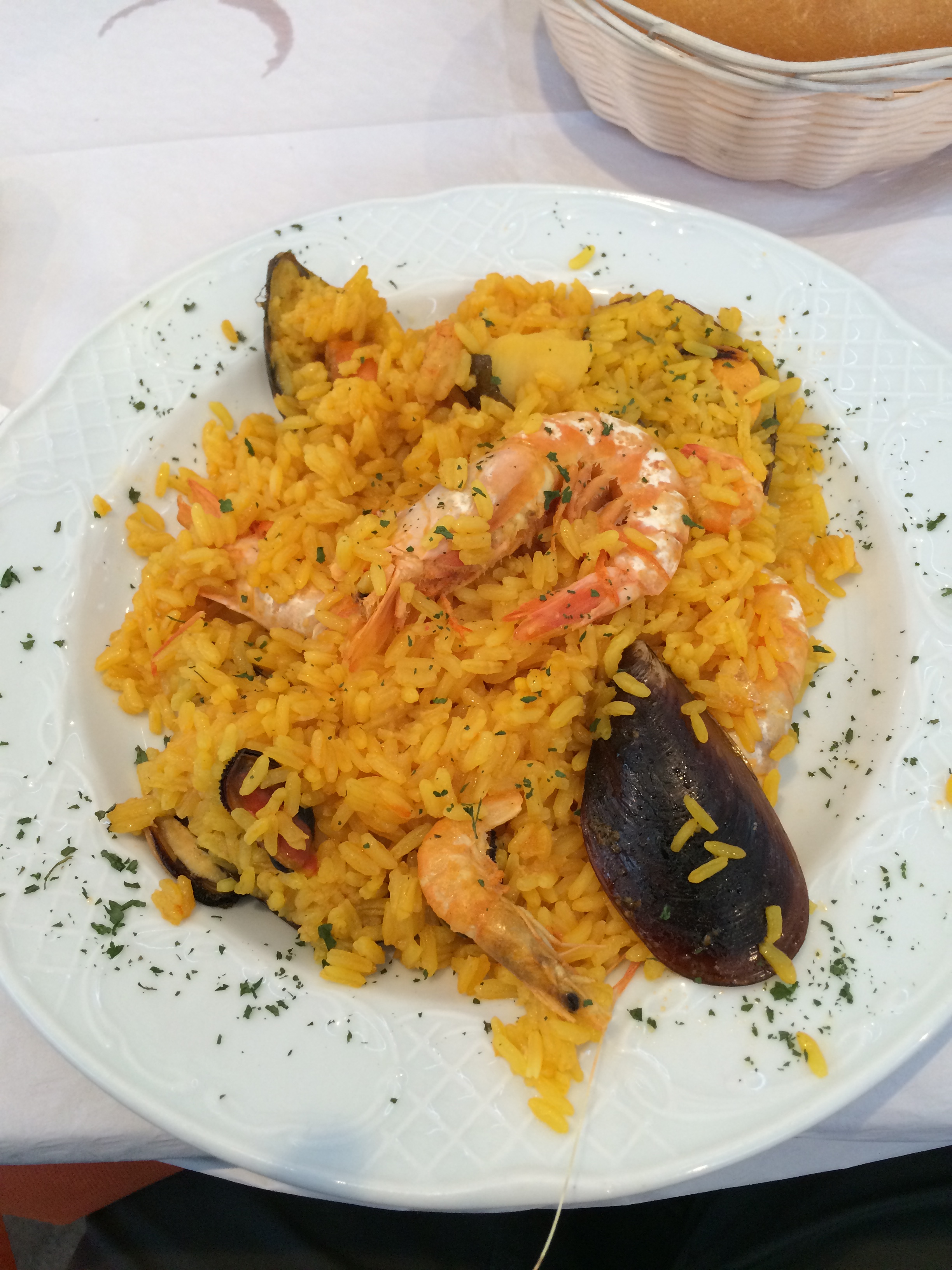
The village itself seemed to have fallen on hard times, like most of Spain we’ve visited, with many buildings up for sale and businesses closed.  Despite this everyone seemed to be enjoying themselves and it was here we ate our first paella – correction, it was here Flavio ate his first paella, Judith seemed a bit nonplussed by the claws sticking out of her rice and somehow lost her appetite.  A waiter in the restaurant named Jesus spoke at length about the decline in the village and in Spain as a whole.  He said the fishing industry was being destroyed by EU regulations (interesting concept which I’m sure the Cornish fishermen would like to comment on!), that the division between rich and poor had increased and that Spain was poorer for being in the EU.

Cudillero - pretty but fallen on hard times.

Cudillero – pretty but fallen on hard times.

Celebrating San Pedro's day.

Celebrating San Pedro’s day.

Proudly displaying the Asturian flag - every region in Spain has a strong regional identity.

Proudly displaying the Asturian flag – every region in Spain has a strong regional identity.

Jesu telling us ordinary Spanish people were better off before the EU.

Jesu telling us ordinary Spanish people were better off before the EU.

Paella - before..

Paella – a bit fiddly to eat.

IMG_3532

Tuesday 30th June – La Coruna

Standard

Two things stood out for us during our visit to La Coruna (or A Coruna to give it its official Galician name): the Tower of Hercules and the ‘Glass City’.

As well as those, there was a fun, chance encounter with an English teacher singing the praises of Macmillan books and a regional rep working for a well-known but rival publisher to Macmillan.

We couldn’t remember who exactly had told us, if we were going to Santiago, to make sure not to miss out La Coruna, nor whether any specific reasons were offered as to why it would be interesting.

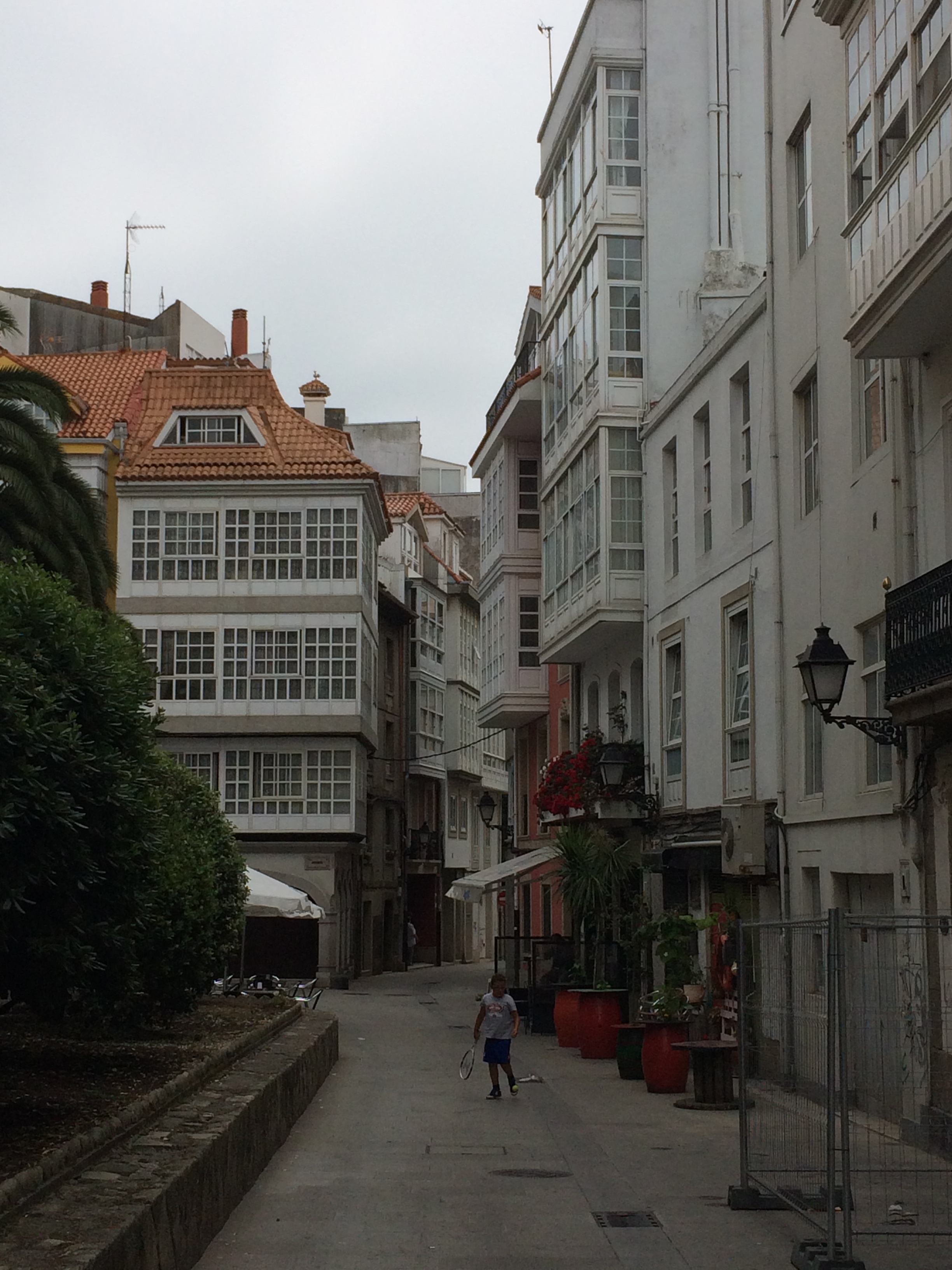
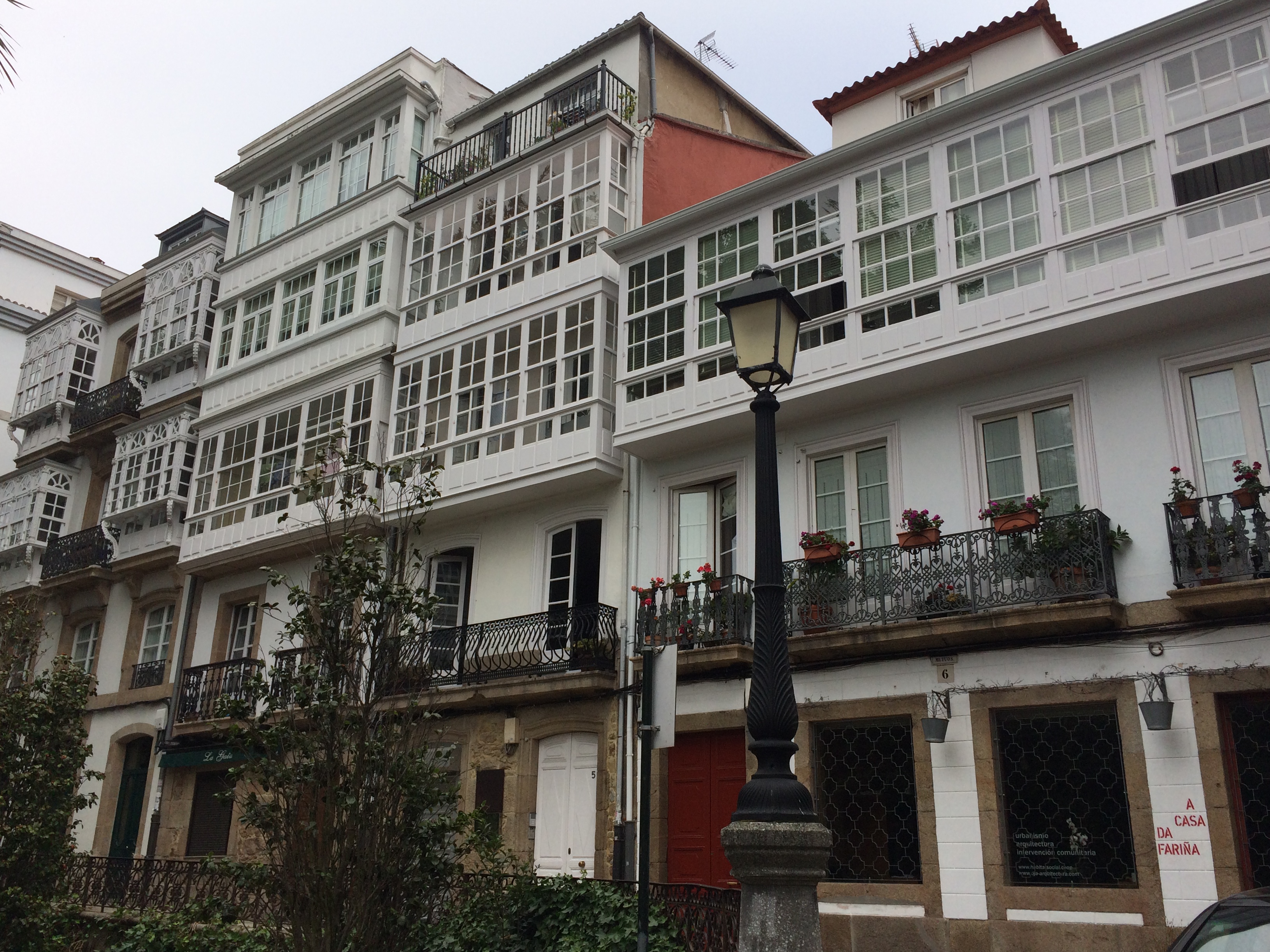
What we found was a city very unlike Santiago, built in the 19th and early 20th centuries in the modernist style rather than medieval but very distinctive nonetheless with its glass-covered balconies or “gallerias”.

La Coruna city centre with typical buildings with glass covered balconies or "Gallerias".

La Coruna city centre with typical buildings with glass covered balconies or “Gallerias”.


Gallerias are reminiscent of the 'Regency' style in England.

Gallerias are reminiscent of the ‘Regency’ style in England.


La Coruna is the second most important city in Galicia and a busy port and important distribution point for agricultural goods in the region.   Called Brigantium by the Romans, it became important to them for maritime trade due to its strategic position.   They built a lighthouse that started as an observation tower called The Tower of Hercules. The town fell into decline after the fall of the Roman Empire and Norman and Viking raids while the Muslims showed little interest in the region. It started prospering again in the 13th and 14th centuries and saw growth in fishing and mercantile business, becoming the capital of Galicia for several centuries before being replaced by Santiago.

Another interesting fact is that it was from nearby Terrol that the Spanish Armada set sail in 1588 for England and Holland.

Before the expulsion of the Jews in 1492, a thriving Jewish community created a rich artistic heritage in the city.

We started by going straight to the Tower of Hercules – no problem spotting it straight away as it rises 55 metres high overlooking the Atlantic. It is said to be modelled on the Pharos of Alexandria and is the oldest lighthouse in the world, having been in constant use since the 2nd century. We were looking at a still functioning structure that was 1900 years old! In 1788, the original 34 metres Roman structure was given a neoclassical restoration including a 21 metre fourth storey. The restoration was ordered as a way of strengthening security in the port thereby contributing to the growth and success of the city.

The 55 metre tall Tower of Hercules.

The 55 metre tall Tower of Hercules.

The oldest lighthouse, modeled on the Lighthouse of Alexandria, and in continuous use for 1900 years.

The oldest lighthouse, modeled on the Lighthouse of Alexandria, and in continuous use for 1900 years.


We paid our 6 Euros to go up the Tower. At each level were information panels telling the history of the lighthouse and the various stages of reconstruction. On the ground floor was the actual enormous stone original oil lamp showing the hole where the giant wick would have been inserted and whose flame would have been reflected by a huge curved metal mirror.

The original Roman giant stone lamp which was used in the lighthouse

The original Roman giant stone lamp which was used in the lighthouse

The view from the top was breathtaking – it was difficult to stay up there for long without getting vertigo. Legend has it that King Breogan, the founder of the Galician Celtic nation, constructed here a tower of such height that his sons could see a distant green shore from its top. The glimpse of that distant green land lured them to sail north to Ireland. These descendants of Breogen and their followers are the Celtic descendants of the Irish people.

View from the top of the Tower of Hercules.

View from the top of the Tower of Hercules.

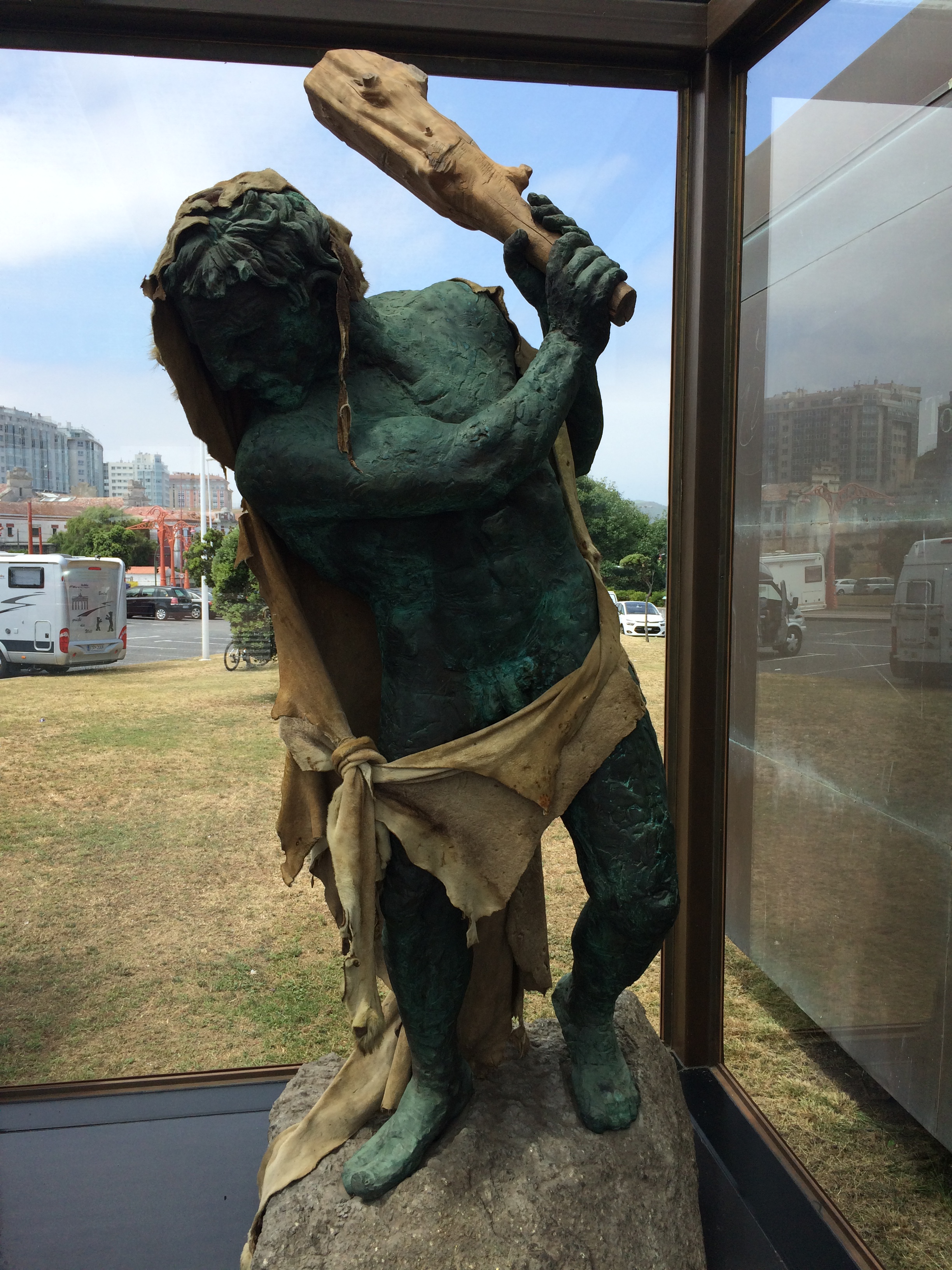
But the more prevalent myth, and the reason it is called the Tower of Hercules, is that it was here that Hercules slew the giant tyrant Geryon after 3 days and 3 nights of battle. Hercules then buried the head of Geryon with his weapons and ordered that a city be built on the site.

According to legend, Hercules slew the tyrant Geryon and ordered that a tower be built on the site.

According to legend, Hercules slew the tyrant Geryon and ordered that a tower be built on the site.

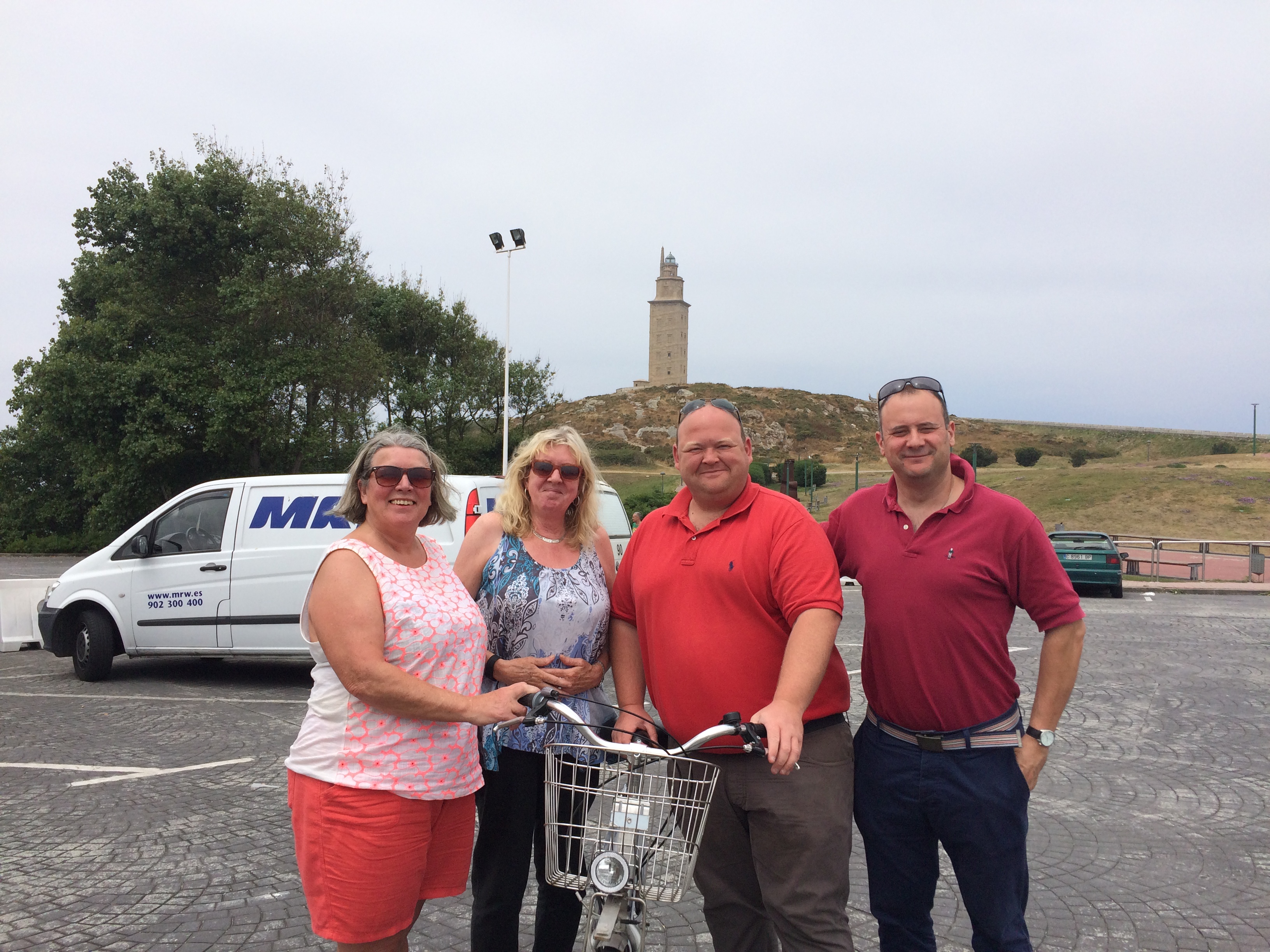
Our visit to the lighthouse complete and almost recovered from our vertigo, we were discussing where exactly to go next when, not sure how or in what sequence exactly, we were suddenly engaged in lively conversation, about several things at the same time, with an extremely friendly and helpful group of people that had gathered around Brenda. First there was Sharon and friend, who were showing interest in Brenda and Judith was giving a mini-tour (it’s the only kind really with a campervan). Then Carlos the English teacher was kindly offering advice on everything local and Galician. Then Luke the publisher’s rep was called over when I asked a specific question about which town we should visit next, Gijon or Leon. Luke was the expert because they were in his territory. “So hard to say. They’re my two favourite places!” “Gijon is a carbon-copy of Coruna but better.” Carlos looks mildly hurt. “Carlos doesn’t agree because he’s from Coruna, ha ha”. “What do you think of La Coruna?” asks Carlos. “Um, we’ve only seen the lighthouse so far”.

“Ah, you like Radiohead – manic depressive music – Carlos likes Radiohead” interrupts Luke. After lots more bonhomie and laughter, a photo taken and blog details given, we left cheered up to take a quick look round the centre of town.

The friendly 'locals' Carlos, Luke and Sharon who spared no effort with their friendly advice.

The friendly ‘locals’ Carlos, Luke and Sharon who spared no effort with their friendly advice.

Our impressions were that Coruna was not a very touristic place but relaxed with great little restaurants dotted around the place but what stood out most of all were the ‘gallerias’. A ‘galleria’ is a balcony that is enclosed in a glass frame protecting it from cold winds and making it usable all year round. The reason they’re prevalent in Coruna is first because a large part of the city is modernist and was built in the 19th and early 20th centuries and this style was popular then (it is in fact reminiscent of the ‘Regency’ style in England). And secondly it’s because the original fishermen’s houses that lined the harbour were built in this way and subsequent structures continued this style.

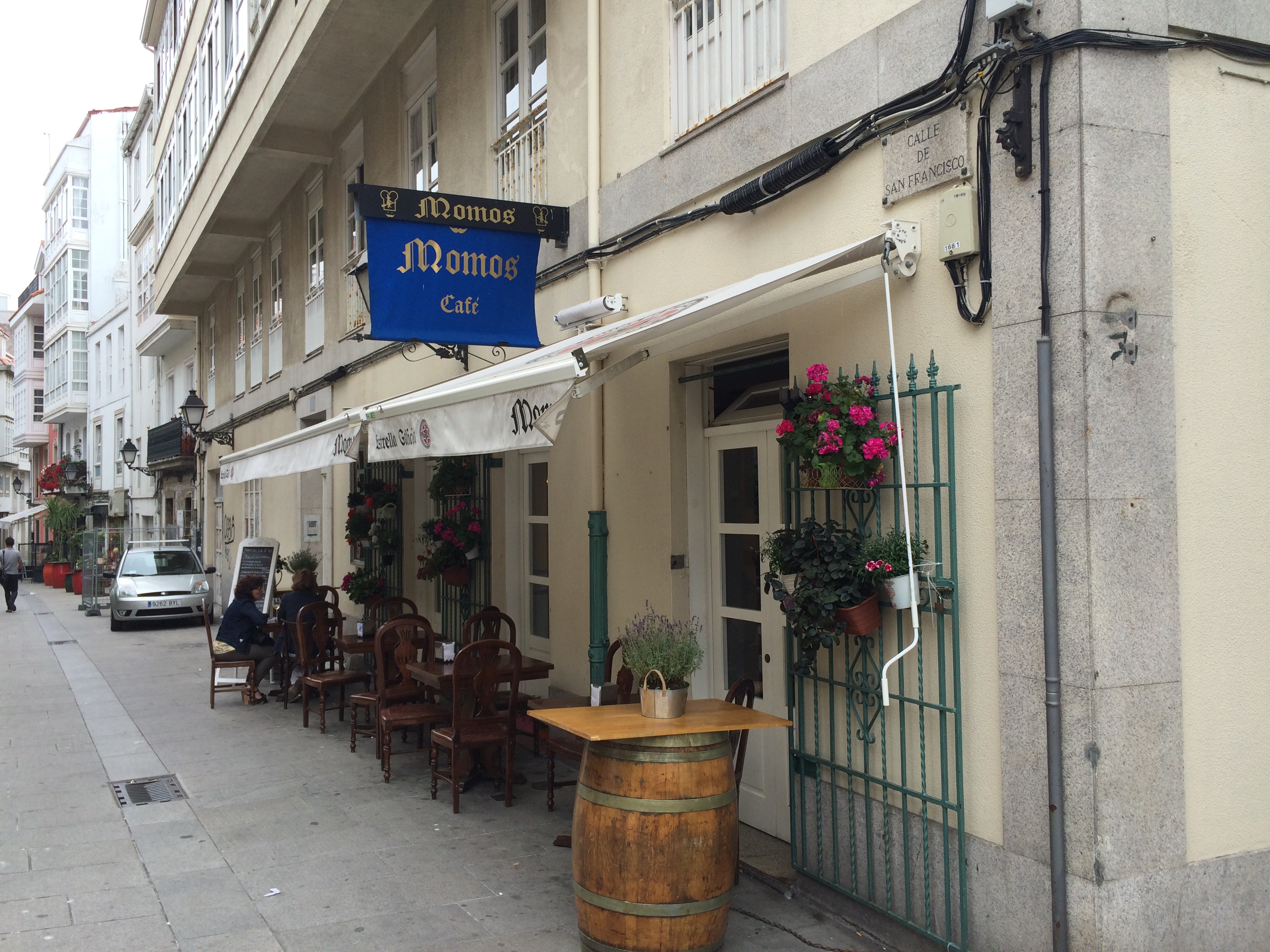
Plenty of good local gastronomy.

Plenty of good local gastronomy.

Typical building on the corner of the harbour front.

Typical building on the corner of the harbour front.


We spotted gallerias here and there as we walked around. But when we reached the harbour front area on Marina Avenue, we realized why Coruna was nicknamed ‘Cidade de Cristal’ (Glass City). The sky was overcast when we were there but apparently on a clear day, when the sun faces the harbour, the reflection from all the gallerias can be blinding. This area is called “Gallerias Corunesas”.

So to go back to Carlos’s and Luke’s question, the answer was of course that we left La Coruna with very pleasant memories of a relaxing half day gazing at what the Lighthouse of Alexandria could have looked like and a multitude of glass balconies, but made infinitely more pleasant by our jolly meeting with him and Luke et al at the foot of the Tower of Hercules.

IMG_3471

Monday 29th June to Tuesday 30th June – Santiago de Compostella to La Coruna

Standard

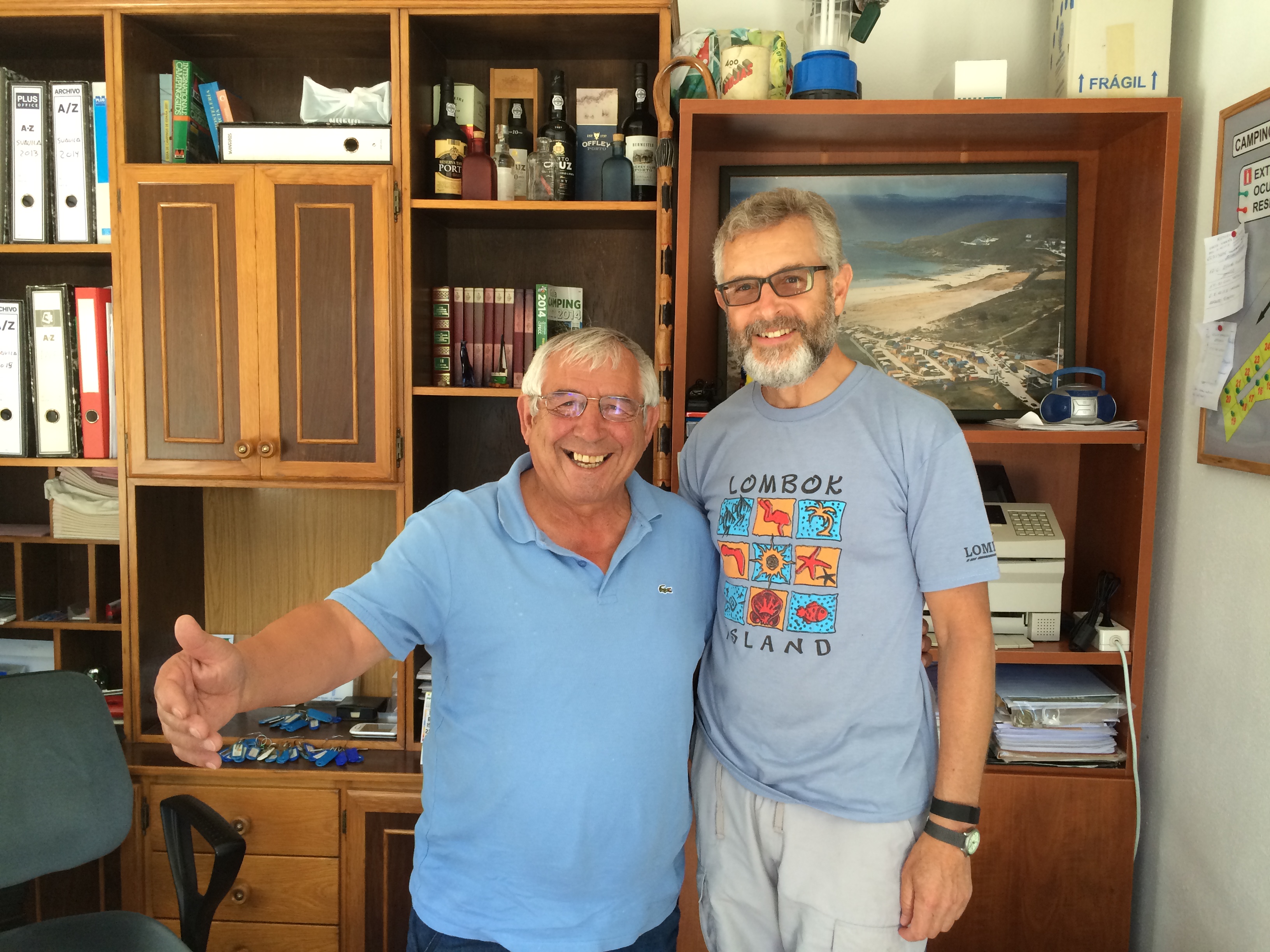
From Porto, we took the motorway north past Braga and crossed the border into Galicia at Tui, left Vigo to our left and Pontevedra to our right and headed for a charming little campsite at the end of a promontory on the Ria de Pontevedra estuary, extremely busy with locals returning home after a weekend on the coast, but a lovely spot in a place called Sangenjo (Sanxenxo in Galician) run by a very friendly and jocular man called Evencio.

Some friendly riders crossing a bridge as we pass through Villa Nova de Cerveira just south of the Spanish border.

Some friendly riders crossing a bridge as we pass through Villa Nova de Cerveira just south of the Spanish border.

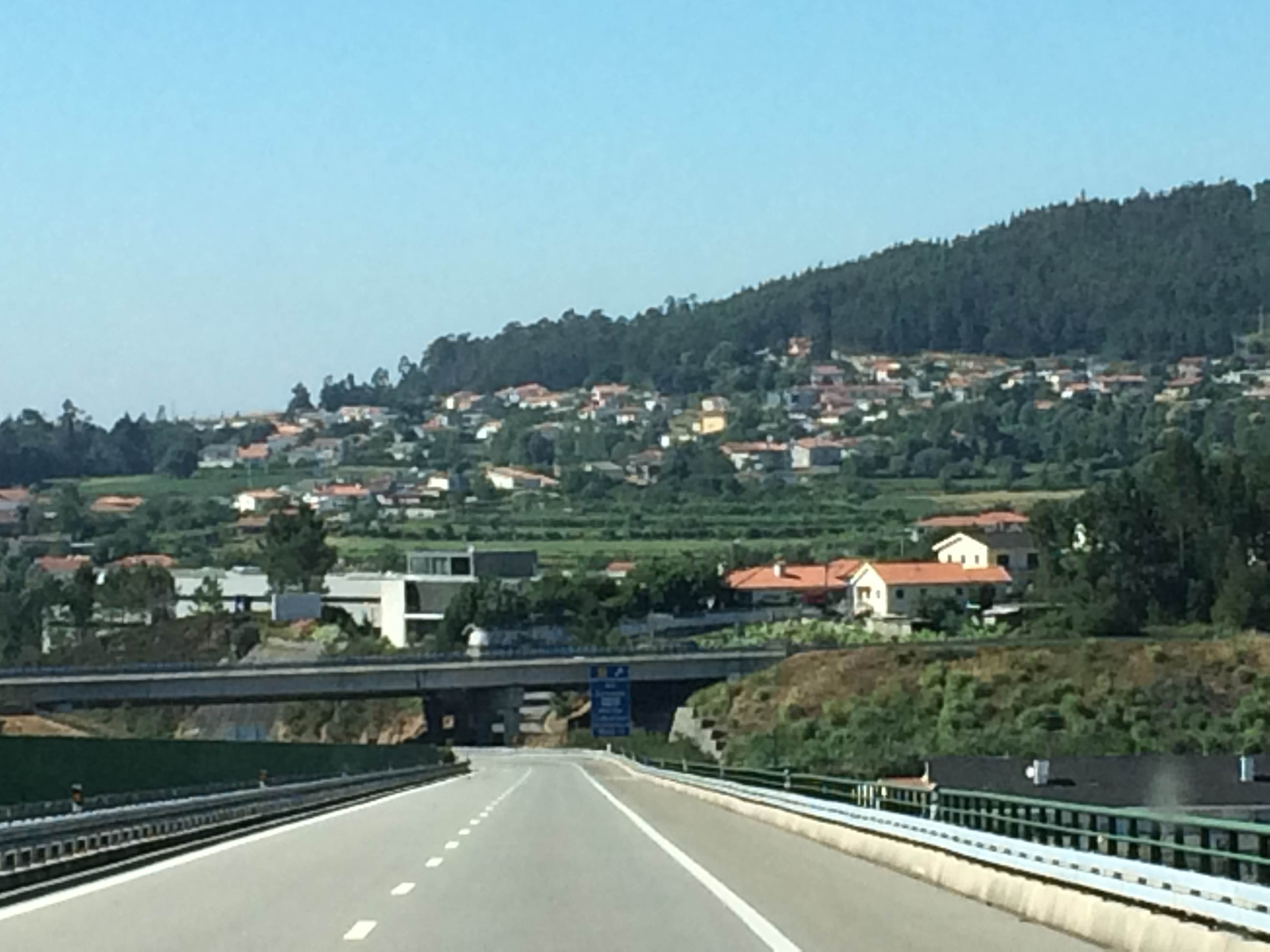
The road past Braga.

The road past Braga.

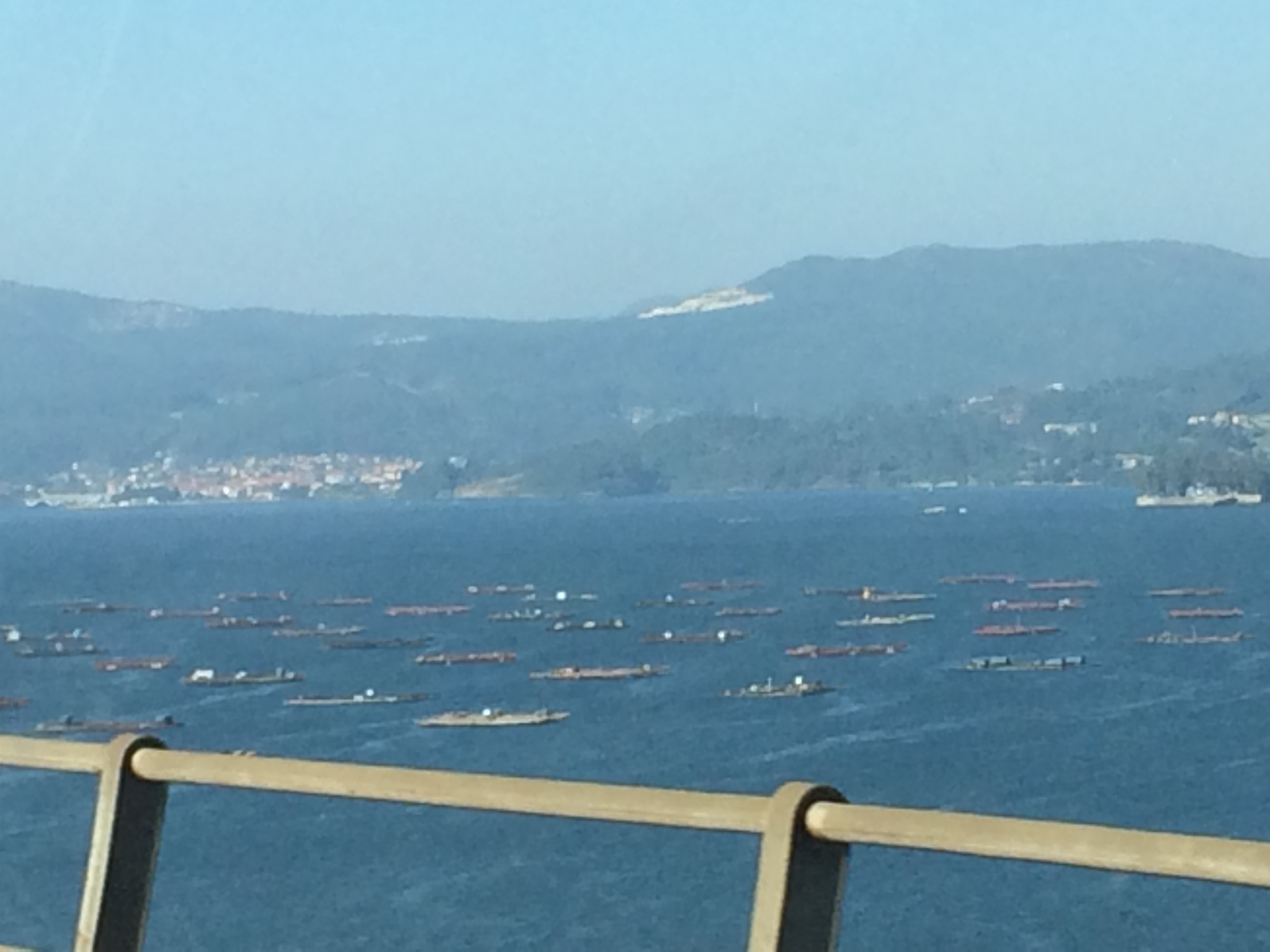
Going over the Ria de Pontevedre estuary.

Going over the Ria de Pontevedre estuary.

Evencio, the friendly jocular owner of the Camping Suavila campsite in Sanxenxo.

Evencio, the friendly jocular owner of the Camping Suavila campsite in Sanxenxo.

Camping Suavila (“your home”) is two thirds full of Spanish families in semi-permanent encampments of varying sizes and degrees of sophistication and it feels very homely and as if we’ve been allowed into an established little community as temporary guests.  “But don’t they have to go to work?” we ask Evencio.  “The fathers go to work Mon-Fridays then join their families on the coast at the weekend the whole summer”.  Hence the endless line of traffic going back into town as we were making our way there.  What a nice way to live – all you need is a nice beaches and a good climate.  Talking of which we went down to investigate the sea and it looks so appealing, with soft white sand and clear calm water (though chilly) we instantly decide to go in for a satisfying swim.

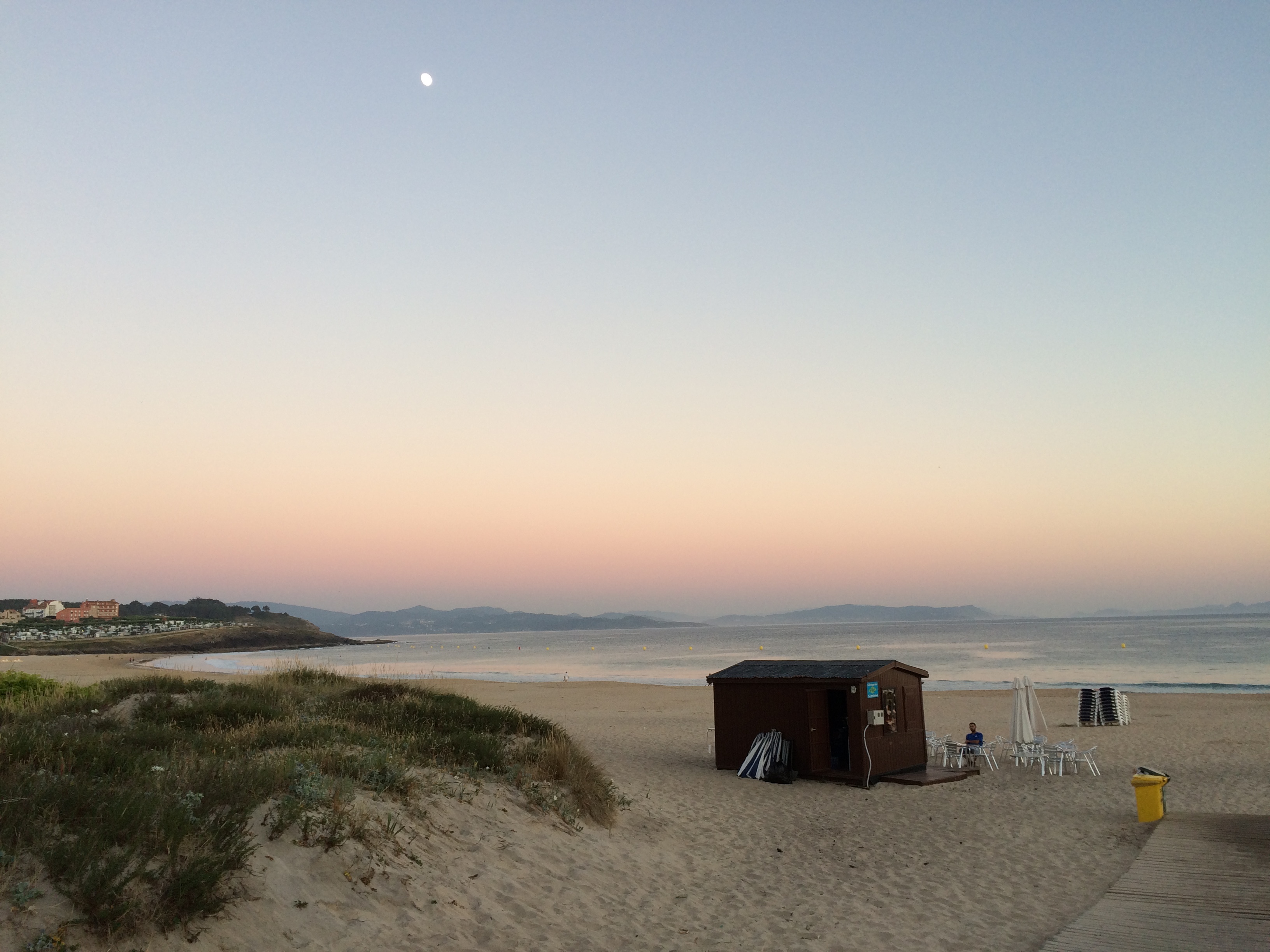
The beach at Sanxenxo at sunset.

The beach at Sanxenxo at sunset.

Evencio invites us to try out some white wine made by the family.  His niece who serves us says when I ask how his name is spelt that he’s the only Evencio she’s ever come across and his brother was called Belarmino, which again was a very rare name, as was that of their mother who named them.  Evencio has trouble talking audibly as he’s has some vocal chords cut in an operation (which must be a severe disadvantage in Spain where people tend to talk let’s say quite emphatically!).  But it doesn’t stop him communicating and joking – he’s full of joie de vivre.  And why wouldn’t he be?  It’s a nice little business, a lovely spot, and there doesn’t seem to be much economic hardship in this tranquil part of the country.

In characteristic style by now, we arrived in Santiago de Compostella at around midday. Our arrival  coincided with the arrival of a heat wave so in temperatures of 38 and rising we started the climb which would lead to the Cathedral of Santiago de Compostel and visit the final destination of Camino pilgrims.   Had we been earlier we could have joined the pilgrims on their way to the midday pilgrims mass. Pilgrims received the compostela,a certificate of accomplishment for having completed the Way (walking a minimum of 100 km or cycle at least 200 km) on arrival at Santiago de Compostele after producing their pilgrims passport with the required stamps.

The Compostela is an indulgence which reads, in Latin: ‘The CHAPTER of this holy apostolic and metropolitan Church of Compostela, guardian of the seal of the Altar of the blessed Apostle James, in order that it may provide authentic certificates of visitation to all the faithful and to pilgrims from all over the earth who come with devout affection or for the sake of a vow to the shrine of our Apostle St. James, the patron and protector of Spain, hereby makes known to each and all who shall inspect this present document that [Name] has visited this most sacred temple for the sake of pious devotion. As a faithful witness of these things I confer upon him [or her] the present document, authenticated by the seal of the same Holy Church.

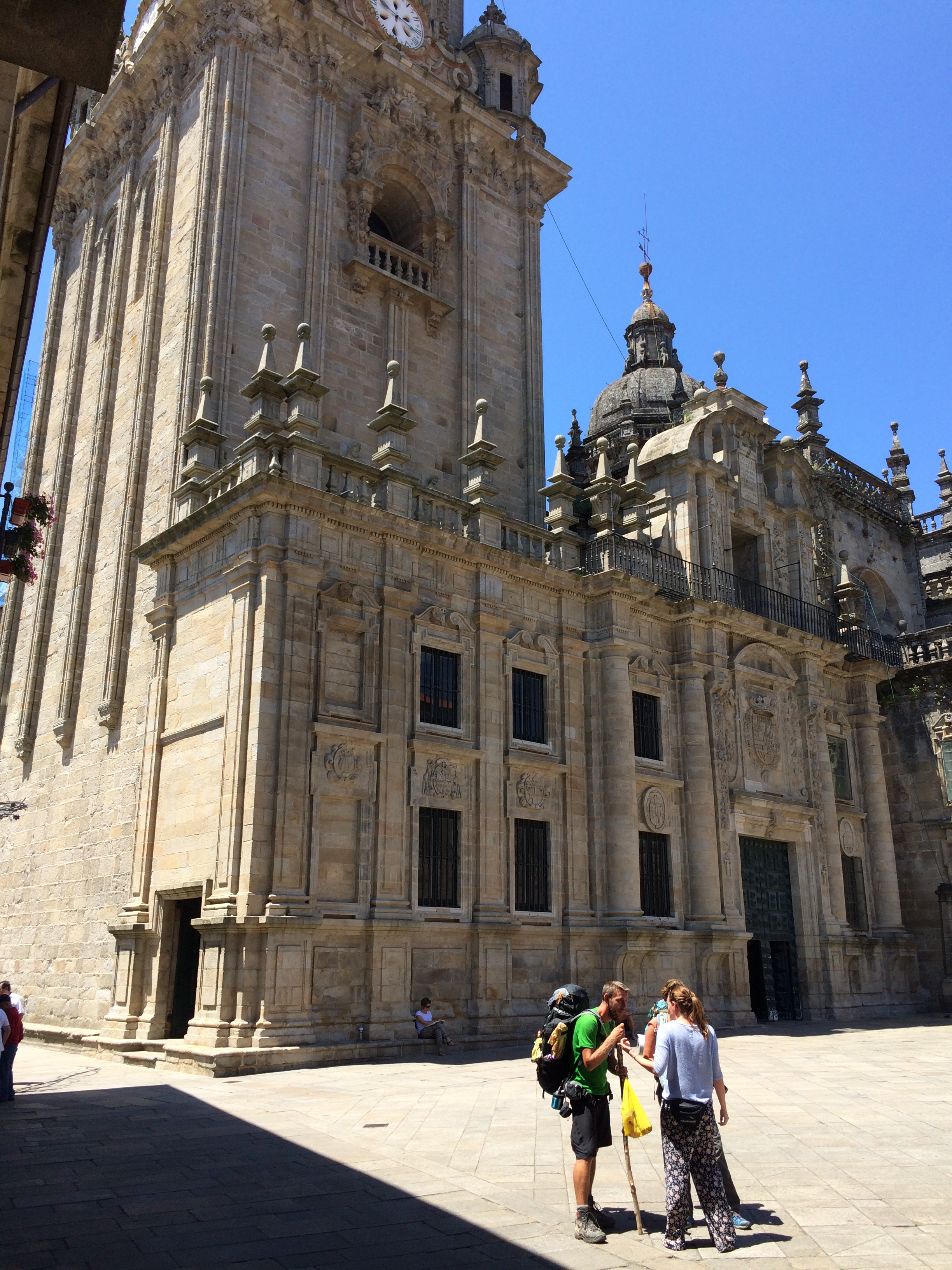
The Cathedral has been adapted and added to over the centuries following the discovery of the tomb of St James in 814 and is now a magnificent ‘Romanesque structure visited by hundreds and thousands of pilgrims each year. Although we missed the pilgrims Mass we were able to climb via a narrow passage behind the altar to reach the statue of Saint James, rises above the main altar, to witness pilgrims kissing the saint’s mantle

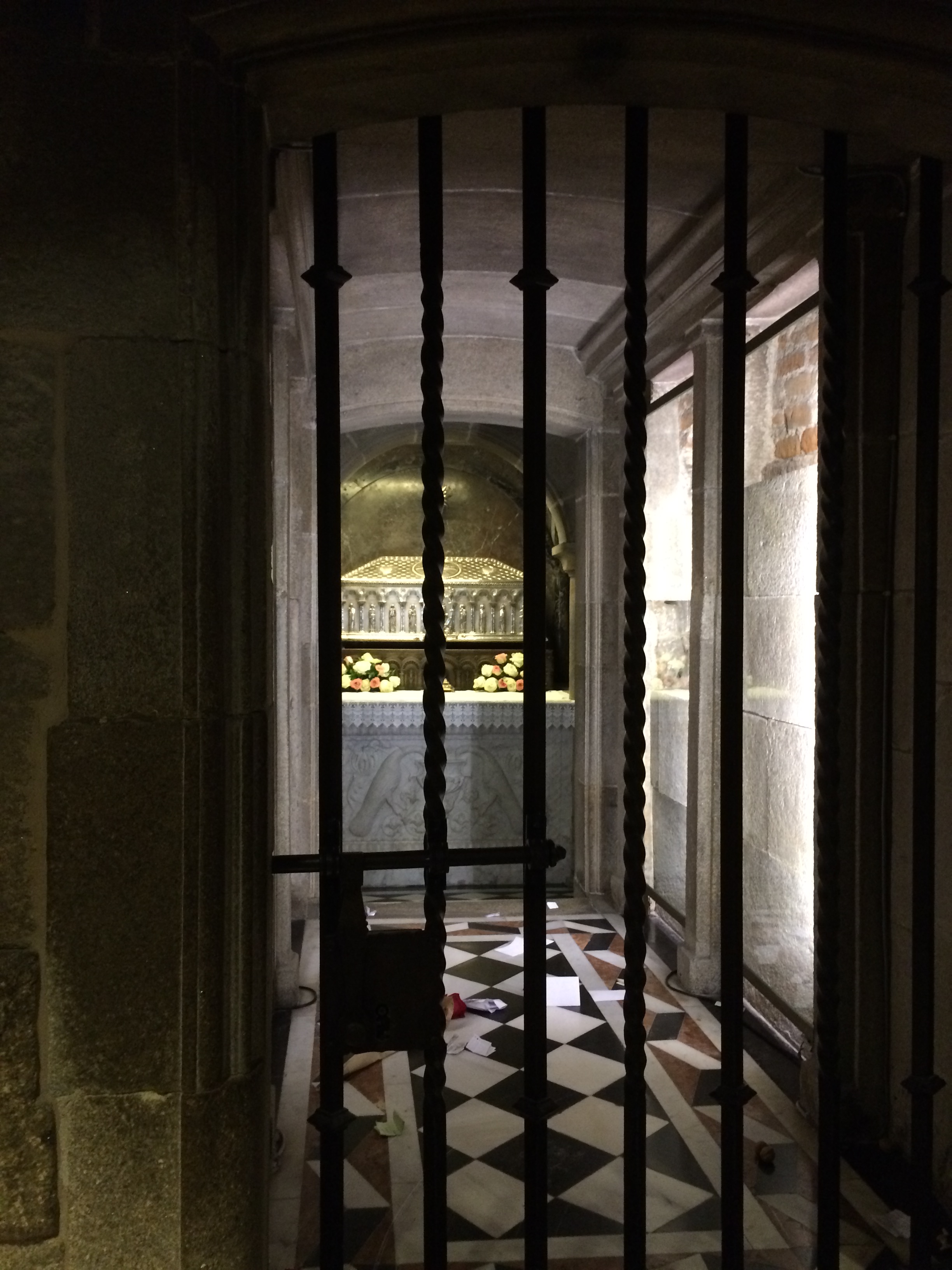
In the crypt, below the main altar houses the relics of Saint James and two of his disciples, Saint Theodorus and Saint Athanasius. This is the final destination of the pilgrimage where pilgrims stand or kneel in silent prayer.

Outside the cathedral, the medieval quarter of the city is home to Santiago de Compostela University, housed in various beautiful buildings throughout the quarter, some of which you could visit. Behind the cathedral was the Paradors Hotel, built originally as a hospital for pilgrims by Queen Isabella and King Ferdinand of Spain, the architects of the Inquisition.   The surrounding streets were bustling with bars, cafes and shops selling Compostela regalia – staffs, shells and crosses in abundance. People were seen wearing tee-shirts proclaiming that they had ‘Done the Camino 2015’. The visible commercialisation did detract somewhat from the meaning and intention of the Camino de Santiago de Compostela.

Pilgrims outside Santiago's Cathedral where the relics of St James are held.

Pilgrims outside Santiago’s Cathedral where the relics of St James are held.

The ornate altar of Santiago's Cathedral behind which lies a statue of St James that pilgrims ritually touch or hug at the end of their long pilgrimage.

The ornate altar of Santiago’s Cathedral behind which lies a statue of St James that pilgrims ritually touch or hug at the end of their long pilgrimage.

The sepulcher holding the remains of St James.

The sepulcher holding the remains of St James.

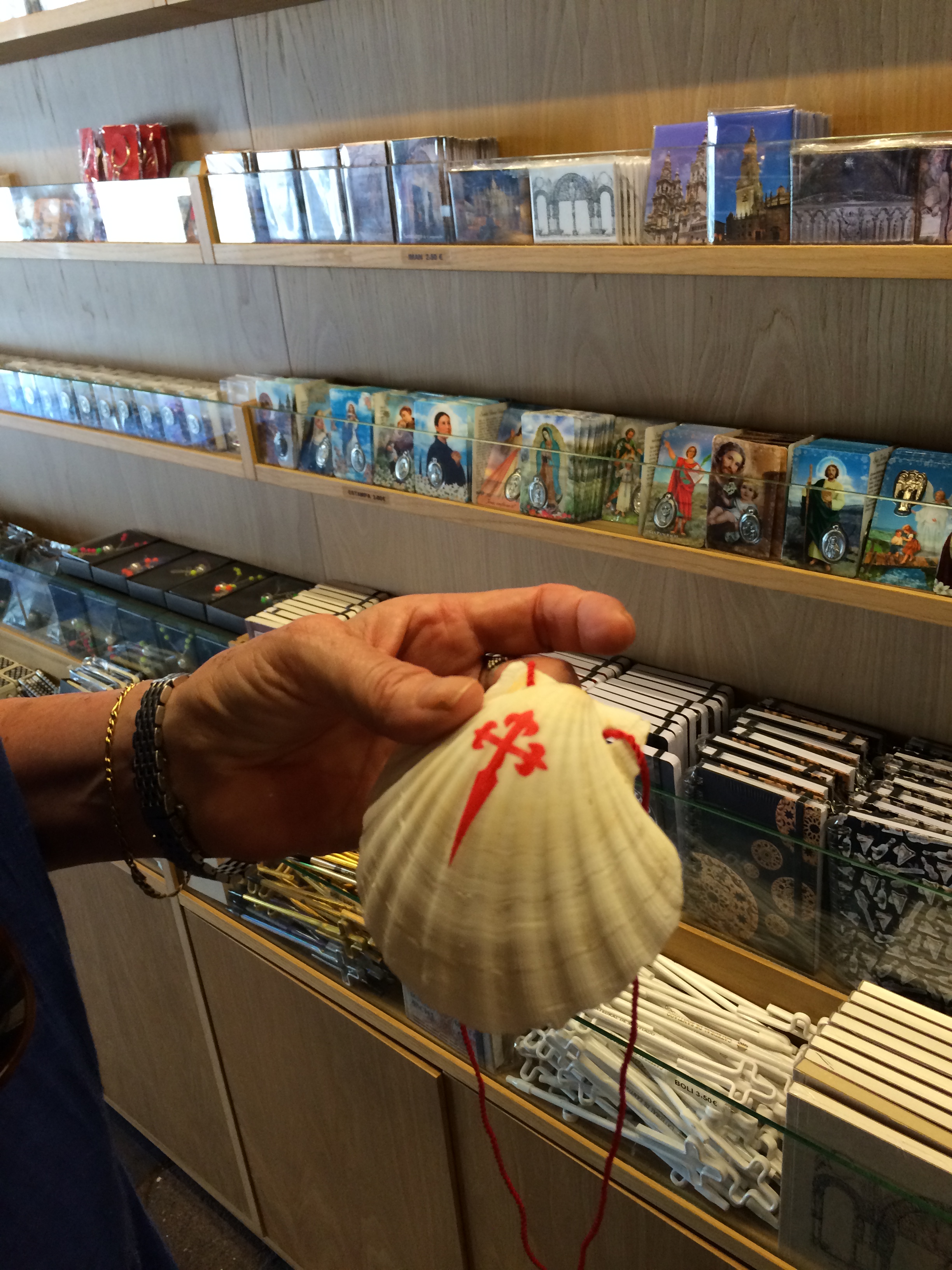
The St James shell pilgrims are traditionally given when they complete the pilgrimage.

The St James shell pilgrims are traditionally given when they complete the pilgrimage.

The symbol of the shell engraved everywhere.

The symbol of the shell engraved everywhere.

Young pilgrims refreshing themselves in the fountain outside the Cathedral.

Young pilgrims refreshing themselves in the fountain outside the Cathedral.

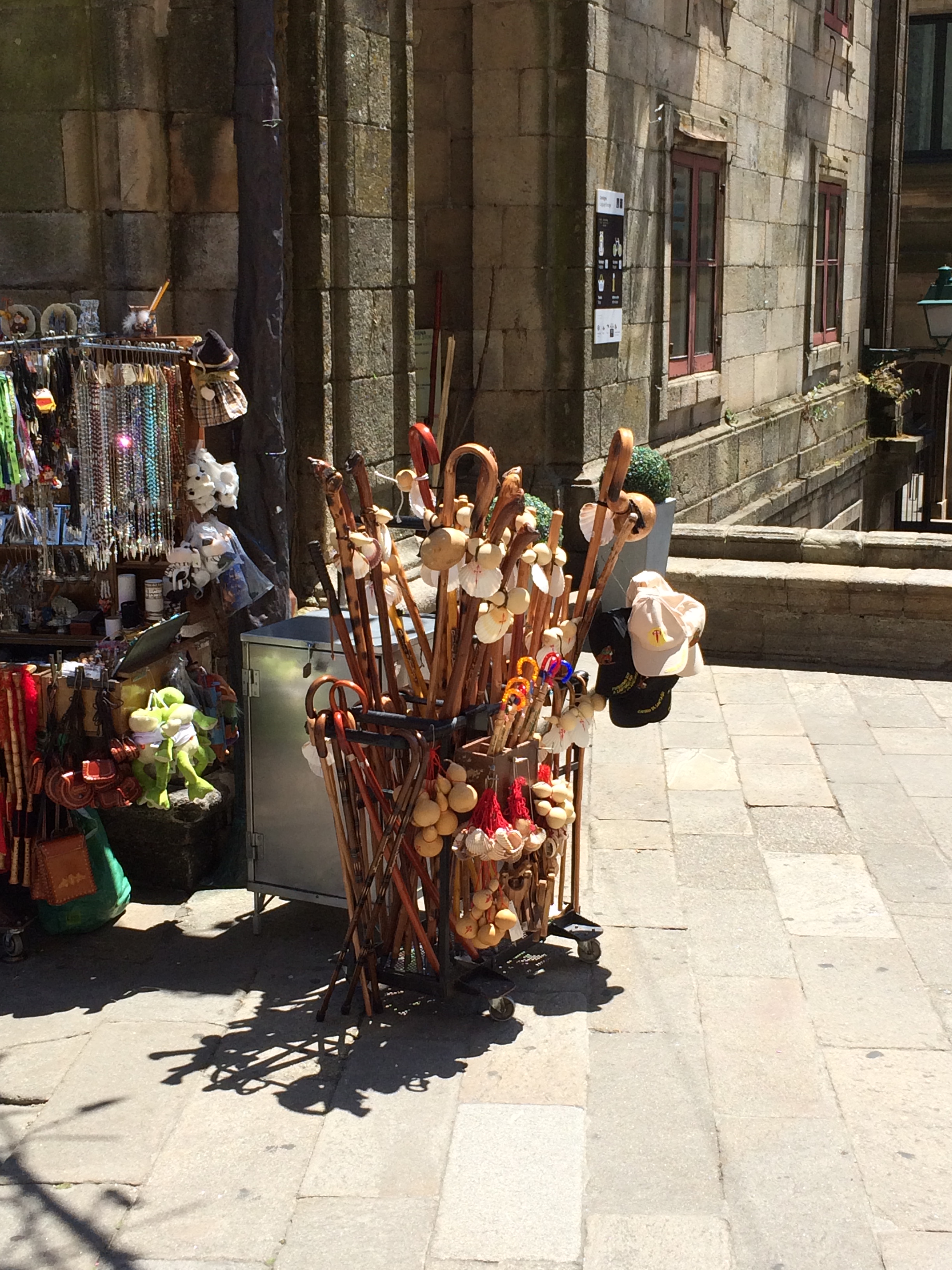
All manner of walking sticks are used by pilgrims.  Seem odd having them on sale at the end point - these are presumably just souvenirs.

All manner of walking sticks are used by pilgrims. Seems odd having them on sale at the end point – these are presumably just souvenirs.

Some do the camino on a bike.

Some do the camino on a bike.

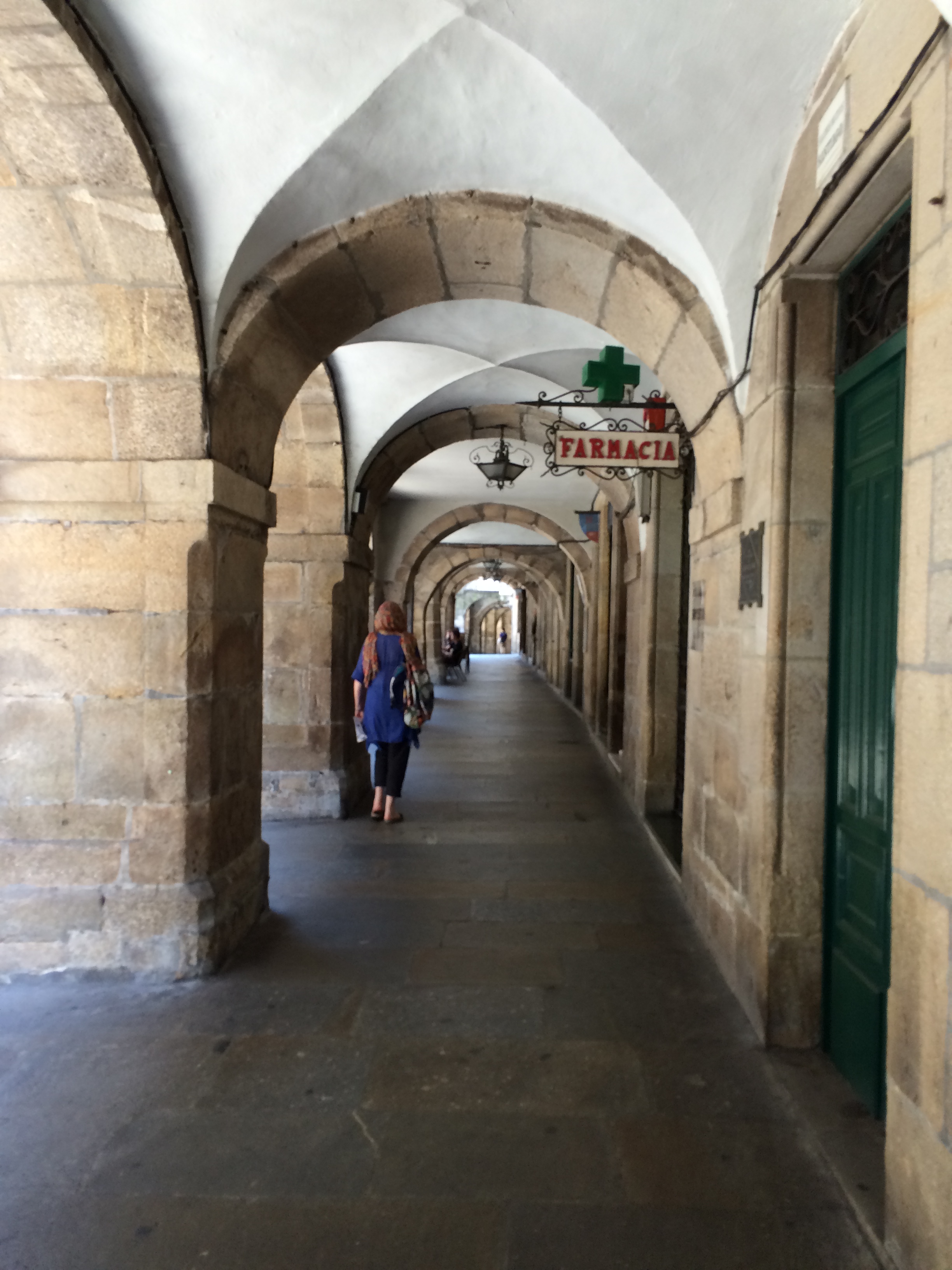
Strolling through the covered archways in Santiago's old town.

Strolling through the covered archways in Santiago’s old town.

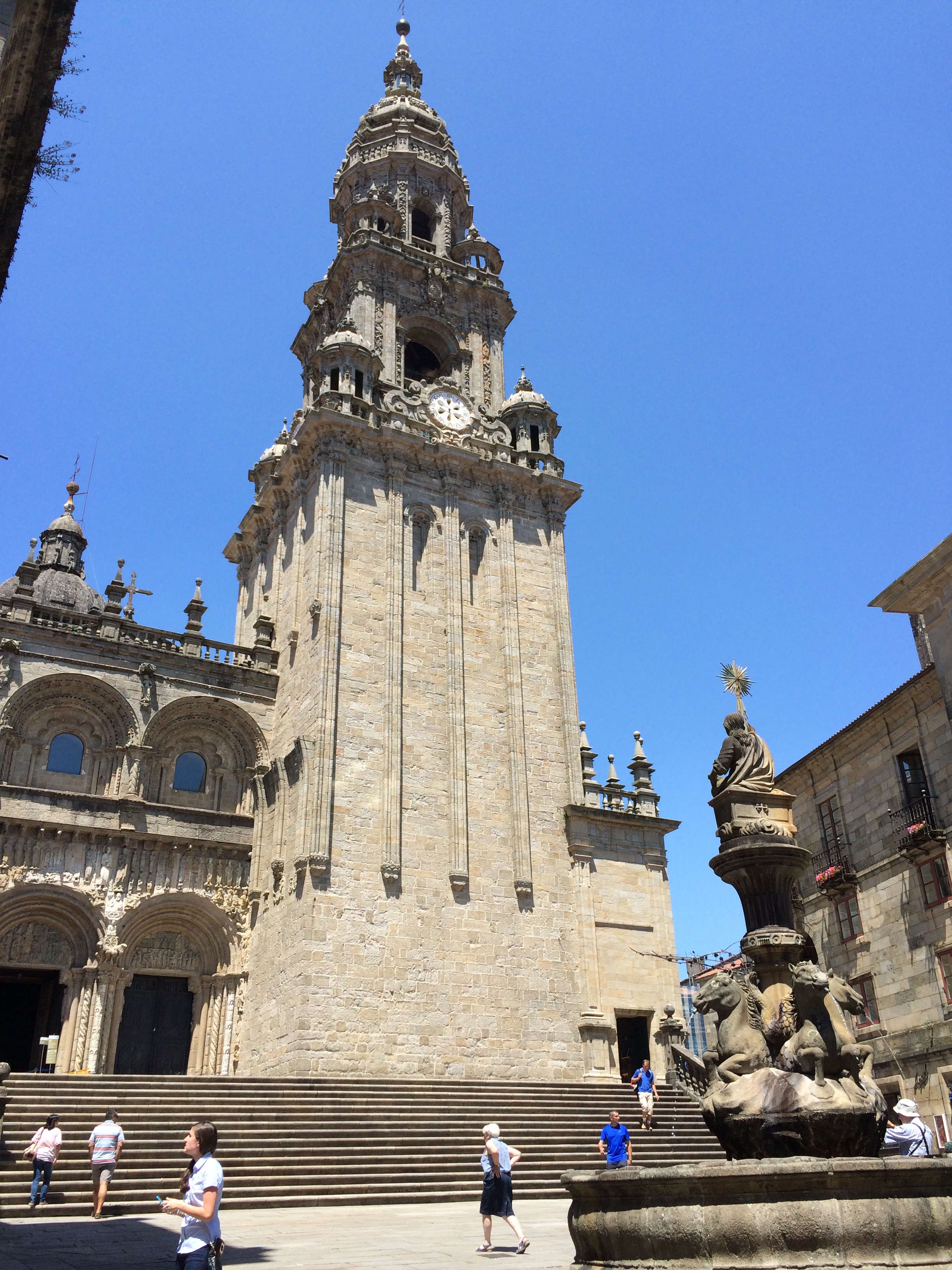
The Cathedral seen from the Praza do Obradoiro, undergoing some upkeep.

The Cathedral seen from the Praza do Obradoiro, undergoing some upkeep.

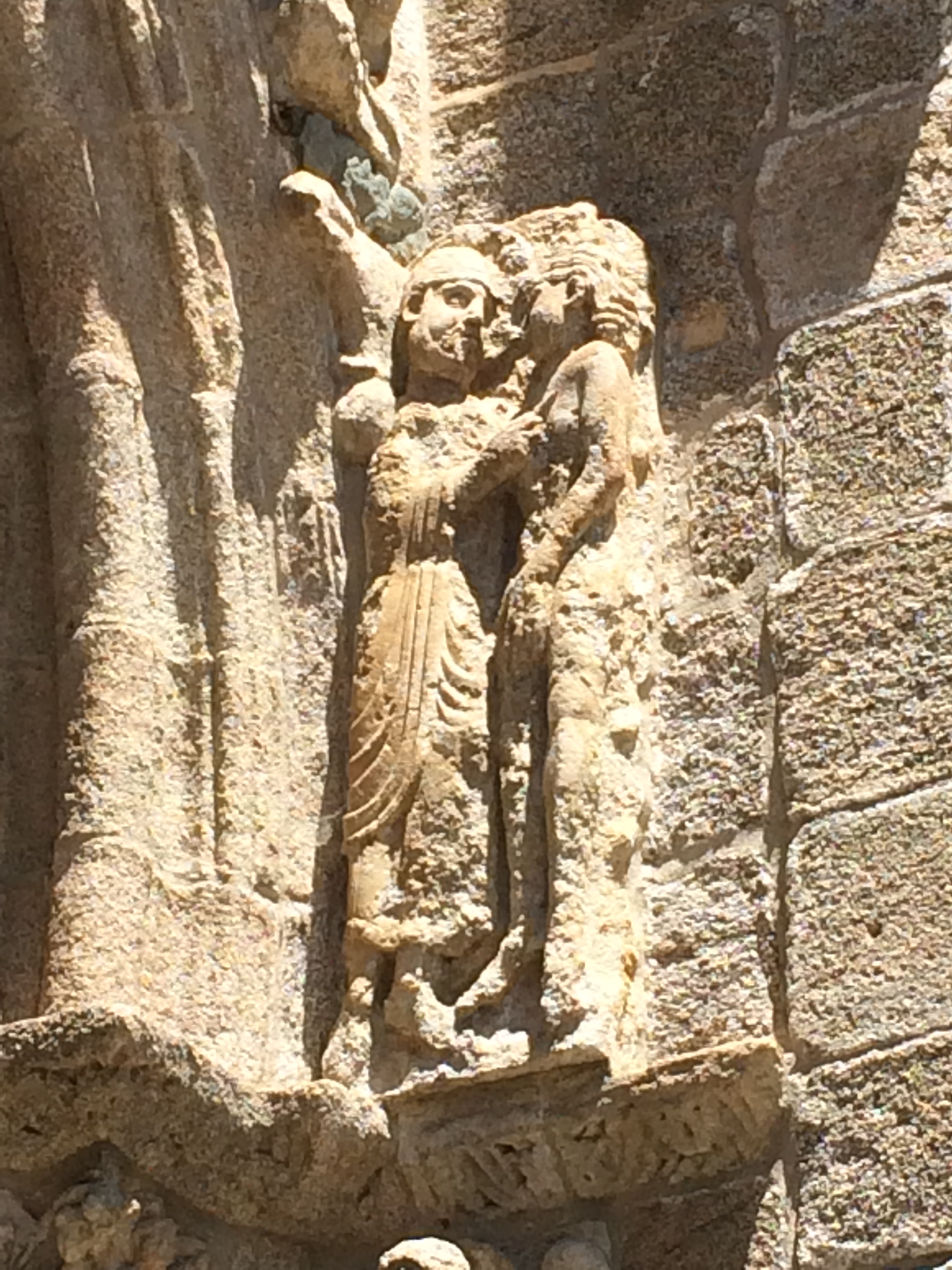
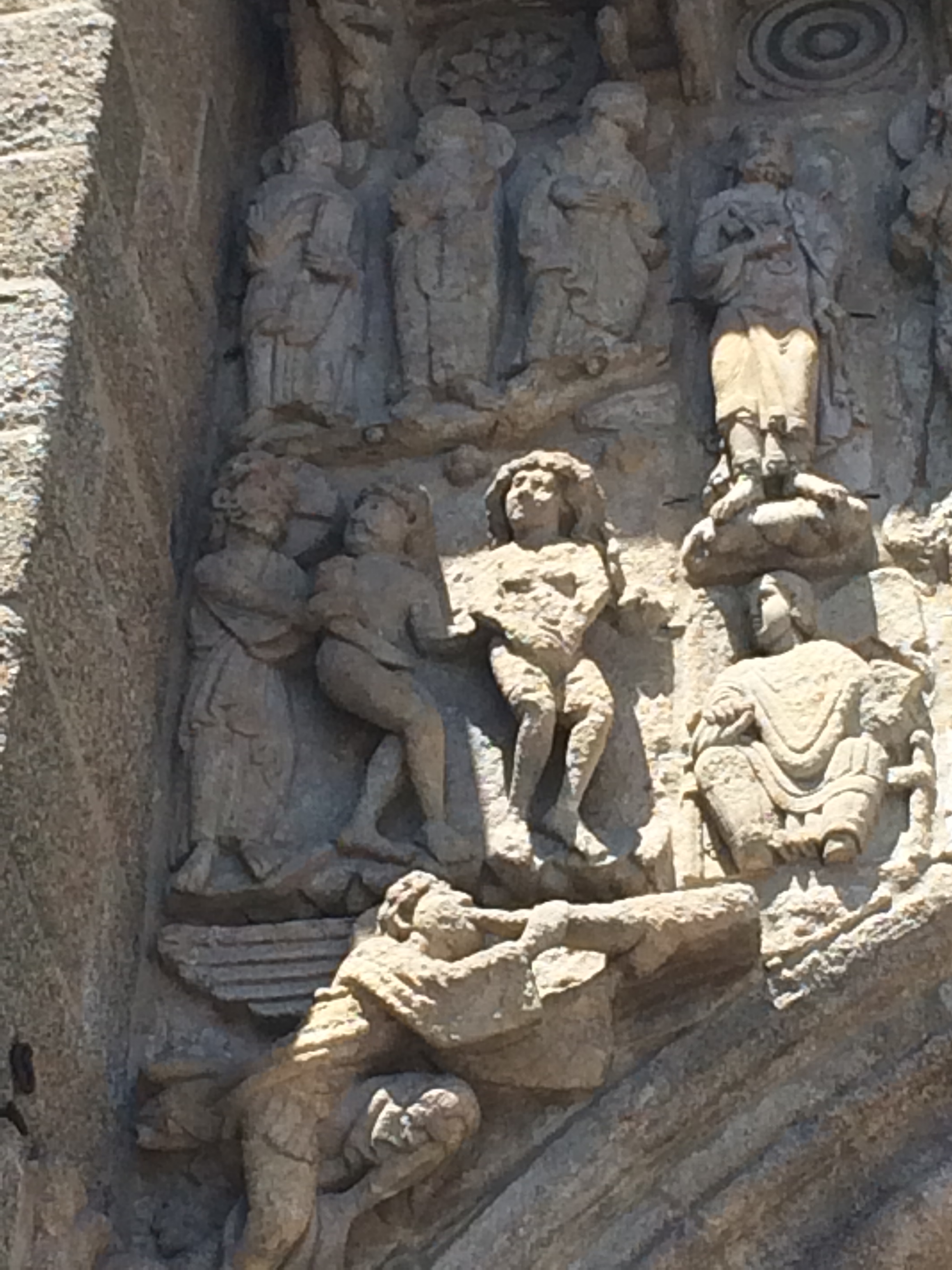
Unusual depictions on the outside of the Cathedral.

Unusual depictions on the outside of the Cathedral.

Not sure what they signify.

Not sure what they signify.

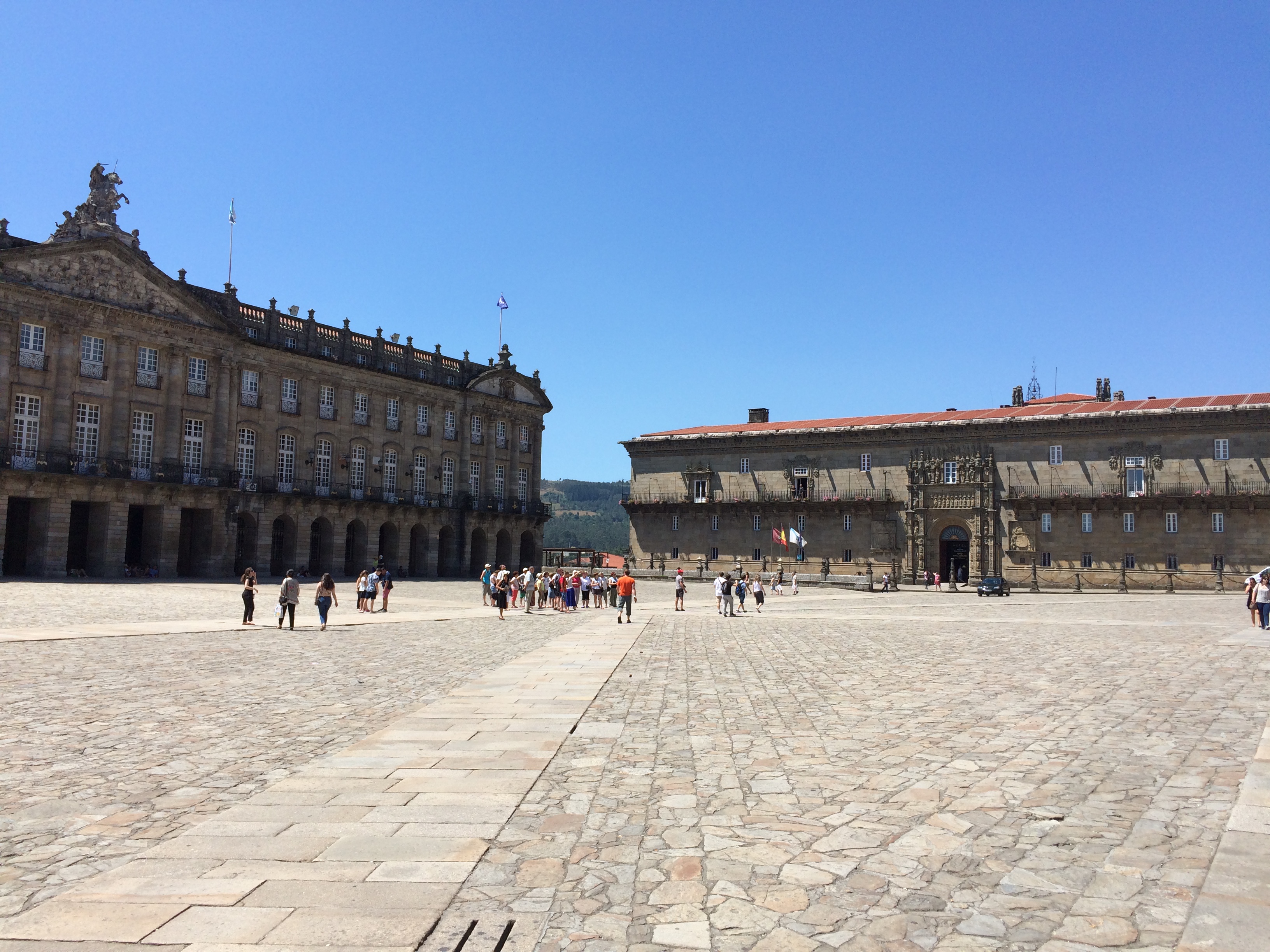
The Praza do Obradoiro showing the Hostal dos Reis Catolicos in the background.

The Praza do Obradoiro showing the Hostal dos Reis Catolicos in the background.

The Hostal dos Reis Catolicos, commissioned by Queen Isabella and King Ferdinand as a hospital for the Pilgrims.

The Hostal dos Reis Catolicos, commissioned by Queen Isabella and King Ferdinand as a hospital for the Pilgrims.

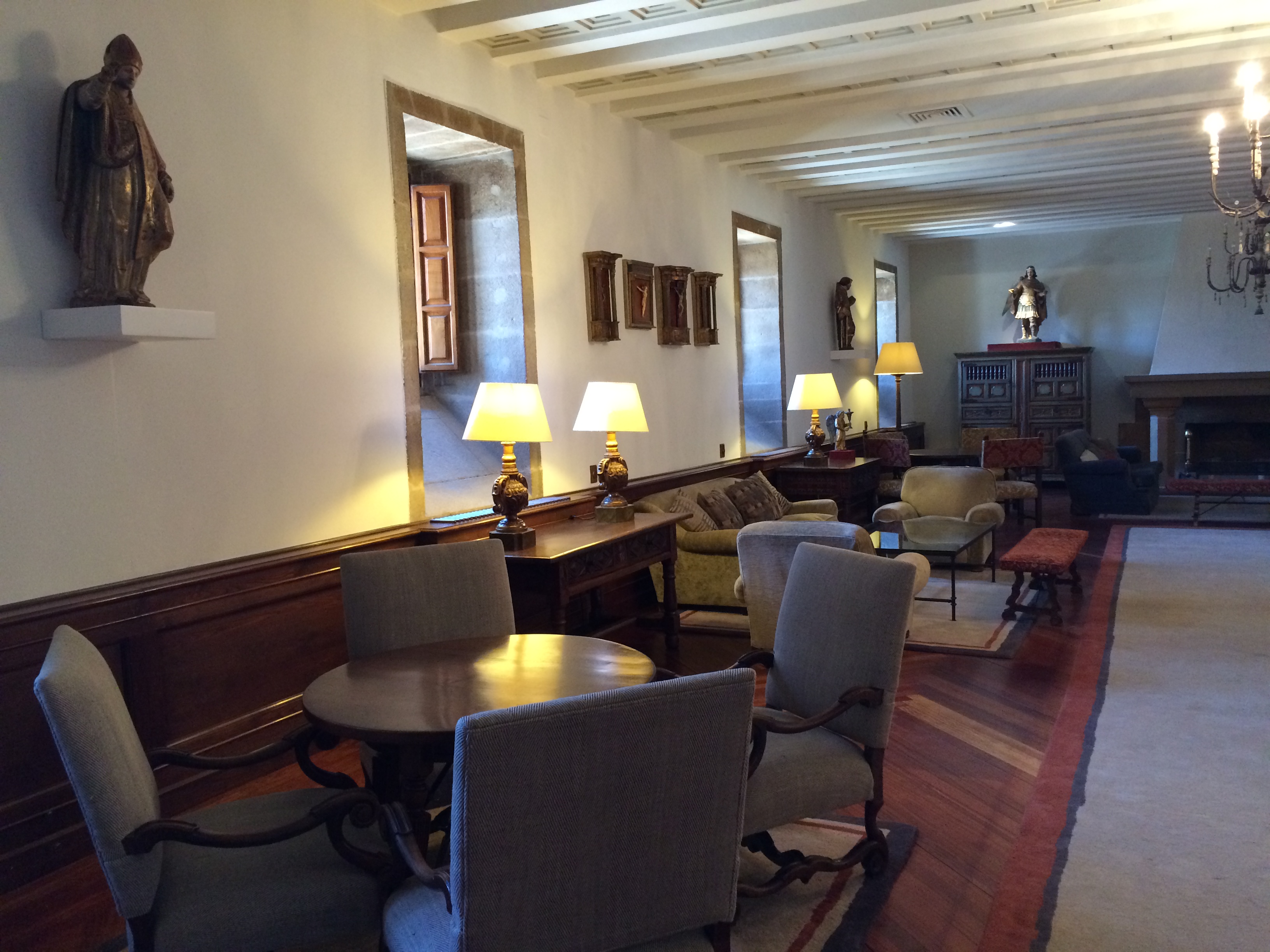
The plush interior of the Hostal dos Reis Catolicos, now a luxury hotel, commissioned the year Ferdinand and Isabella started the Inquisition.

The plush interior of the Hostal dos Reis Catolicos (now the luxury Paradors Hotel) commissioned the year Ferdinand and Isabella started the Inquisition.

An old wooden engraving in the Hostal dos Reis Catolicos depicting the Good Samaritan.

An old wooden engraving in the Hostal dos Reis Catolicos depicting the Good Samaritan.

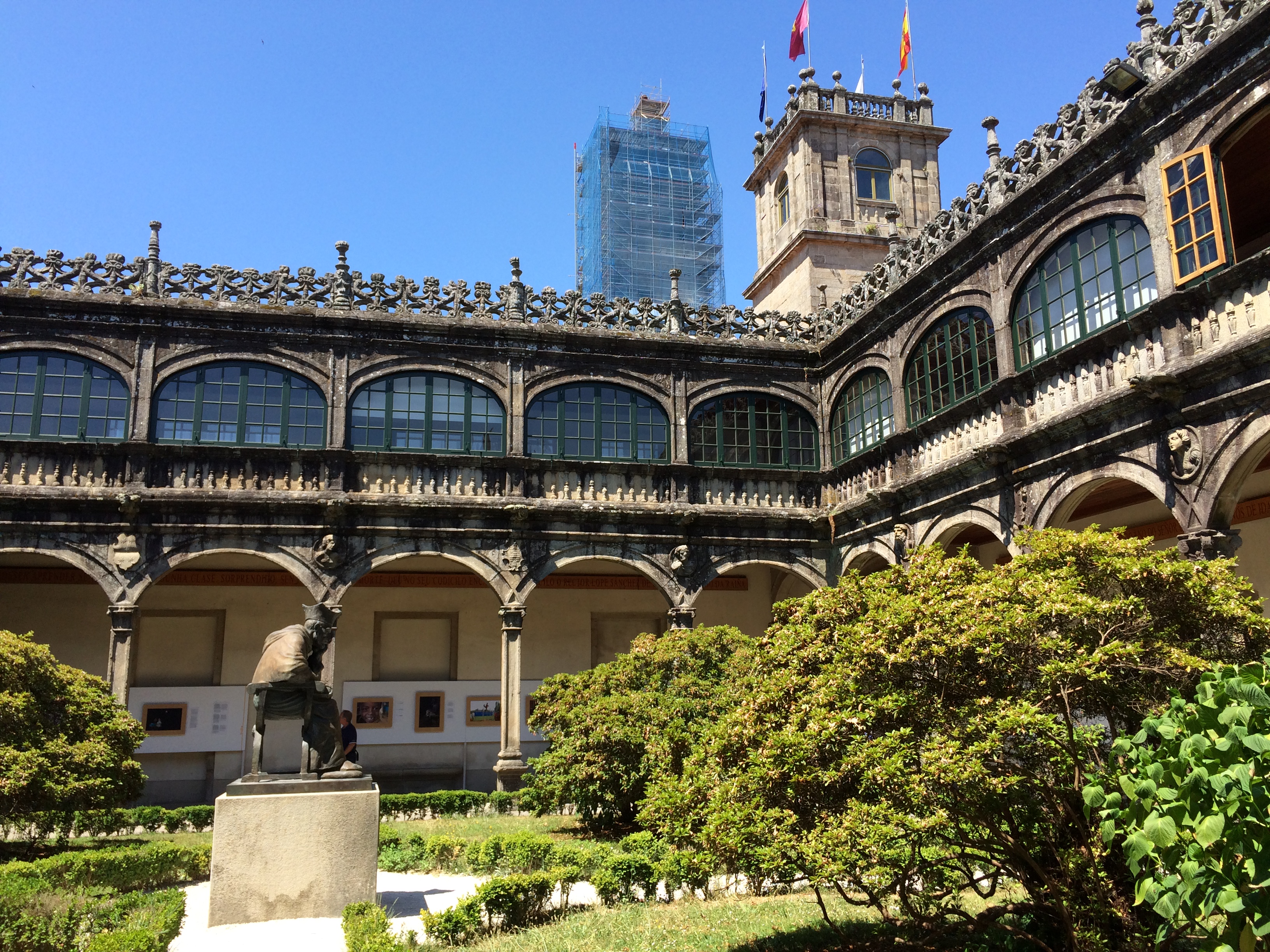
The old university library in Santiago.  Unfortunately we weren't allowed a look inside.

The old university library in Santiago. Unfortunately we weren’t allowed a look inside.

IMG_3370


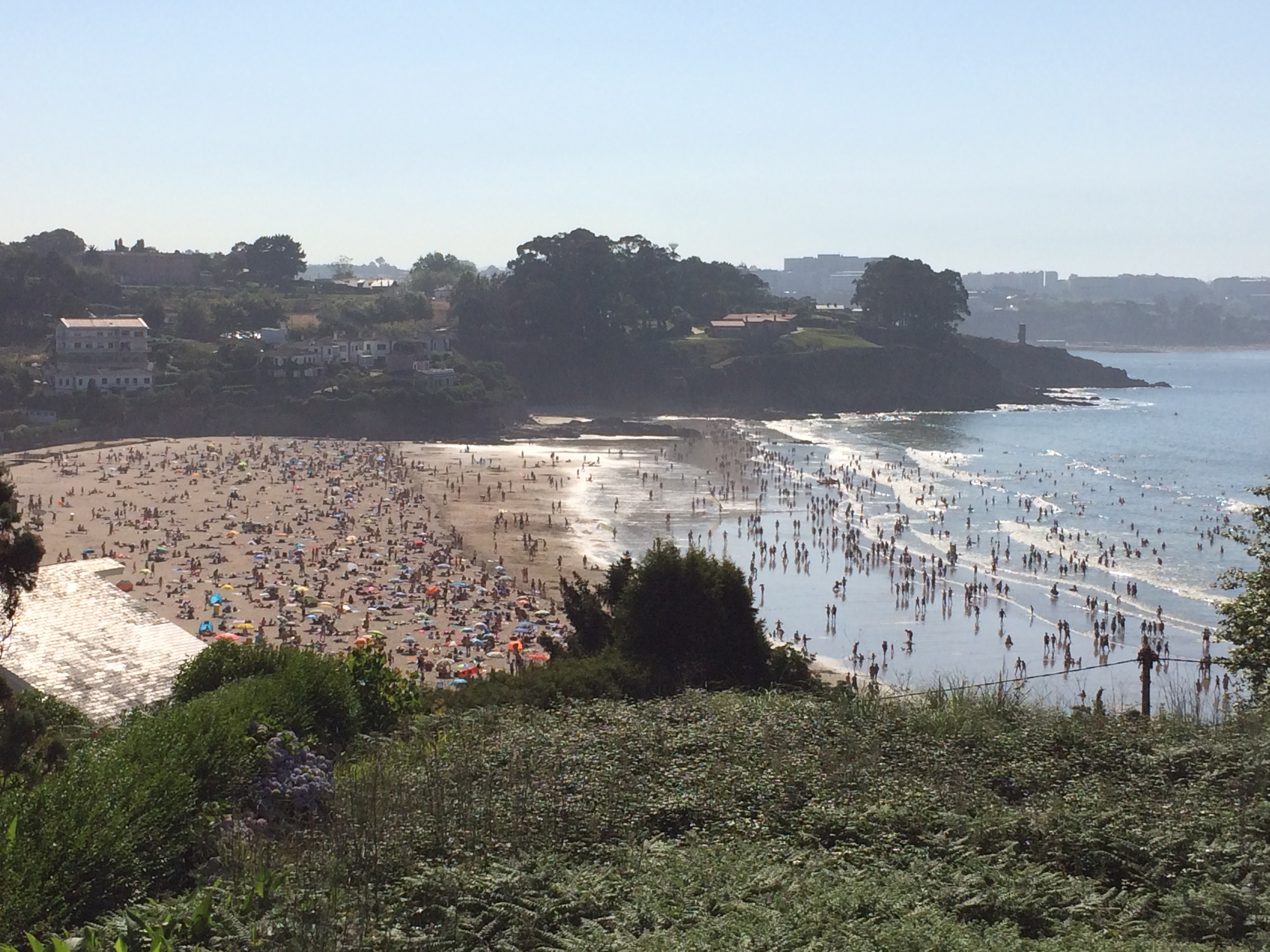
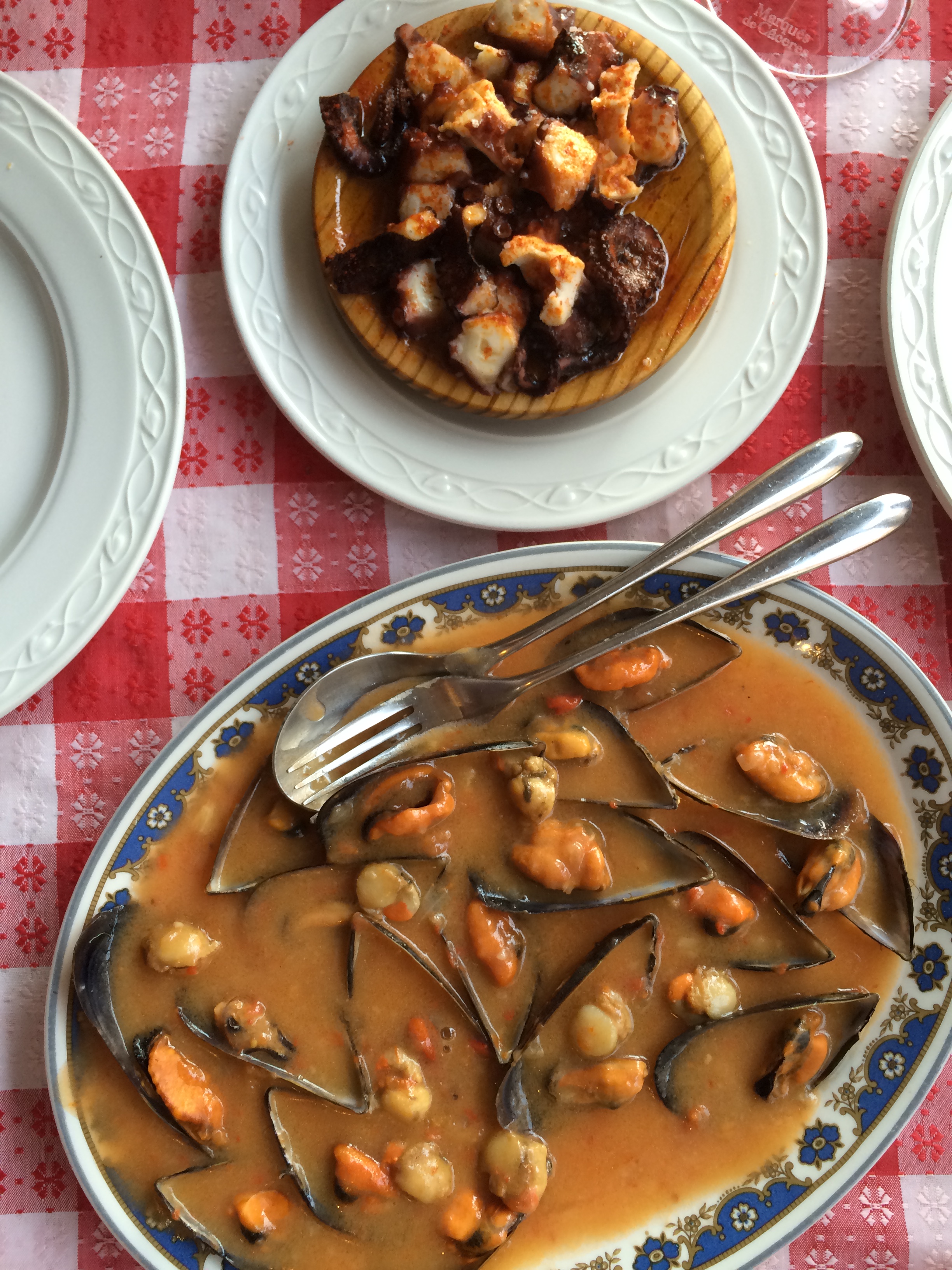
Next stop was La Coruna (or A Coruna in Galician) lying on the north west corner of Spain.  We found a campsite in Santa Cruz on the other side of the wide bay on a hilltop overlooking a seemingly very popular beach.  Though large, it was teeming with people who looked like ants from the hilltop, both in and out of the water.  A swim seemed de rigueur but once in the water, it was more wading through a thick broth of seaweed and wasn’t pleasant in the least. So it was back at the campsite and a 2 km walk to Santa Cruz village for a taste of the local cuisine. There were several busy seafront bars and restaurants but we avoided these and found in a side street the Meson Pulpeira which was empty but where the chef/owner greeted us warmly and talked us convincingly through the menu and the Galician and Asturian specialities.  It was worth every penny.  We ordered some Mejillonada de Zamburinas as la Cavalcanti (Mussels and Coquille St Jacques in a very tasty sauce) and grilled Pulpo (octopus) with garlic for starters and a Rape a la Plancha (grilled local fish) and Cordero Asado (roast mutton) as a main.  All washed down with a local regional white made with the Godello grape which was very much like a good Sauvignon.

We asked why they didn’t put some tables outside to attract more people like other restaurants were doing.  Because their food needs to be served straight away and they couldn’t do this if they had tables outside as well as in without employing more staff, and that was too complicated.  They preferred to serve to fewer regular discerning customers than to a large number of visitors. In any case, it was only 8.30pm and still quite early for Spanish diners – the place would start filling up later.  Sure enough a large group of 12 regulars arrived shortly before we left.

The excellent Meson Pulpeira restaurant in Santa Cruz.

The excellent Meson Pulpeira restaurant in Santa Cruz.

The campsite at Santa Cruz overlooking the popular beach at 6pm.

The campsite at Santa Cruz overlooking the popular beach at 6pm.


A mouthful of pulpo, a speciality of the region.

A mouthful of pulpo, a speciality of the region.

Grilled pulpo and mejillonada de zamburinas a la cavalcanti.

Grilled pulpo and mejillonada de zamburinas a la cavalcanti.


Walking back from Santa Cruz fishing village.

Walking back from Santa Cruz fishing village.

Saturday 27th and Sunday 28th June – the faded but authentic charm of Porto

Standard

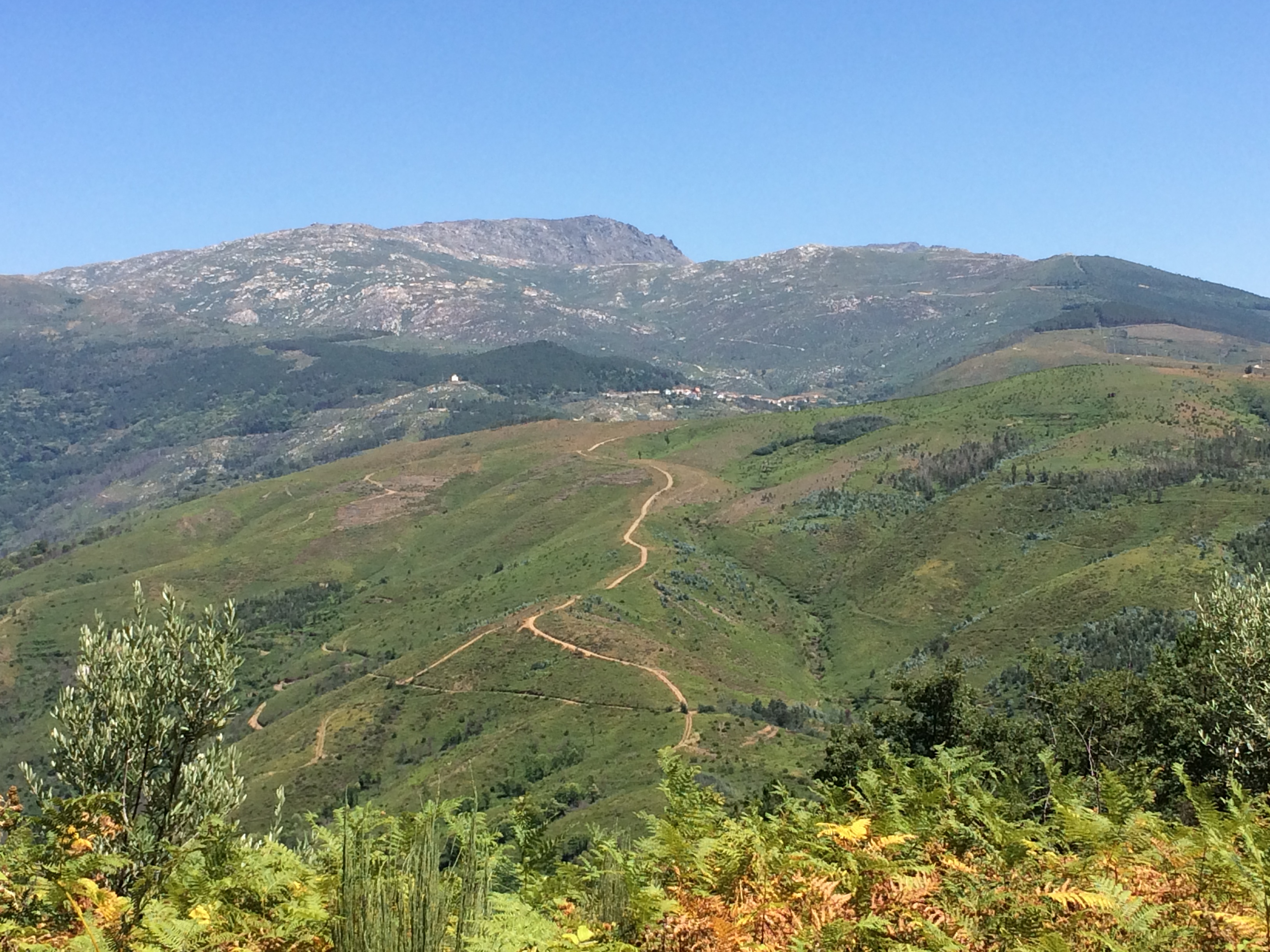
No sooner have we left Ponte das Tres Entraps than we find ourselves climbing very steeply up a never-ending incline.  It feels as if we’ve never been this high before and driving along hairpin bends here is not for the faint-hearted.  At Seia we have to stop and take a photo as we seem to be above other mountain peaks.

Shortly after leaving Ponte das Tres Entradas, we reach a very high point above other peaks.

Shortly after leaving Ponte das Tres Entradas, we reach a very high point above other peaks.

The breath-taking view from Seia.

The breath-taking view from Seia.

We continue travelling cross-country on ‘B’ roads until we reach the main national route just south of Viseu from which we cross the Serra do Caramulo to just north of Aveiro before turning into the coastal road to Porto.

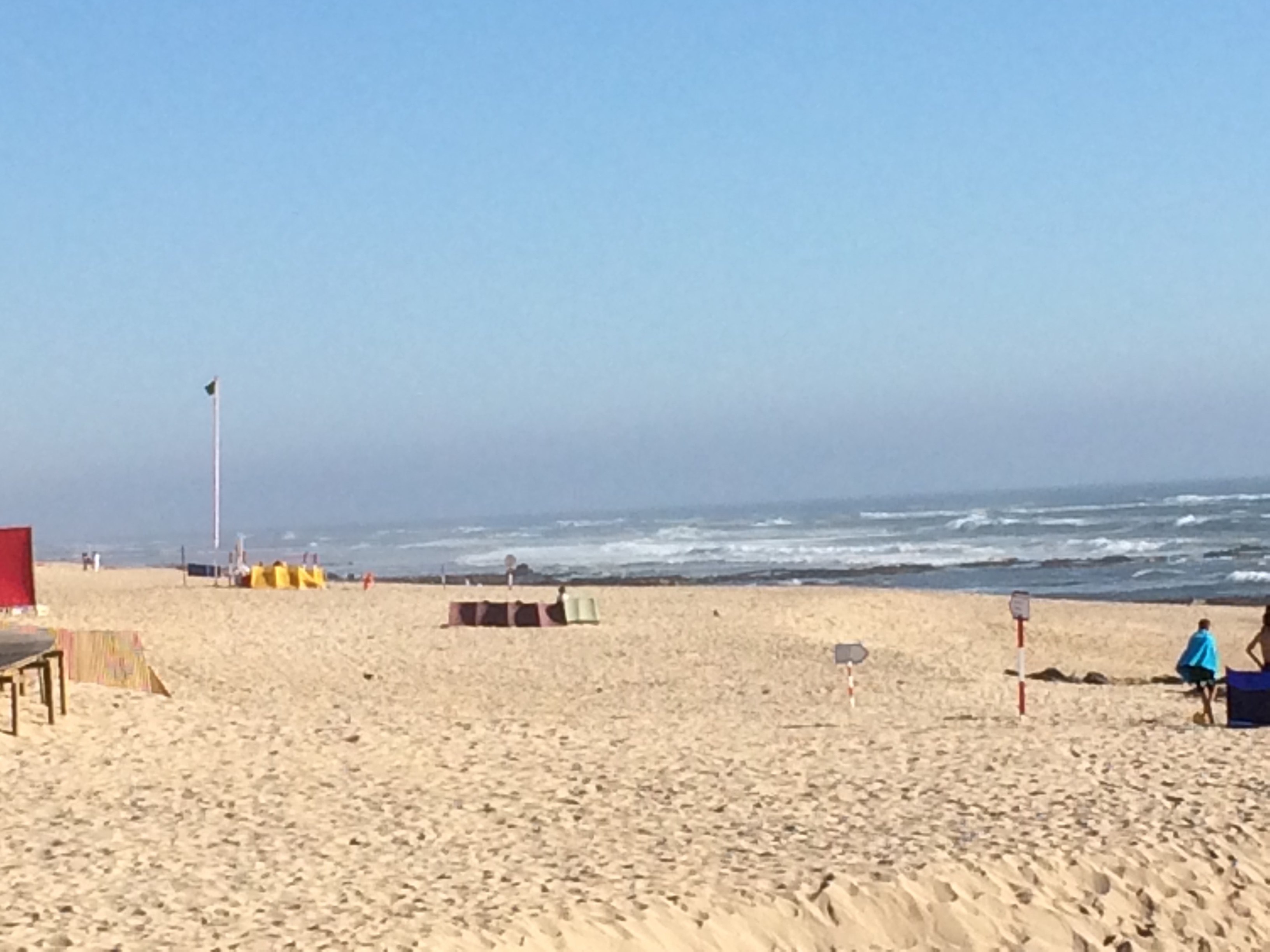
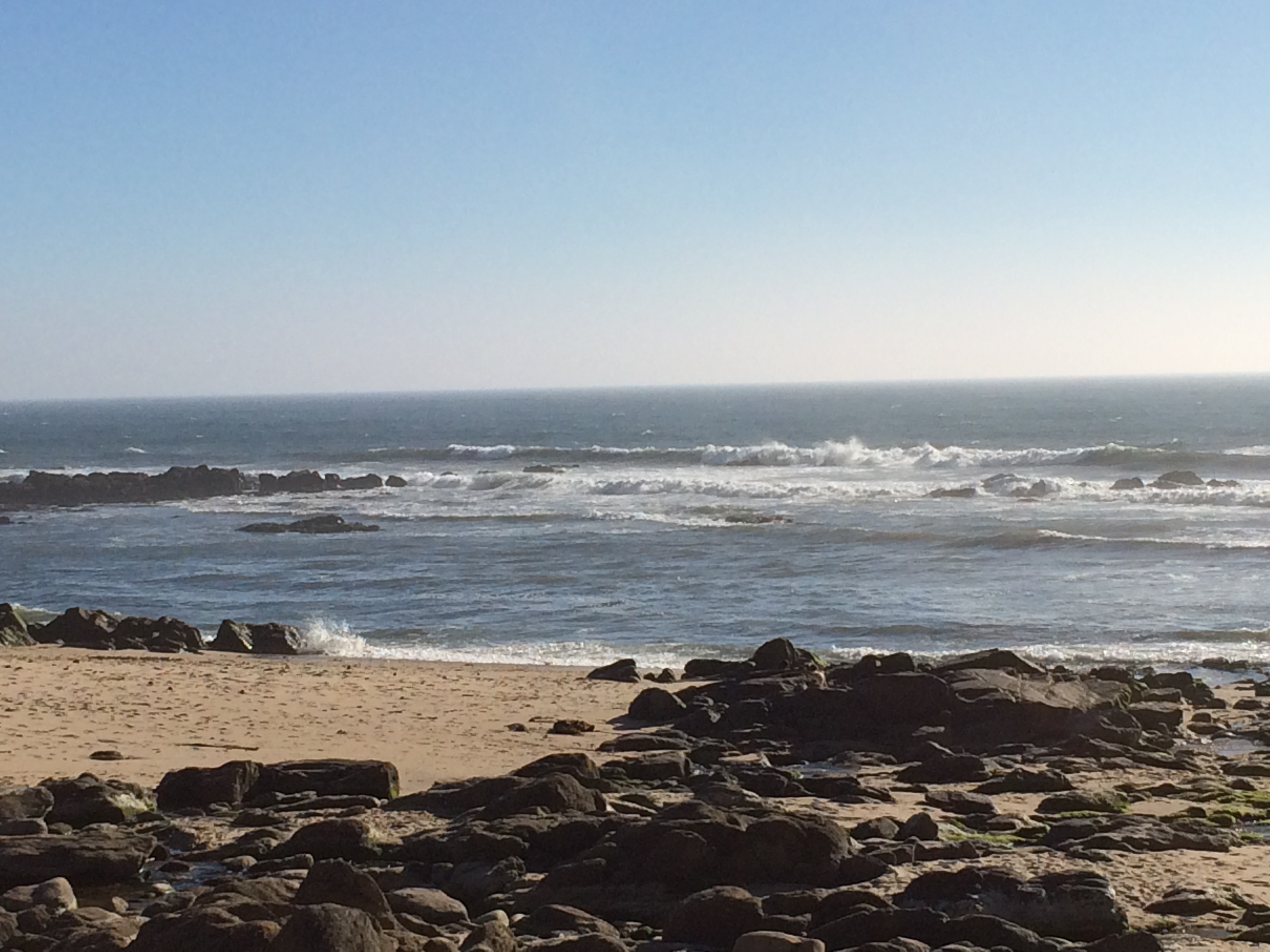
Our campsite turns out to be in a seaside resort in Vila Nova de Gaia just south of Porto. As we arrive in the late afternoon the temperature has dropped sharply from 37 degrees on the route there to 22 degrees, and a strong wind is blowing.  The sea off the seemingly endless sand and rocky beach looks rough and angry and a black flag is fluttering violently. For once, I’m not really tempted – it really is blowy and the sea looks positively suicidal.  As it’s a weekend, crowds of people are making their way back home clutching rolled-up mats, umbrellas and other beach equipment.  They have that determined look people have on a Bank Holiday weekend in Brighton or Littlehampton when the weather’s been a total disappointment but they’re not going to allow that to deny them their seaside fun. But as the manager of the campsite says (his name’s Nunu, another Nunu), this isn’t the Algarve, here in the north you have to be made of hardier stuff. “Is it always like this?” I ask him.  “Half and half” he says, elliptically, “there’s a reason foreigners prefer the south.  The beaches look good but as soon as they dip their toe in the water – ouch!” And that’s on a good day.

The by now deserted beach at Vila Nova de Gaia with the black flag flying.

The by now deserted beach at Vila Nova de Gaia with the black flag flying.

Really not very inviting at all.

Really not very inviting at all.


The campsite is very basic and not terribly inviting either, but it’s just for the night, ready to visit Porto the next day.

A brief background note:

Porto is Portugal’s second city, with a population of c 1.5 mil. It’s located along the Douro River estuary and it’s an important city in the heavily industrialized north of the country with many large companies headquartered there. In 2014, it was elected the ‘best European destination’ by the Best European Destinations Agency. Its historical core has been designated a UNESCO World Heritage Site.

It was an outpost of the Roman Empire.  Portugal’s name is derived from the Latin-Celtic name “Portus-Cale”. It came under Moorish control in 711 but was recaptured by the ruler of Galicia, Leon and the Asturias in 868.

In 1387 it was the site of the marriage between John 1 of Portugal and Philippa of Lancaster, daughter of John of Gaunt, initiating the Treaty of Windsor military alliance which NATO is based on.

In the 14th and 15th centuries, Porto was an important contributor to the ship-building effort that was vital to the success of the naval expeditions. Henry the Navigator sailed from Porto to embark on the conquest of Ceuta in Morocco which paved the way for the exploration of West Africa and initiated the Age of Discovery.

People from Porto are still referred to as ‘tripeiros’ (tripe-eaters) because at that time, higher quality cuts of meat were shipped off with the sailors leaving off-cuts for the citizens.  Tripe is still a culturally important dish.

In the 18th century, via the treaty with England, the English came to dominate port wine production for a while.

In the 19th century, the 1st Duke of Wellington’s Anglo-Portuguese army pushed back Napoleon’s troops in a surprise ‘coup de main’ by crossing the river on wine barges.

The first revolt by the Republicans against the Monarchy was in Porto in 1891. This led eventually to the formation of the Republic in 1910.

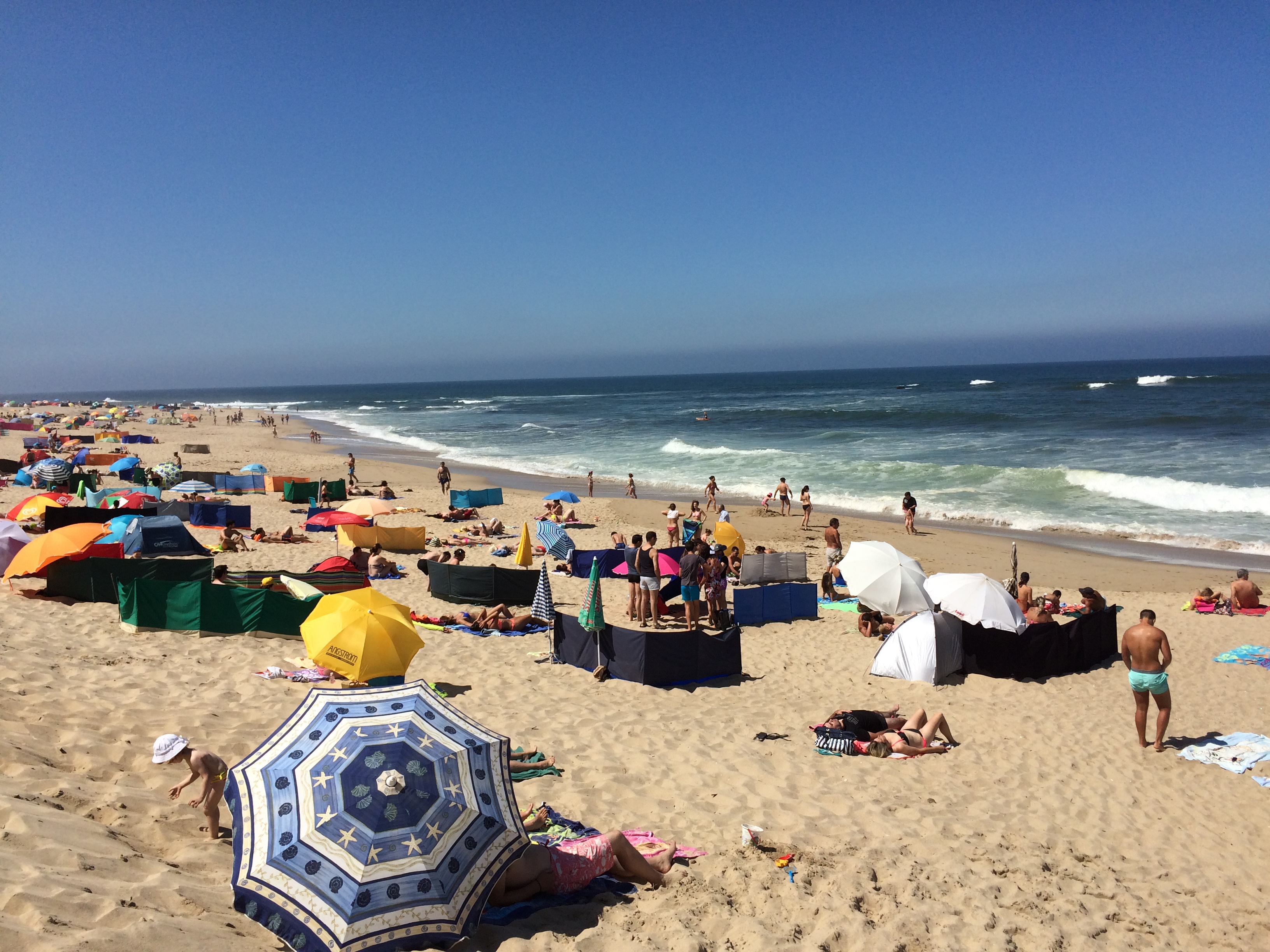
By morning, the weather has improved significantly and by 10 am the whole of the promenade is a hive of sporty activity, with dozens of people jogging and cycling on their designated paths while the beach is already filling up with colorful umbrellas.  People in both Portugal and Spain are generally really quite sporty.  With such a rich variety of tasty food, you probably need to be.  Enjoying eating is probably a great motivator to exercise, and surely that’s as good a reason as any to exercise?

The seafront at Vila Nova de Gaia is already a hive of activity with people jogging or cycling

The seafront at Vila Nova de Gaia is already a hive of activity with people jogging or cycling

The sea has calmed down and the beach is already filling up.

The sea has calmed down and the beach is already filling up.


We find a convenient open-air car park not far from the centre and take our bikes into town.

We chained up our bikes near the closest Tourist Information Office and and walked round the old centre in no particular order after getting a few basic recommendations.

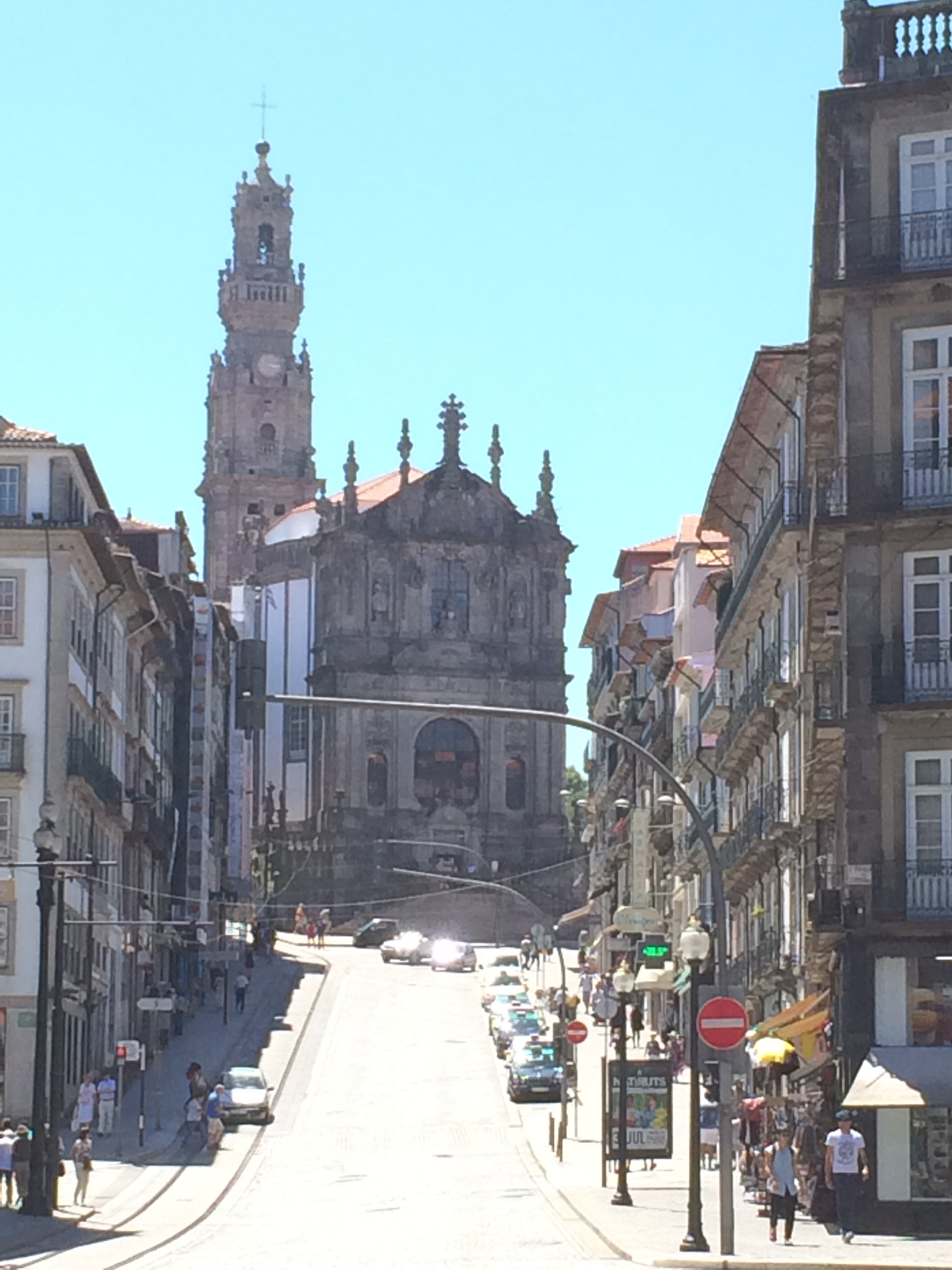
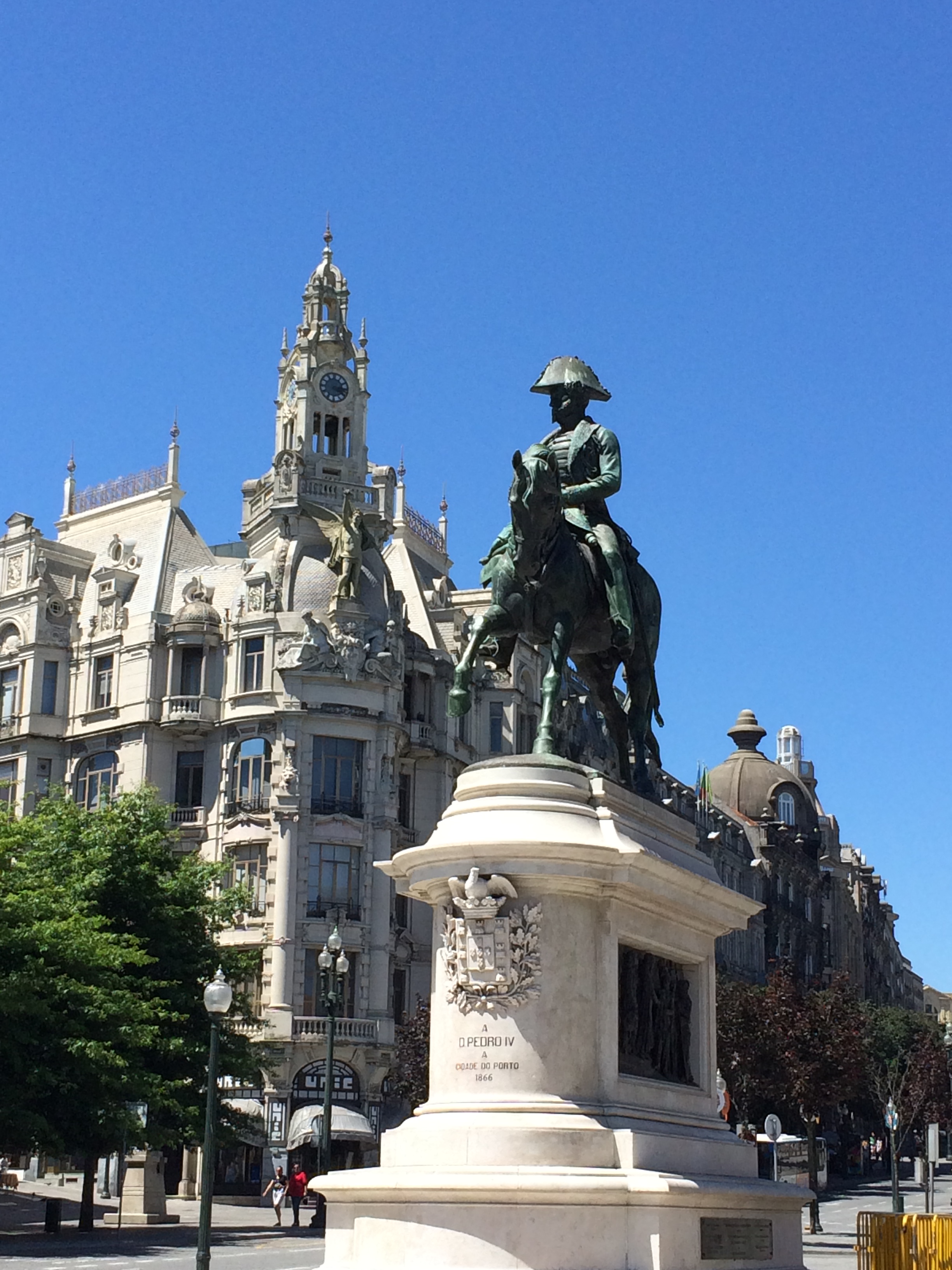
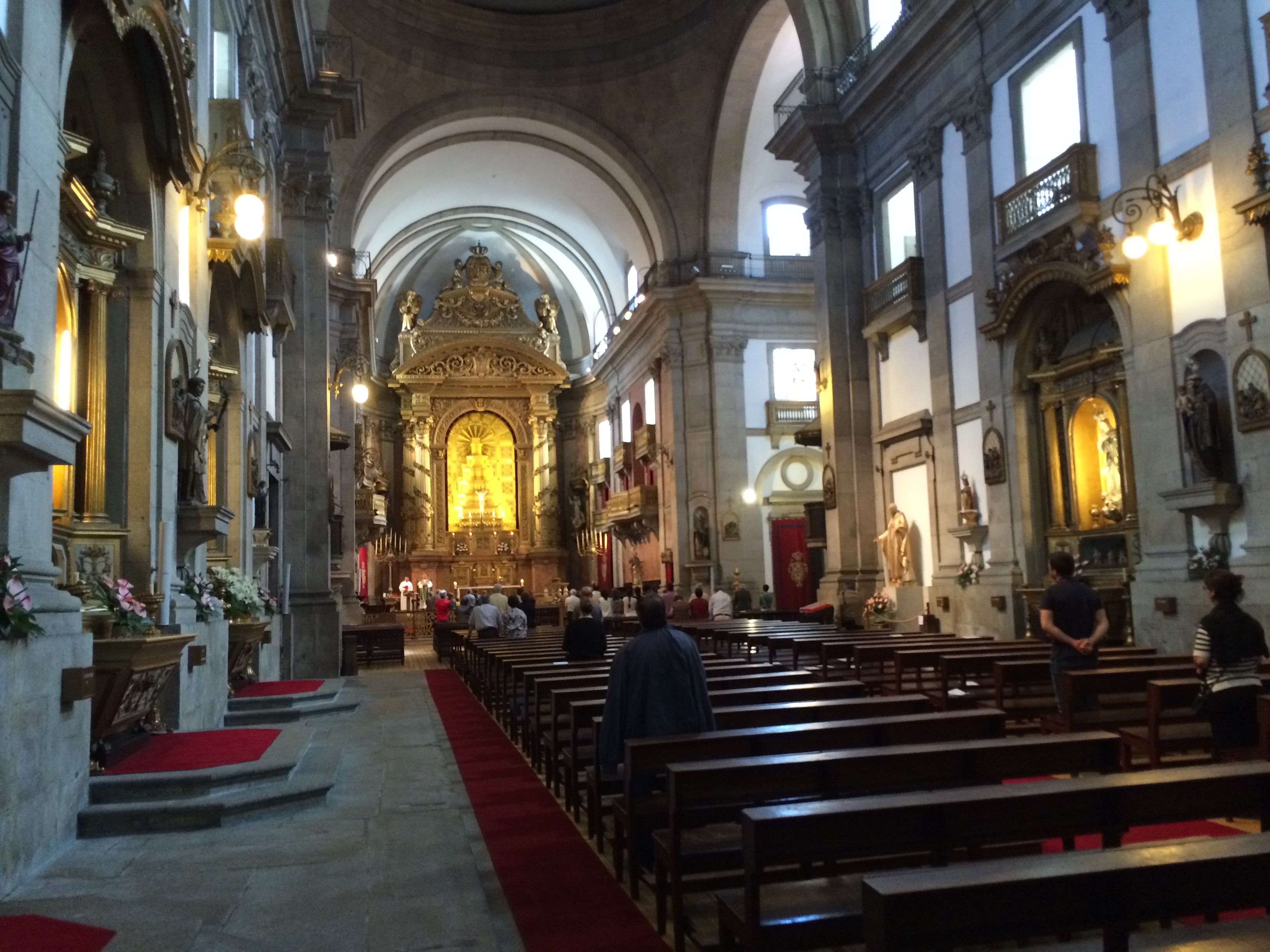
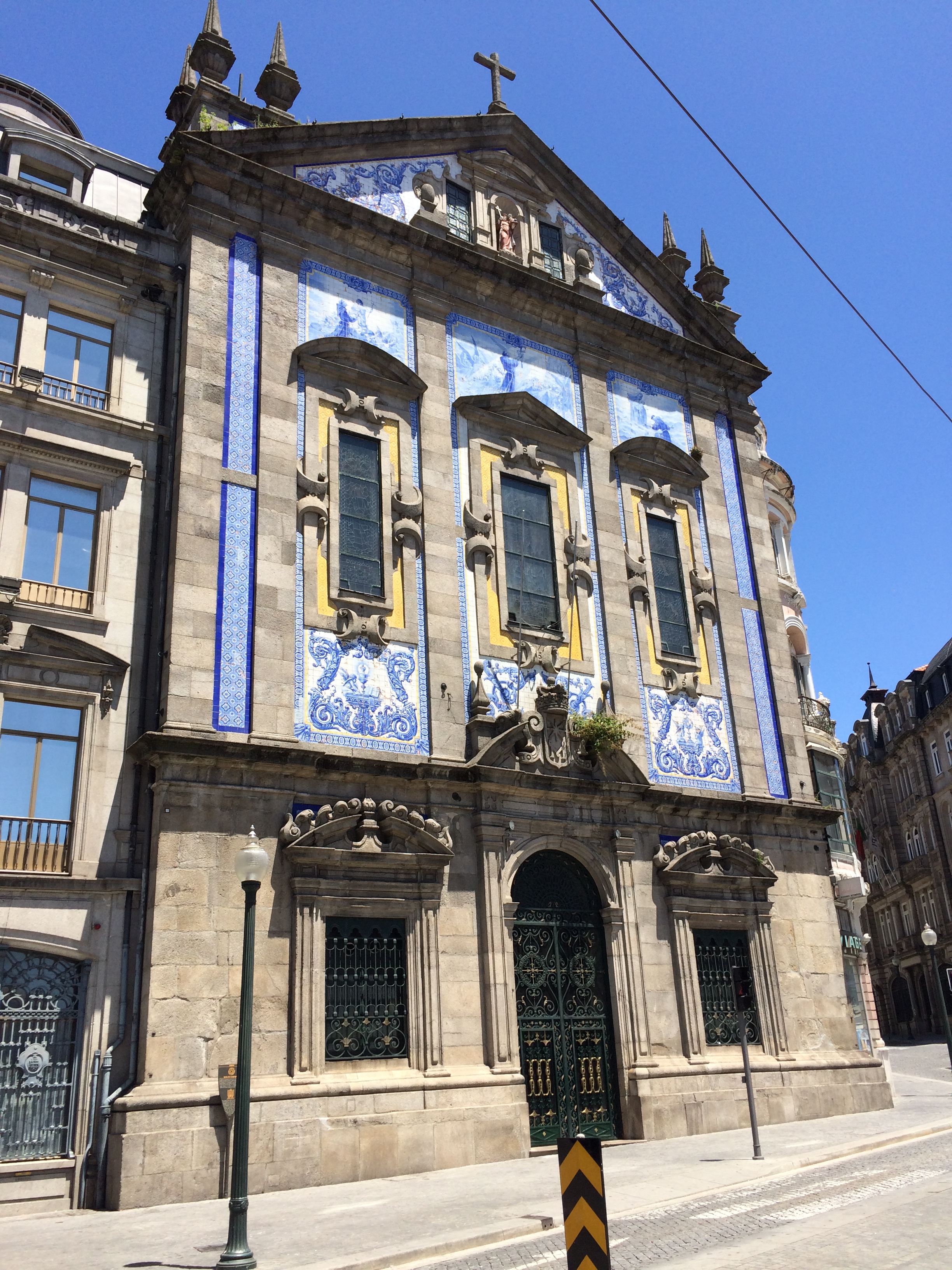
First we saw the baroque style Igreja da Trinidade in Santo Ildefonso where a mass was being held to a surprisingly small congregation. We then walked down the Avenida dos Aliados to the Praca de Liberdade at the centre of which was a statue of Pedro IV on horseback.  Across the road is the Igreja dos Congregates, built at the end of the 17th century on the site of an older chapel dedicated to St Anthony.  The blue tiles however were added later in the 20th century.Turning right into the Rua dos Clerigos and at the intersection with Rua das Carmelitas, we found the famous baroque Torre dos Clerigos, built by an Italian architect in the mid-18th century and which has become Porto’s main visual icon.

The iconic Torre dos Clerigos built in the 18th century by an Italian architect as seen from Rua dos Clerigos.

The iconic Torre dos Clerigos built in the 18th century by an Italian architect as seen from Rua dos Clerigos


The Praca da Liberdade with statue of Pedro IV.

The Praca da Liberdade with statue of Pedro IV.


Another view of the Praca  da Liberdade.

Another view of the Praca da Liberdade.

Sunday mass at the Igreja  da Trindade before a surprisingly small congregation.

Sunday mass at the Igreja da Trindade before a surprisingly small congregation.


The 17th century Igreja dos Congregados with tiles added in the 20th century.

The 17th century Igreja dos Congregados with tiles added in the 20th century.

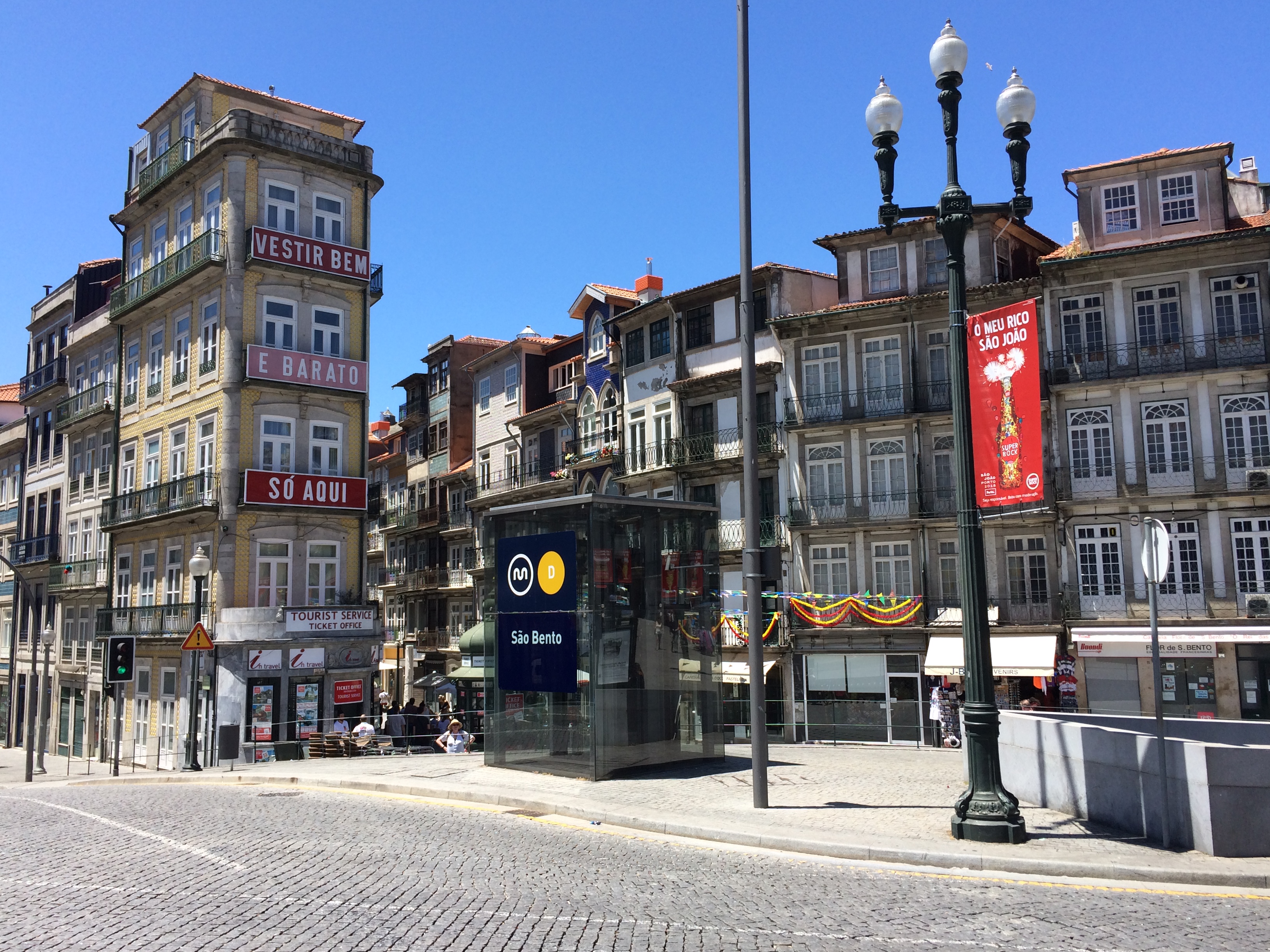
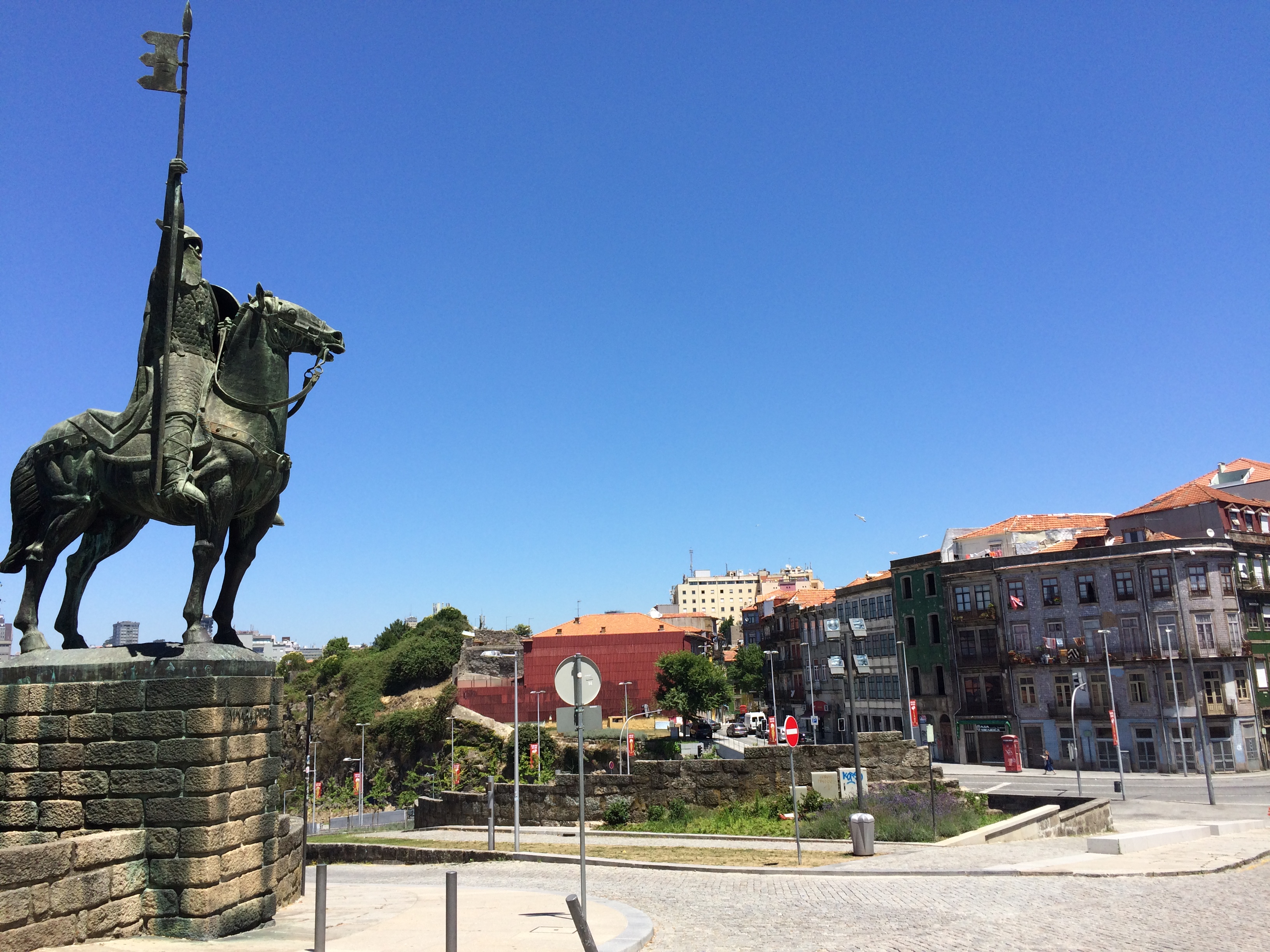
We went down further to the Sao Bento Train Station area with its typical Porto facades and narrow buildings then turned left into a poorer and more shabby quarter through the Rua do Souto before reaching the imposing 12th century Romanesque Se do Porto Cathedral located at the top of a hill. In front of the cathedral and in a heroic pose on horseback was a statue of Vimara Perez, a Spanish nobleman from the Asturias and first ruler of the ‘County of Portugal’ in the 9th century.

The Sao Bento Railway Station area.

The Sao Bento Railway Station area.

The narrow streets of the poor quarter.

The narrow streets of the poor quarter.


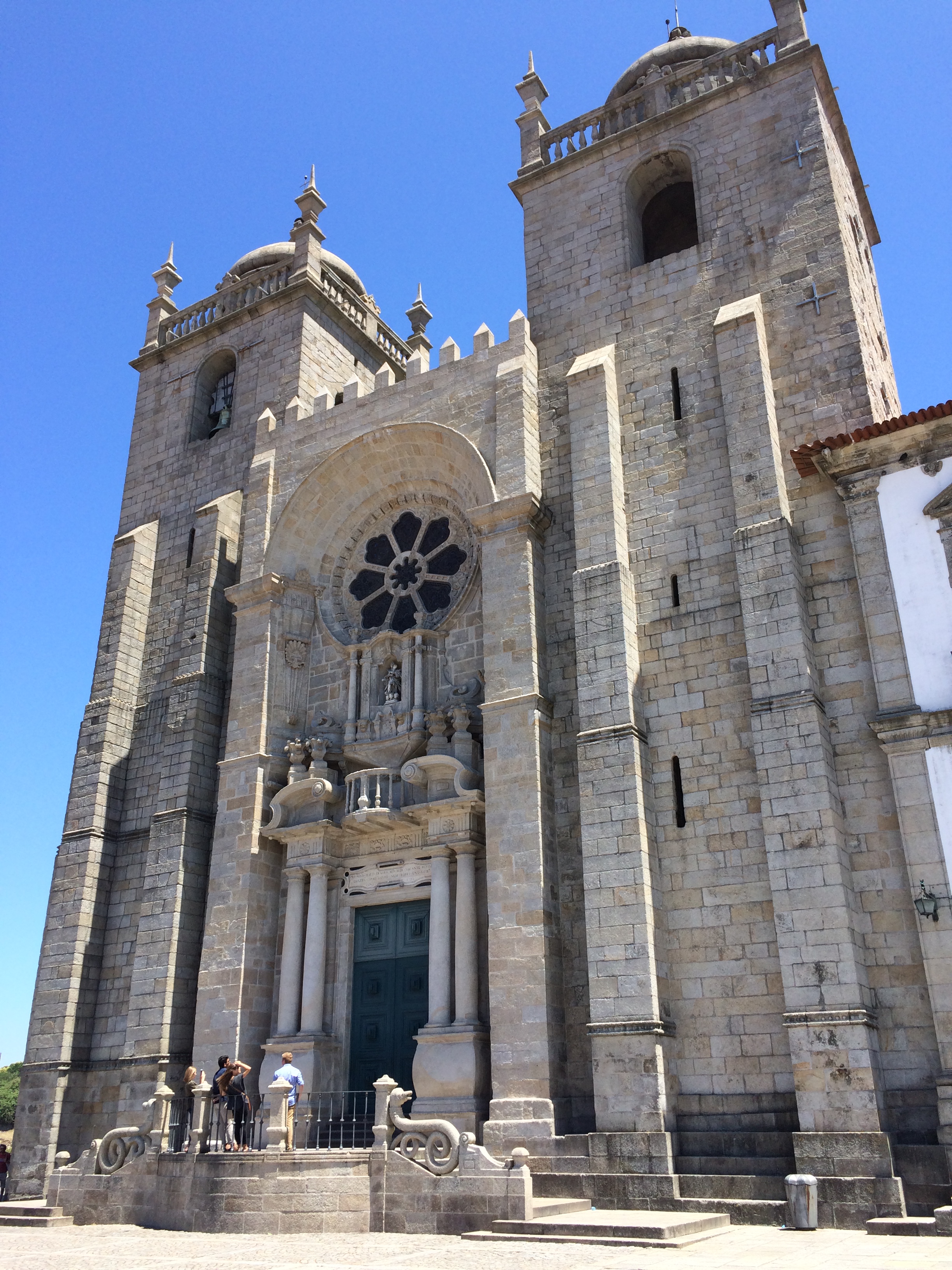
The 12th century Se do Porto Cathedral.

The Romanesque 12th century Se do Porto Cathedral.

Statue of Vimara Perez, 9th century nobleman from the Kingdom of Asturias in Spain and first ruler of the 'County of Portugal'.

Statue of Vimara Perez, 9th century nobleman from the Kingdom of Asturias in Spain and first ruler of the ‘County of Portugal’.


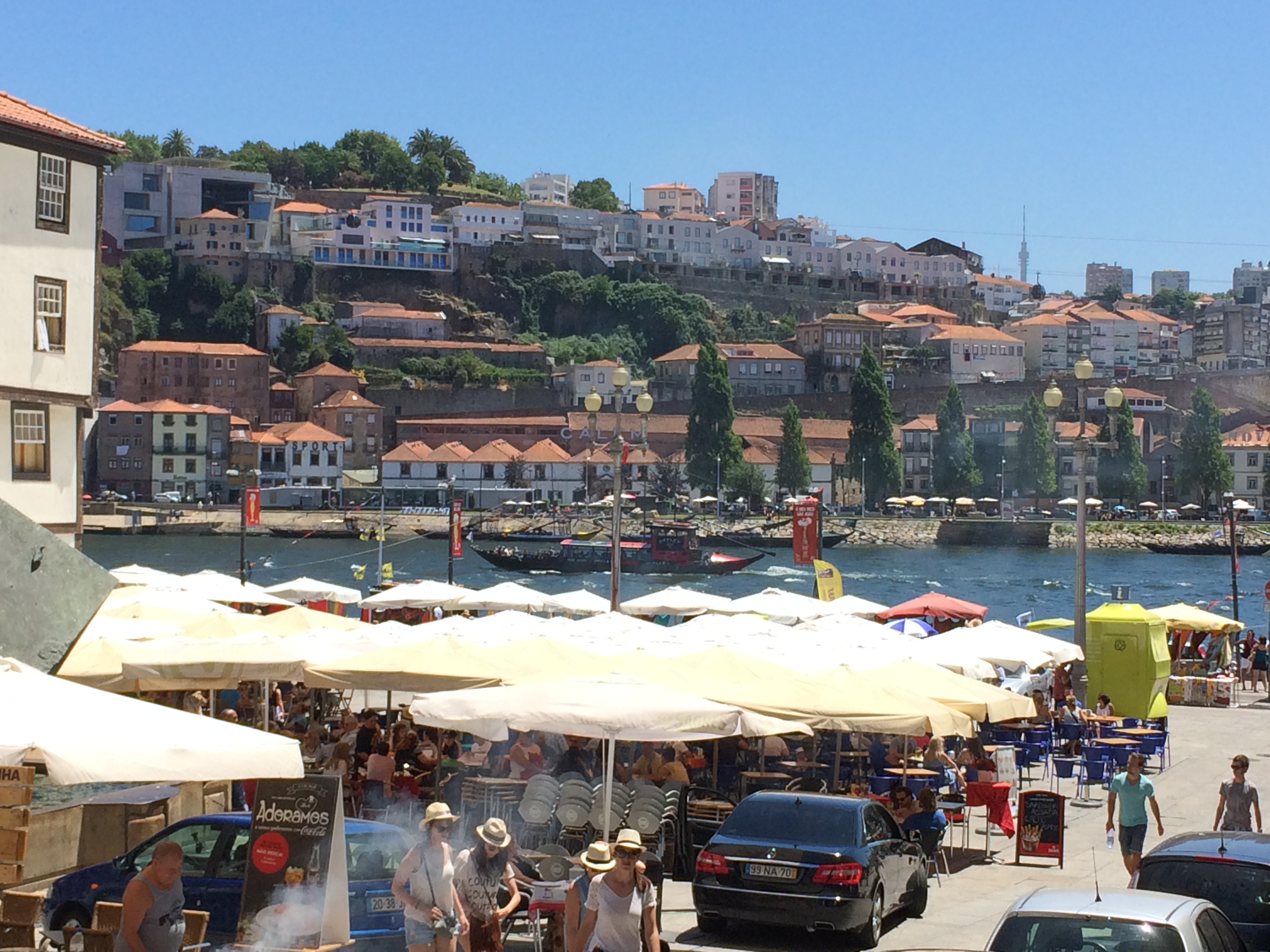
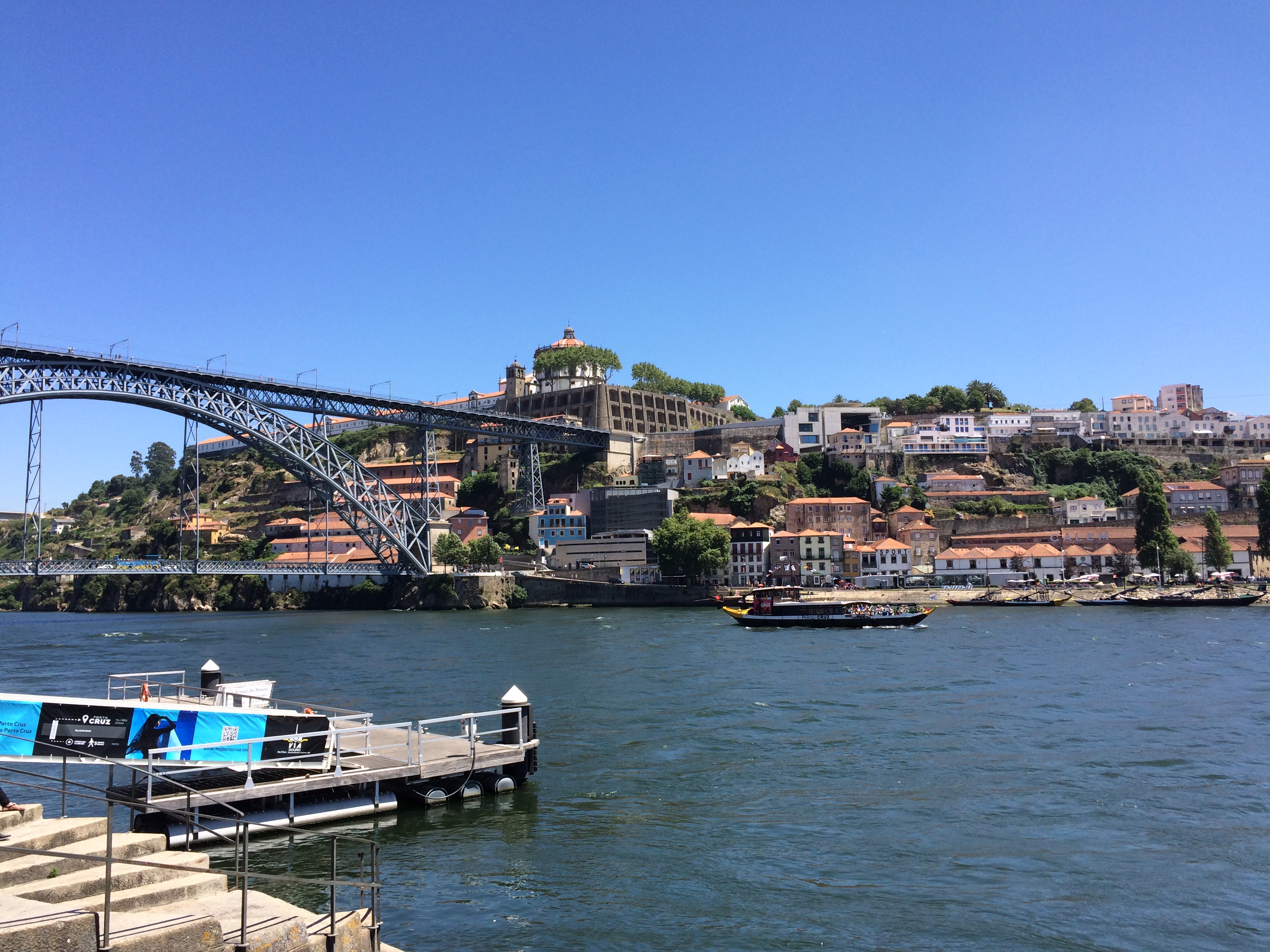
We walked down the hill along the Rua de San Joao to the busy and touristy Sao Nicolau district on the bank of the estuary.  Attractive boats carried tourists up and down the estuary and under the Ponte Luis I (Porto is known for its many bridges).  We had been advised to look for a good place to eat on either the Rua das Flores or the Rua de Mouzinho da Silveira nearer the main square but we didn’t want a full lunch and picked a place that served smaller snacks.  I was intrigued by an item on the menu called Pastel de Chavez as Chavez was the place Flavio Miguel had said down in the Algarve that ‘all the Flavios came from’.  Having researched it, a more accurate explanation was that the town of Chavez had an older Roman name of the Flavian town after one of the Flavius Emperors who founded it and consequently, to this day, people who come from Chavez are nicknamed ‘Flaviensen’.  As we weren’t going to have time to make a detour to visit the town, if this Pastel de Chavez actually was a Chavez speciality, the next best thing to going there I reckoned was to eat one of their pastries.  When the friendly waiter Felipe confirmed that was the case, we ordered two as well as two Bolinhos de Bacalhau (cod fish cakes) and two Rissois de Leito (pork rissoles).  I’m delighted to say the Pastels de Chavez (tasty mince in flaky pastry pasties) were the tastiest of the three and it left me feeling irrationally vindicated.  A couple of tourists (from Florida and Toronto) even stopped to ask what the pasties were as they looked so good, which gave me an opportunity to tell them the whole story and make me feel even better!  It led to a very interesting conversation with them (they were just coming to the end of a tour of Europe by train the whole way) and this wouldn’t have happened without the Chavez / Flaviensen connection!

The popular Sao Nicolau district on the bank of the Douro river estuary.

The popular Sao Nicolau district on the bank of the Douro river estuary.


The busy estuary with Ponte Luis I bridge in the background.

The busy estuary with Ponte Luis I bridge in the background.


The Pastels de Chavez in the foreground with, behind, the Bolinhos de Bacalhau and the Rissois de Leitas.

The Pastels de Chavez in the foreground with, behind, the Bolinhos de Bacalhau and the Rissois de Leitas.

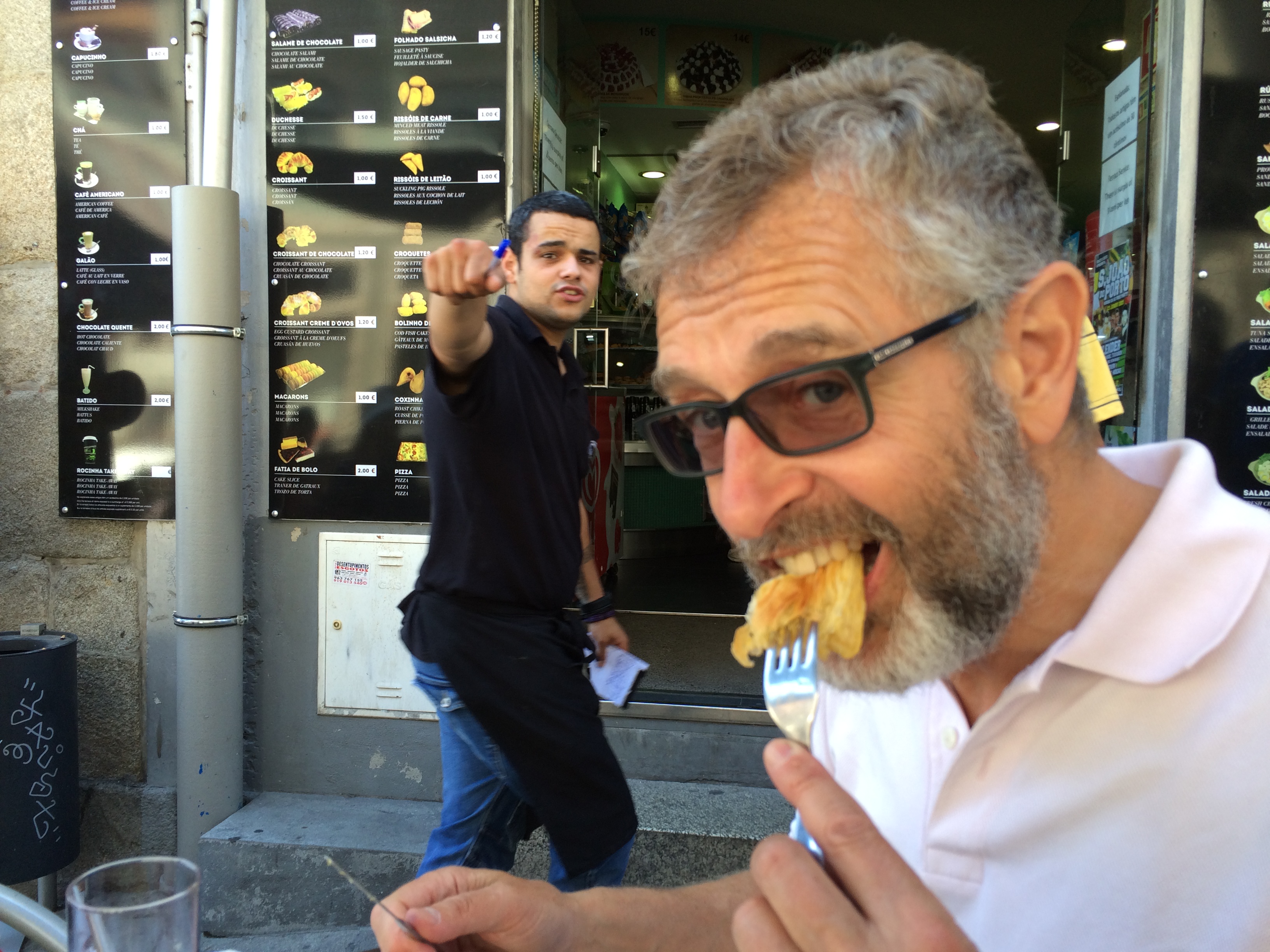
About to bite into a Pastel de Chavez (formerly known as Flavien).

About to bite into a Pastel de Chavez (formerly known as the Flavian town).


More typical Porto picturesque houses in Sao Nicolau.

More typical Porto picturesque houses in Sao Nicolau.

Back streets in Sao Nicolau quarter.

Back streets in Sao Nicolau quarter.


We start to make our way back via the Praca do Infante D Enrique where a statue has been erected to commemorate the 5th centenary of the birth of the legendary Prince Henry the Navigator.  It shows him in battle dress next to a globe and symbolically pointing overseas.  As I take a photo a pigeon decides to show his devotion by resting on his head (it would be unkind to put any other interpretation on this).

We then walk up the historically important Rua das Flores which in the 16th century became one of the most elegant streets in Porto, favoured by nobility and the bourgeoisie, who built grand houses along it. At the end of the street is the ornate Igreja da Misericordia built in the 16th century and distinctive for its Rococo style frontispiece added on in the 18th century. Then we continue up the Rua Ferraz and the Rua Caldeireiros.

The famous and elegant Rua das Flores.

The famous and elegant Rua das Flores.

Statue of Henry the Navigator in battle dress and symbolically pointing overseas (plus devotee on head).

Statue of Henry the Navigator in battle dress and symbolically pointing overseas (plus devotee on head).


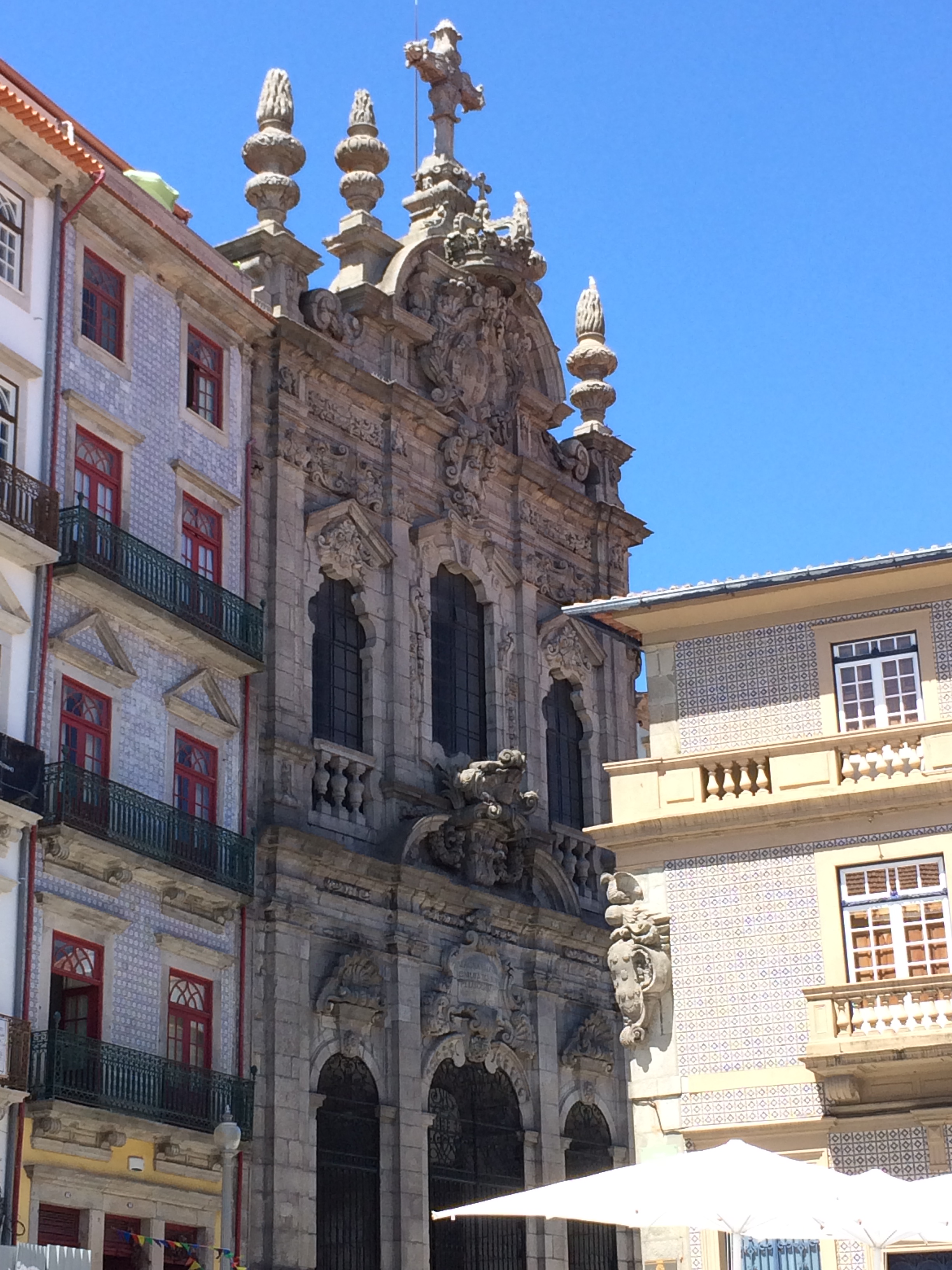
The Rococo style Igreja da Misericordia.

The Rococo style Igreja da Misericordia at the end of Rua das Flores.

The colourful Rua dos Caldeireiros.

The colourful Rua dos Caldeireiros.


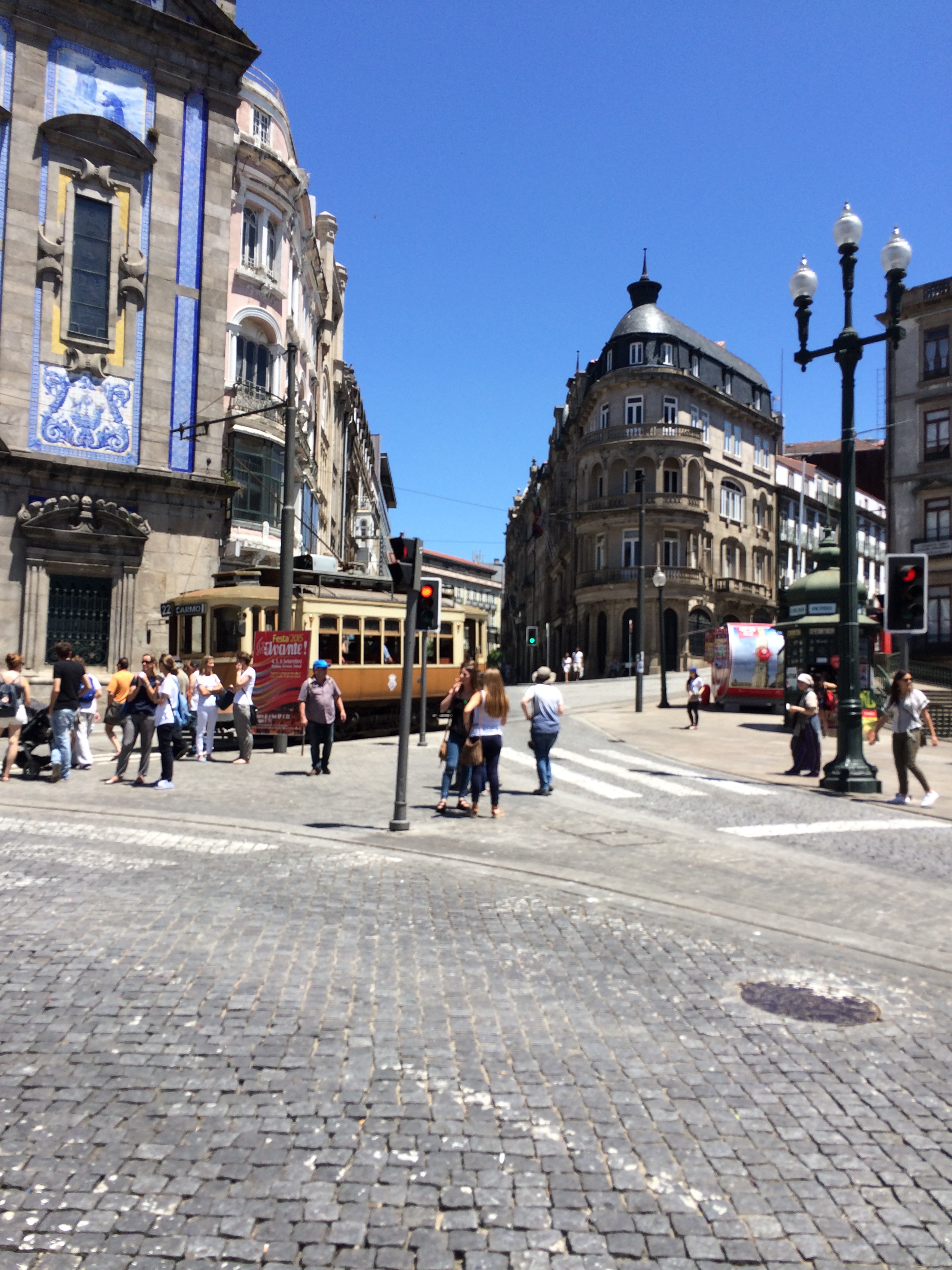
Finally, we find something quite strange – a church that looks like it’s been built in two different styles, one Classic/Baroque, the other Rococo – but which in fact turns out to be two separate churches built 150 years apart, confusingly right next the each other.  The first is the Igreja dos Carmelitas, built in the first half of the 17th century in a blend of Classic and Baroque styles and the second is the Igreja do Carmo, built in the second half of the 18th century in Rococo style by Silvestro Silvestri.  A afternoon Sunday mass was being held in the first and this time, the church was completely full.  Clearly, Classic Baroque has it against Rococo.

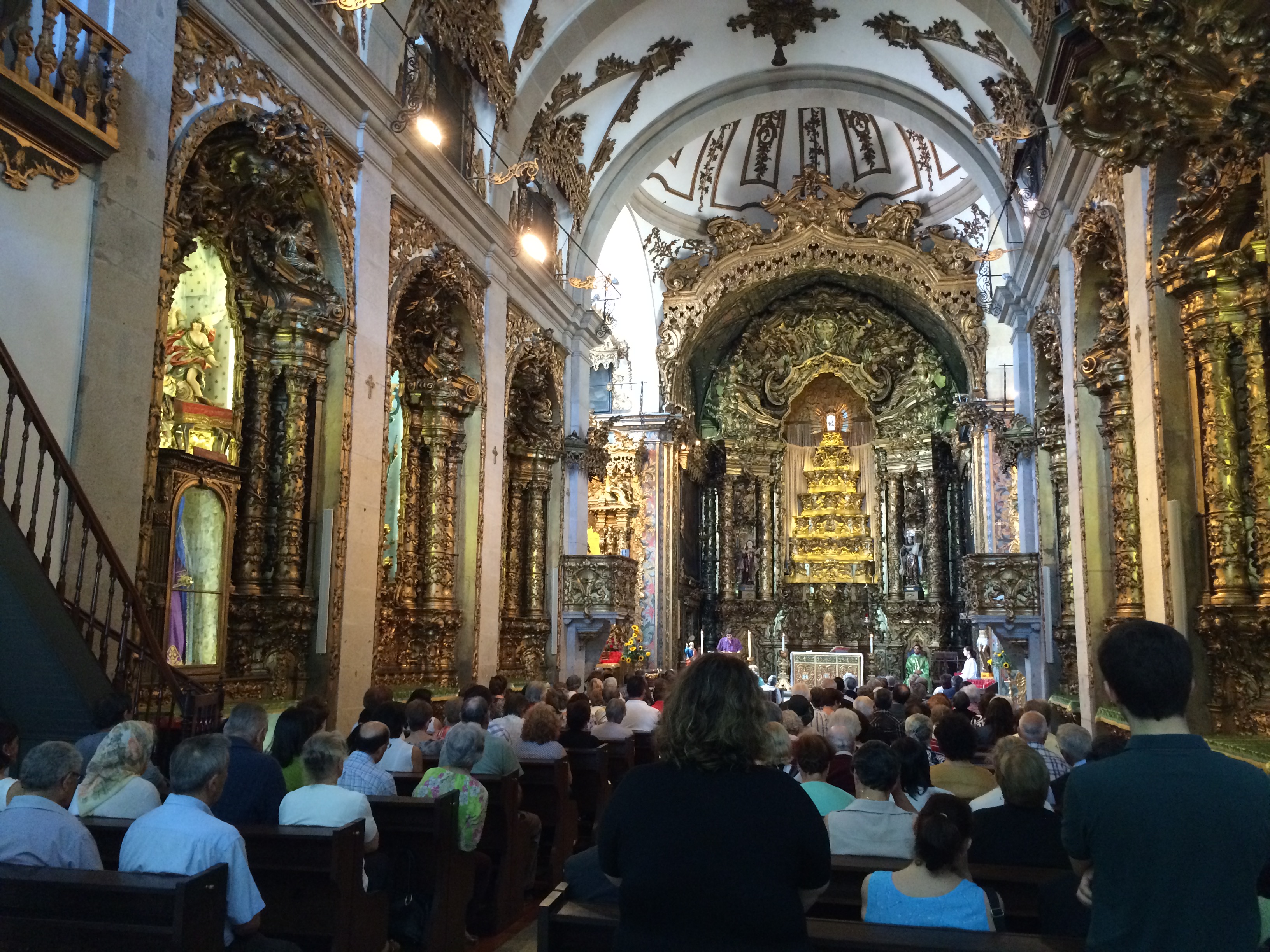
Mass to a full congregation in the clearly popular Igreja dos Carmelitas.

Mass to a full congregation in the clearly popular Igreja dos Carmelitas.

The Igreja da Carmelitas and the Igreja da Carmo right next to each other.

The Igreja da Carmelitas and the Igreja da Carmo right next to each other.


And so we cycle back to the car park, not without getting slightly lost first and set off for our final drive through Portugal (‘siempre infrent’ north, as we learnt was the Portuguese way of saying ‘straight on’) and to a place in Galicia on the sea called Sanxenco south of Santiago de Compostella.

Judith and I agree that overall Porto didn’t have the immediate appeal and excitement that we felt in Lisbon but it’s probably more a city to be savoured over a longer period to fully appreciate what it has to offer.  We didn’t have time to visit the Port-selling district on the opposite bank of the estuary, but in any case, we wouldn’t have been able to buy anything to take back with us owing both to lack of space and hot temperatures we expect to experience as we enter into Juillet in France and Agosto in Italy. Peccato.

We really enjoyed Portugal and would like to say ‘Obrigadi’ for a really delightful 9 days. We will definitely be back.

IMG_3248