Tuesday 28th to Thursday 30th July – Trani, the Pearl of Puglia

Standard

Post-script from last post:

We had bought a small tent in France in preparation for our daughter Catherine joining us. We’d used it once in Lake Garda.  It was a lovely little pop-up tent, orange, blue and white and very easy to put up (it just pops open ready to use as the name implies) but proved impossible to fold up and get back into the bag.  Seeing that we were camping amateurs two Dutch fellow-campers rushed over in an impulse of solidarity to give us a hand.  After a marathon struggle involving a good deal of twisting, wrestling, kneeling, head-scratching, almost giving up but then a final last-ditch double-twist tackle designed to catch it off-guard the mother and daughter super-campers somehow succeeded in getting it into the bag.  Much appreciation and gratefulness all round. At Molinella it was still hot and as we were staying 2 nights we decided to put the tent up again.  On opening up the bag, we quickly realized that whilst obtaining the desired result of getting the tent folded and forced into the bag, our altruistic fellow-campers had unwittingly inflicted multiple fractures on both poles of the tent and rendered it quite unusable.   Attempts by Judith to fix the poles with plasters from the first aid box proved futile so sadly our lovely tent ended its days in the Molinella camping village recycling bins. We wouldn’t hazard to infer a moral from this story but there were no hard feelings! Honestly.

The discarded pop-up tent can be seen dumped on the ground after attempts at reconstructing it had been abandoned.

The discarded pop-up tent can be seen in a heap on the ground after attempts at reconstructing it had been abandoned.

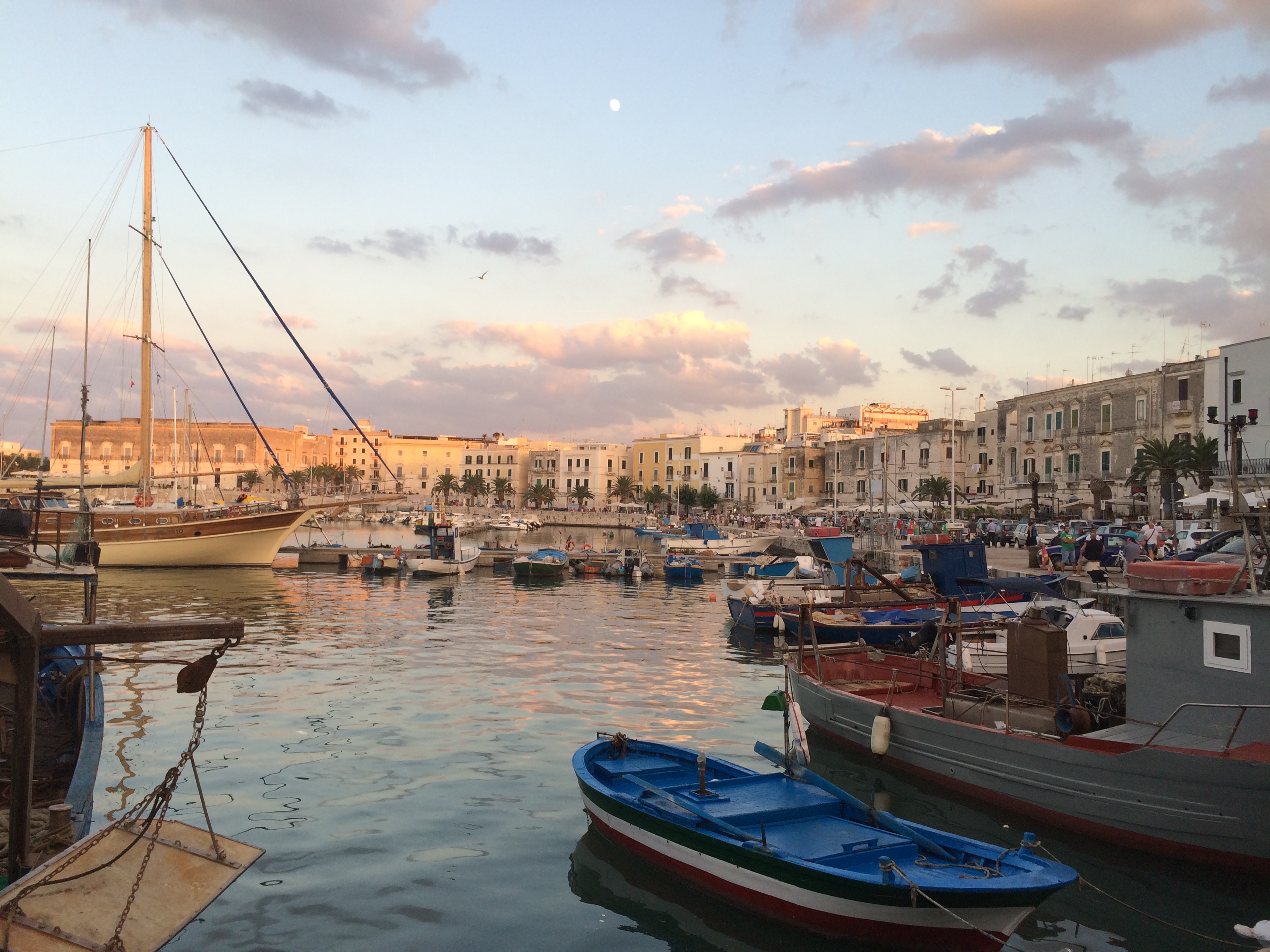
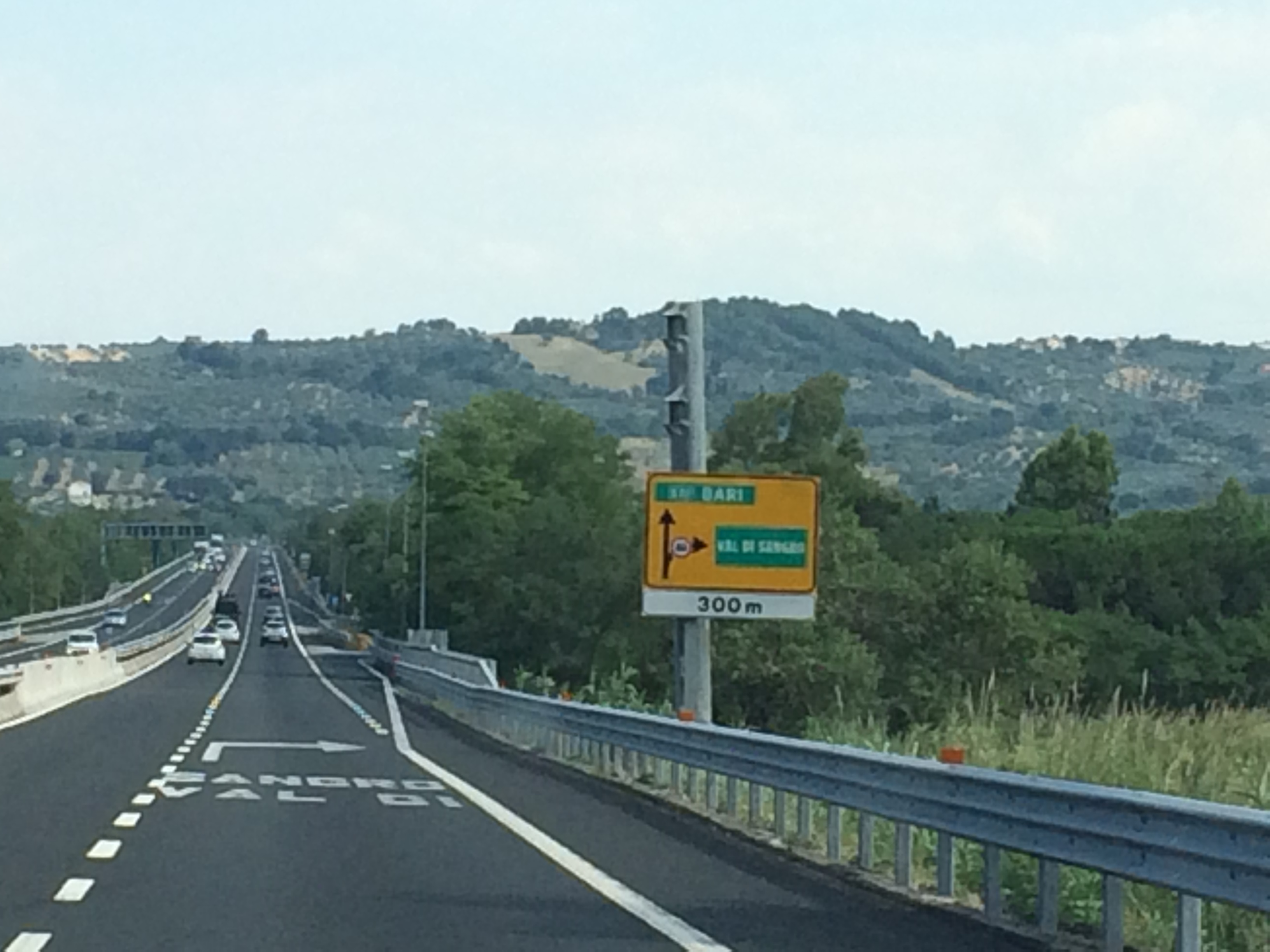
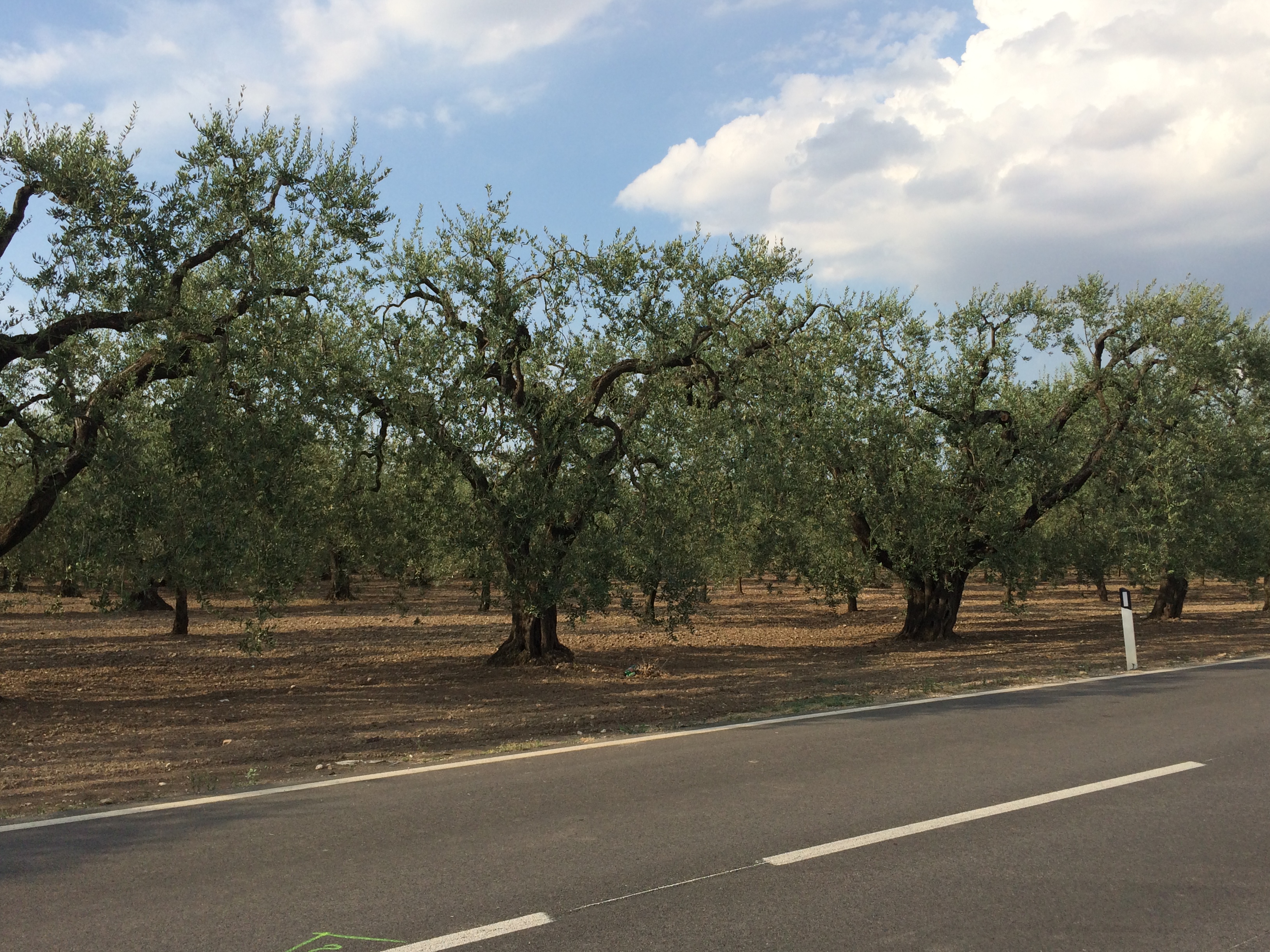
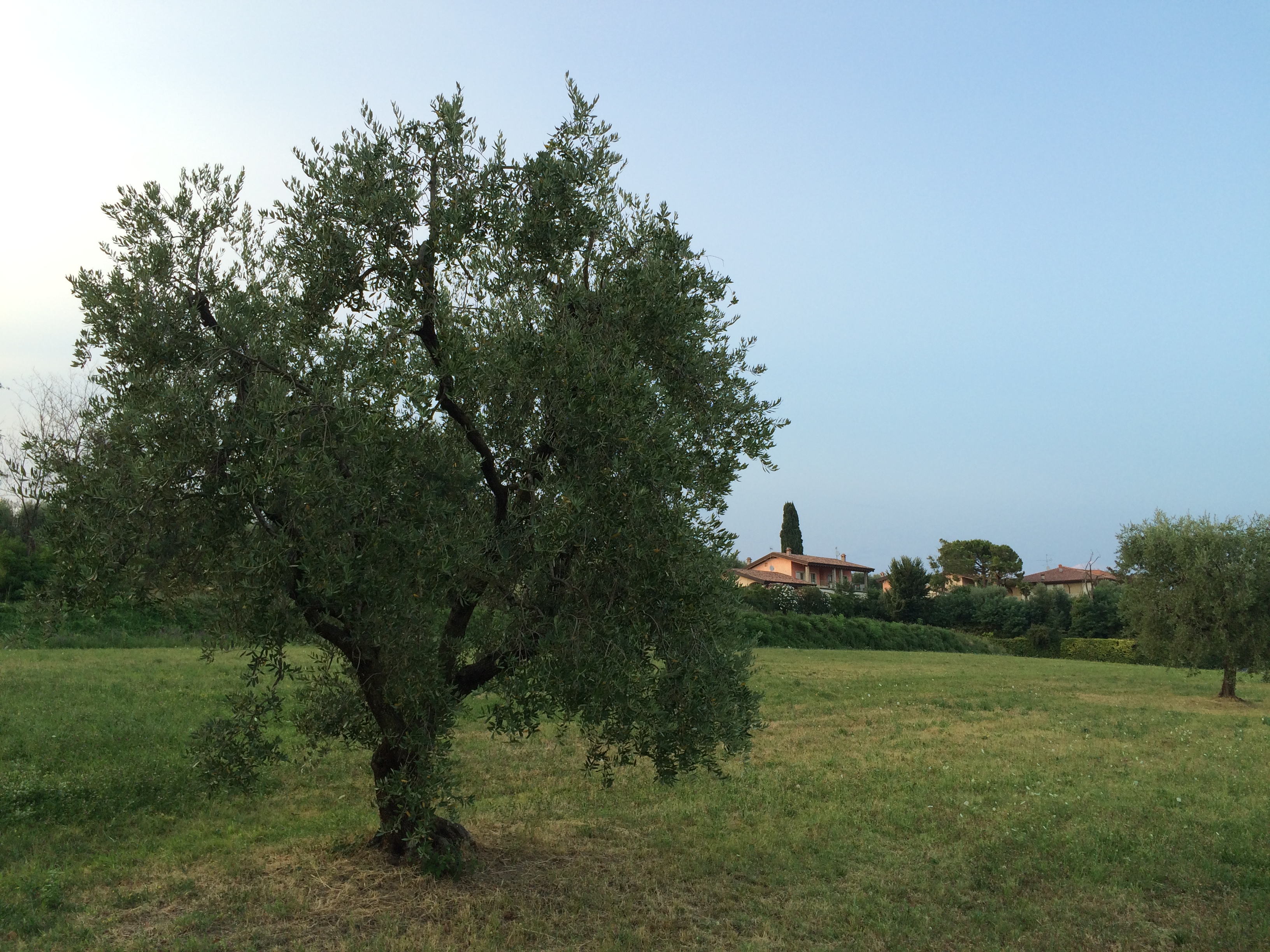
From Vieste and the Gargano we continued following the coastal road down the Golfo di Manfredonia past Monte Sant’Angelo and Cerignola until we started seeing signs to Trani just after Barletta. All around us were hundreds upon hundreds of acres of olive groves insterspersed with the occasional vineyard.  This really was a very different landscape from the north, flat if slightly undulating, very arid and Mediterranean, with seemingly enough olive trees to supply the whole world with olives and olive oil. It was nearly 9pm when we drove into Trani’s Porto Vecchio and the orange glow of the sunset reflected beautifully against the water-front and the old fishing boats.

Around Barletta - acres of olive groves and rows of vines everywhere you looked.

Around Barletta – acres of olive groves and rows of vines everywhere you looked.

Finally, arrival in Trani.
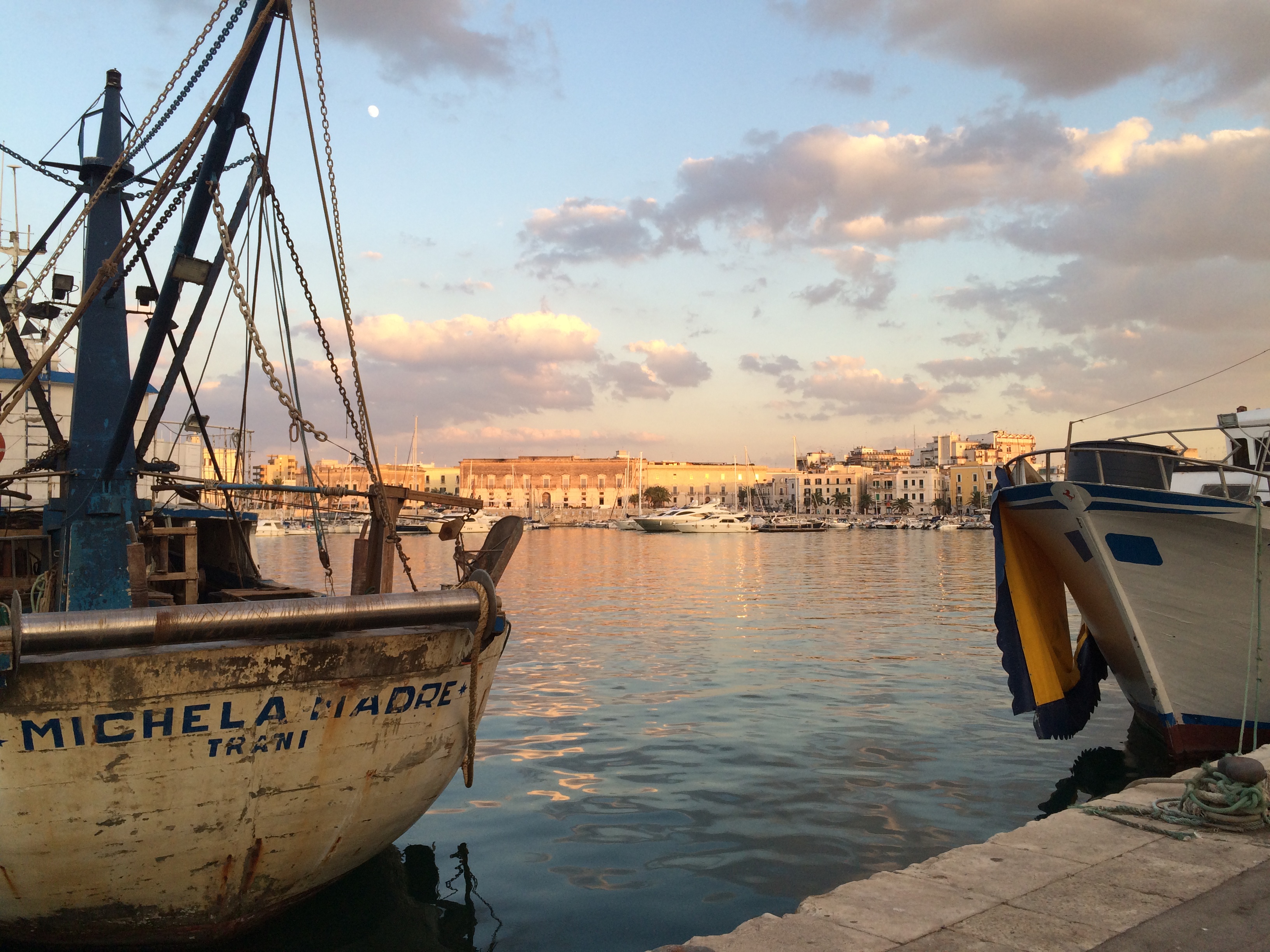
Finally, arrival in Trani.

IMG_4982

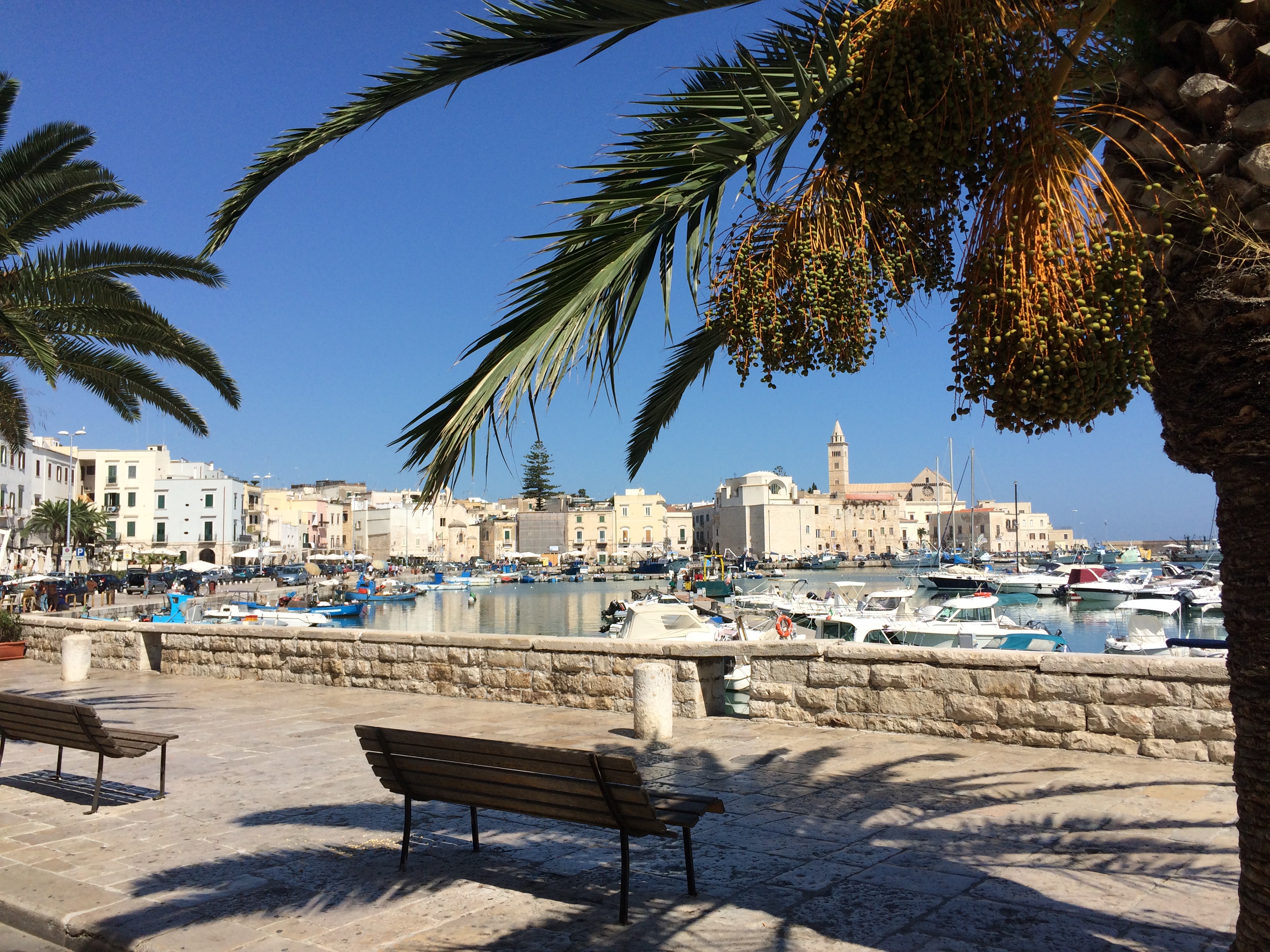
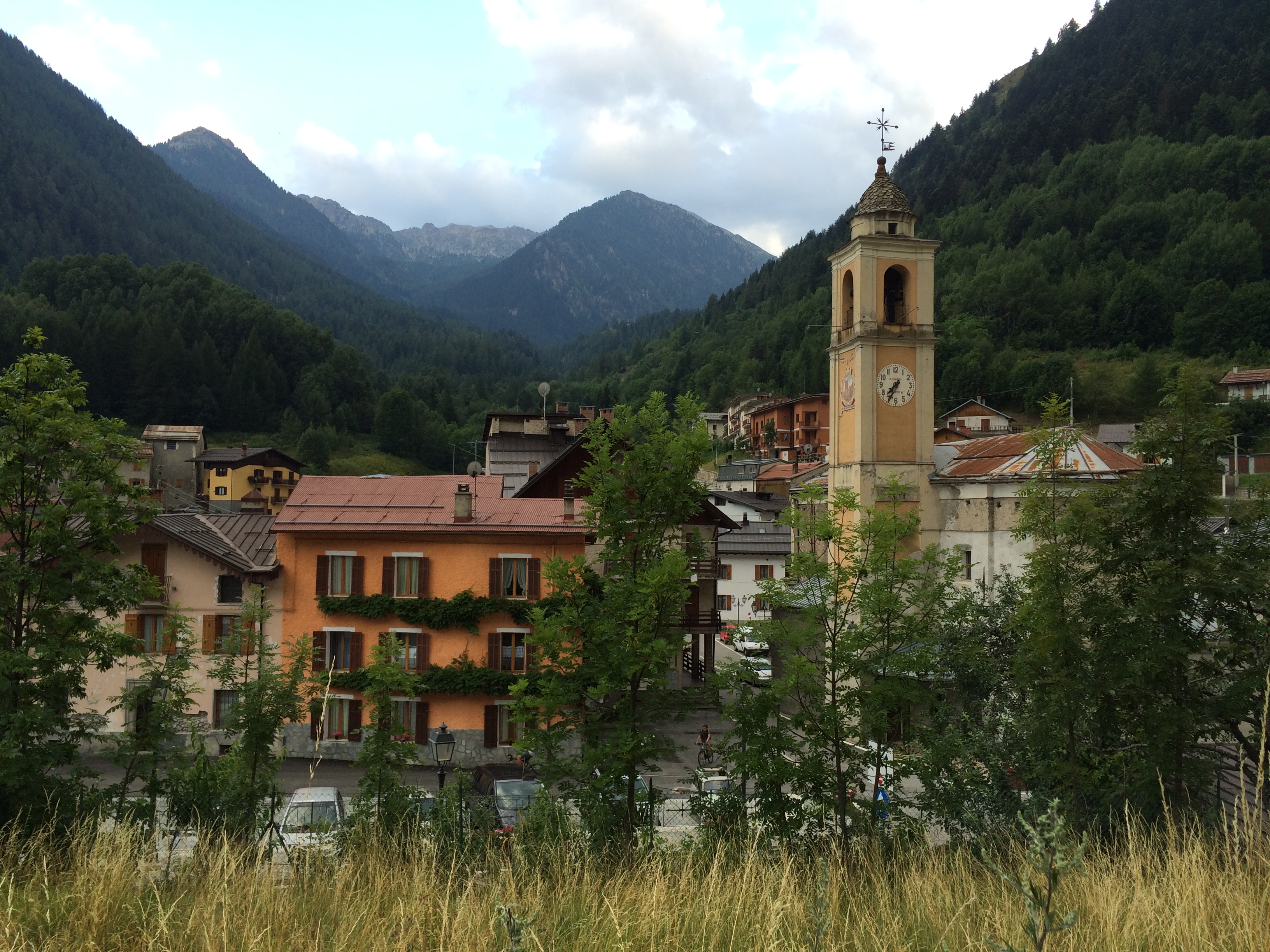
Standing at the point where the Adriatic and Ionian seas meet, Trani was once the Adriatic’s most famous sea port, carrying crusaders to the Holy Land, a famous trading post during the Middle Ages and much later the port southern émigrés leaving Italy went to to join the great Italian diaspora.  Indeed, in the year 1063 Trani issued the ‘Ordinamenta et Consuetudo Maris’, the oldest surviving maritime law code in the Latin West and Frederick II built one of his many castles here, which still stands today.  Trani is now still a busy fishing port but its main economic activity, as it has been for a long time, is quarrying the ‘marma di Trani’ (Trani stone). A beautiful example of this is Trani’s lovely Romanesque cathedral, situated right on the edge of the sea and almost seeming to rise from it, which has become one of the symbols of Puglia.

Trani's beautiful cathedral, one of the symbols of Puglia.
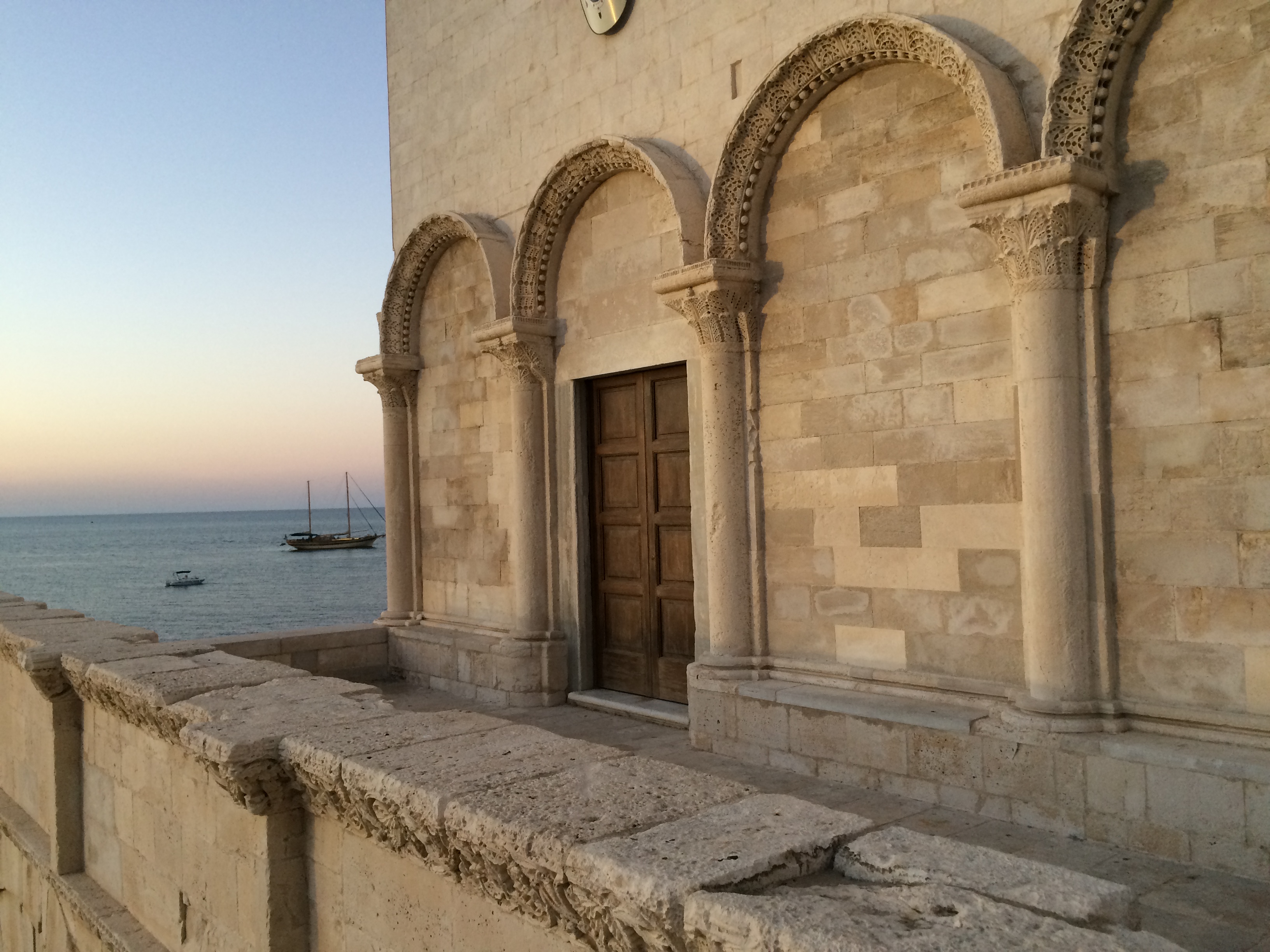
Trani’s beautiful cathedral, one of the symbols of Puglia.

Made of Trani's famous stone, it seems to 'rise out of the sea'.

Made of Trani’s famous stone, it seems to ‘rise out of the sea’.

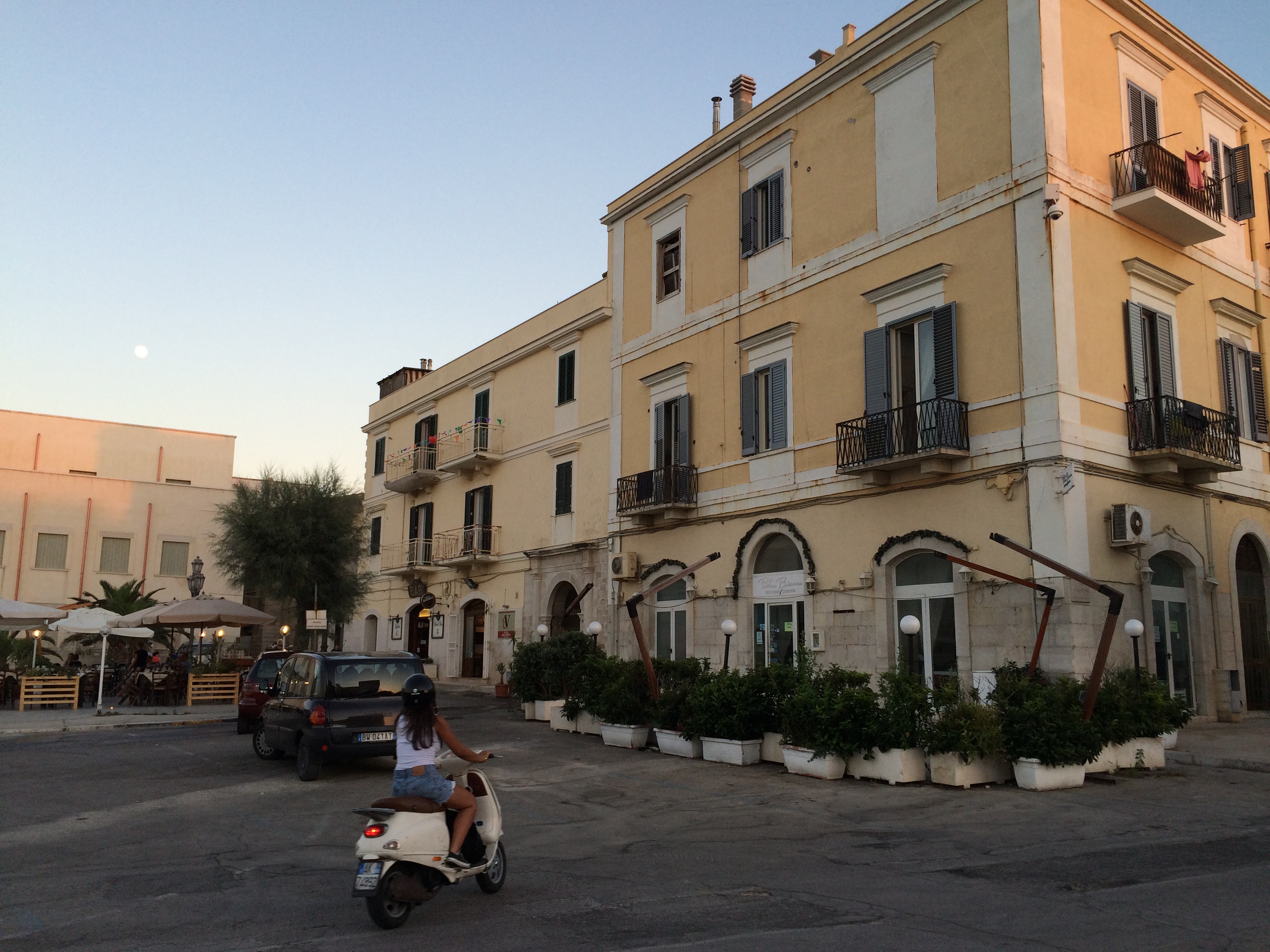
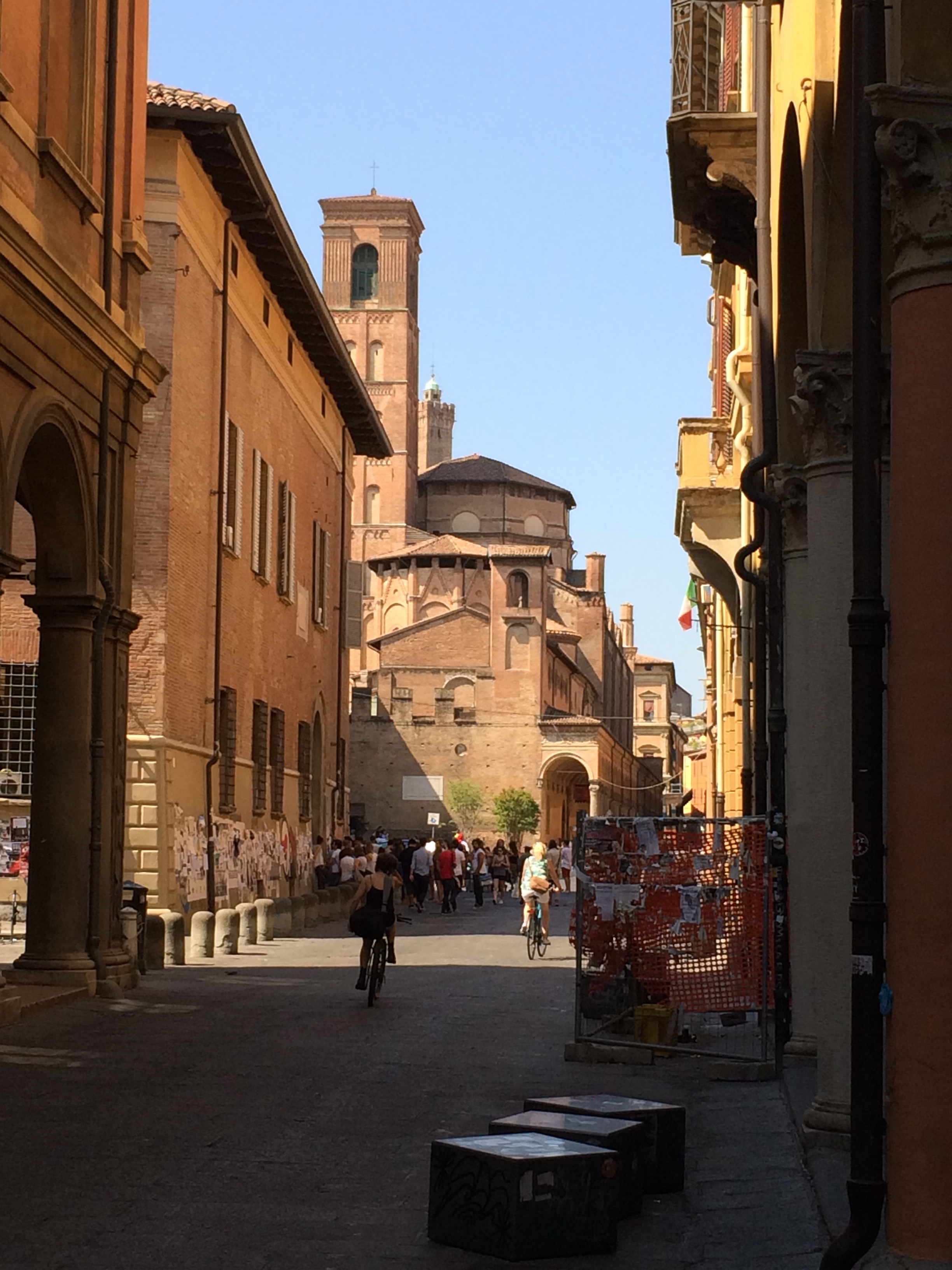
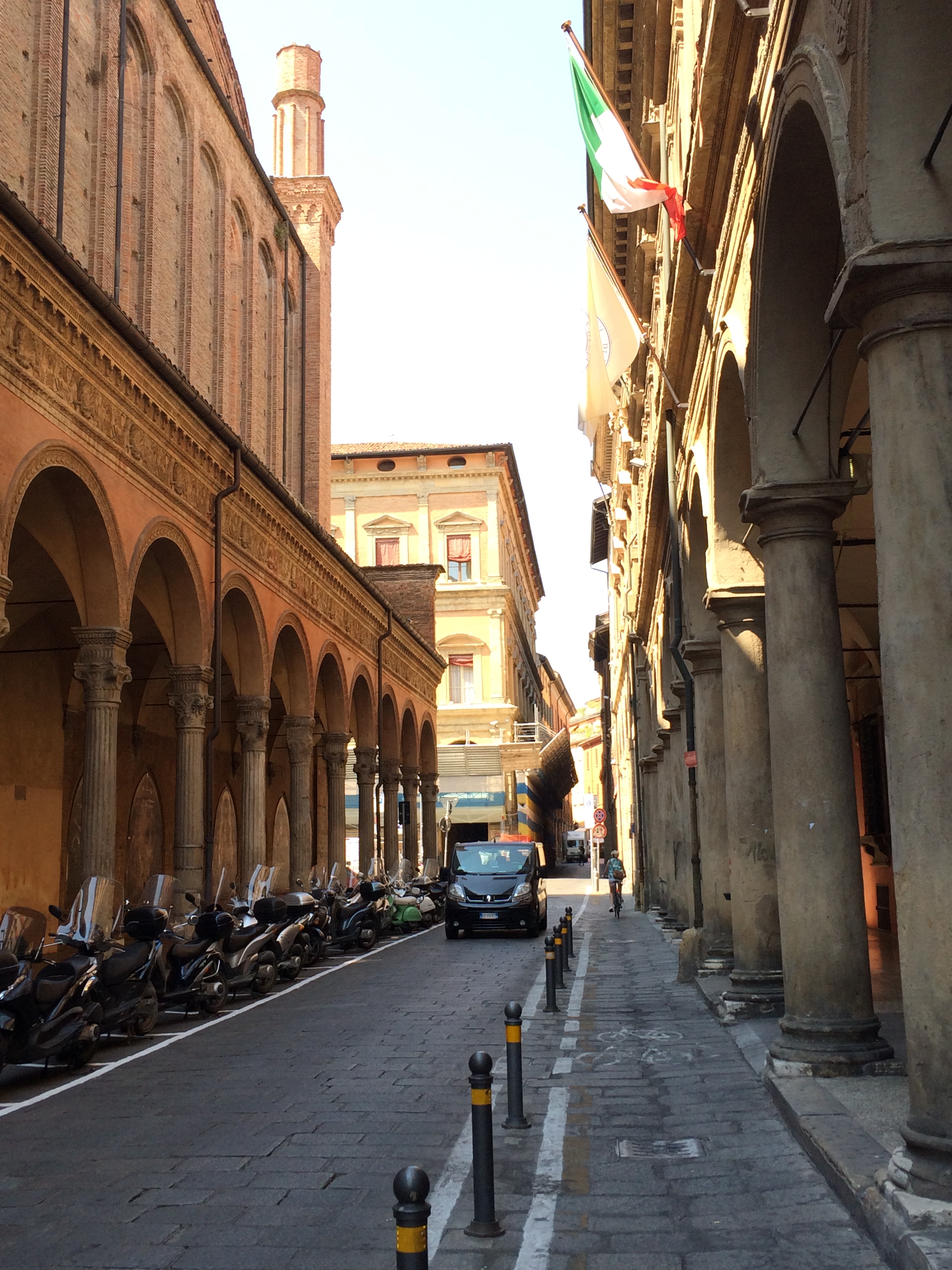
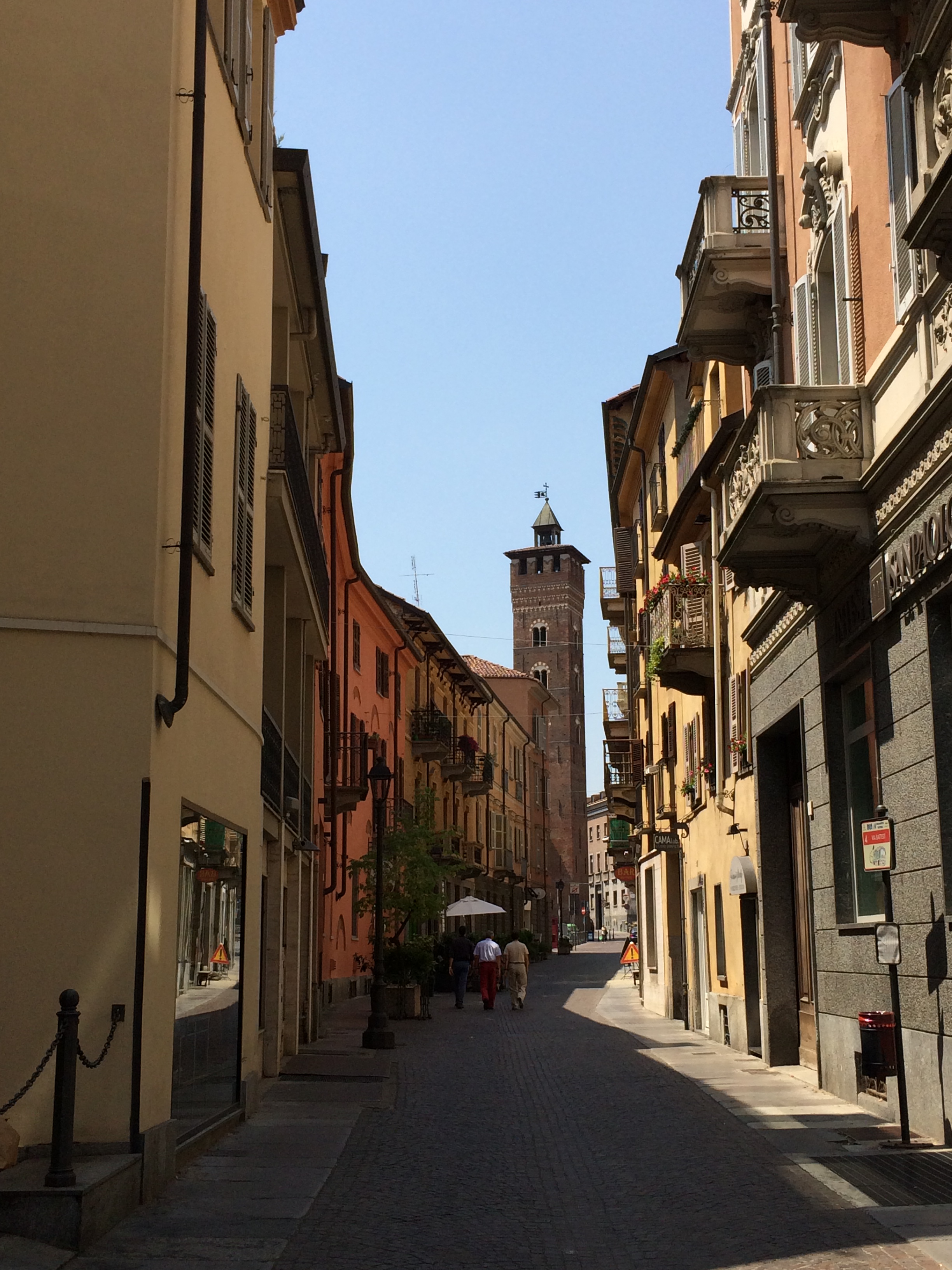
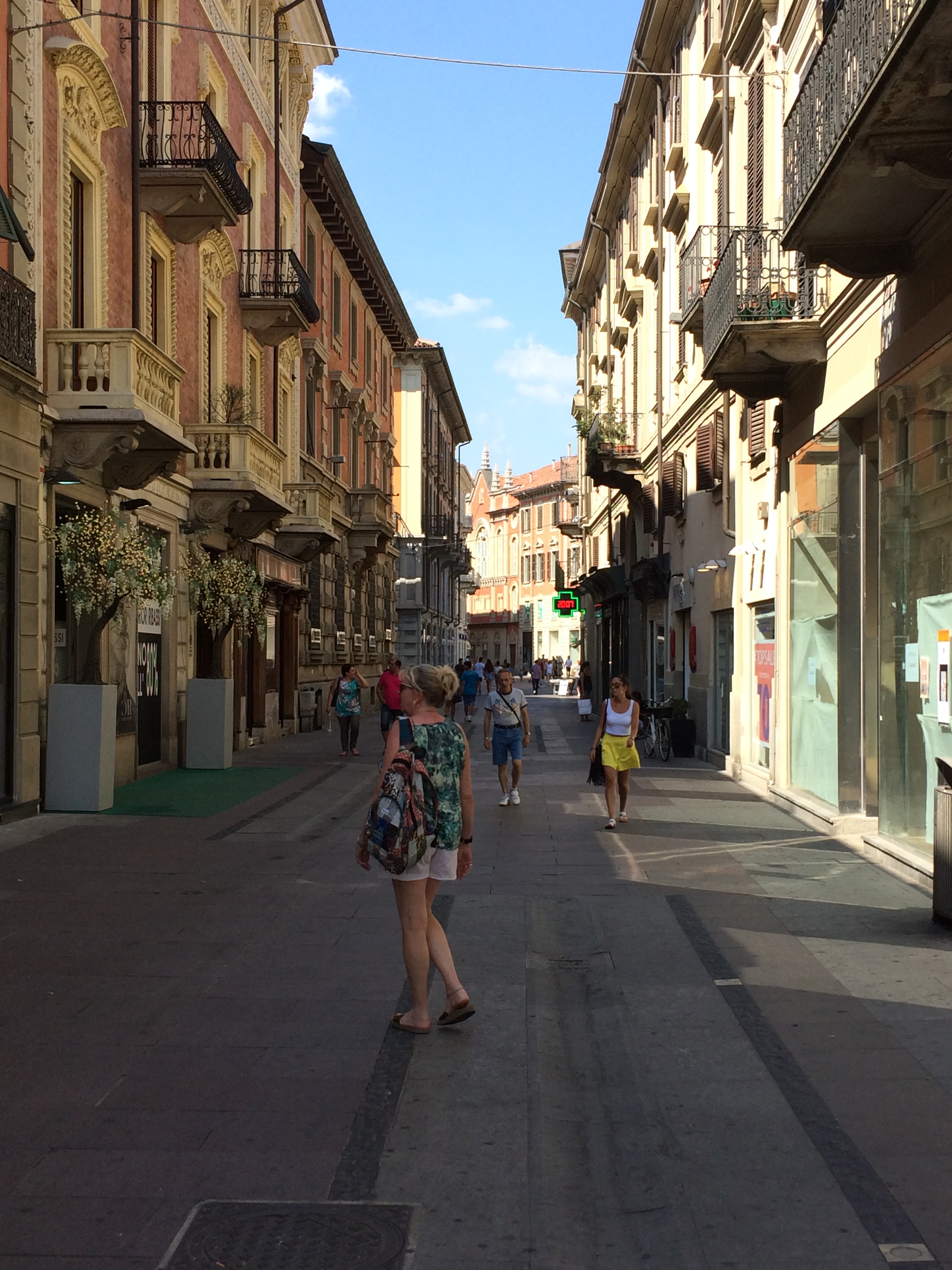
A typical street in old harbour area of Trani.

A typical street in old harbour area of Trani

The old harbour at sunset.

The old harbour at sunset.

Train train station.

Train train station

The piazza off the Via Ogni Santo.
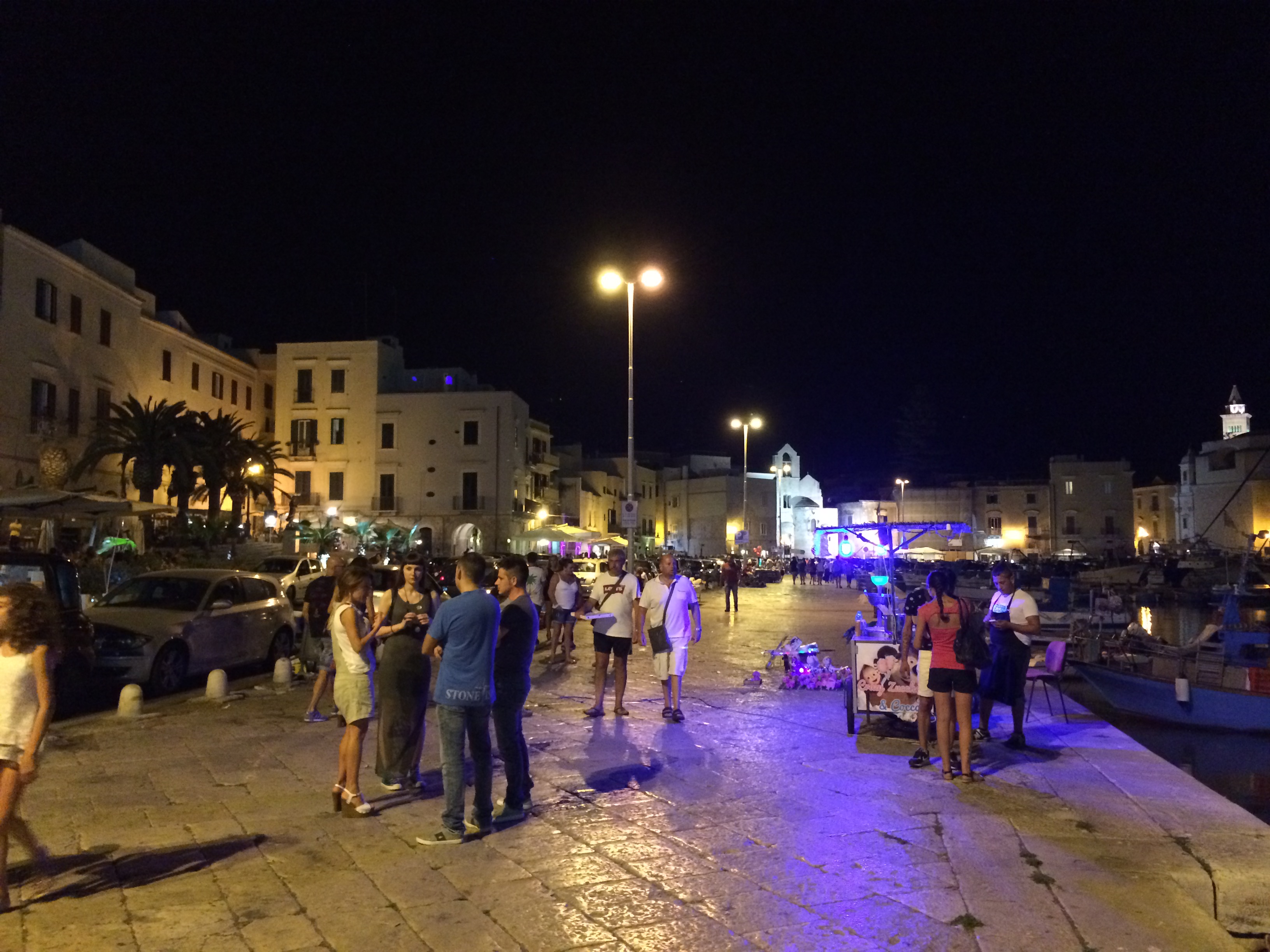
The piazza off the Via Ogni Santo.

Trani has a lively night-life at least in summer and during feast days.
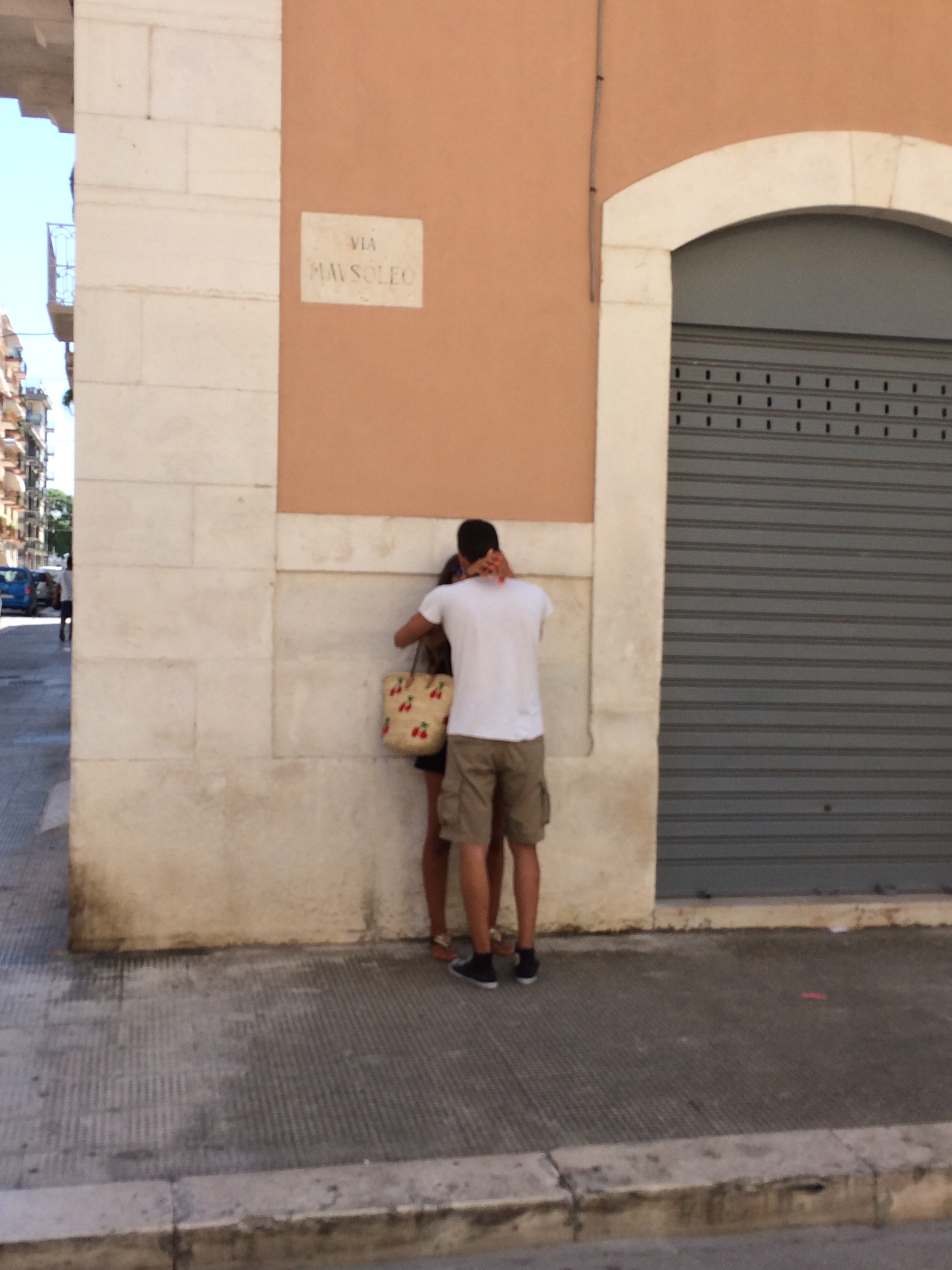
Trani has a lively night-life at least in summer and during feast days.

Romance Tranese-style on the Via Mausoleo, Trani.

Romance Tranese-style on the Via Mausoleo, Trani.

The ancient entrance to our B&B, Porto Trani.

The ancient entrance to our B&B, Porto Trani.

Notwithstanding all the above, Trani is also famous for being the ancestral home of the Centofantis and it was here we would begin our search for information on the origins of Flavio’s family.  We checked into the very friendly and welcoming Porto Trani B&B on the harbour which in the evening transforms from fishing port to an attractive hub of restaurants and promenades.

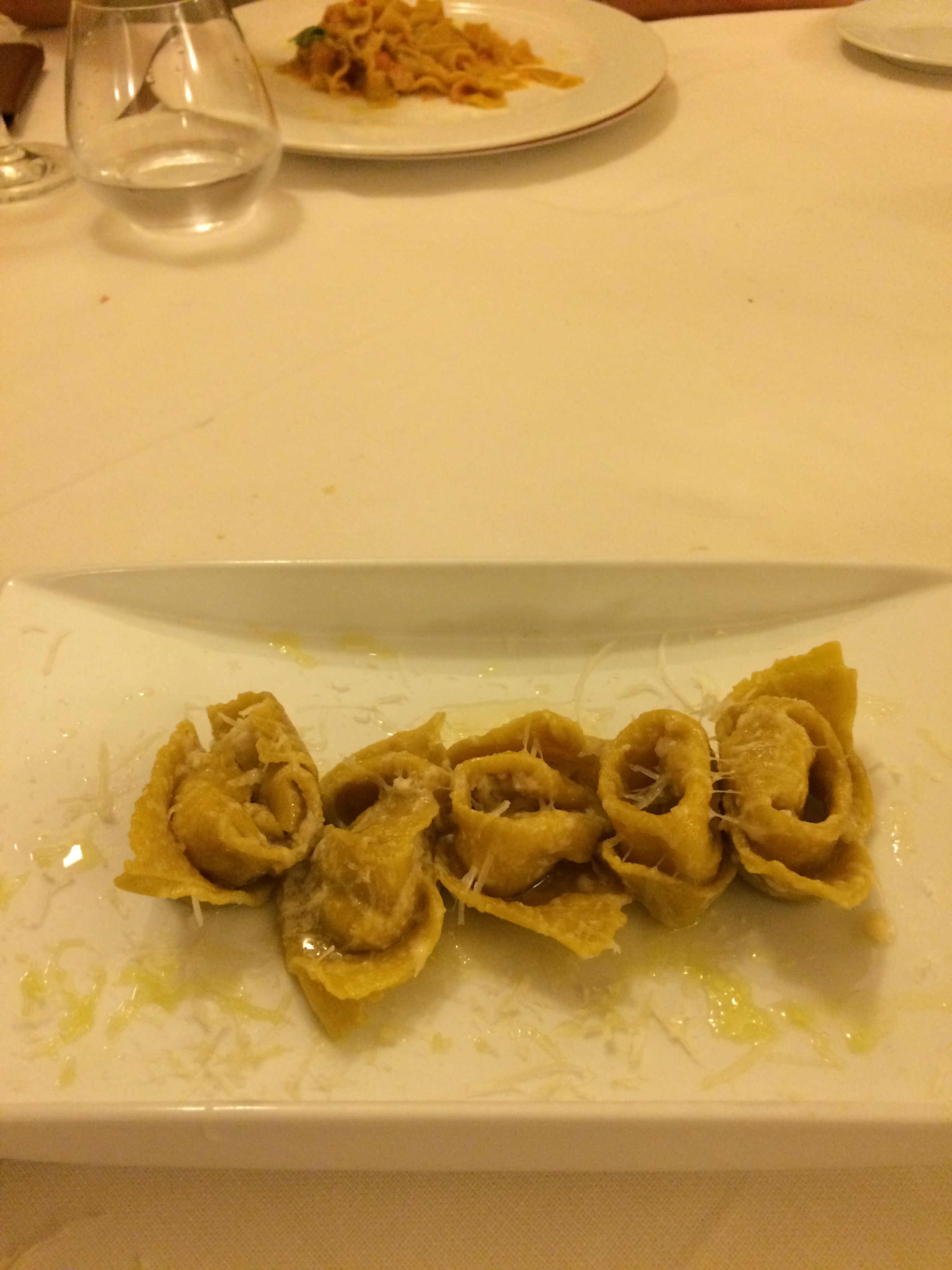
Our first evening was spent in one of the many harbour restaurants with Brenda safely parked, or so we thought, in the Cathedral car park.  Chatting to the waiters after a lovely supper of salcicie and Orechiette con frutta di mare, and ‘Tomaresca’ white wine made principally from the local Minervino Murge grape variety which was a very pleasant discovery for us, we were alarmed by their insistence that we move Brenda to a spot in front of the restaurant as she was not safe.  From what or whom no one would say but the exchange of knowing looks and nods and raised eyebrows were enough to convince us to move her to a spot ‘guaranteed’ by the restaurant would be OK as long as we paid a little something which they would pass to the night watchman! When in Trani, do as the Tranese do, vero o no?

Brenda 'safely' parked next to the restaurant on the water-front.

Brenda ‘safely’ parked near to the restaurant on the water-front.

The orecchiette with seafood and salcicie.

The orecchiette with seafood and salcicie.

Next morning we set off for the ‘Palazzo di Citta’ of the Commune of Trani and were referred to the ‘Capo Settore of the Servici Demografici’, Dott. Vito Luciano Preciosa. Disappointingly, he told us he hadn’t come across the Centofanti name and that we would need to make a request in writing providing as much information as possible to justify them spending the time on it but that in any case, the person in charge of doing any genealogical research was on holiday and would be back until mid-August.  (Later we were told by the owner of the Giudica souvenir shop that he had actually lost his mind and wouldn’t be coming back! Curiouser and curiouser!)  Despite this everyone was very helpful and made suggestions for a way forward.   We had two problems though: all public offices closed at 12 noon for the day and things being as they are here, only one visit a day was possible; the second was that we didn’t have the full name and details of Flavio’s great grandfather who left Italy to work in Alexandria, Egypt.  We therefore  decided to research Flavio’s grandfather, Galileo Centofanti as his passport application should include his parents’ details.

On the way back, Flavio seeks out a ‘parruchiere’ (literally, a wig provider) for a hair and beard trim he’s finally decided to have for at least some measure of relief against the continuing relentless heat.  As well as being a very good barber, Francesco who’s 58 talks interestingly about the history of Trani. “Yes Trani is famous for its marble but the local industry has all but been destroyed.  The Chinese were buying large quantities then realized that they could simply buy entire quarries, ship the blocks of stone to China and pay the Tranese stone cutters three times their salary to transfer their skills in China.” “There’s a reason why manyTranese emigrated to Egypt and to Argentina – to Egypt to work on cutting the banks of the Suez Canal (something Flavio had suspected for a long time) and to Argentina to work on the National Palace, which was entirely made of Trani stone.” “As well as its Muscato wine, Trani is also known for its eating grapes, which are better than anyone else’s in Puglia.”
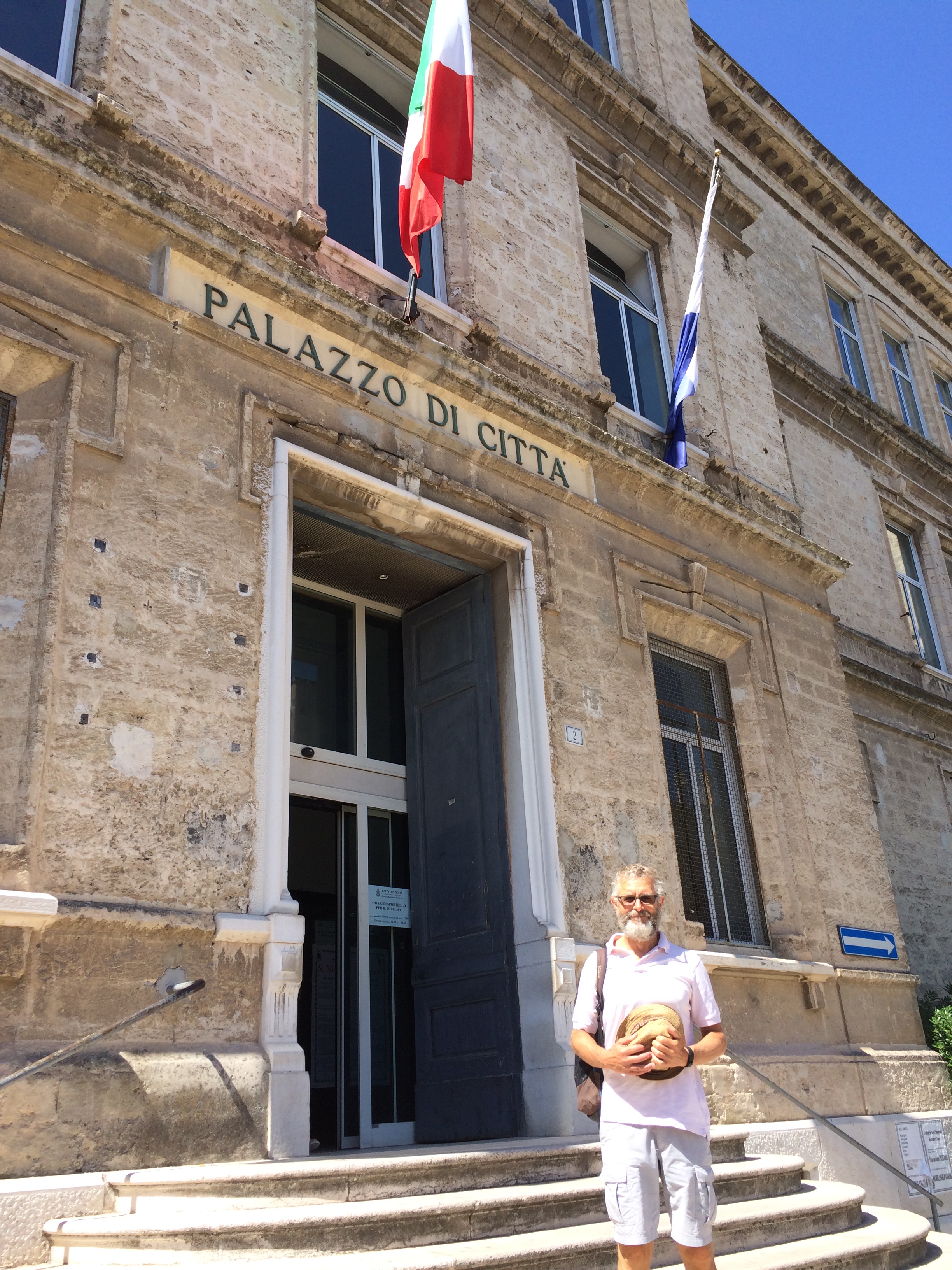
About to enter the 'Palazzo di Citta' of the Commune of Trani, a little nervous without knowing why.

About to enter the ‘Palazzo di Citta’ of the Commune of Trani, a little nervous without knowing why.

The Capo Settore, Dott. Vito Luciano Preziosa's name plate.

The Capo Settore, Dott. Vito Luciano Preziosa’s name plate.
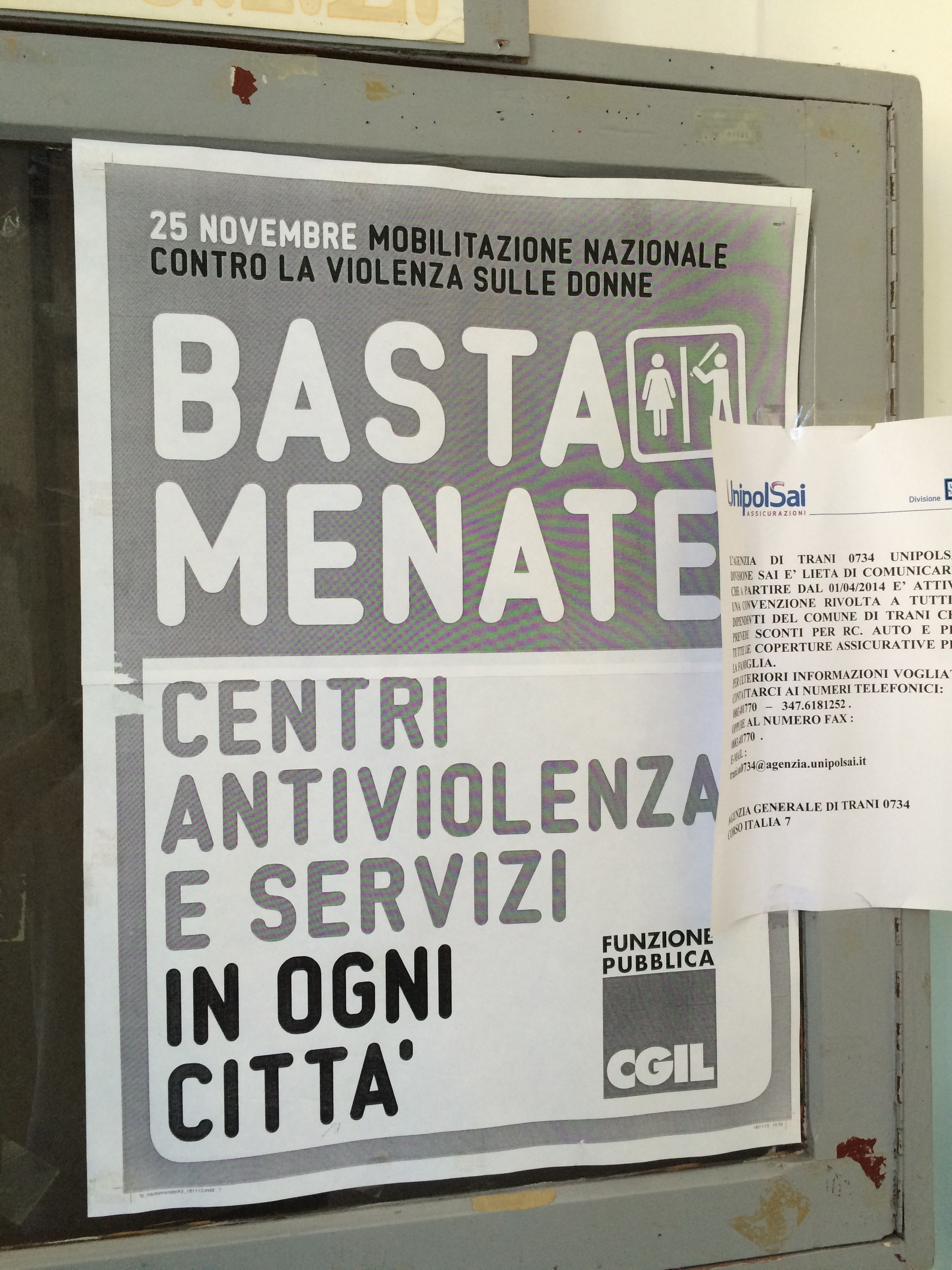
A poster in the Commune raising awareness about violence against women -

A poster in the Commune raising awareness about violence against women – “Stop the threats”.

On the way back, Flavio finally decides to have his first beard and hair trim in 11 weeks. Francesco is 2 years younger and a very good barber.

On the way back, Flavio finally decides to have his first beard and hair trim in 11 weeks. Francesco is 3 years younger, a very good barber and talks interestingly about Trani.
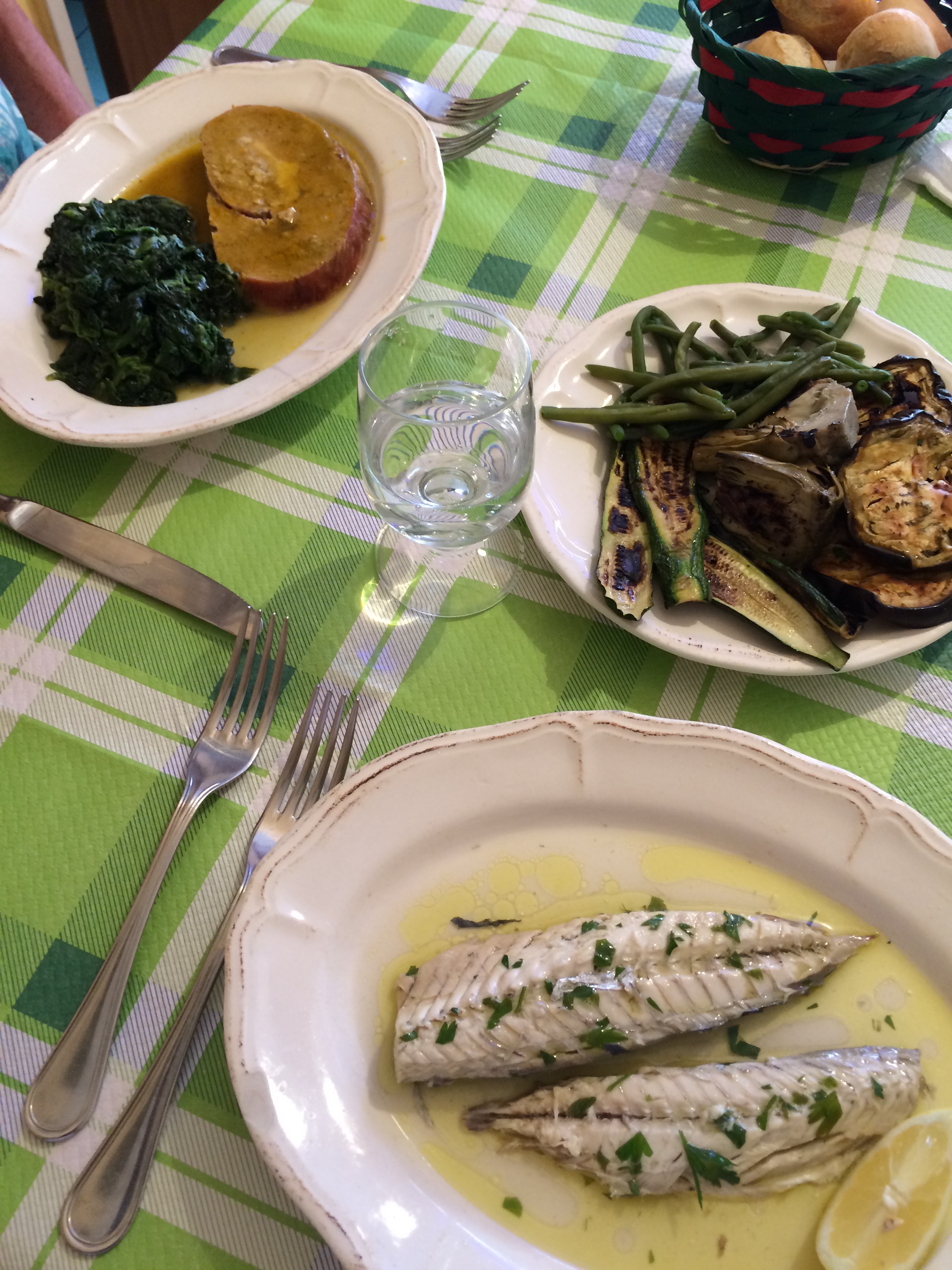
We also stop at a very reasonably-priced canteen next to the station for a light lunch.

We also stop at a very reasonably-priced canteen next to the station for a light lunch.

Posters of 'Toto', the hilarious old Italian comedian of our childhood on the walls.

Posters of ‘Toto’, the hilarious old Italian comedian of our childhood on the walls.

Mocking fascism.

Mocking fascism.

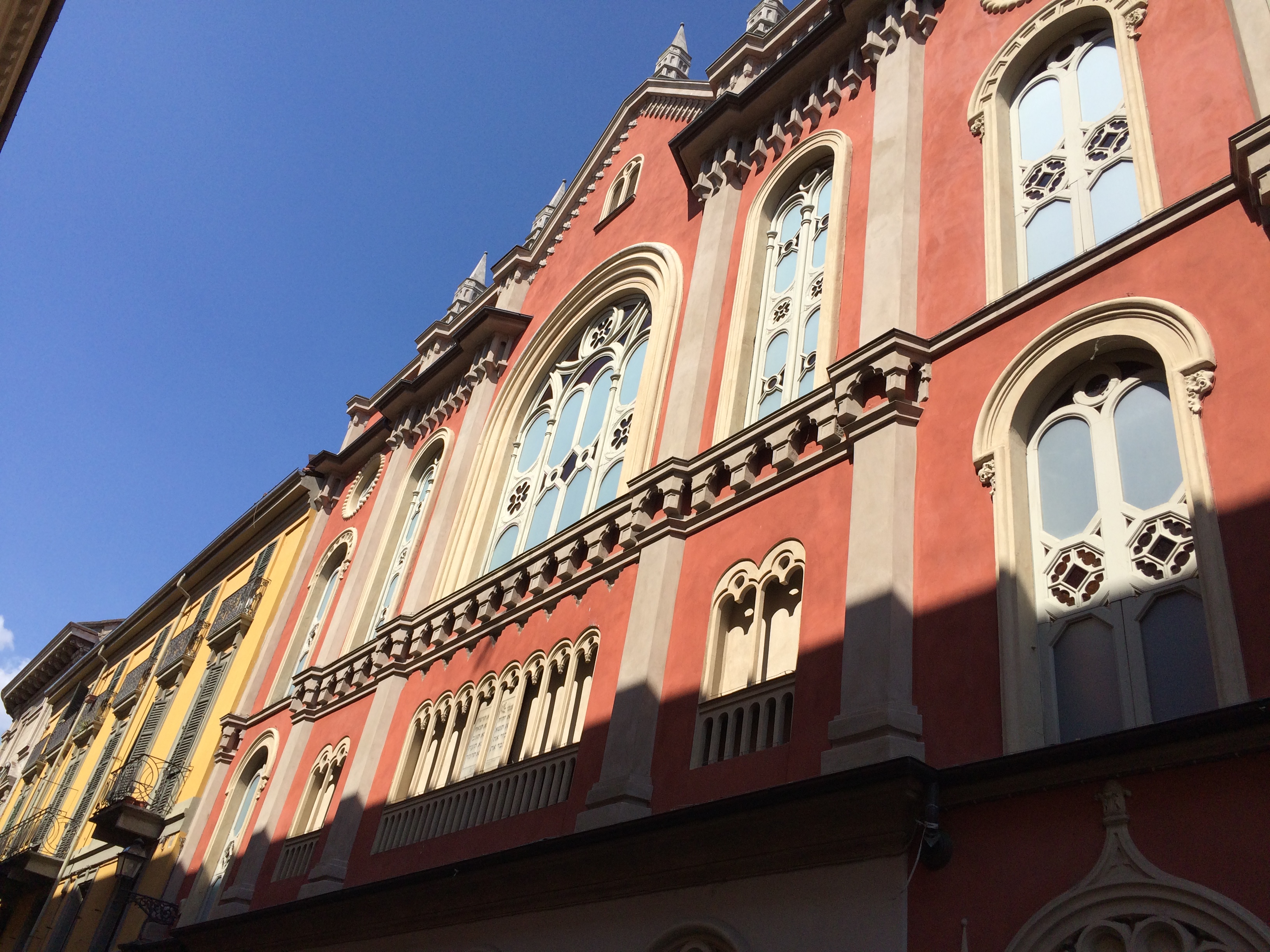
The afternoon was spent exploring Trani’s medieval town, a labyrinth of narrow streets and alleys which remain a living community despite the gift shops, artisans workshop and tourist sites. The medieval town has a Jewish quarter which houses the oldest Jewish temple in Europe.  There is a church and hospital once belonging to the Knight’s Templar along with many ancient churches.  Every so often the streets would open onto a piazza with coffee shops and restaurants.  Our tour ended at the cathedral on the harbour.  Walking through Trani we decided to approach local, mainly older people, to see if they recognised the Centofanti name.  It was quite disheartening to keep coming up with blanks.  Later in the evening we stopped in a gift shop and Flavio began chatting to the owner about our reasons for being in Trani.  He was fascinated with our search and said there was a book about old Trani families which he would try and get us a copy of.

Later that evening, walking past a small unprepossessing cafe/restaurant out of which classical music was blaring, Flavio was stopped by the owner almost as though he had had prior knowledge that he’d pass by and of his search. “Where are you going? Stop.  Let me make you a coffee, or have a bichiere on me.  Who are you?” “Centofanti? ma come no ci sono Centofanti? Come back tomorrow and I’ll take you to some Centofantis.” His name was Marchese and Flavio wasn’t sure whether to be fascinated by or slightly suspicious of his eccentricity.  “Ma si che conosco i Centofanti, they were like us, the Fabiano family.  We both had the best fishing boats.” “I could have guessed you were a Centofanti.  You’ve got a Centofanti face and Centofanti mannerisms.”  “Come back tonight, or tomorrow and I’ll tell you some more.”  Flavio’s sister Laura, who knows Italy better than the rest of us, had told us not to be gullible and always believe what people said and so we were accordingly wary.  He had some interesting old framed photos on the wall and claimed to have met Prince Charles and Lady Di when they stopped in Trani to visit the cathedral shortly after they were married – their first port of call in Italy.

A group of older citizens of Trani chilling out in the late afternoon - they were happy to have their photo taken.

A group of older citizens of Trani chilling out in the late afternoon – they were happy to have their photo taken.
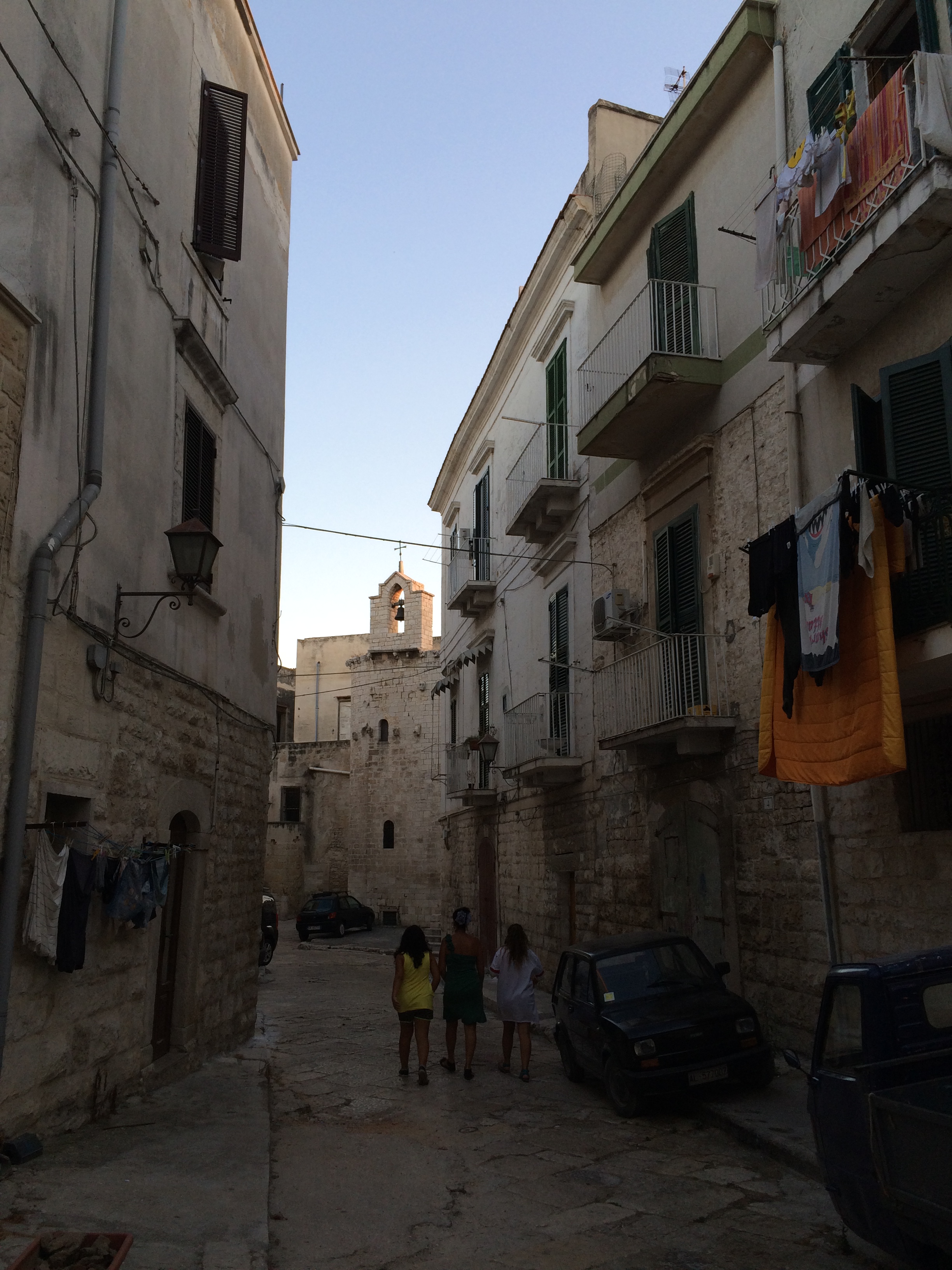
The Via Sinagoga - Trani once had a thriving Jewish community. Jews still come every year to celebrate Hanukah.

The Via Sinagoga – Trani once had a thriving Jewish community. Jews still come every year to celebrate Hanukah.

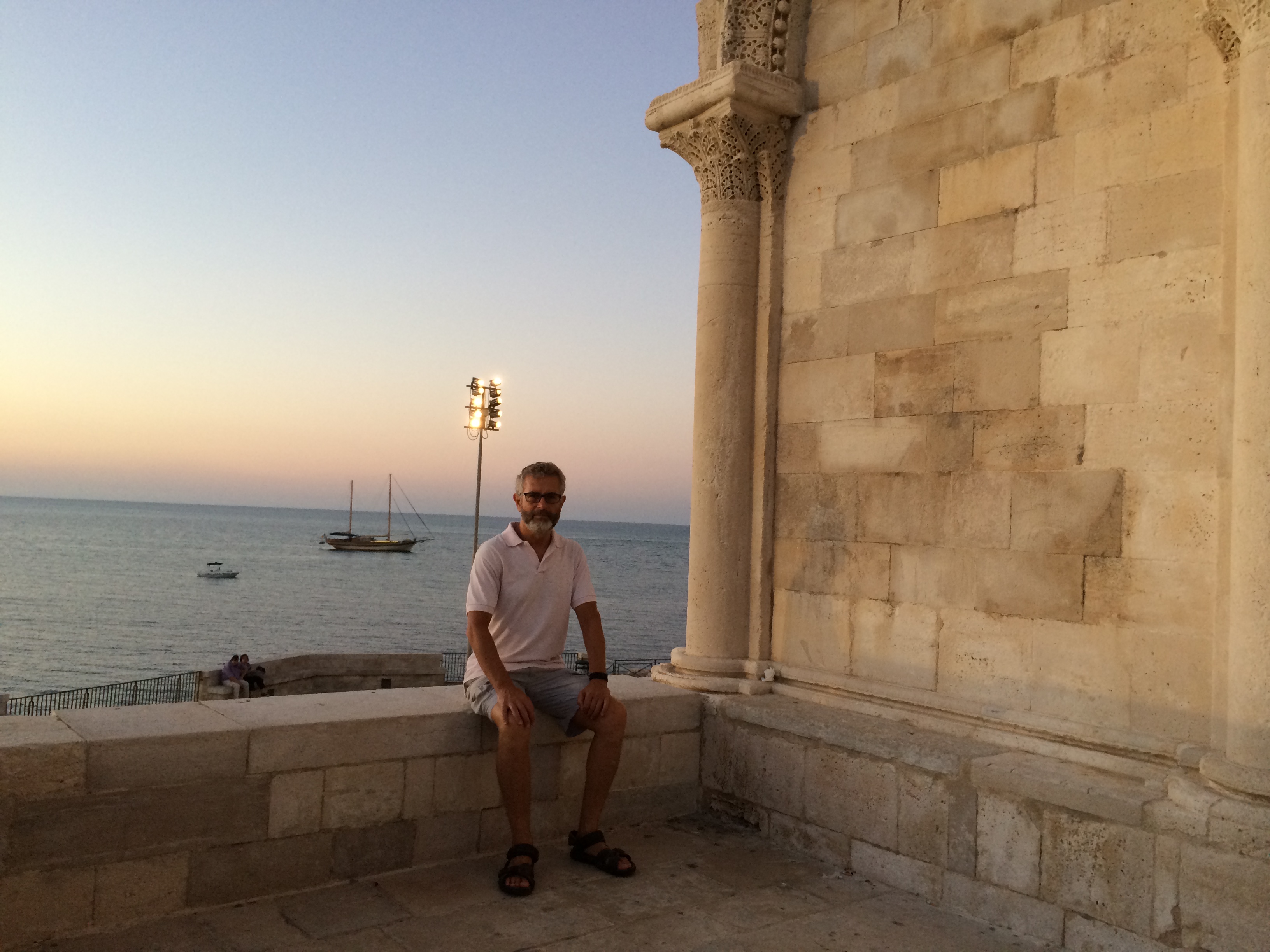
In front of Trani's magnificent cathedral.

In front of Trani’s magnificent cathedral.

Sandro, the friendly and helpful owner of the Giudeca souvenir shop - interested in helping us with our quest.

Sandro, the friendly and helpful owner of the Giudeca souvenir shop – interested in helping us with our quest.

Marchese Fabiano:

Marchese Fabiano: “You’ve got a Centofanti face and Centofanti mannerisms”.
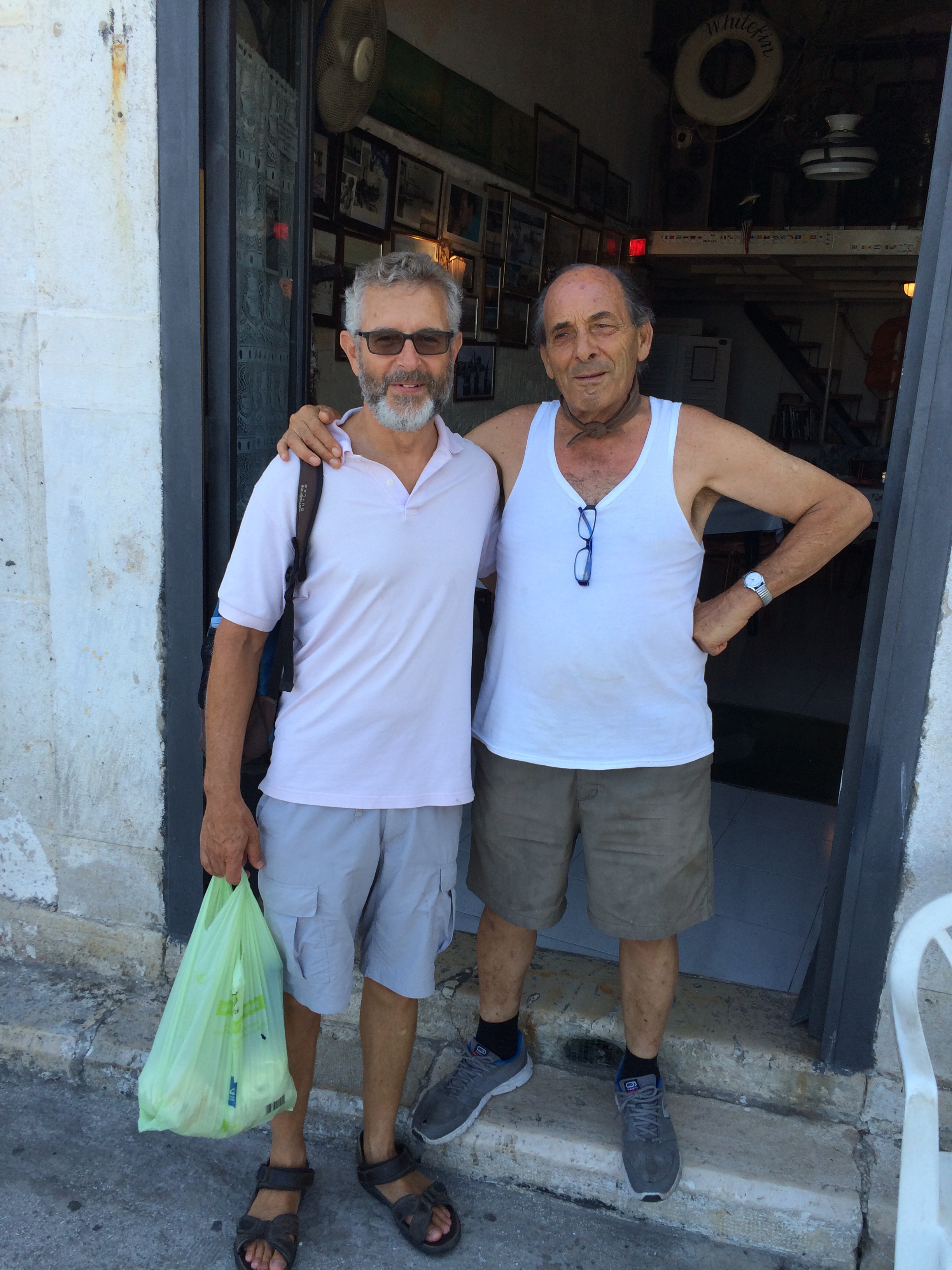
“Ma come non ci sono Centofanti?”

“I Centofanti avevano una barca” said this old Tranese sitting outside the Porto Trani B&B.
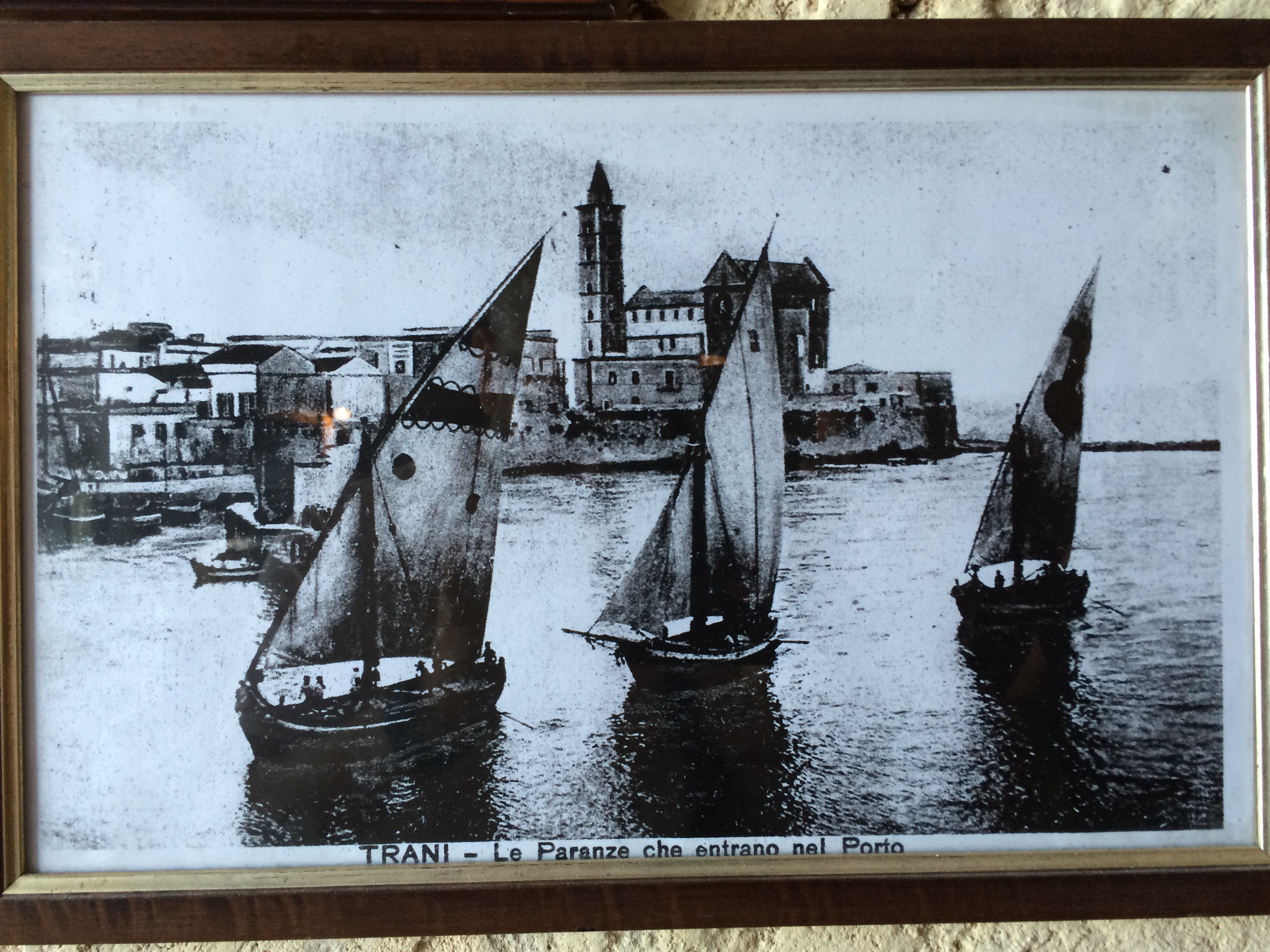
One of the old photos on Marchese's walls showing old 19th century fishing boats in Trani.

One of the old photos on Marchese’s walls showing old 19th century fishing boats in Trani.

True to his word, the next day Sandro had a copy of the promised book for us and it turned out that Centofanti was an old Trani family.  One chapter in the book details a massacre in Trani carried out by France’s Nepoleonic army.  Listed amongst the names of the dead was a Centofanti.

The next morning we went to the Ecclesiastical Records office and had a long chat with Monsignor Savino Giannotti,  Vicario General (effectively the Deputy Bishop).  He was very helpful and confirmed immediately and without hesitation “ma si, come non ci sono Centofanti?  Ansi, e una famiglia famosa e nobile” (who says there aren’t any Centofantis. Of course there are – indeed it’s a famous and noble family!)  He took our details and promised, as soon as he received a request from us in writing, to begin his research and get back to us, though nothing would happen until September as the office was about to close for the summer vacation.  He was a lovely amiable chap and gave us a present of a book about St Nicola il Pellegrino, the patron saint of Trani.  Not to be confused with St Nicola of Bari who was an old man like me said Monsignor Giannotti pointing at my grey beard!  “St Nicola il Pellegrino came from Greece and was passing through Trani on his way to doing a pilgrimage in Rome. Being a very simple and devout young man, he spent his time preaching holiness and purity of lifestyle but died in Trani and became our patron saint. ” What did he die of? “Of repeated ‘colpi’ (blows) he got from people for getting up their nose.” How old was he? “18.”

The Vicario General's residence.

The Vicario General’s residence.

Monsignor Giannotti, Vicario General.

Monsignor Savino Giannotti, Vicario General. “Centofanti e una famiglia famosa e nobile”.

Monsignor Giannotti signing a copy of a book on St Nicola il Pelegrino, Trani's patron saint.

Monsignor Giannotti signing a copy of a book on St Nicola il Pelegrino, Trani’s patron saint.

The cathedral where San Nicola il Pellegrino is buried.

The crypt of cathedral where San Nicola il Pellegrino is buried.

Meanwhile Flavio had emailed his cousin Mario in Australia to see if he had any information about their mutual great grandfather.  Mario spoke to his mother and got back to us to confirm that his mother couldn’t remember the name of her grandfather as the ‘family’ didn’t talk about him.  It seems he could have had a partner and child in Italy and a wife and six children in Italy and/or Alexandria, Egypt.

When we married the Italian Consulate in London insisted on taking our original marriage certificate and sending it to Bari.  Whenever Flavio had to renew his passport Judith had to go to the Italian Consulate with proof of marriage and sign the application forms.  When questioned they said it was to prevent Italian men having ‘a wife in each port’.  So maybe it was a problem and Flavio’s great grandfather was just keeping up with tradition?

Leaving Trani for Bari we were informed by the very same waiters we met on the first night that Bari was dangerous and we should be vigilant but they again failed to say why or from whom. So off to Bari we went, praying to the two Saints Nicola to watch over us!
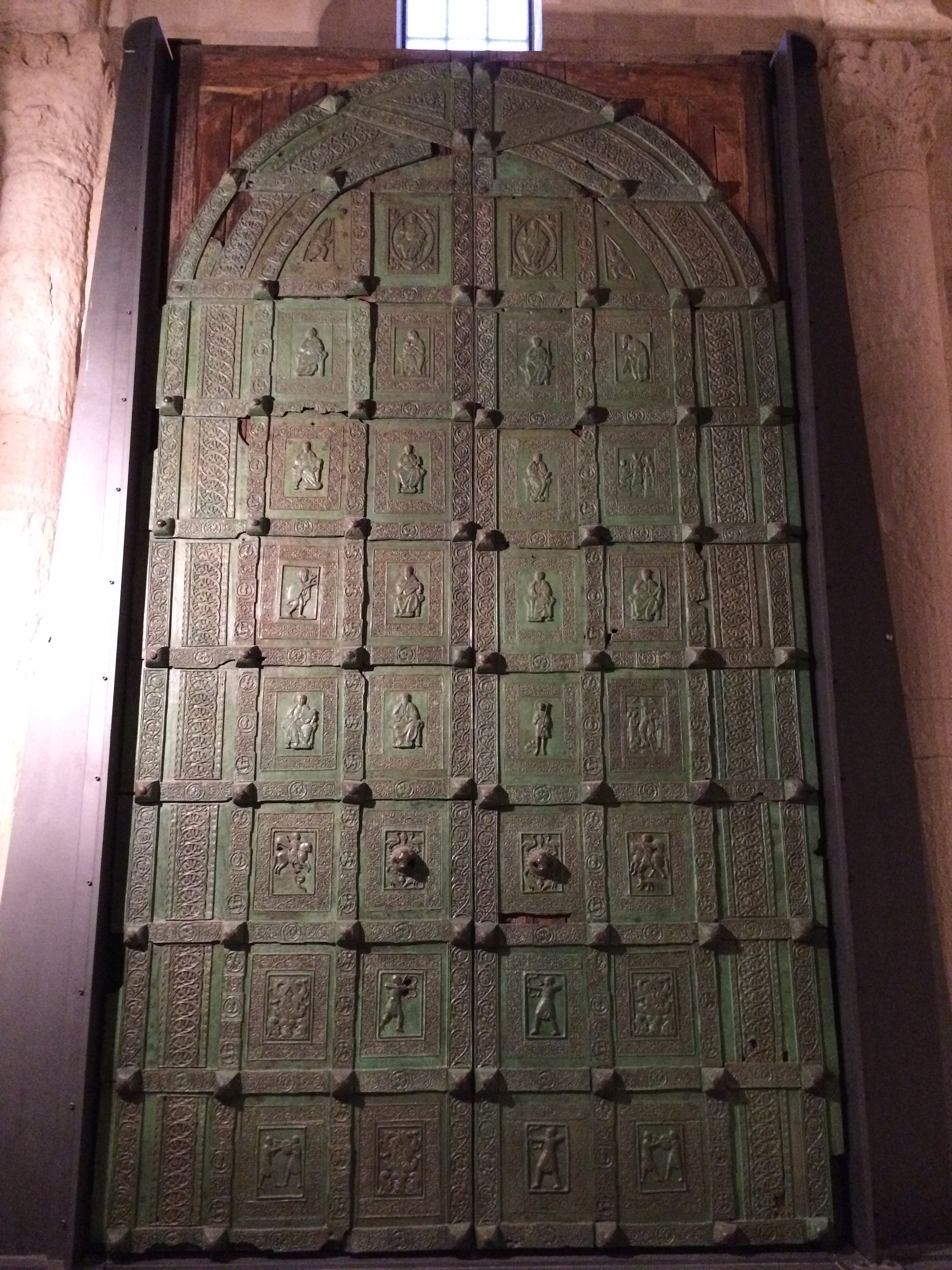
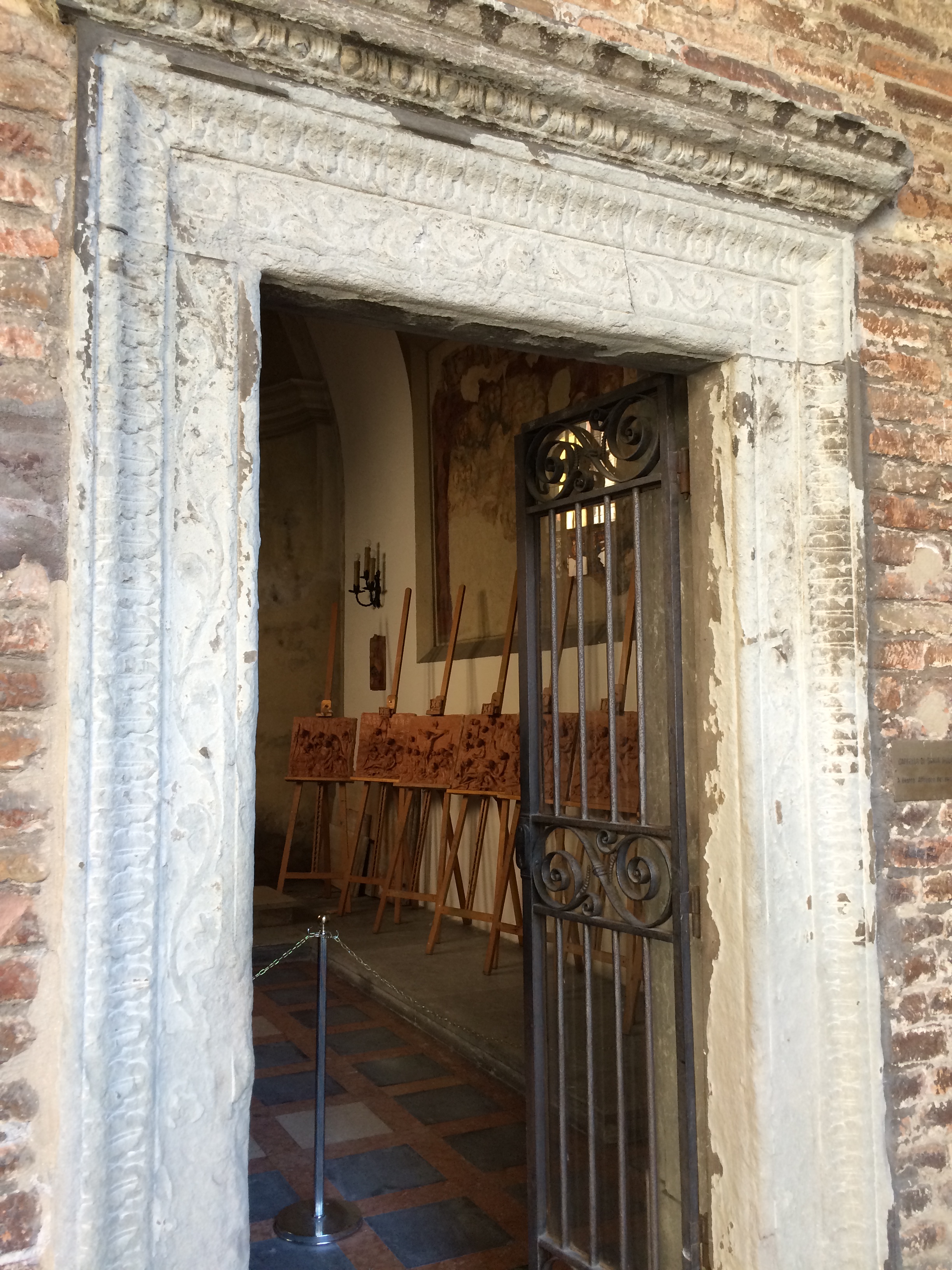
The medieval bronze door of the cathedral.

The medieval bronze door of the cathedral.

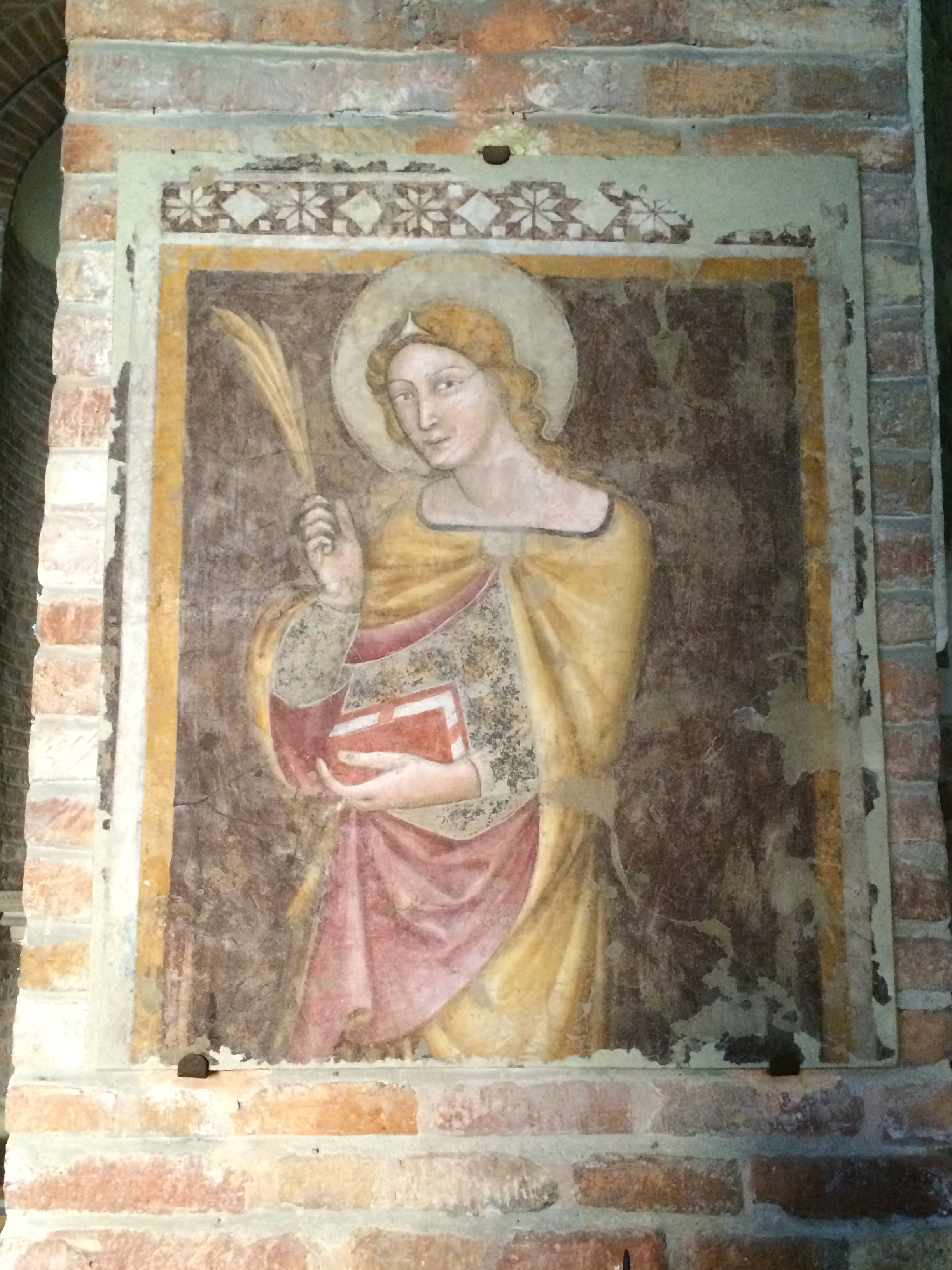
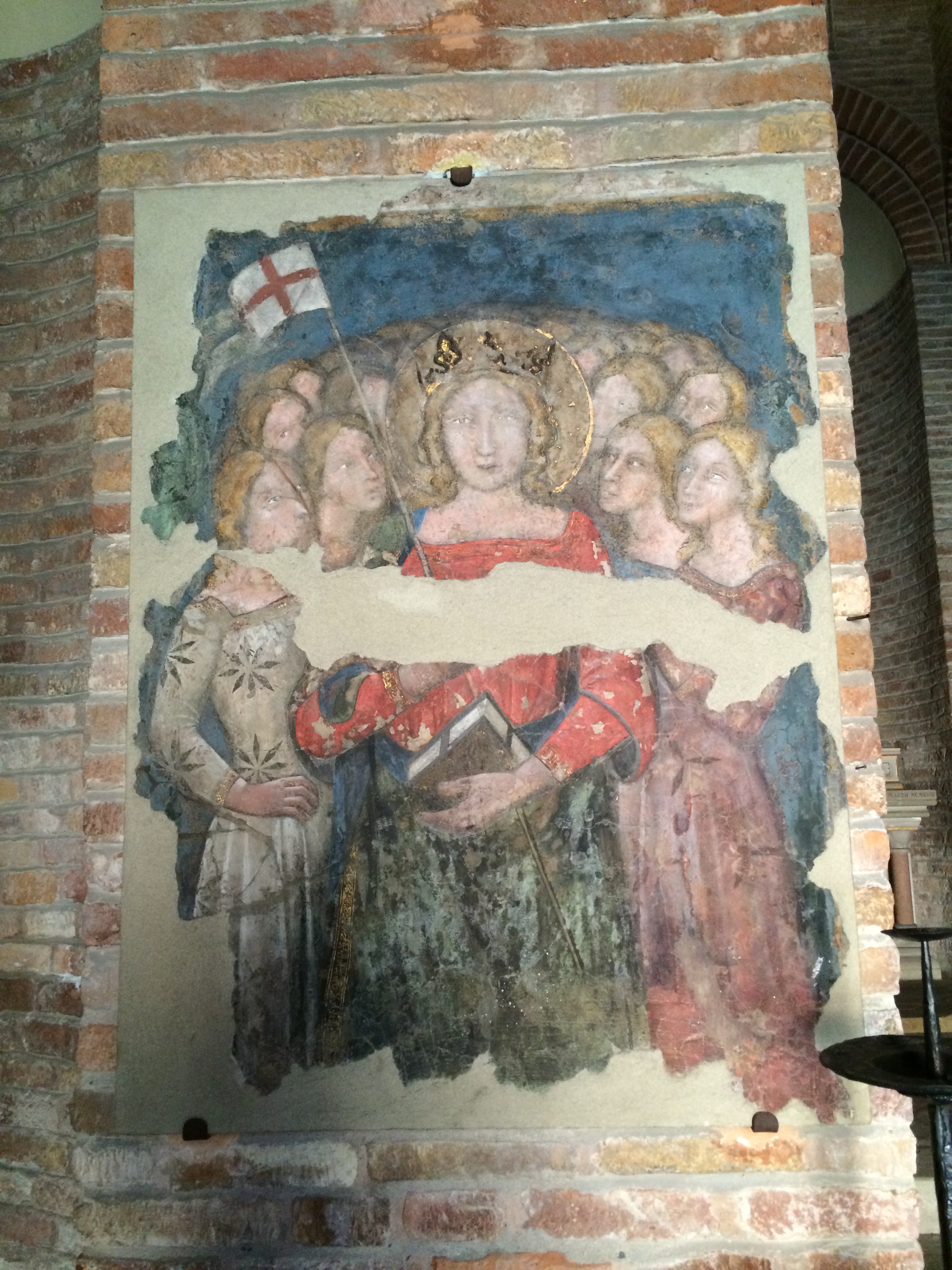
A very old fresco in the crypt of the cathedral.
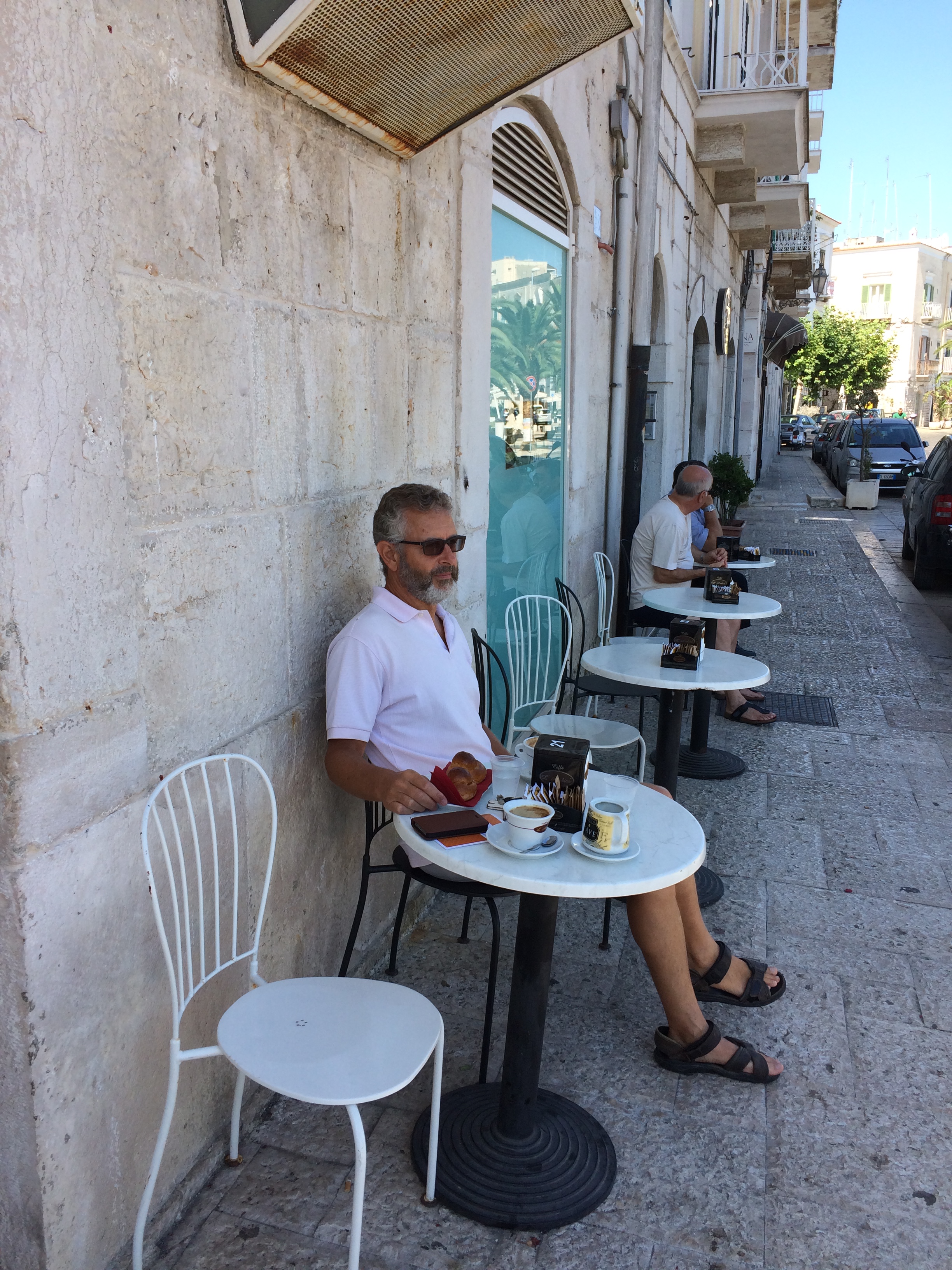
A very old fresco in the crypt of the cathedral.

H
H

F

F

IMG_5136

IMG_4987

Sunday 26th and Monday 27th July – and so to Puglia

Standard

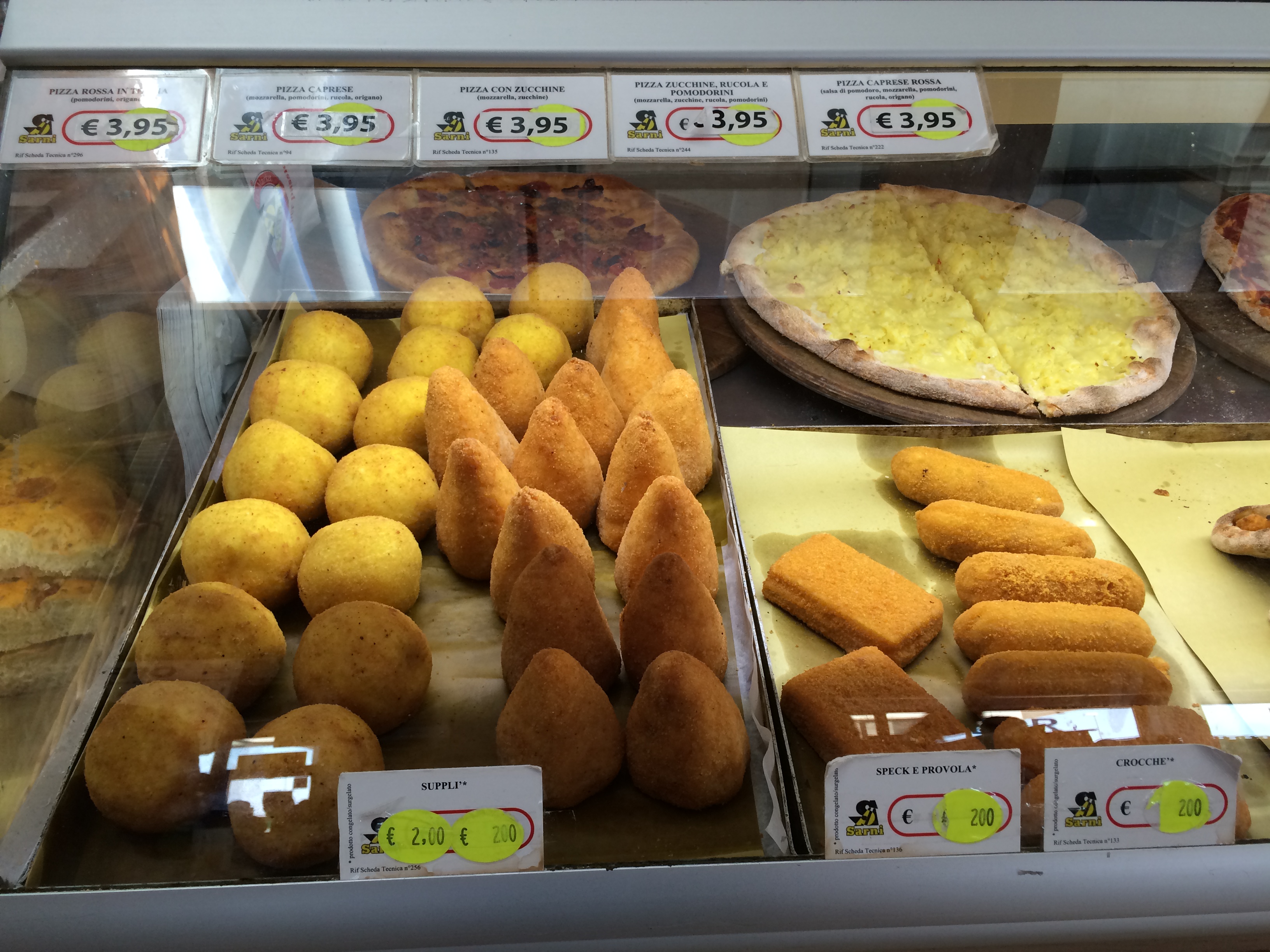
We press on down the Adriatic coast past San Benedetto, Roseto degli Abruzzi, Montesilvano and Pescara which we decide to take a quick look at but finding nothing of especial interest, drive straight out again.  Then further south still past Ortona, Vasto and Termoli and we finally reach Apricena where, stopping at a service station and seeing the array of ‘suppli’ and other Pugliese food on offer we realise we’ve reached Puglia. ‘Suppli’ are mozzarella and ham or meat-filled rice balls or cones often eaten as antipasti. They used to be served at the Italian Club restaurant at the back of the Italian consulate in Boulaq in Cairo – sadly, it’s very doubtful this will still be open after the attack on the consulate not long ago. These suppli were giant-sized and easily make a meal in themselves.

Headed for Trani and Bari in Puglia.

Headed for Trani and Bari in Puglia, Flavio’s ancestral home.

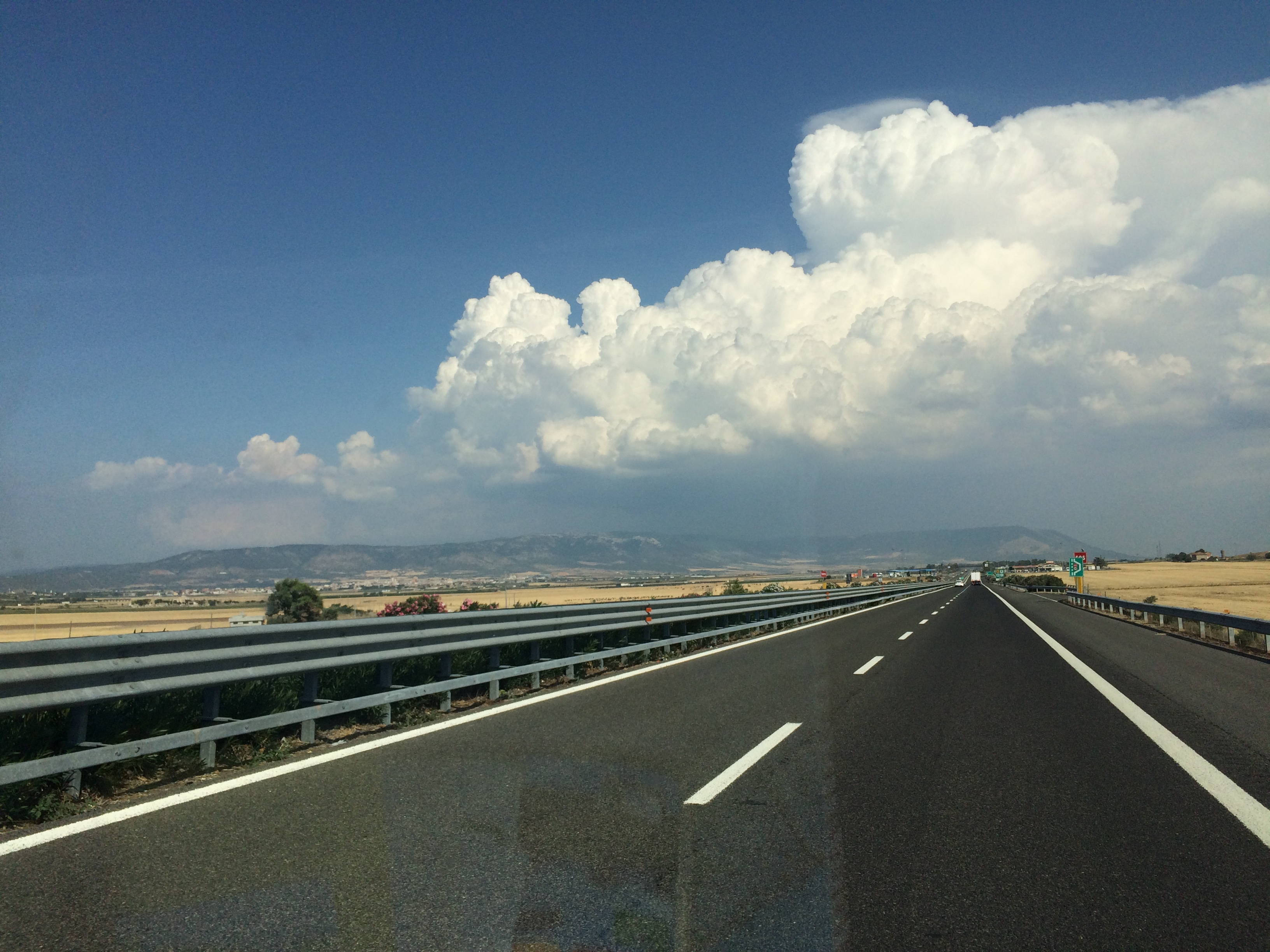
The road at Apricena.

The road at Apricena – pretty good and much less busy than in the north.

Selection of Pugliese food on offer at the service station in Apricena including the famous 'suppli.

Selection of Pugliese food on offer at the service station in Apricena including the famous ‘suppli’.

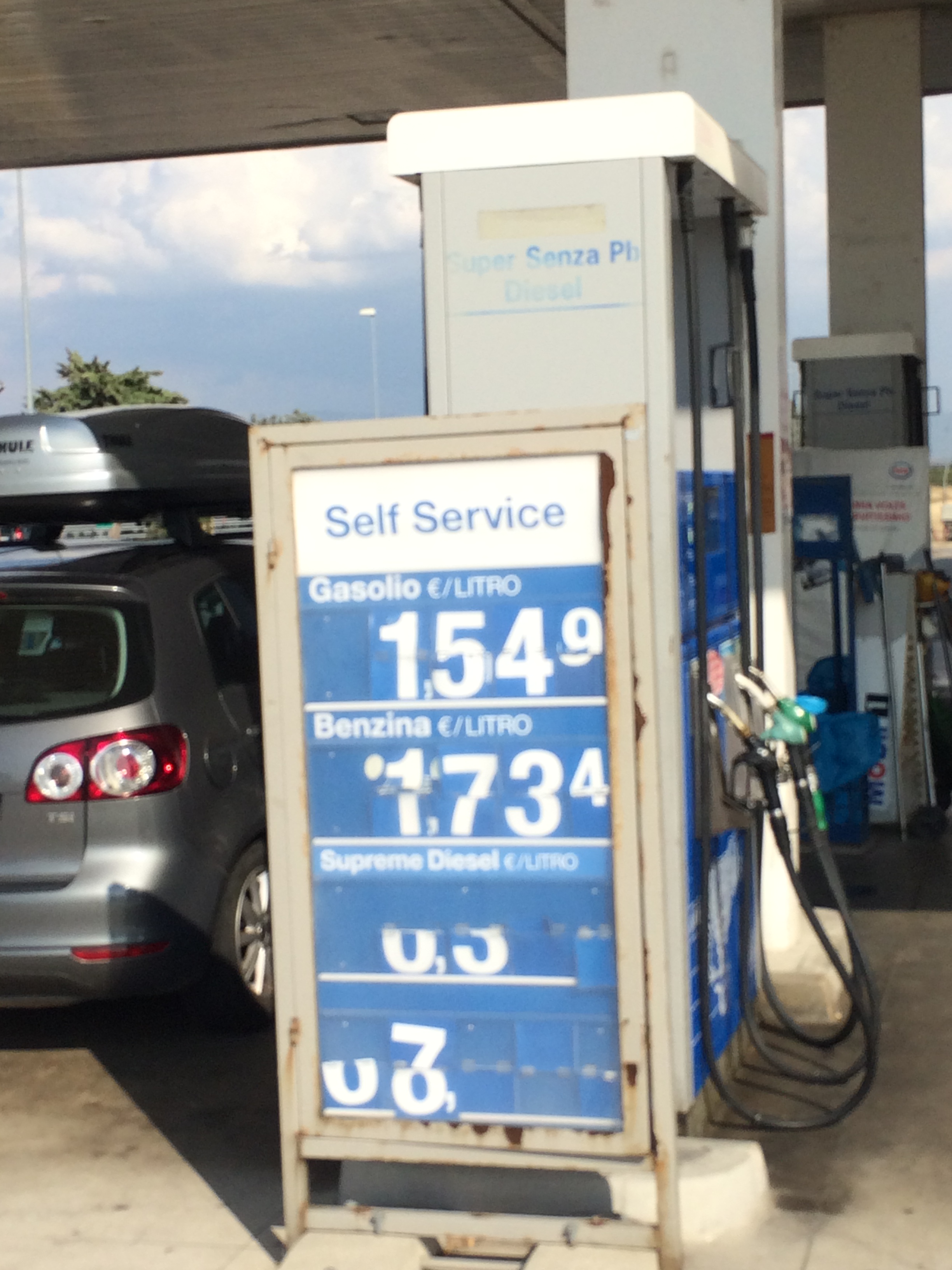
The price of diesel however was the highest we'd come across in all our travels so far.

The price of diesel however was the highest we’d come across in all our travels so far. The cheapest were Portugal and France.

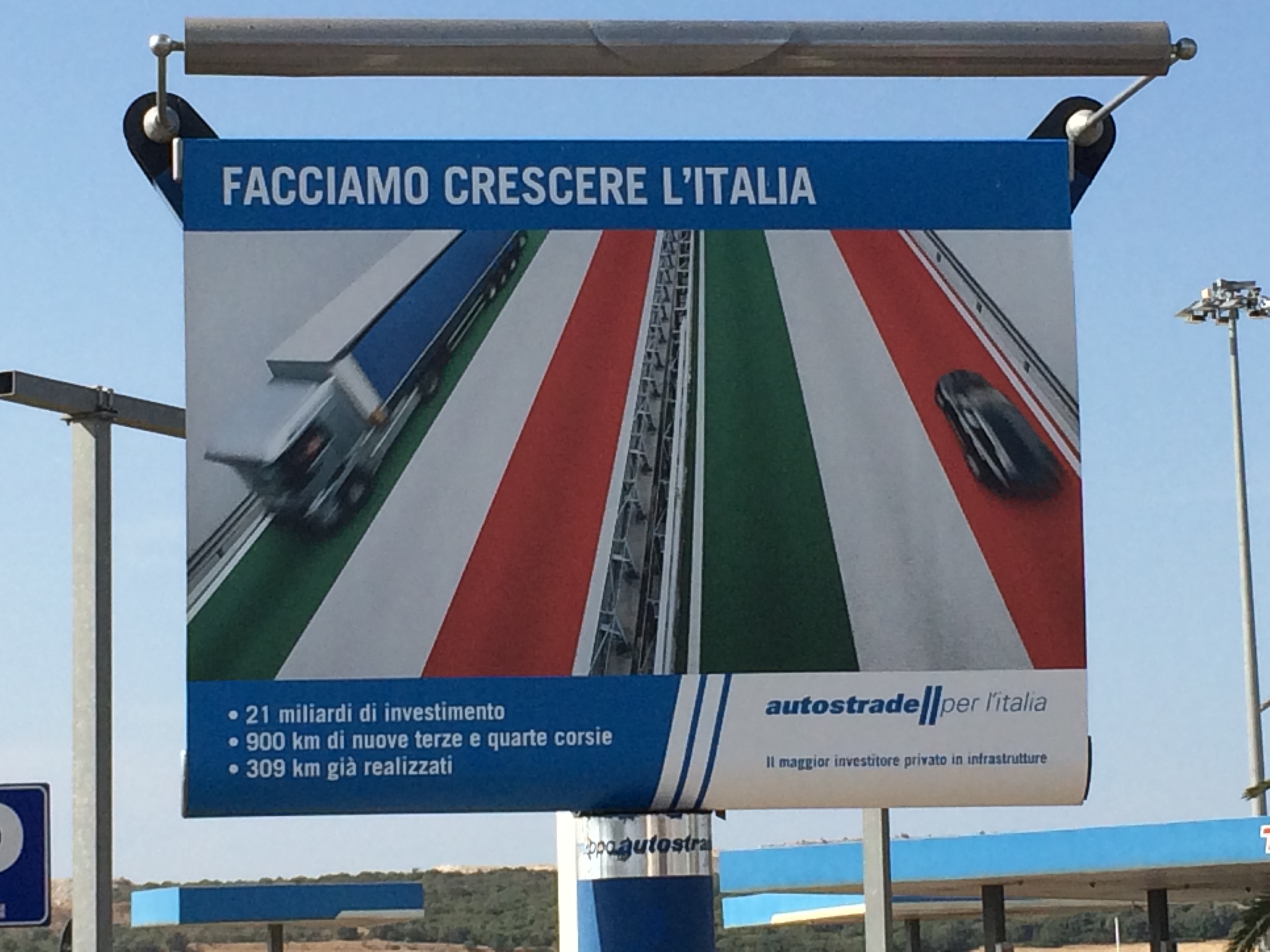
Hoarding at Apricena advertising private infrastructure investor 'Autostrade per Italia's plans to invest Euros 21 bn on 900 kms of new motorways.

Hoarding at Apricena advertising private infrastructure investor ‘Autostrade per Italia’s plans to invest Euros 21 bn on 900 kms of new motorways.

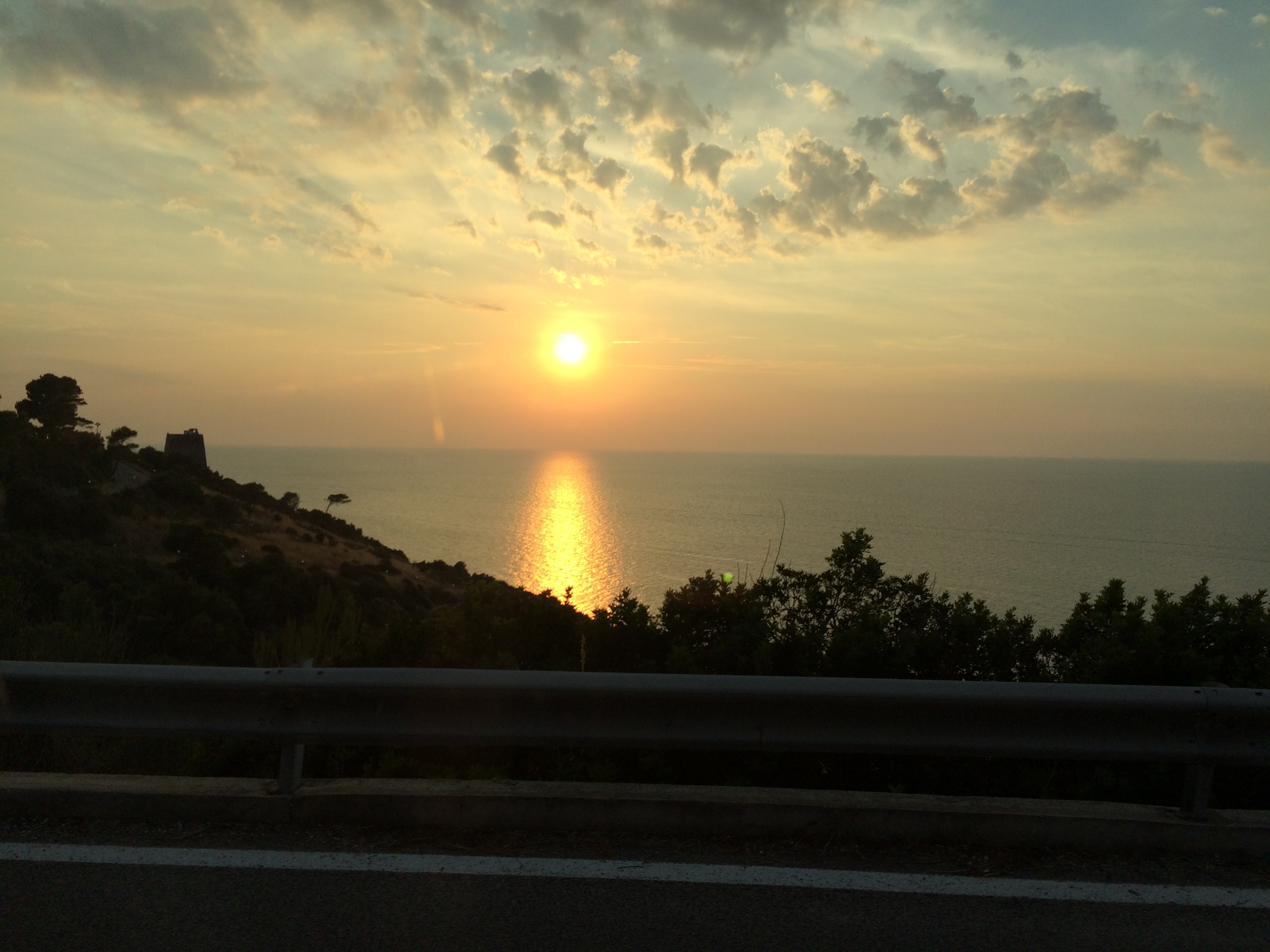
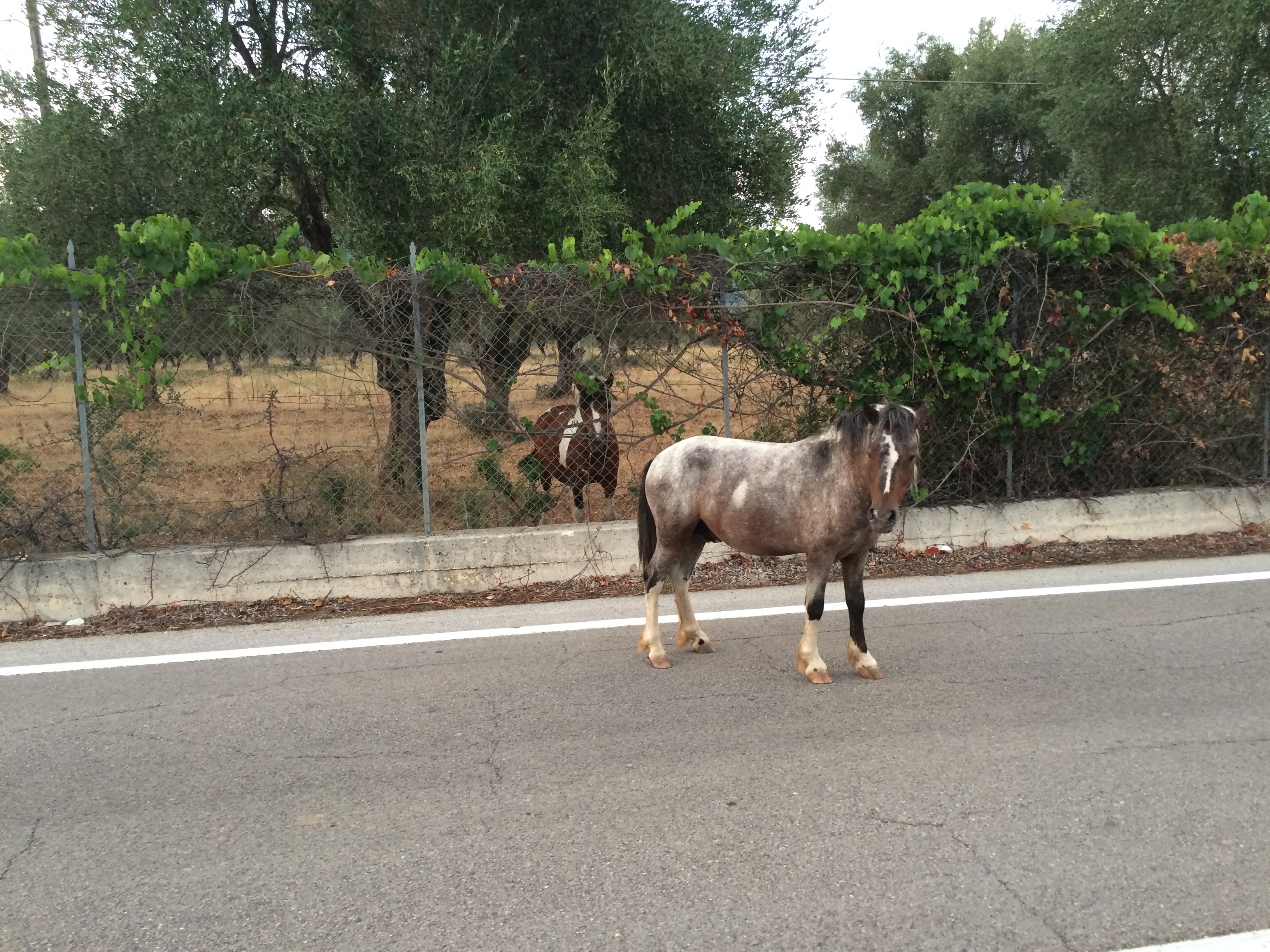
The spur that is the promontory just above the heel of Italy is called the ‘Gargano National Park’.  It is an area of outstanding natural beauty.  Having driven inland on the main autostrada which circumvents it we decided it would be a shame to miss it so we turned eastward at San Severo to rejoin the coastal road. We got onto a very narrow and long natural corridor between the Adriatic to our left and the vast Varano Lake to our  right before negotiating the impossibly windy and mountainous road tracing the outline of the spur.  It was gone 8pm and we had been on the road since lunchtime so were getting quite desperate to find a suitable campsite.  A couple of places we stopped at on the ‘corridor’ turned out to be large holiday camp places that couldn’t be further removed from our idea of relaxation so we pressed on round vertiginous bends as the sun was setting. At one point we had to brake suddenly when an apparently  stray horse appeared on the road.  It had obviously somehow got out of its enclosure and another horse, within the enclosure was looking out with concern. We stopped a car coming out of a country lane further down the road and raised the alarm.  Luckily, they knew who it belonged to saying it had happened before and that they’d deal with it. That was a relief.

Olive groves line the road at San Severo.

Olive groves line the road at San Severo.

Sun setting as we drive past Peschici in Gargano.

Sun setting as we drive past Peschici in Gargano.

Disoriented-looking horse wandering on main road on its own as we approach Vieste.

Disoriented-looking horse wandering on main road on its own as we approach Vieste. Is this anything to do with ‘cacciacavallo’?

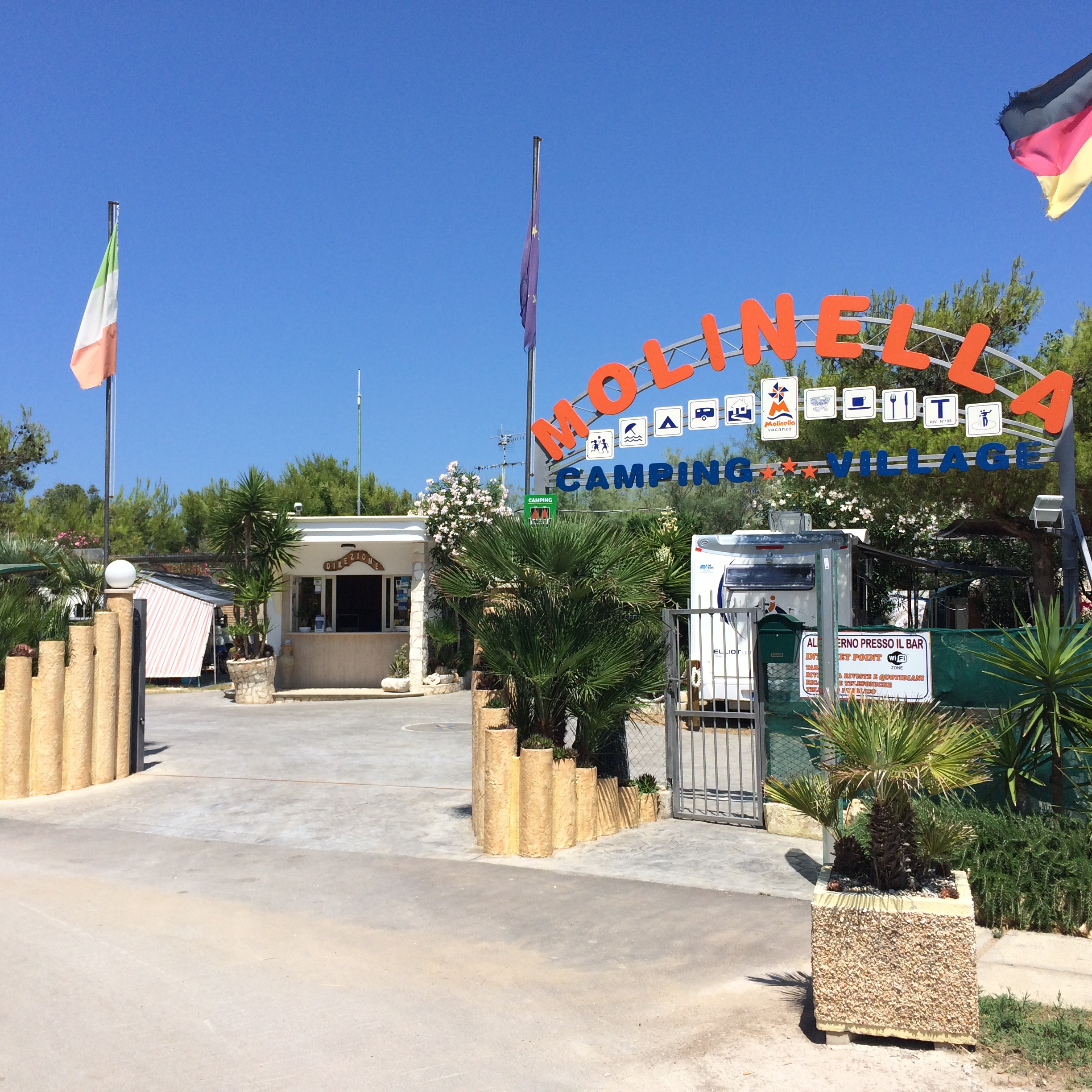
The Molinella Camping Village in Vieste - it ticked all the boxes.

The Molinella Camping Village in Vieste – it ticked a lot of the boxes.

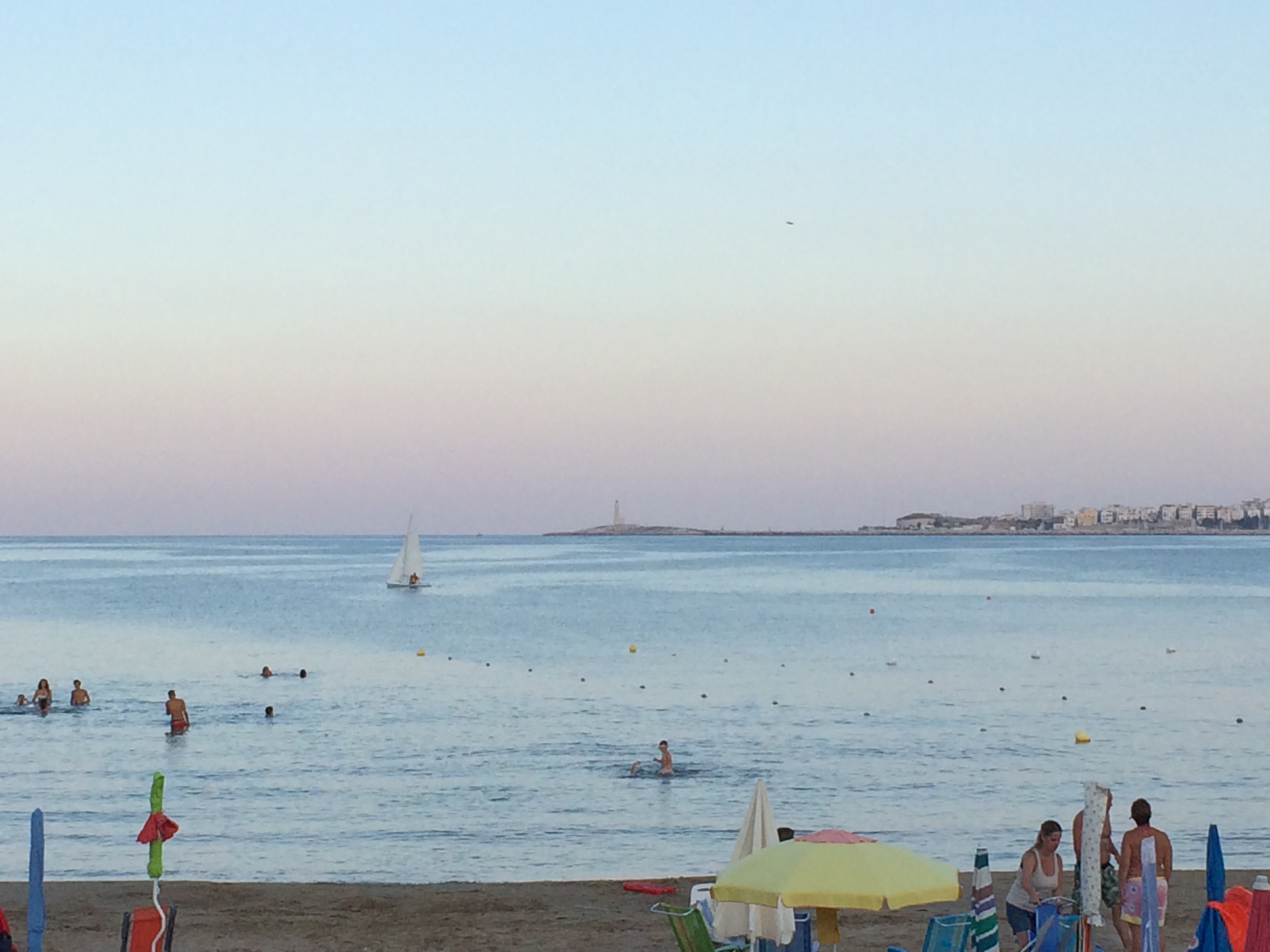
The beach at Molinella with Vieste appearing in the background.

The beach at Molinella with Vieste appearing in the background.

Cycling into Vieste.

Cycling into Vieste.

The place we found in the end – the Molinella Camping Village just south of the beautiful little town of Vieste – turned out to be our best campsite in Italy to date!  Situated at the very tip of the ankle bone in the heel of Italy and looking out to Podgorica or Tirana across the Adriatic. Molinella was a lovely place on the beach and with lots of shade, good loos and very friendly staff and other (mainly Italian) campers, what more could you want.  Fewer and less noisy daytime and evening activities perhaps but that would be going a tad too far! The sea was warm and crystal clear and cried out to be swum in.

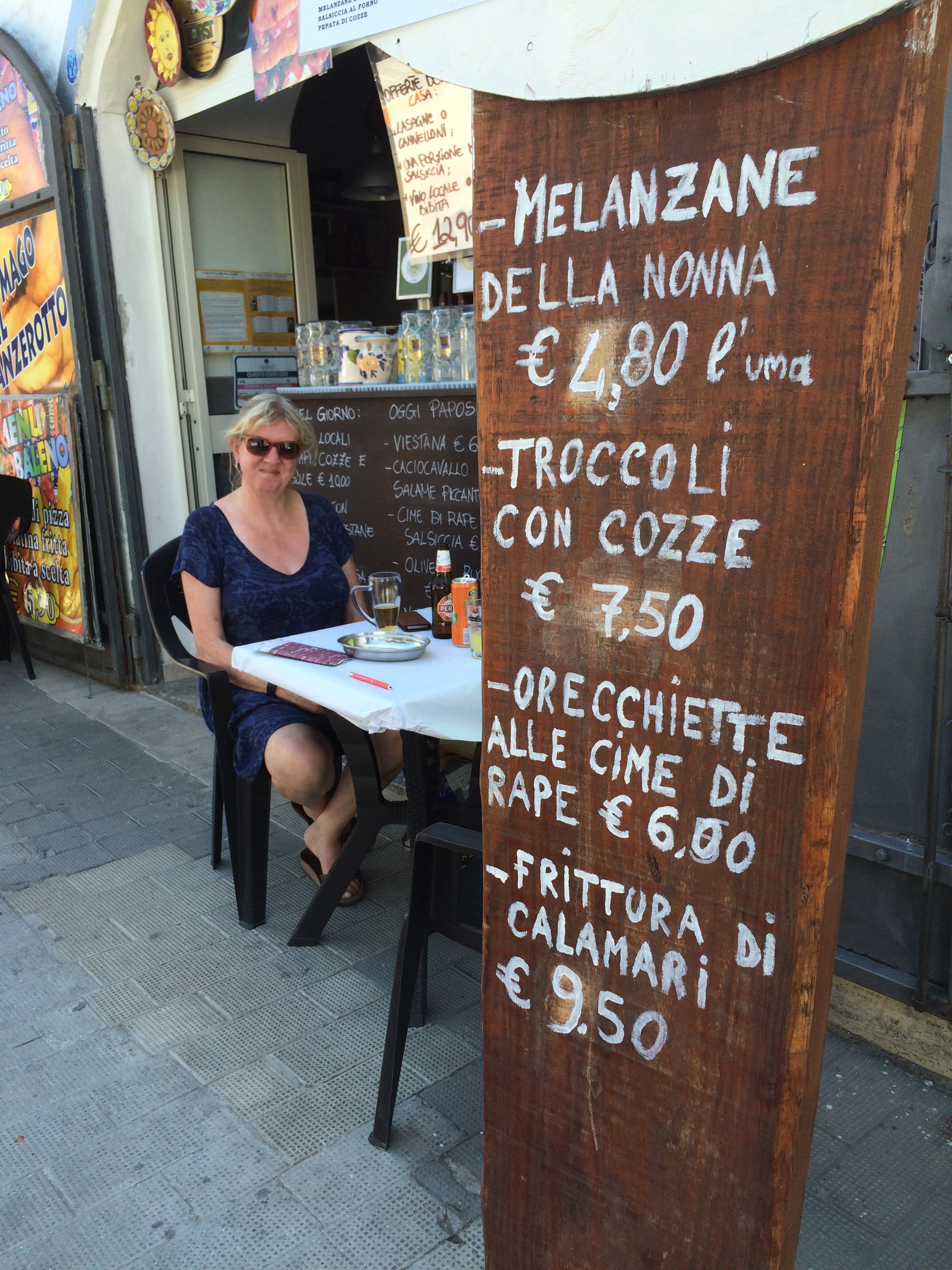
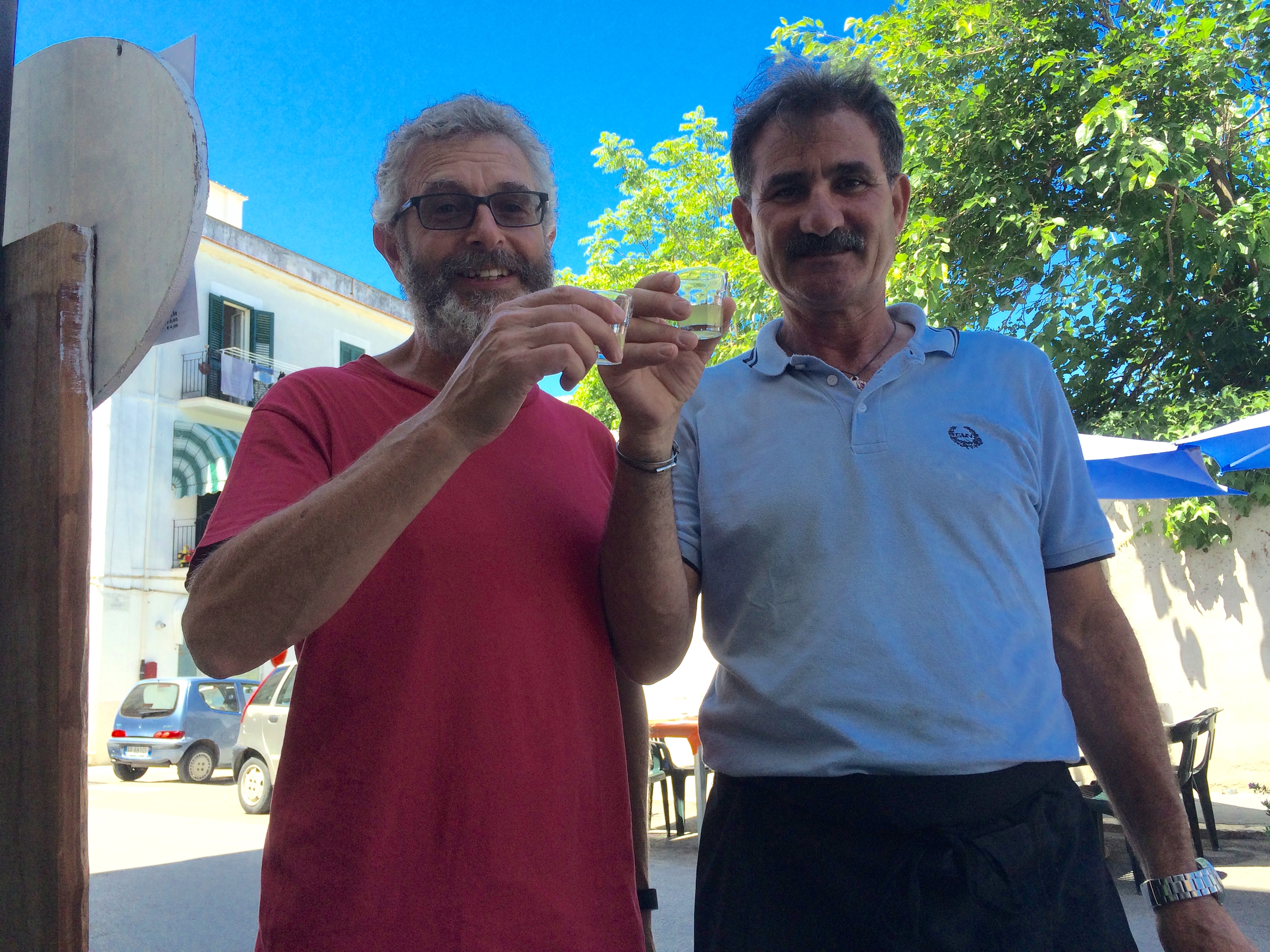
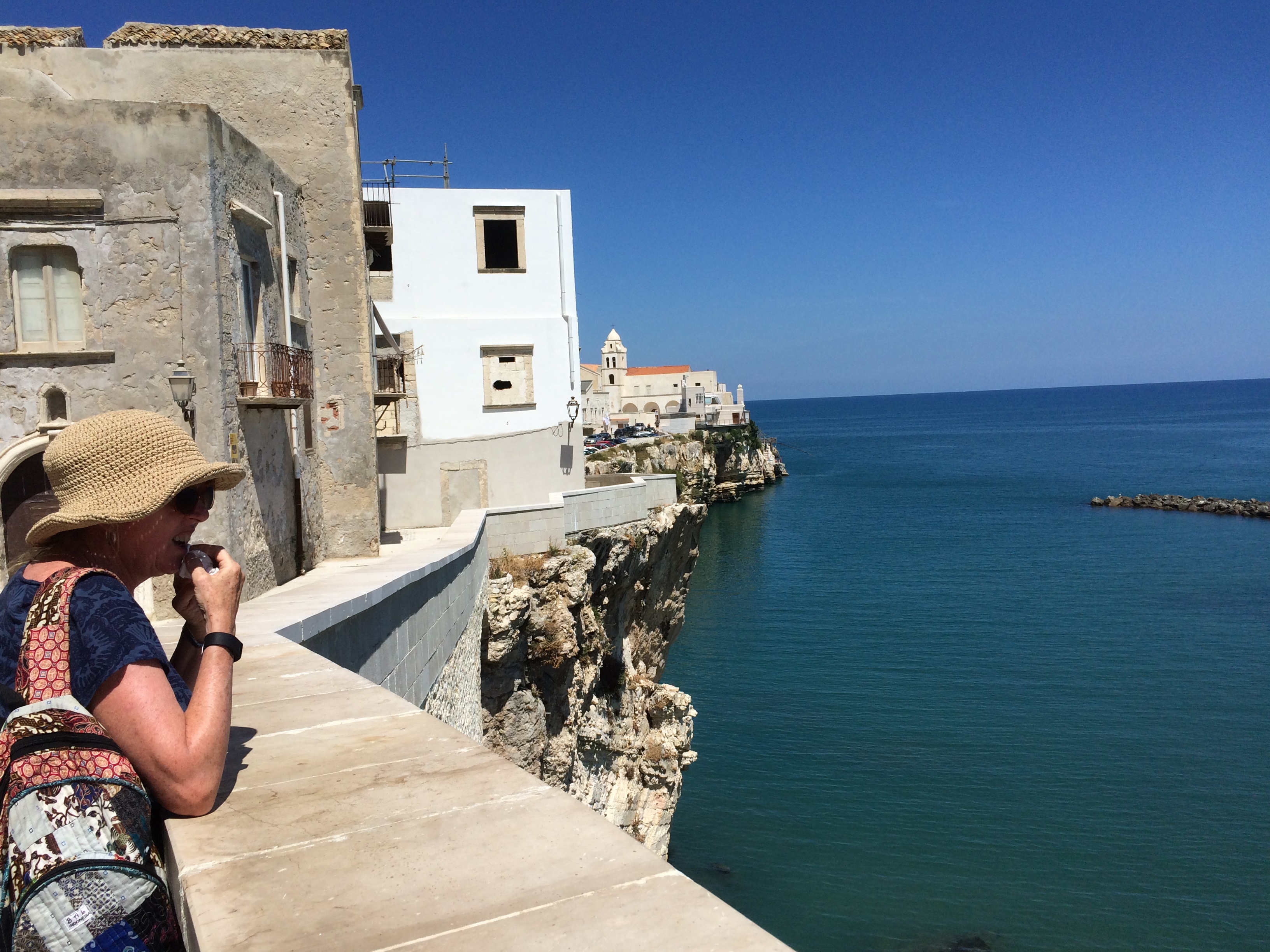
We cycled into Vieste, once a busy fishing port but now dependent almost entirely on the holiday season.  Many of its young people, we were told, leave to look for work in the cities, a tale repeated in many parts of Italy. It had a small fort built by Frederic II who we came to realise is a great hero for the Pugliese, who refer to him variously as ‘Puer Apulia’ (son of Apulia), Frederick of Swabia and ‘stupor mundi’ (wonder of the world).  In medieval times, Vieste was frequently attacked by pirates and Saracens and the enemies of the Kingdom of Naples. According to Wikipedia, in 1554 around 5,000 inhabitants were executed by the Turks on the grounds that they were too elderly or infirm to merit transportation into slavery. As we climbed up to the fort we asked an elderly man if that was true. “Hanno ucciso 2,000” he said, so locals still remember it even if the figures differ.  For lunch we picked the least fussy little restaurant with barely room for a few tables on the pavement but which  served revived old Pugliese recipes.  Flavio got on particularly well with Nicola the owner who, when he found out they were exactly the same age (61) rushed in and came out again with two shots of Limoncello. Explaining that Nicola (pronounced with the stress on the ‘o’) is the most popular name in Bari – after its patron saint – he launched into a song by Nicola di Bari Flavio likes very much called “Il cuore e uno zingaro” (the heart is a gypsy).

“Che colpa ne ho s’el cuore e uno zingaro e va, Catene non ha, il cuore e uno zingaro e va, Finche trovera il prato piu verde che c’e, Raccogliera le stelle su di se, E si fermera chissa e si fermera.”  (What can I do, if the heart wanders like a gypsy, Chains it has not, the heart wanders like a gypsy, Till it finds the greenest of prairies, It can but continue gathering stars for itself, And one day, who knows, it will stop..it will stop..)

IMG_4889

The old fort built by Frederick II.

The old fort built by Emperor Frederick II.

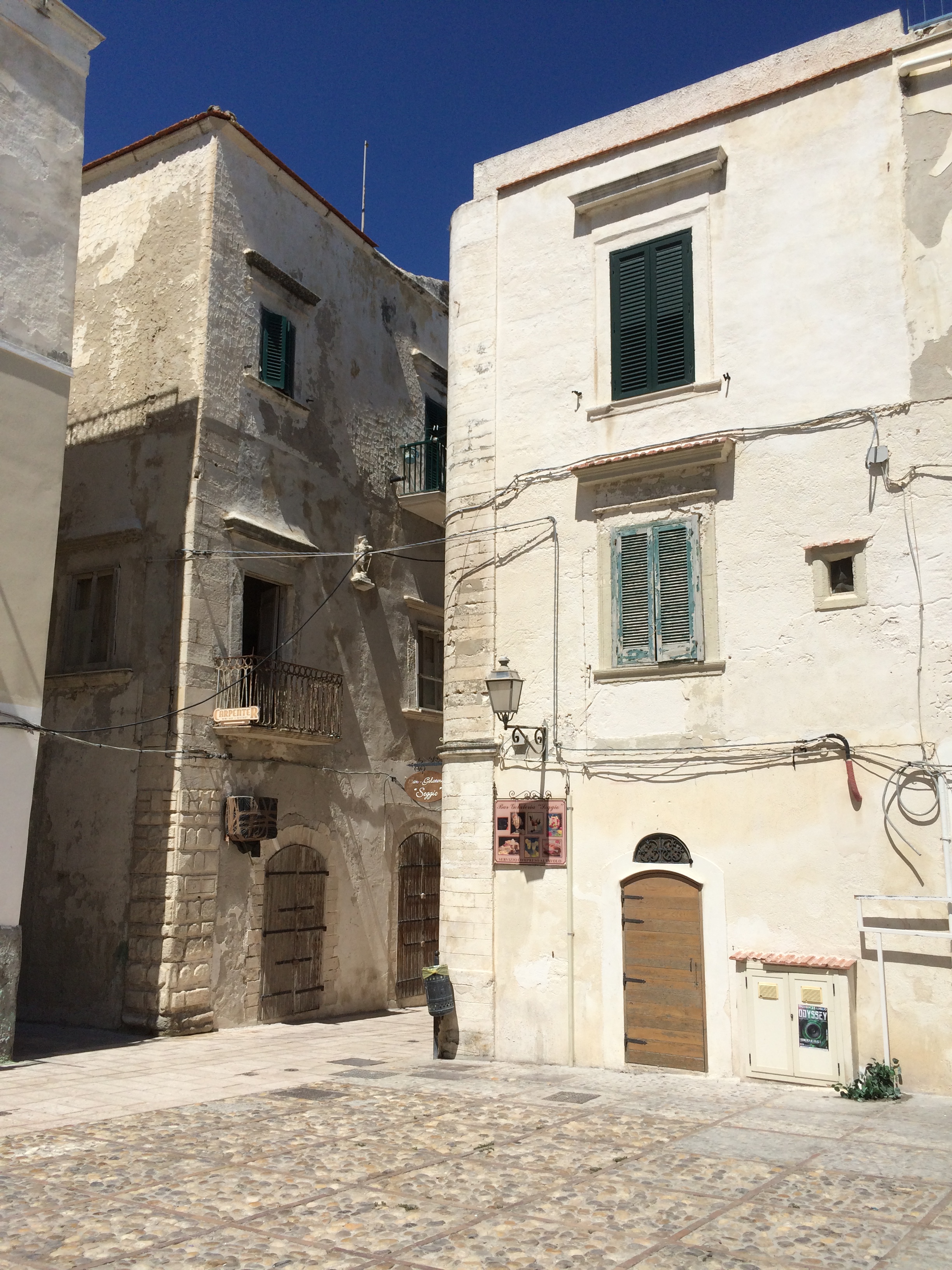
A typical old square in Vieste.

A typical old square in Vieste.

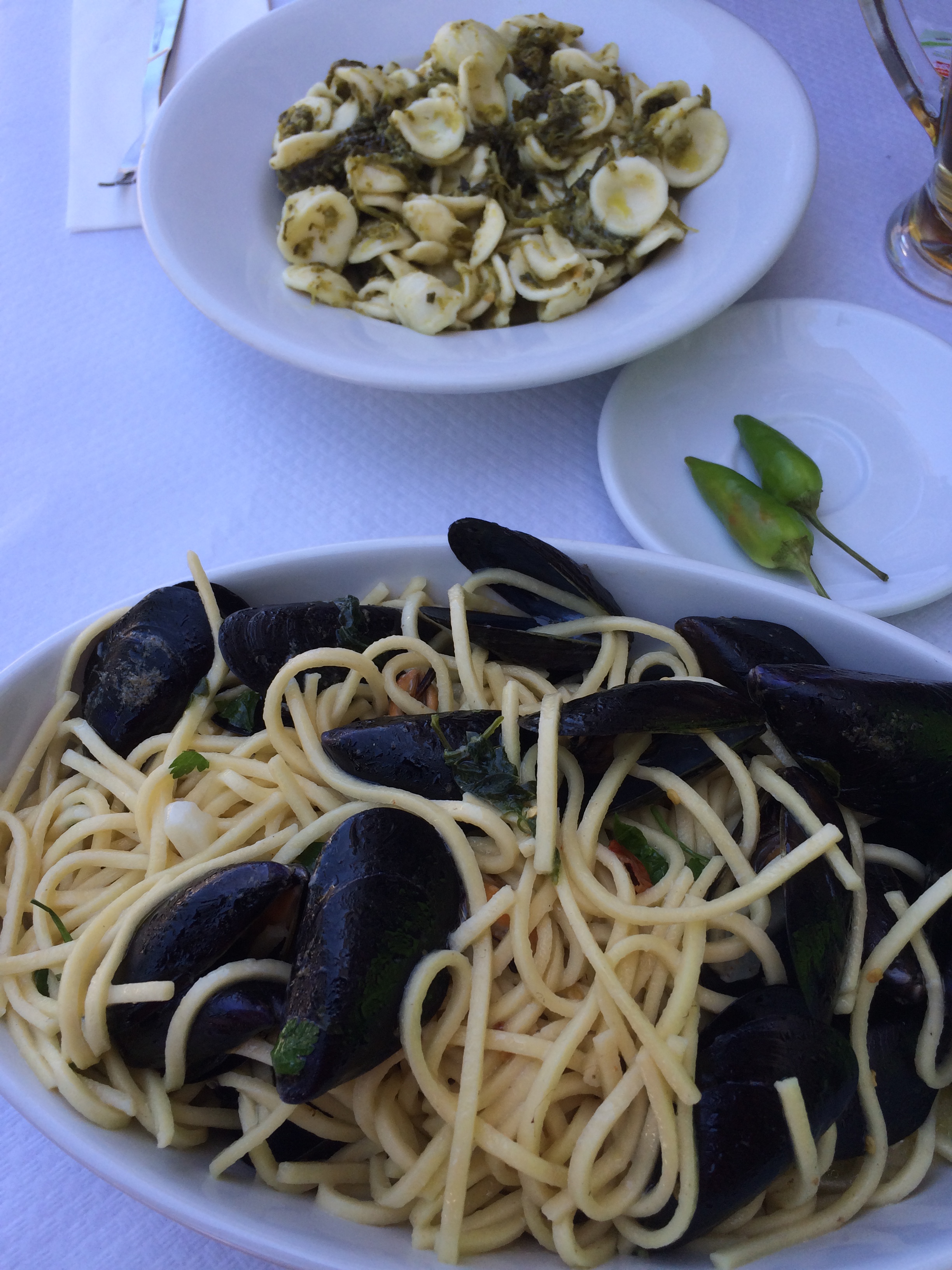
Local and simple specialities offered by Nicola - Aubergines grandma-style, Thick tagliatelle with mussels, Ear-shaped pasta with local greens.

Local and simple specialities offered by Nicola – Aubergines grandma-style, Thick tagliatelle with mussels, Ear-shaped pasta with local greens.

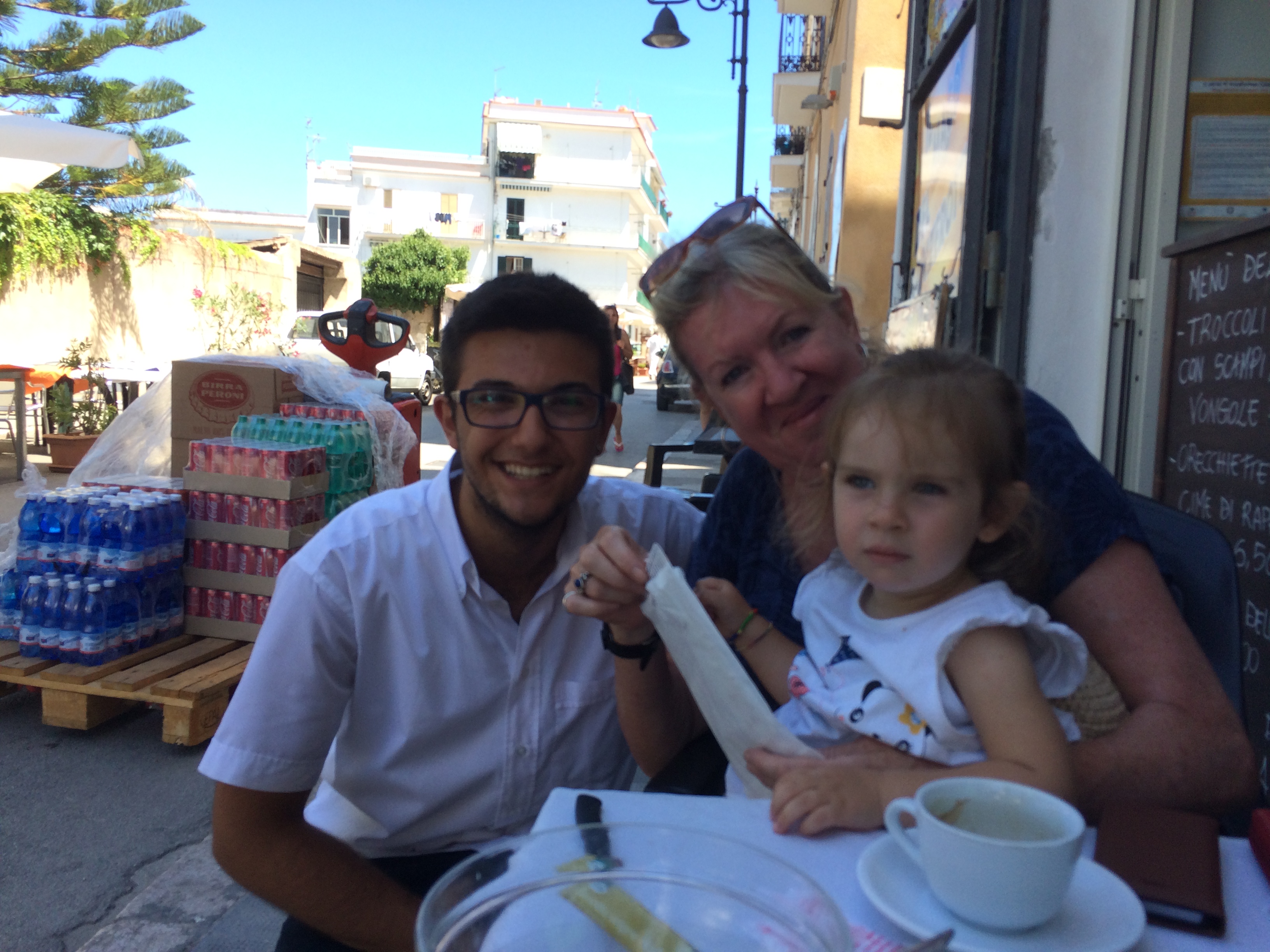
With Nicola at the 'Mago del Panzerotto' in Vieste - celebrating being the same age.

With Nicola at the ‘Mago del Panzerotto’ in Vieste – celebrating being the same age.

The 'troccoli con cozze' and 'orecchiette alle cime di rape'. Reasonably-priced.

The ‘troccoli con cozze’ and ‘orecchiette alle cime di rape’. Reasonably-priced.

Judith with Nicola's son and granddaughter. His son Antonio was about to go to Sutton, England to study English.

Judith with Nicola’s son and granddaughter. His son Antonio was about to go to Sutton, England to study English.

'Panzerotti' -  tasty local batter-based snack.  They normally come with a vegetable or caciocavallo cheese stuffing.

‘Panzerotti’ – tasty local batter-based snack. They normally come with a vegetable or caciocavallo cheese stuffing.

Vieste is a maze of picturesque old alleyways, piazzas and arches.

Vieste is a maze of picturesque old alleyways, piazzas and arches.

Father (Saint) Pio is also revered in the area, being from the region.

Father (Saint) Pio is also revered in the area, being from the region.

Back at Molinella, it was siesta time.  The sign said quiet must be maintained between 2-5pm.

The road back to Molinella from Vieste.

The road back to Molinella from Vieste.

Siesta time is sacred.

Siesta time is sacred.

Taking advantage of the quiet time to catch up on the blog at the cafe, pretty soon surrounded by a group of kids noisily setting about doing their holiday ‘compiti’ (homework). Non-stop chatter of course. Hard to concentrate. A brother and sister start squabbling and one simple question about what the problem is and they’re off.  Nicole, Alessandro, Martina, Julia and Georgia are all asking and answering questions at the same time.  “What? no holiday homework in England?  What? Only 6 weeks summer holidays?” “Are you two sisters?”  No, she’s my sister, says Alessandro – I wish she wasn’t, I’d be much happier if she wasn’t”.  “When do you start learning English at school?” ” Prima elementare for a first language and prima secondaria for a second.” What do you choose?” Either French, Spanish or German.”  French seemed to be the favourite.  “We come here every year.  We haven’t met anyone from England who speaks Italian like you.” “I’m an Italian from Egypt” “Ooh, Egitto?” “What do you know about Egypt?”  Everyone gets up and starts striking pharaonic poses and dances.  “There’s more to Egypt than that.” “Do I speak with an accent?” “Maybe a little bit”. “It’s been lovely to meet you all.  Good luck with your compiti”.

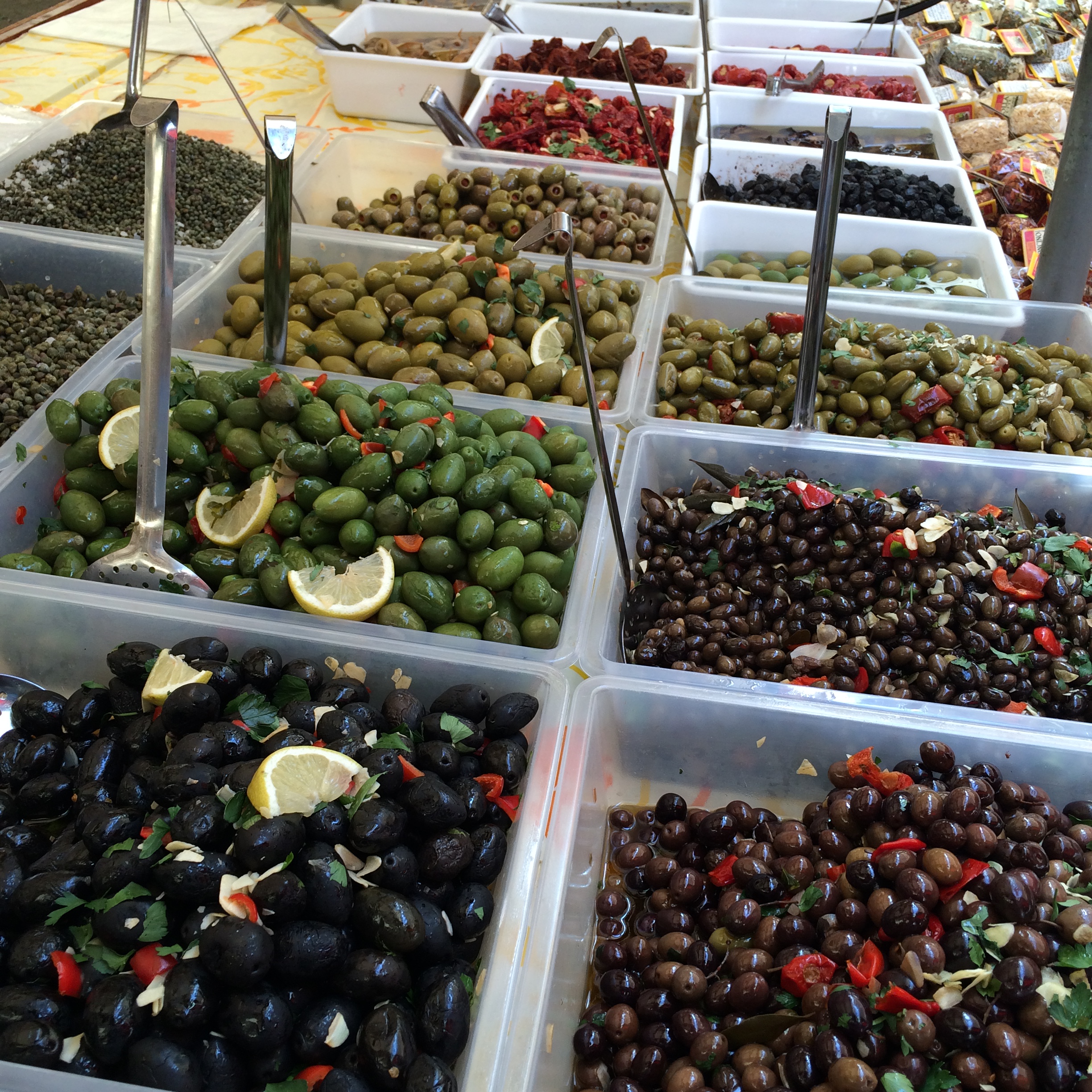
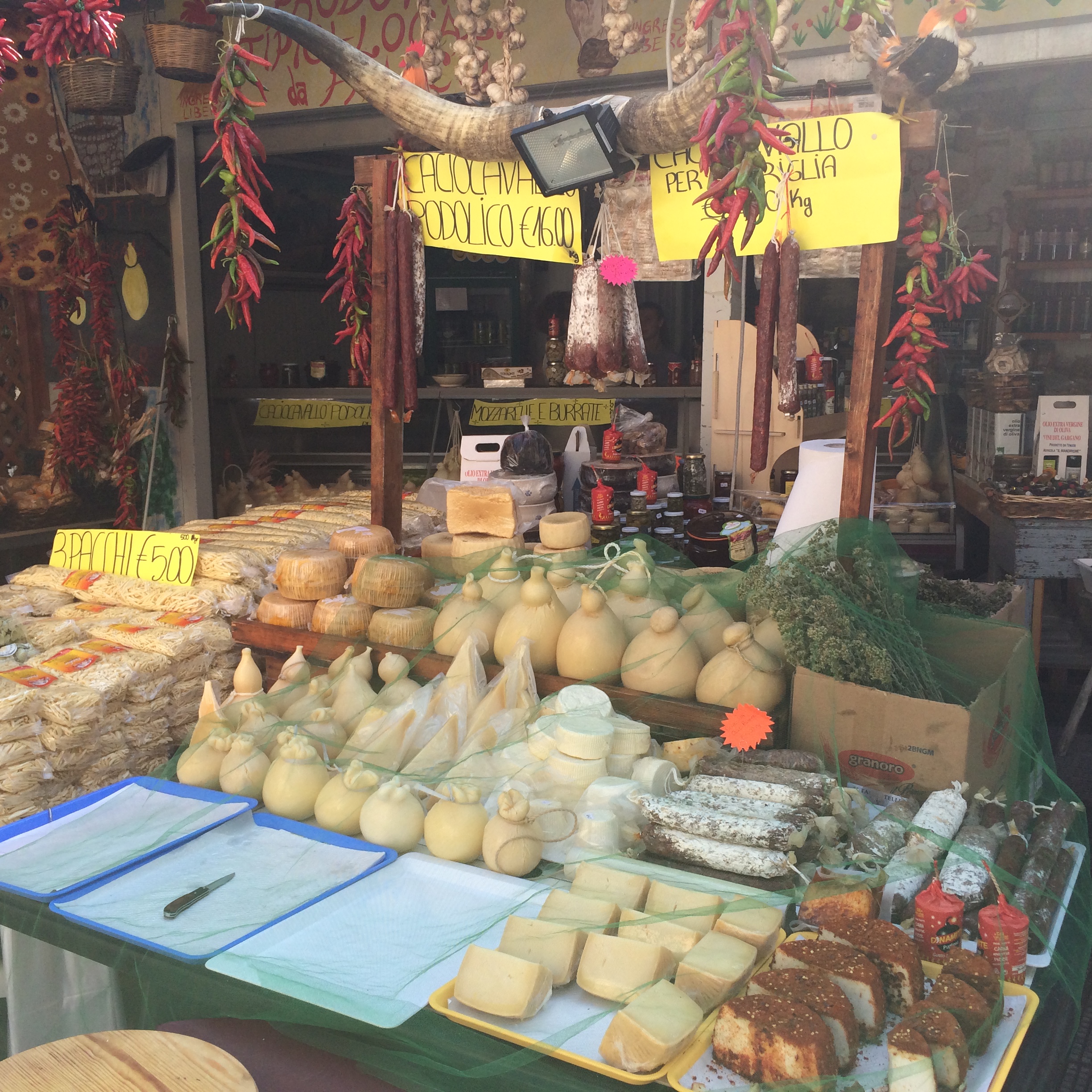
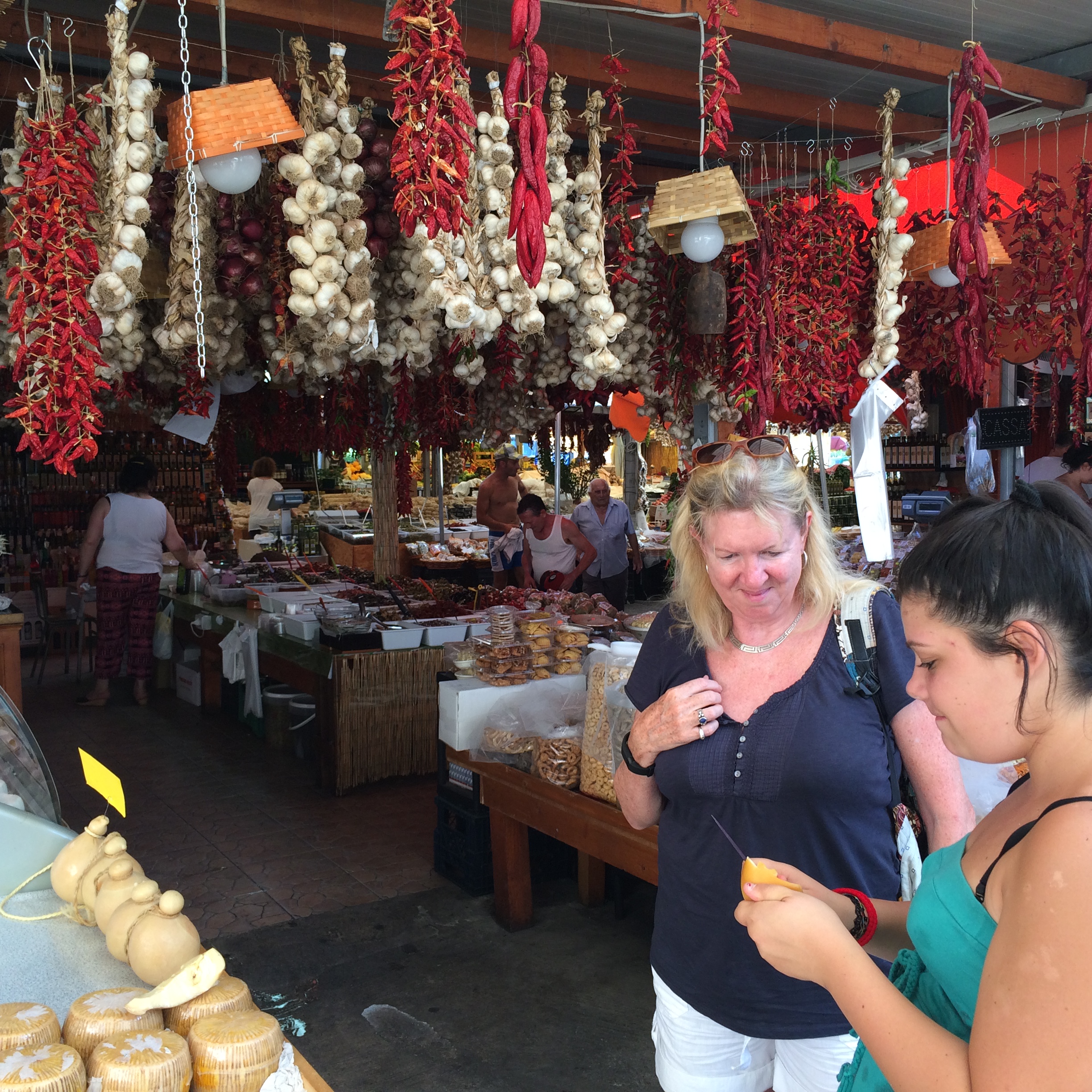
Leaving Molinella we have to pass through Vieste again.  A market seems to be in full swing.  It’s so refreshing to see a market bursting with colorful and irresistible local produce – endless varieties of olives, peppers, herbs, olive oil, salamis and cheeses.  Though we mustn’t as nothing keeps for long in Brenda, we feel obliged to purchase something so pick up some fresh oregano and cacciacavallo cheese (which, four countries later in Greece, we still haven’t quite finished).  Cacciacavallo by the way is where the popular Egyptian ‘cashcaval’ comes from.

Endless variety of olives at the market in Vieste.

Endless variety of olives at the market in Vieste.

.. and cheeses.

.. and cheeses.

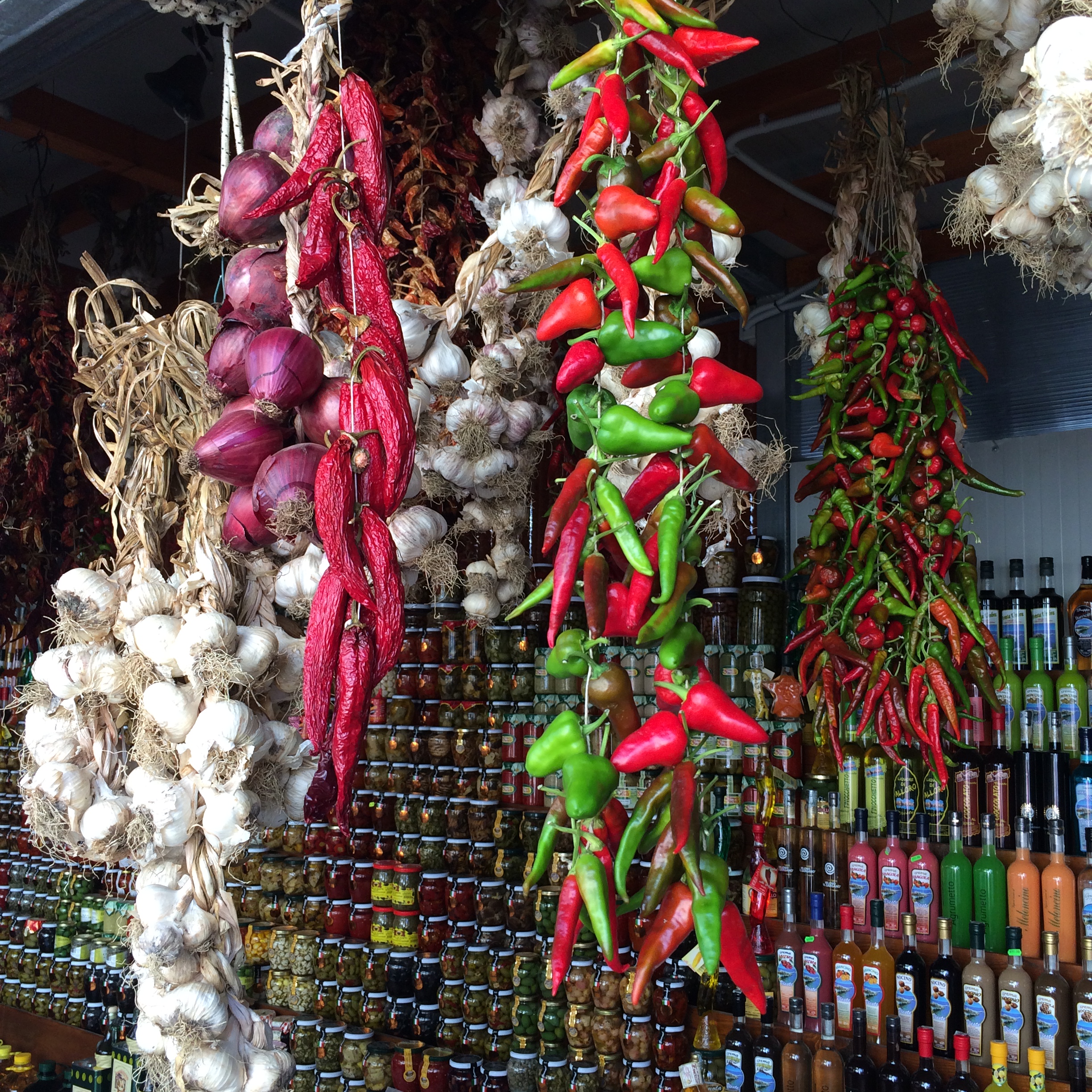
..and peperoncini..

..and peperoncini, onions, garlic..

Judith buys some cacciacavallo.

Judith samples (and buys) some cacciacavallo.

IMG_4882

Saturday 25th to Monday 27th July – Ancona down to Adriatic coast.

Standard

Leaving Pesaro, we continued down the Adriatic coast past Fano, Senigallia and Marina di Montemarciano and generally the popular resort area known as ‘Le Marche’.   As evening fell, we stopped at what was to be our very first and possibly last stop at a ‘Camper stop’ at Porto Recanati just past Ancona.  These are free or relatively cheap places to park overnight for camper vans and there are many throughout Europe.  This one was called ‘Disco-Kart’ as it doubled as a Go-Karting as well as a disco place! Facilities were basic to say the least and extras, such as a shower were an additional cost.  Two euros bought approximately 30 seconds in the shower and as we ran out of change we were forced to share a shower.  Our fellow campers were however very friendly and the beach next to the camper stop was exceptional.

Fano, south of Pesaro on the Adriatic coast.

Fano, south of Pesaro on the Adriatic coast.

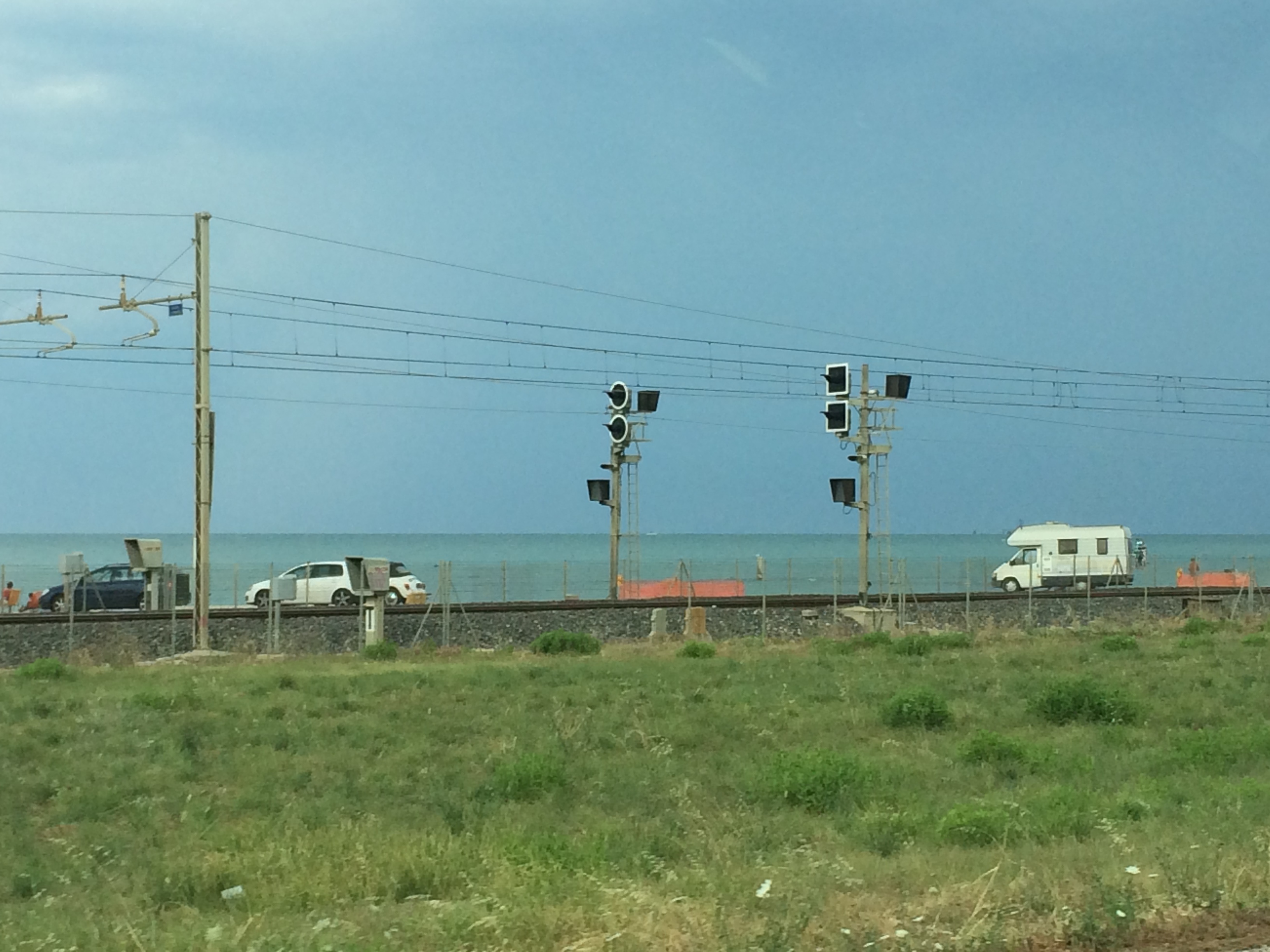
Marina di Montemarciano - a railway line runs all along the coast between the sea and the road.

Marina di Montemarciano – a railway line runs all along the coast between the sea and the road.

Porto Recanati.

Porto Recanati.

The 'Disco-Kart' camper-stop at Porto Recanati had a Go-Kart tack next to it!

The ‘Disco-Kart’ camper-stop at Porto Recanati had a Go-Kart tack next to it!

At least it had a good beach.

At least it had a good beach.

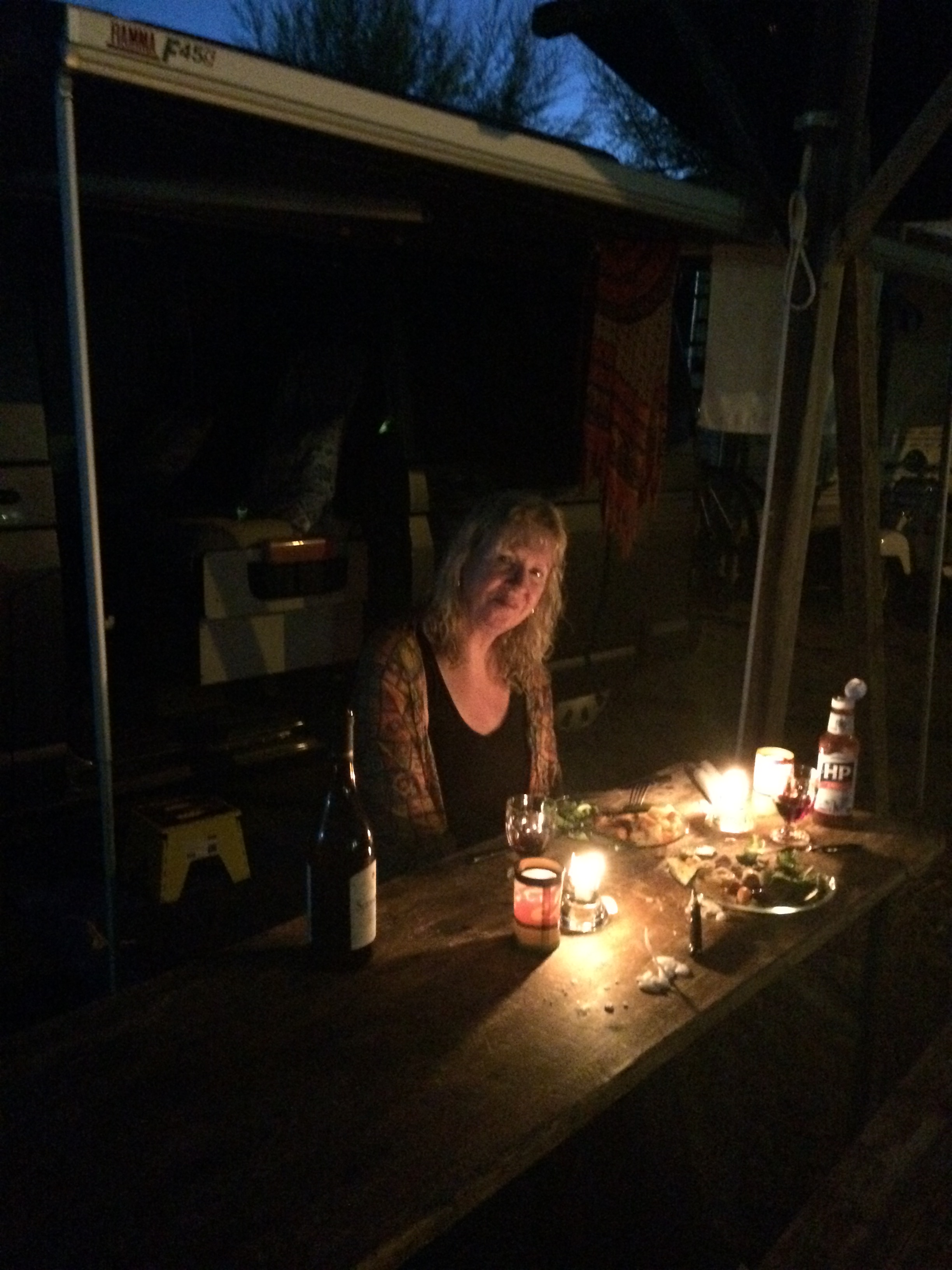
Dinner of left-overs by candle-light at the very basic camper-stop at Porto Recanati.

Very basic dinner by candle-light at the very basic camper-stop at Porto Recanati.


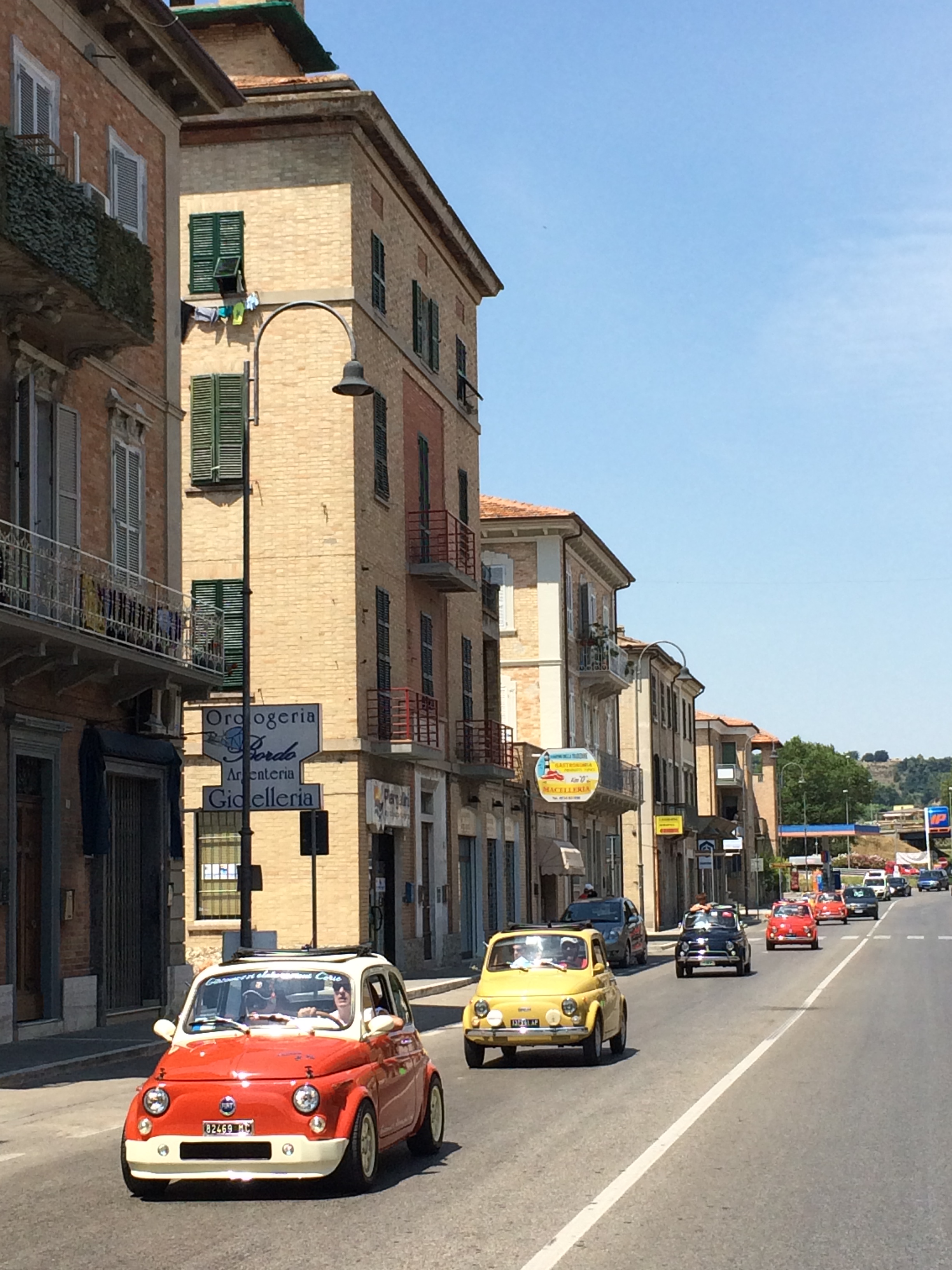
The next morning, conscious of our deadline of 2nd August to catch our ferry from Bari to Dubrovnik we pressed on headed for Gargano in Puglia. On the way we passed Loreto, Porto Potenza, Porto San Giorgio, Pedaso, Colonnella, Tortorello, Montesilvano, Pescara, Fossacesia, Vasto and Camporino.  It was a long drive. With temperatures rising all the time (it was official – Italy was in the grip of a ‘scirocco’ from Africa), we stopped in Pedaso for a cool drink,  ice cream and coffee to perk us up.  Cliches apart, the quantity of ‘gelato’ eaten in Italy in summer must be phenomenal with ‘gelaterie’ at every corner and every few steps you take. Often, the cafes are ‘cafeterie’, ‘pasticerie’,  ‘gelaterie’, ‘rosticerie’ and bar all at the same time.  Lingering at such a place in Pedaso, we found it hard to get going again due to the sheer heat and humidity which induces intense lethargy and listlessness but move on we had to.  While sitting in the cafe, a sudden collective blowing of horns reminiscent of a wedding in the Middle East turned out to be a procession of vintage and colourful cinquecenti.

Taking a quick look at the sea-front, in the middle of a peaceful and shaded little park, we see a monument and tribute to ‘Ai caduti del mare’ (to the victims of tragedies at sea) which we find quite moving.

Porto Potenza Picena.

Porto Potenza Picena.

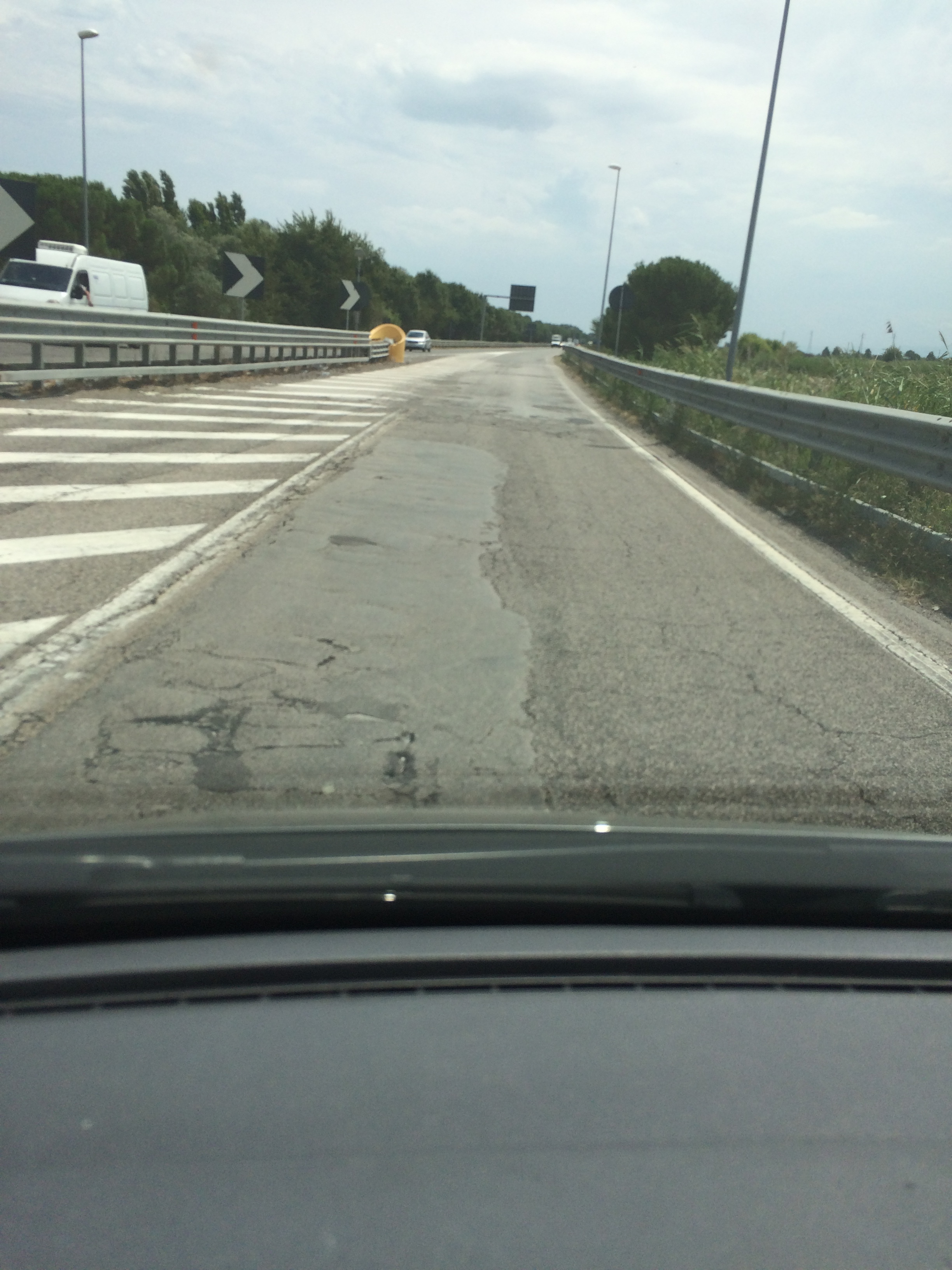
Poor road maintenance along much of the route.

Poor road maintenance along much of the route – sign of the economic downturn?


Vintage 500s parade in Pedaso.

Colourful vintage 500s parade in Pedaso.

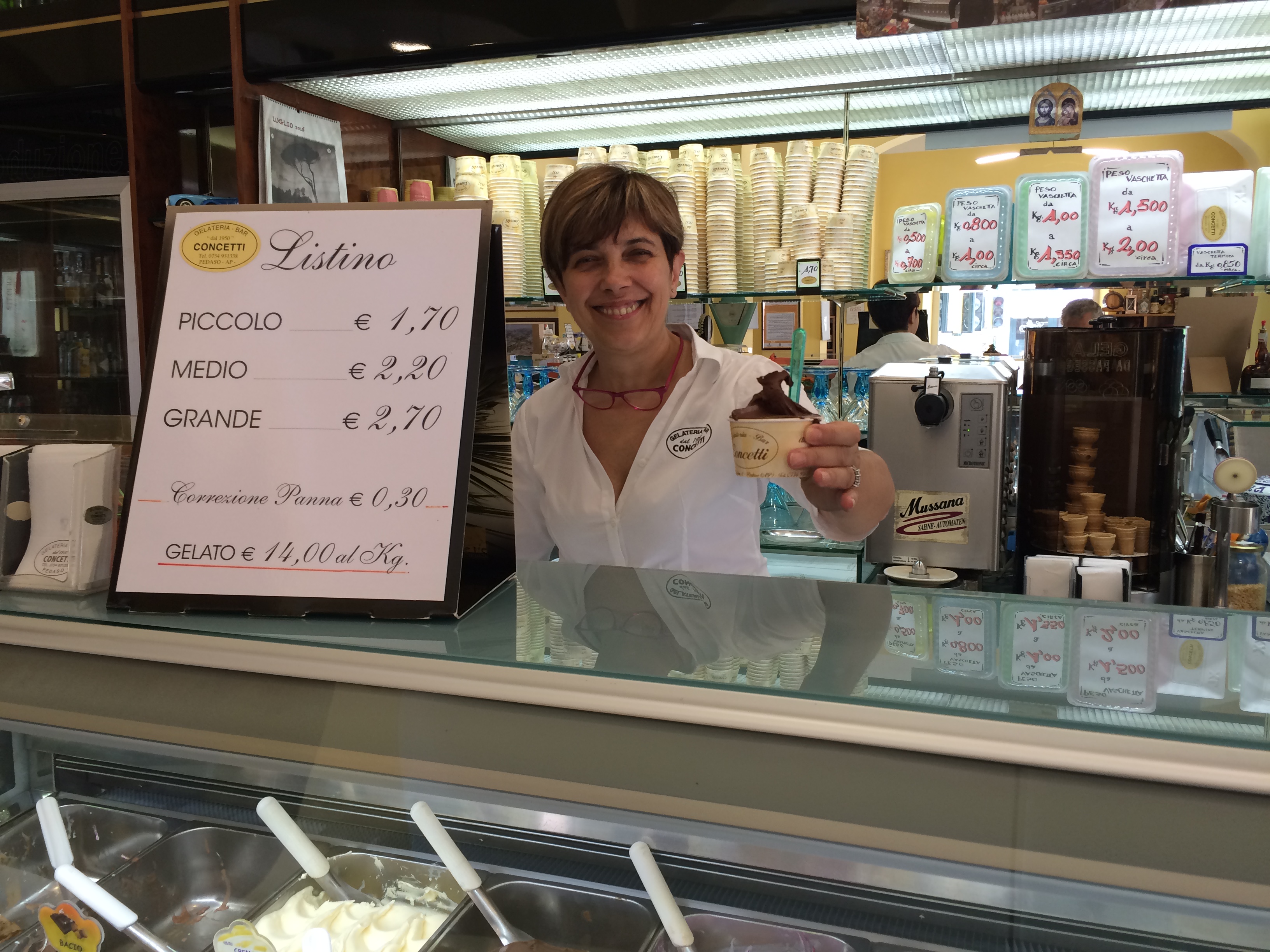
The obligatory gelato - at the cafe-bar-gelateria in Pedaso.

The obligatory gelato – at the cafe-bar-gelateria in Pedaso.


A quick look at the 'Gazetta dello Sport' front page - congratulates Vincenzo Nibali on his stupendous win of the La Toussuire stage and quotes him "Froome said things I cannot repeat".

A quick look at the ‘Gazetta dello Sport’ front page – congratulates Vincenzo Nibali on his stupendous win of the La Toussuire stage and quotes him “Froome said things I cannot repeat”.

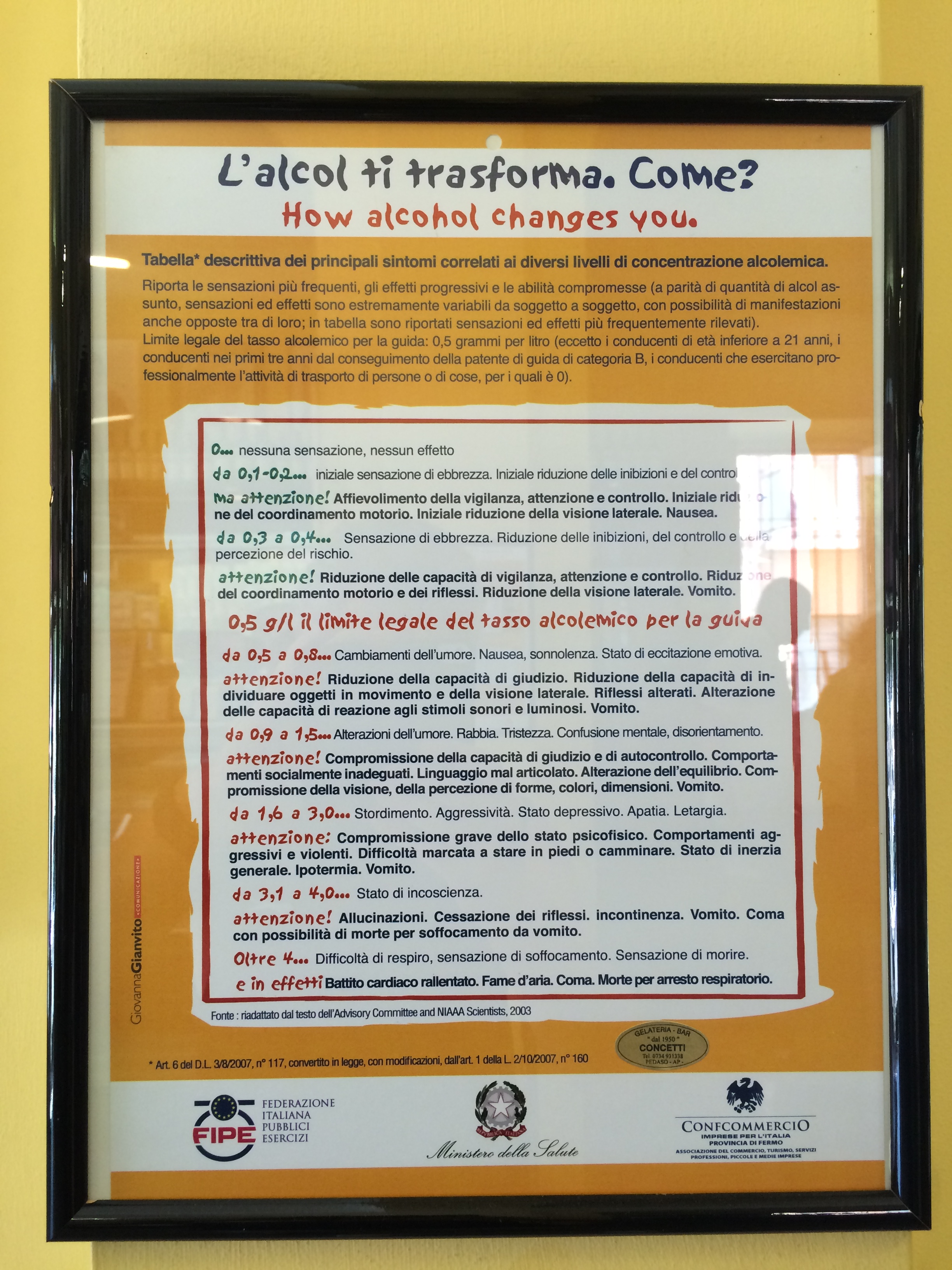
In the cafe-bar, as in many others, a very detailed Ministry of Health notice warning the public about the influence of alcohol on the body depending on exactly how much you drink.

In the cafe-bar, as in many others, a very detailed Ministry of Health notice warning the public about the influence of alcohol on the body depending on exactly how much you drink.


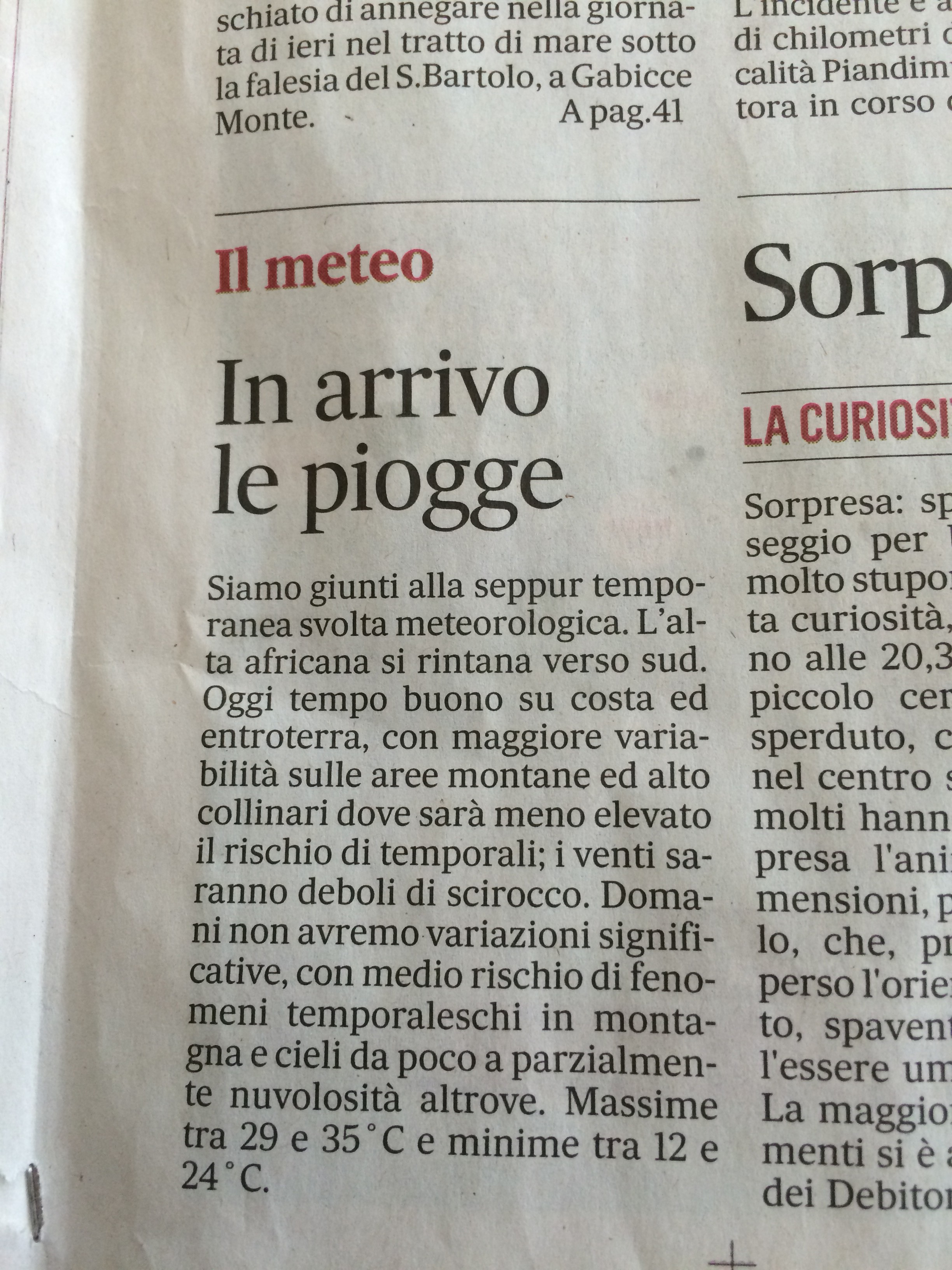
Announcing the end of the 'scirocco' and arrival of rains.

Announcing the end of the ‘scirocco’ and arrival of rains.

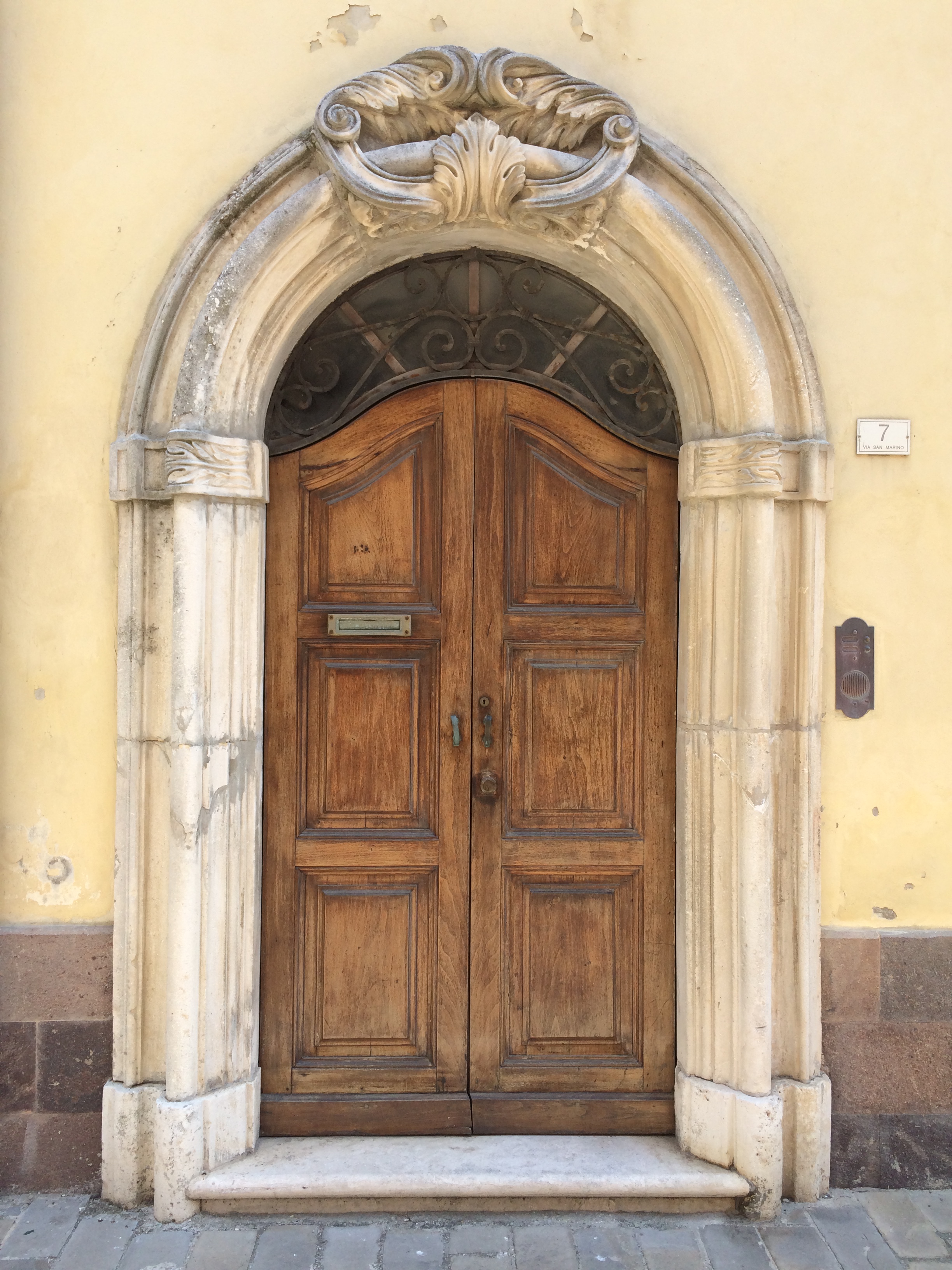
A splendid doorway in Pedaso.

A splendid doorway in Pedaso.


IMG_4764


Thursday 23rd to Friday 24th July – down the Adriatic coast: Ravenna to Pesaro.

Standard

We spent two days in an unimpressive, noisy but friendly campsite near Ravenna – the Pineta di Ravenna. It was on the beach but the sea was quite murky and the off-shore oil rig didn’t add to the appeal of the place. We swam but it wasn’t particularly enjoyable.  Our nearest neighbours were holidaying with their two grandchildren.  Even though we communicated only through nods and hellos, by the end of the two days we felt we’d got to know them fairly well as we were privy to all their non-stop chatter. The eldest boy of about five was called Allessandro.  Granny spent most of the day shouting ‘Allessandro, vieni qui?’ ‘Dove sei?’ ‘Cosa fai?’ ‘ Quante volte ti devo dire..’ (come here, what are you doing, how many times do I have to tell you..)  But if Grandad dared do the same she’d shout him down with ‘Ma perche urli come un pazzo?’ (Why are you yelling like a madman?)

If one thinks of this as a microcosm of what was going on pretty much throughout the campsite, you get an idea of what the general atmosphere was like.  On an Italian campsite in mid-summer there is no such thing as grabbing a quiet coffee in the cafe at 10am while catching up on the blog.  By 10am the place is already in full swing with various inter-connecting groups of youngsters and older people forming noisily and spontaneously, separating then re-merging in different combinations, occupying all available chairs and tables whilst children are running amok and announcements about later activities are being called out on loudspeakers.  Privacy is an esoteric concept. Little girls will run enthusiastically  towards us as we’re coming back from the beach to ask inquisitively all about us – ma voi di dove siete? (Where are you from? .. I love the ‘ma’ (but)).  Really sweet and endearing.  Sometimes, you get so used to the constant chatter around you involving more often than not several in the group talking at the same time or repeating what the other says in a slightly different way or with a different intonation, that you forget to notice that you’re being asked a question: “Voi giocate il poker?” (Do you play poker?) No, lasciateci in pace (leave us in peace) you want to say, but not really as it’s all lovely and uniquely Italian!  At least we’re too old to be asked to play volley-ball!

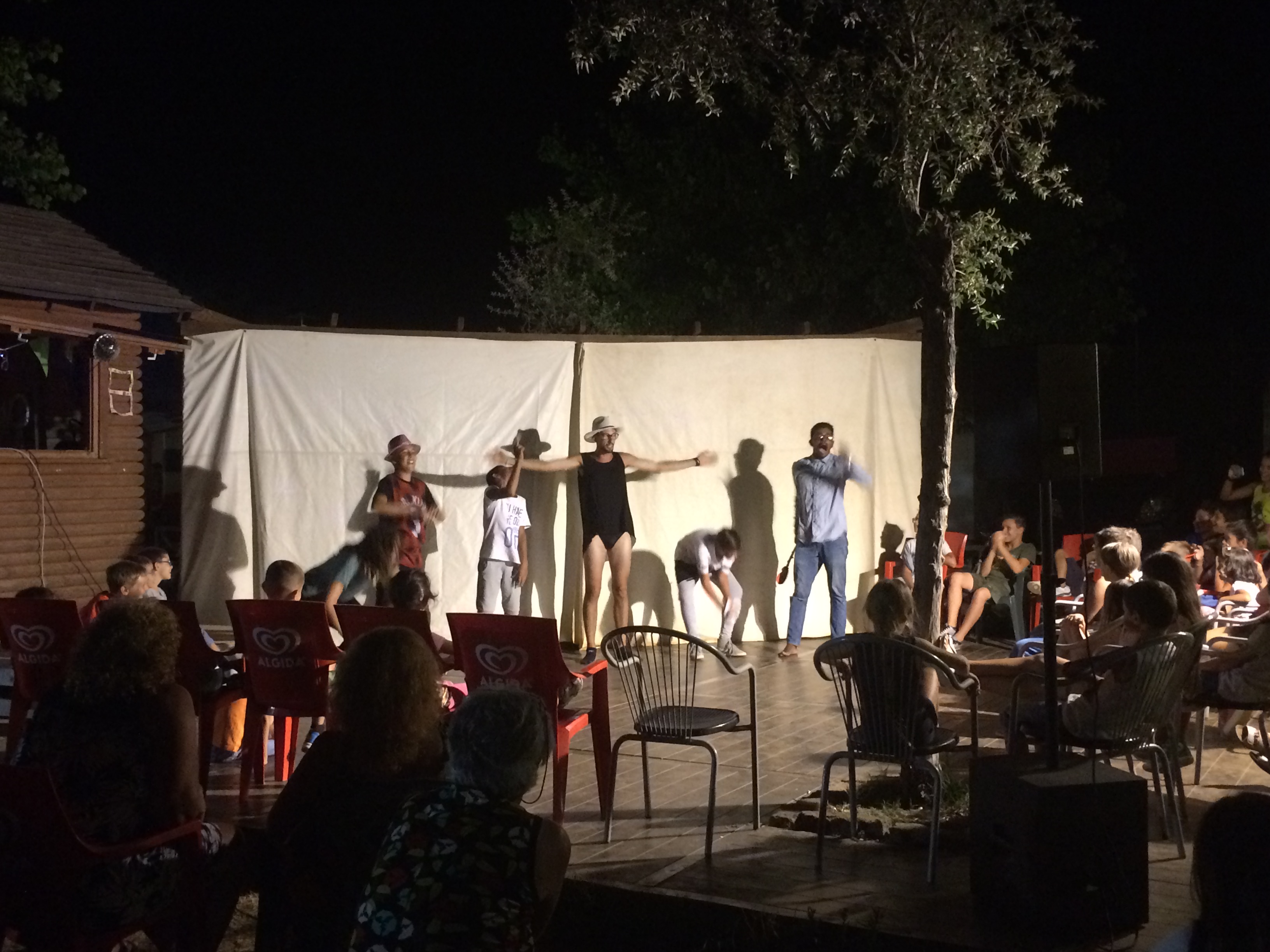
The only respite to be had is at the obligatory siesta time (2pm-5pm) after which the activities and general tumult begin again and go on well into the night.  At Pineta a stage was erected and various slapstick scherzi sketches were performed mostly by teenagers and very much enjoyed by children and older people sitting behind them.

The Riserva Naturale Pineta di Ravenna campsite - an Italian campsite in mid-summer is a unique experience.

The Riserva Naturale Pineta di Ravenna campsite – an Italian campsite in mid-summer is a unique experience.


Our pitch at the Pineta di Ravenna campsite - often you're cheek by jowl with your neighbours.

Our pitch at the Pineta di Ravenna campsite – often you’re cheek by jowl with your neighbours.


A short slapstick sketch being enjoyed by all alike at the Pineta campsite.

A short slapstick sketch being enjoyed by all alike at the Pineta campsite.


The Pineta campsite beach, with the rig appearing on the horizon.

The Pineta campsite beach, with the rig appearing on the horizon.


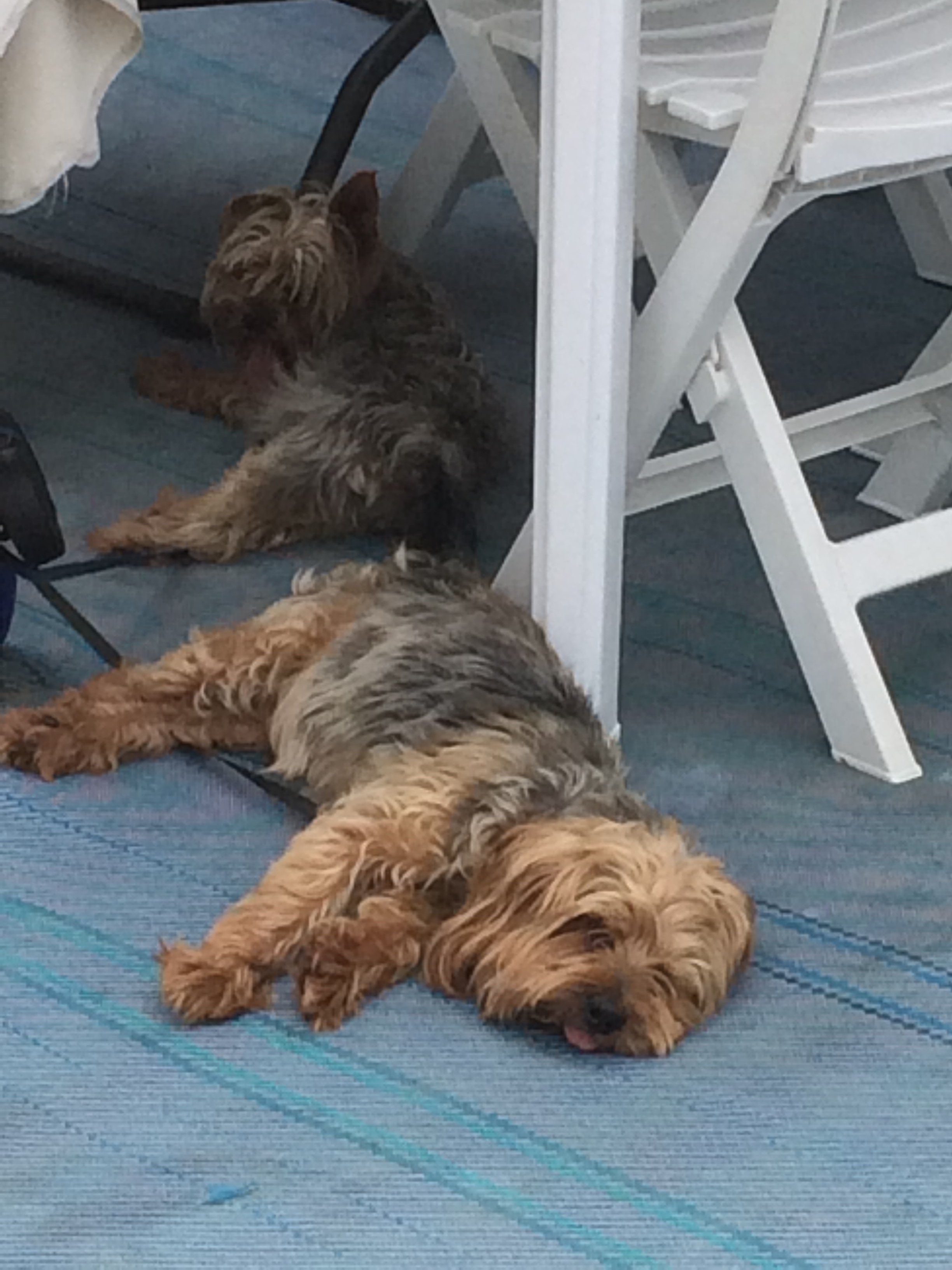
Many people have dogs on campsites and they were suffering from the oppressive heat.

Many people have dogs on campsites (Yorkshires and other small dogs are very popular in Italy) and they were suffering from the oppressive heat.


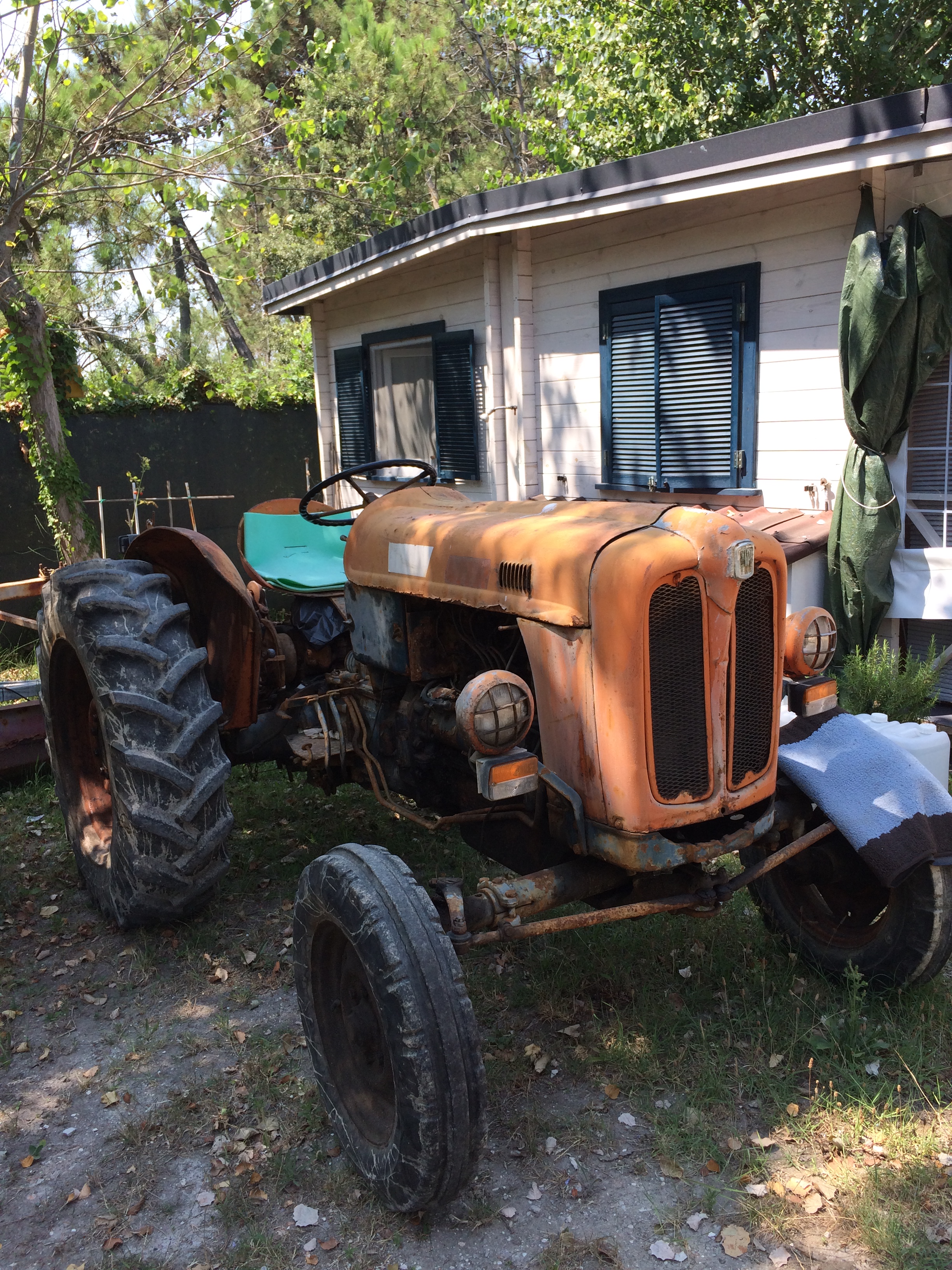
Very old and quaint Fiat tractor at the campsite.

Very old and quaint Fiat tractor at the campsite.


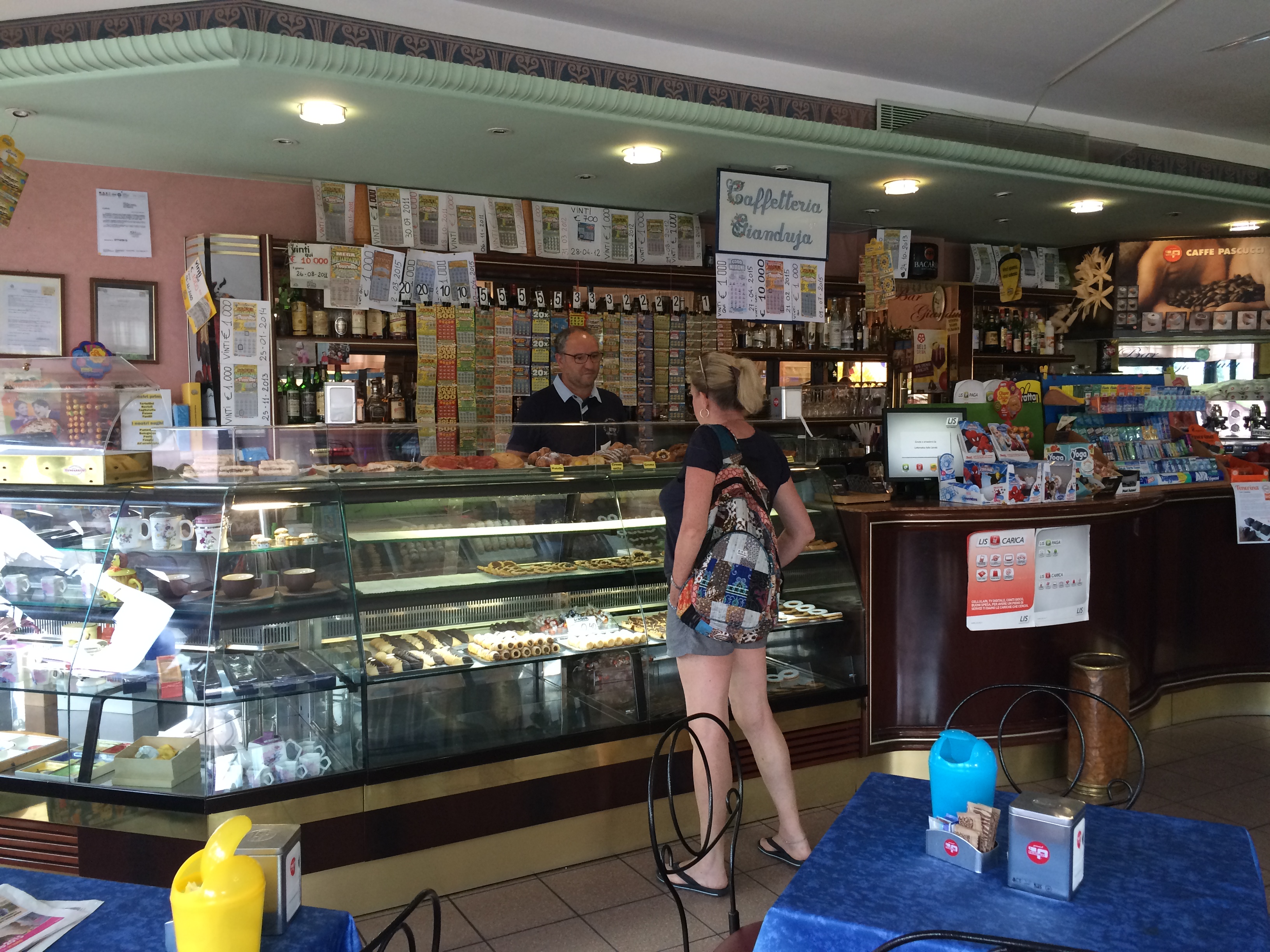
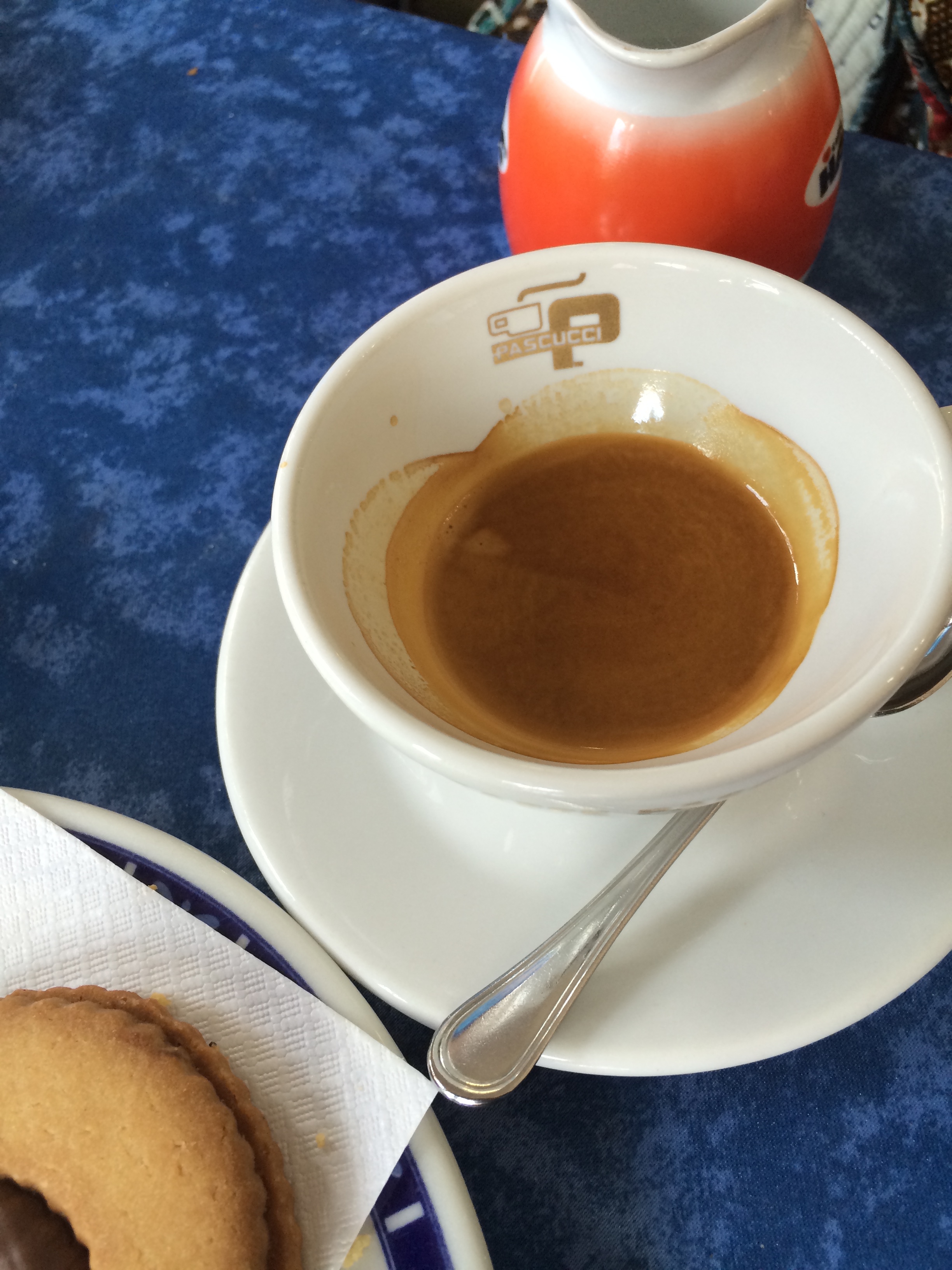
Moving further south down the Adriatic coast, we stopped at Pesaro for a coffee and cake.  The chocolate ones were called “Occhio del bue” (Eye of the Ox).  It was an excellent bar-cum-cafe and it occurred to us that there surely must be a gap in the market in the UK for places like this – part cafe, part bar.  According to Fulvio the owner from Brazil, people tend to eat the buns for breakfast and the cakes in the afternoon.

Typical cakes from the area.  The chocolate ones are called Eye of the Ox.

Typical cakes from the area. The chocolate ones are called Eye of the Ox.

The cafe at Pesaro.

The cafe at Pesaro.


IMG_4672

Wednesday 22nd and Thursday 23rd July – Bologna, authentic and unassuming

Standard

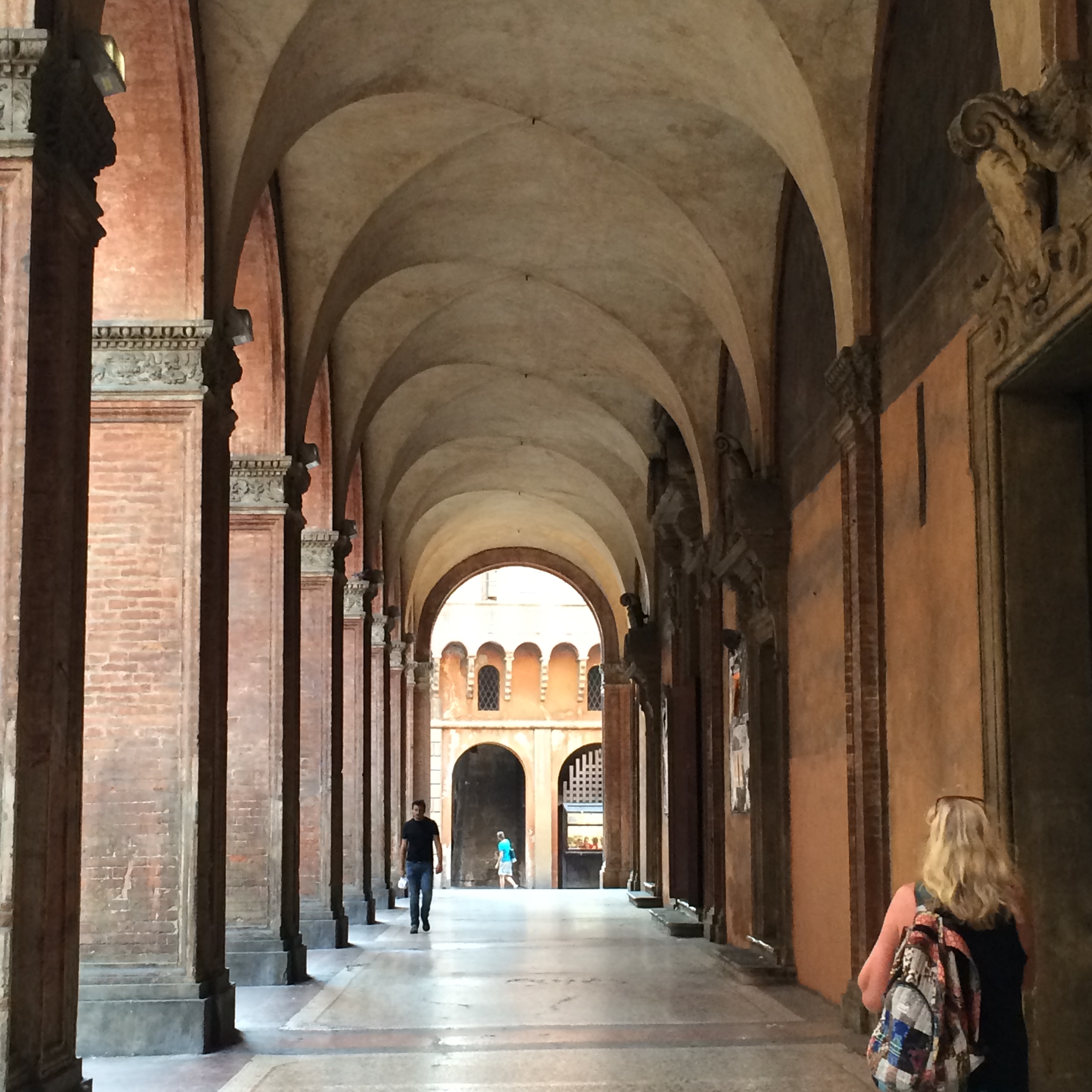
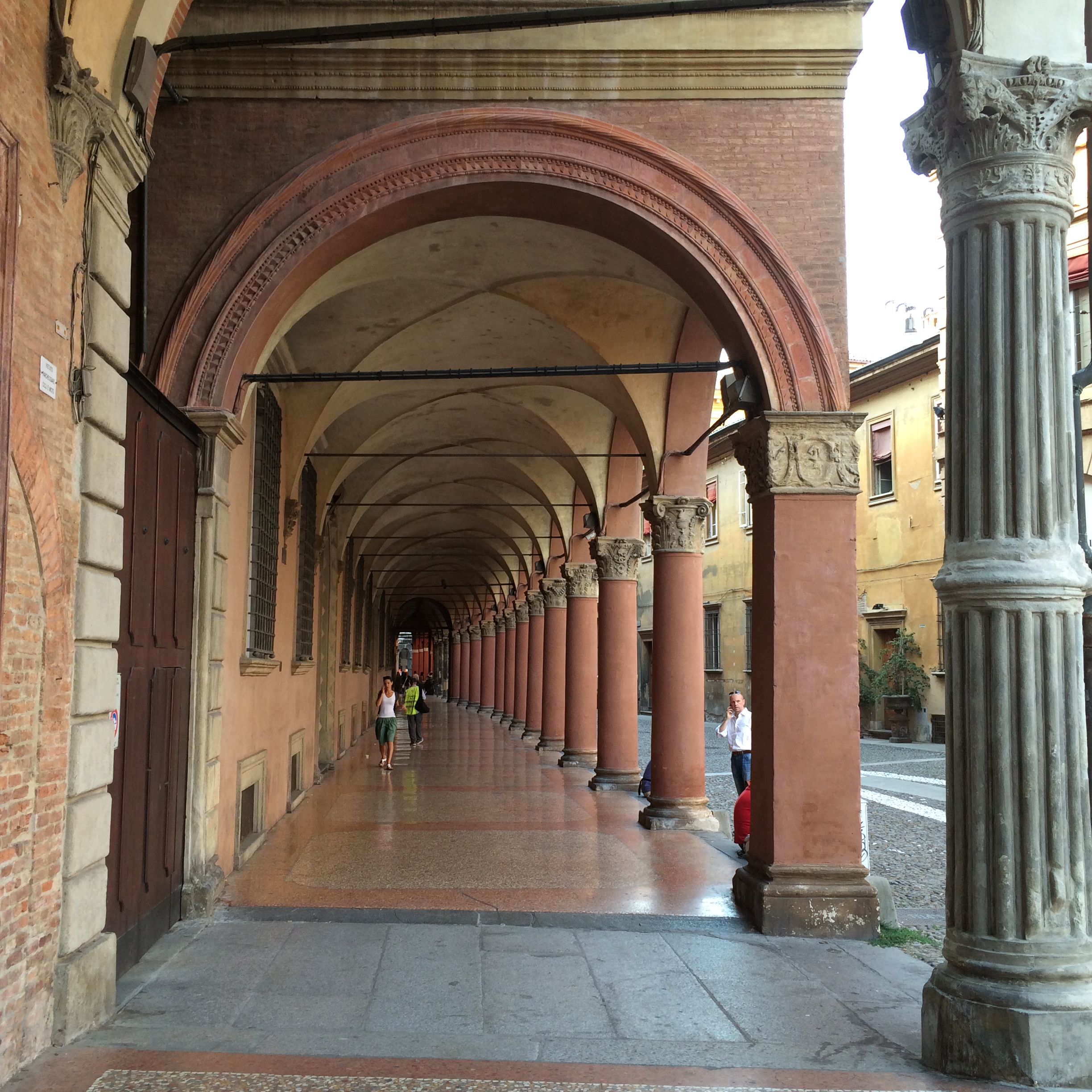
Back into Brenda and in air-conditioned glory we drove on to Bologna.  We were planning on a quick visit and then onto a nearby campsite but we were so enchanted by Bologna that we decided to book into a lastminute.com hotel. In the evening we strolled through the old part of the city marvelling at the arched colonnades for which Bologna is famed, built high enough to enter on horseback, as well as the medieval and Renaissance structures and the leaning medieval towers, one of which, the Asinelli Tower, you can actually climb up – 497 steps!  On the first anniversary of the Bologna Train Station bombing, on 31st August 1981 100,000 people crammed into Via Rizzoli to hear Carmelo Bene recite Dante’s Divine Comedy  from the base of the Asinelli Tower. It will have sounded something like this: “Qual pare a riguardar la Carisenda.  Sotto il chinato quando un nuovol vada. Sovr’essa si, ch’ella in contrario penda: Tal parve Anteo a me che stava a bada Di vederlo chiamare….”  We’d almost forgotten about the train station bombings. What was that about? Who claimed responsibility and why? What was happening at the time – 20 years before 9/11?

Bologna, famed for its porticos and colonnades.  One line stretches for 3 kms.

Bologna, famed for its porticos and colonnades. One line is said to stretch for 3 kms.

Porta Ravegnana, Bologna.

Porta Ravegnana, Bologna.

Bologna has the oldest university in the world and is also a cycle-friendly city.

Bologna has the oldest university in the world. It’s also a cycle-friendly city.

The leaning towers

The two medieval leaning towers of Bologna.

Porta Ravegnana.

Another view of Porta Ravegnana.

A recently-graduated Chemistry student gets the age-old graduation ritual.

A recently ‘laureato’ pharmacy student is put through his paces in keeping with the age-old tradition. (It consists of eating popcorn out of a bowl on the ground with hands tied behind the back while being pelted with water-filled balloons.)

The 'Zona Universitaria' in Bologna.

The ‘Zona Universitaria’, Bologna.

Bologna - Ghetto.

Bologna – Ghetto.

Via Zamboni, Bologna.

Via Zamboni, Bologna.

Porta Ravegnana, Bologna.

Porta Ravegnana.

Neptune Square, Bologna.

Neptune Square, Bologna.

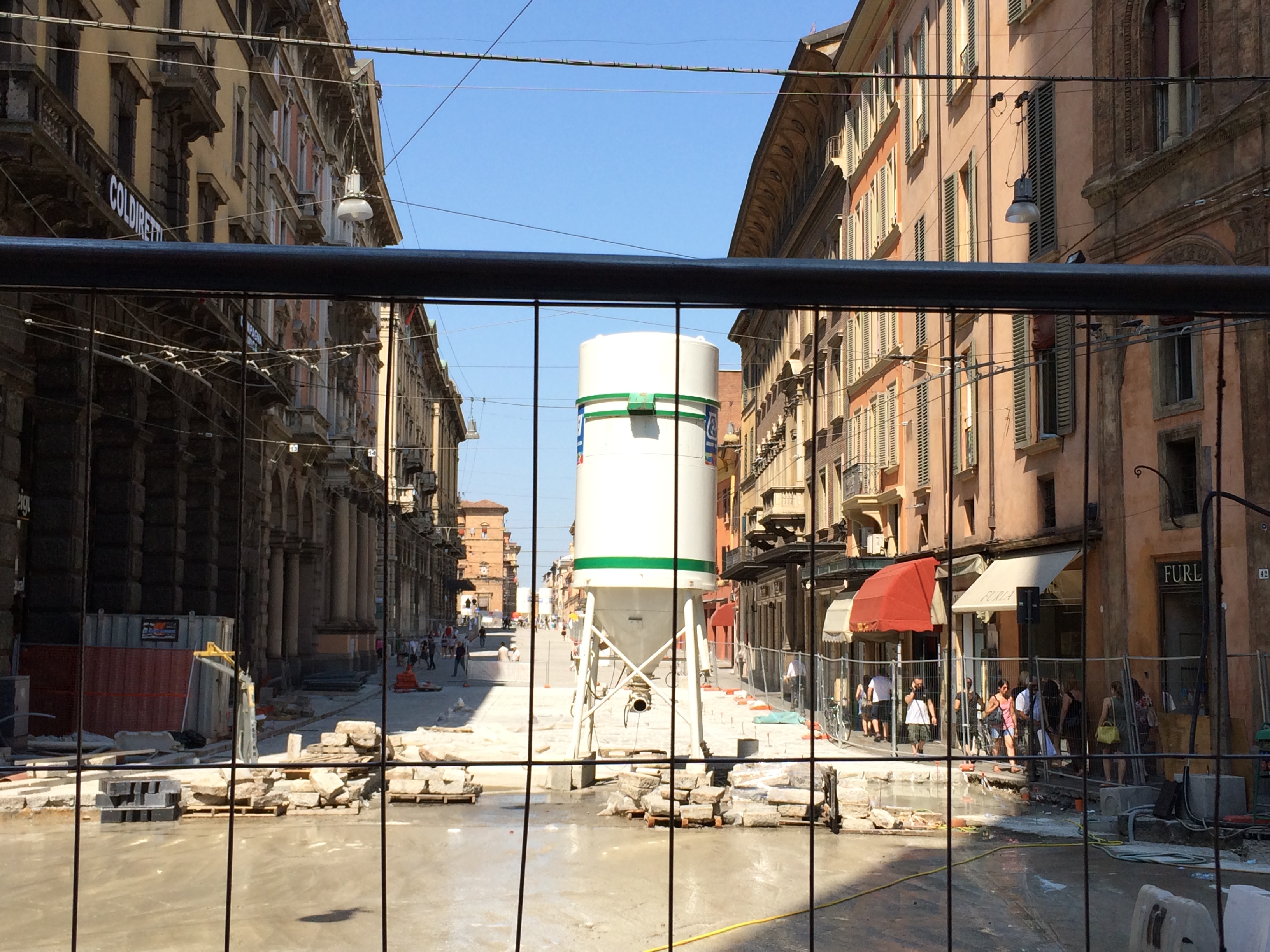
Bologna owes much of its current charm to the restoration work started in the 1970's.  More renovation was still underway.

Bologna owes much of its current charm to the restoration work started in the 1970’s. More renovation was still underway.


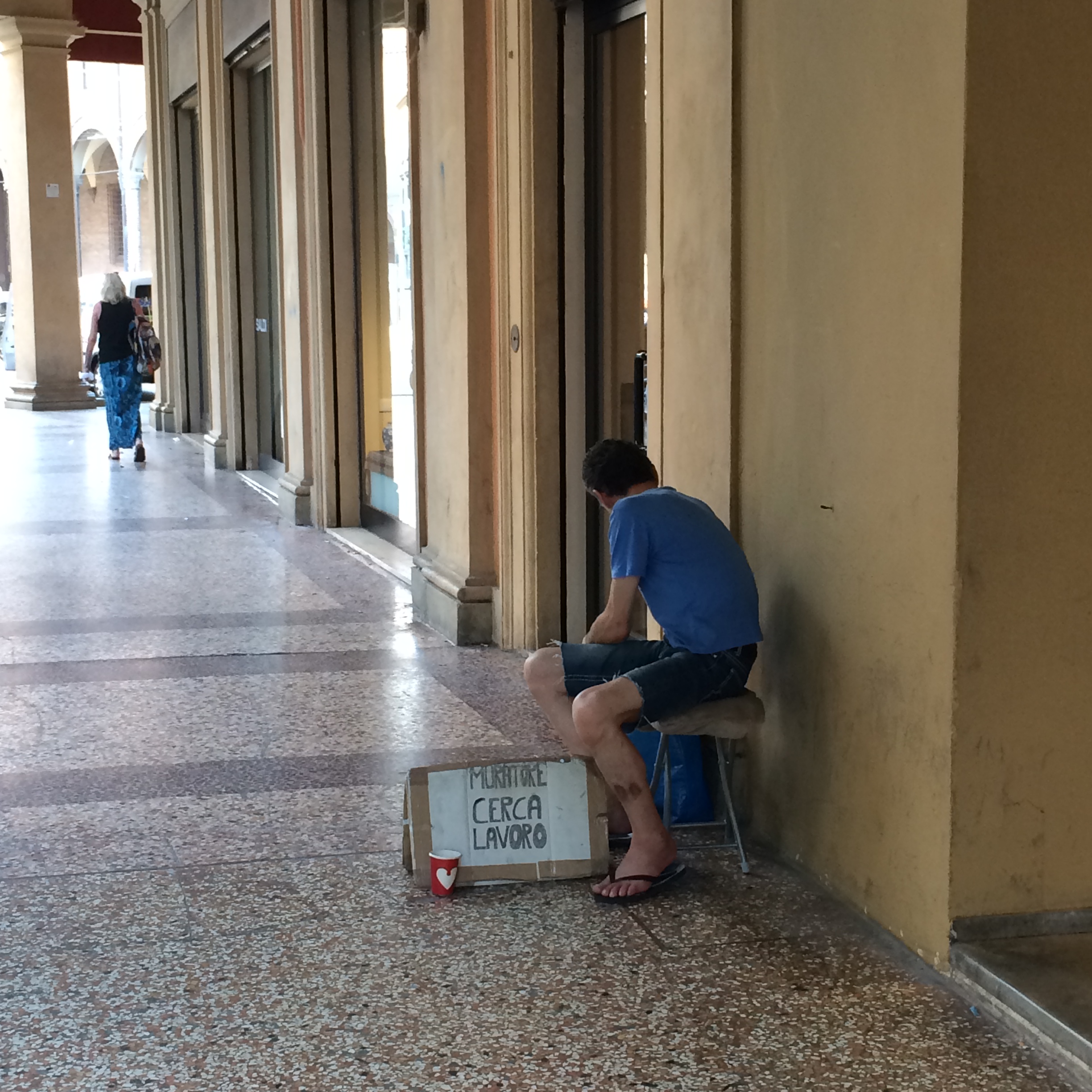
An out of work decorator

Bologna still has its economic problems. An out of work plasterer seeking work (and some spare change) on the Porta Ravegnana.


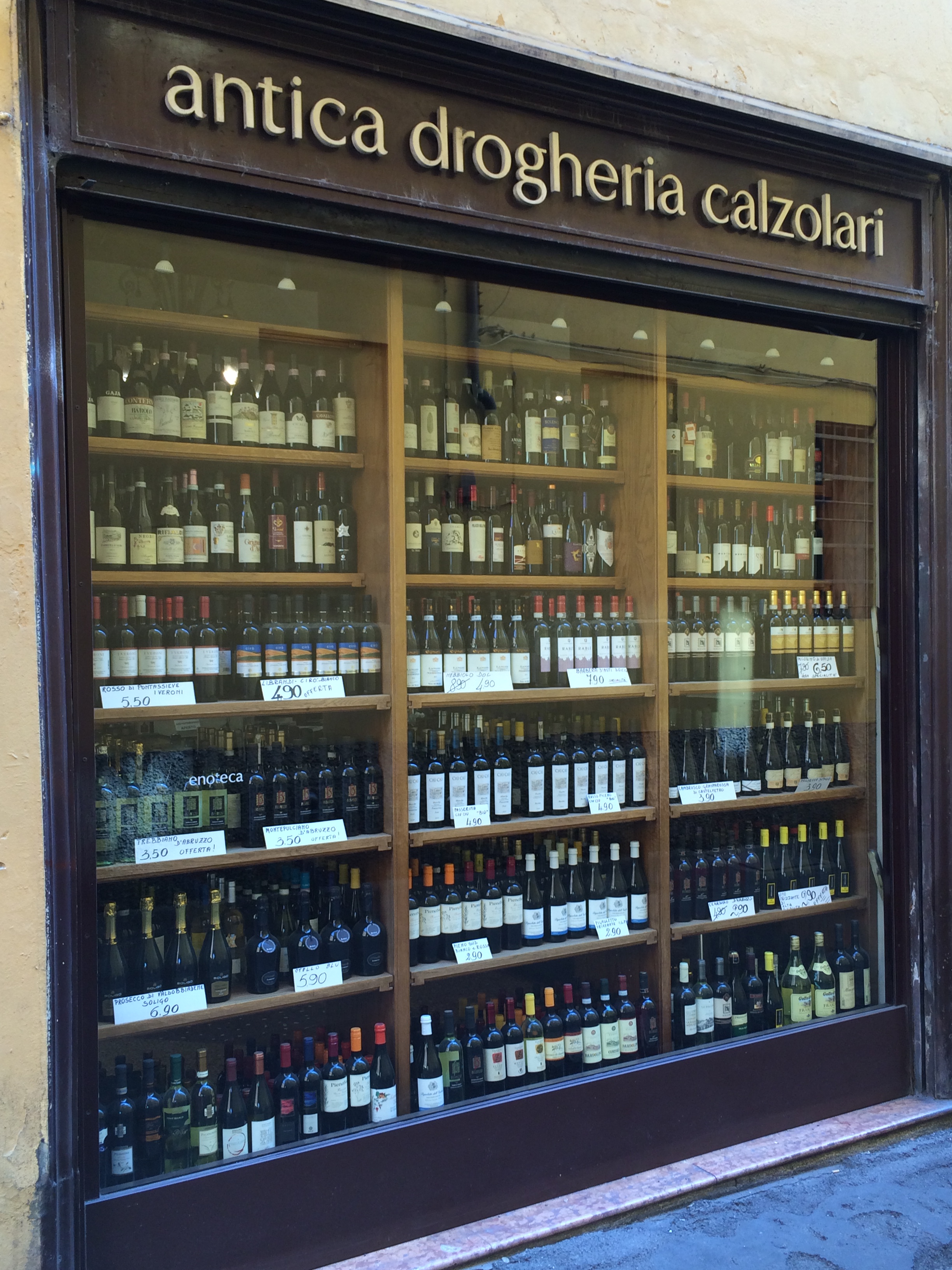
An interesting-looking wine-shop in central Bologna.

An interesting-looking wine-shop in central Bologna.


Student graffiti making some sort of statement about ISIS?

Student graffiti making some sort of statement about ISIS?


In the evening, we ate in the Trattoria Oberdan round the corner from our hotel and the wonderfully named Via dei Malcontenti, which could have been part of a film set for a 1930s gangster film.  The food was just what you’d expect from the gastronomic capital of Italy, the service attentive and reassuring as only the Italians know how, and once he got going, Antonino the Sicilian head waiter, was a veritable encyclopedia of information about both local cuisine and that of other regions in Italy.

The old-fashioned Osteria Ramazotti, Bologna.

The excellent old-fashioned Trattoria Oberdan, off Via dei Malcontenti.

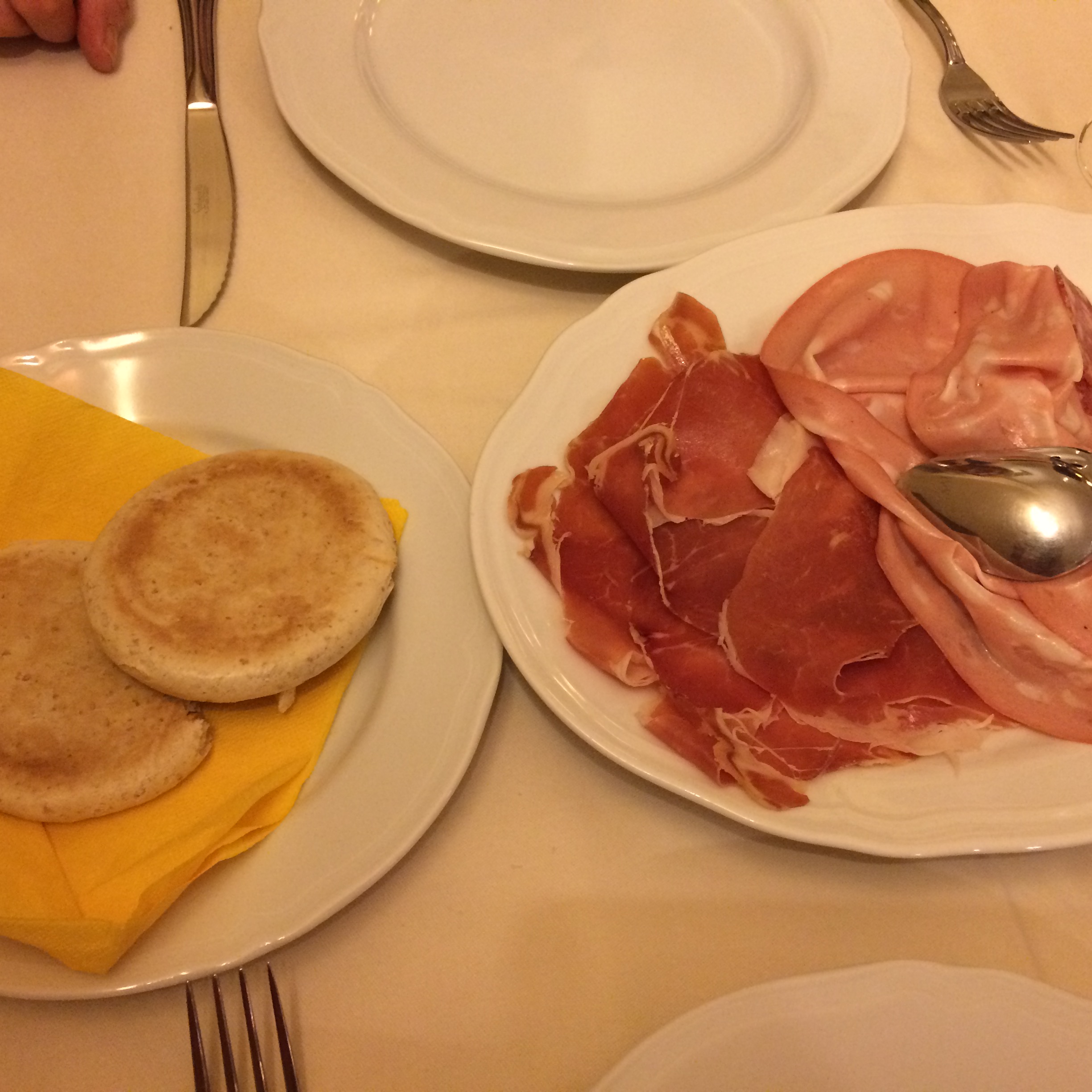
Salumi misti with 'stracchino' cheese and 'tigelle', typical unleavened buns from the Emilia Romagna region.

Salumi misti with ‘stracchino’ cheese and ‘tigelle’, typical unleavened buns from the Emilia Romagna region.

Arrosto di Vitello and Fettuccini ai funghi.

Arrosto di Vitello and Fettuccini ai funghi.

Nino (Antonino), head waiter at the Ramazzotti Restaurant.

Nino (Antonino), the personable and knowledgeable  head waiter at the Trattoria Oberdan.


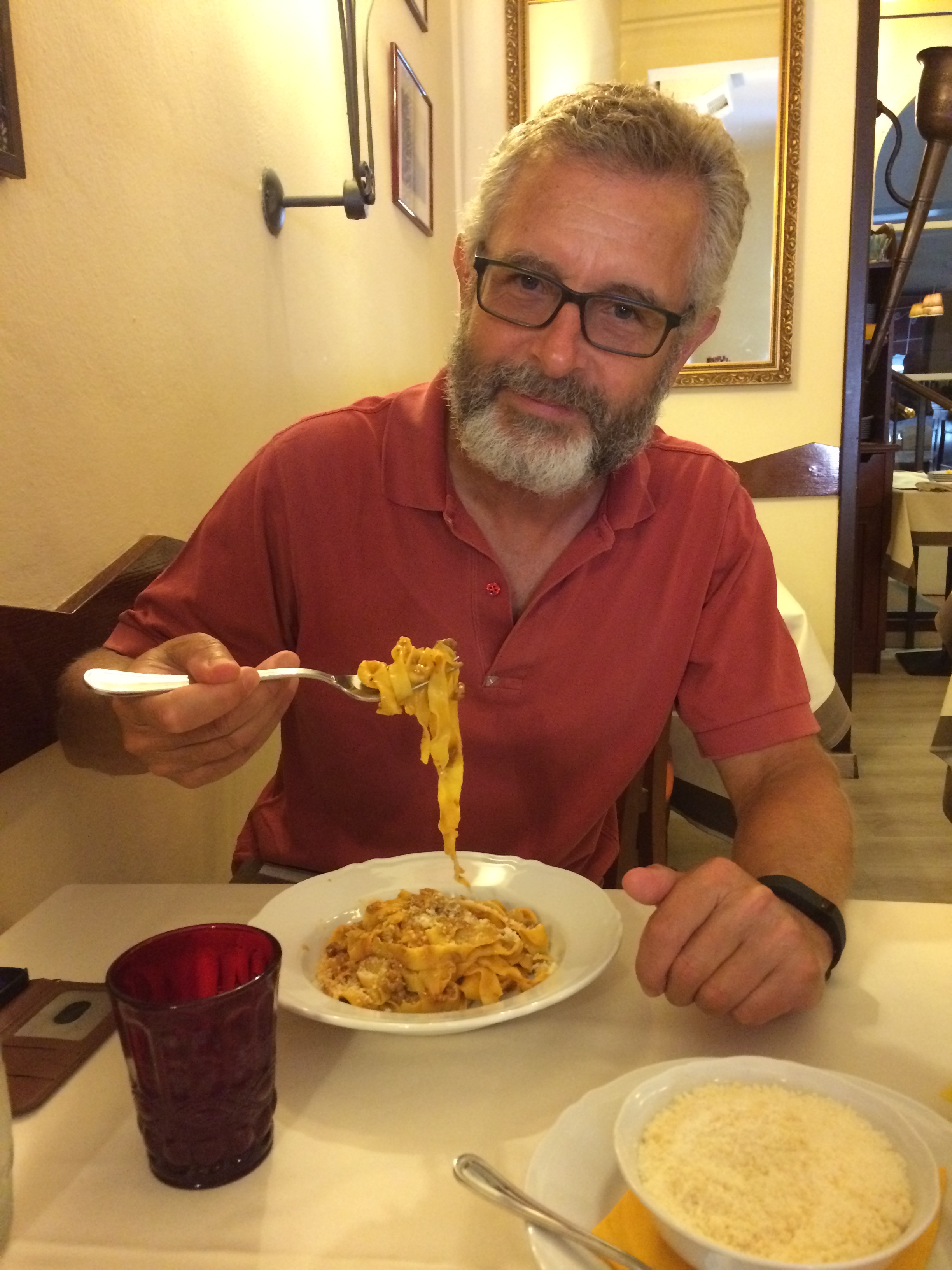
Tagliatelle alla bolognese - couldn't leave Bologna without having a taste of the real thing.

Tagliatelle alla bolognese – couldn’t leave Bologna without having a taste of the real thing.


Here is a quick summary of Nino’s thoughts about Italian cuisine:

Bologna and Emilia Romagna: “La grassa” cuisine; pasta fresca; gnocchi; bollito misto; arrosti con puree and salsa verde, “l’abruzzo” – agnello castrato; salcicie.

Roma: L’agnello piccolo; Coda di Vitello; trippa; carcioffi alla Romana; carbonara; matriciana.

Toscana: Firorentine di carne chianina (in Chianti or Siena area). He didn’t think Tuscan cuisine was very noteworthy.

Puglia: Cuccina a base di verdure; pasta con pomodori; basilico; orecchiette con verdura; pesce.

Sicilia: Cuccina povera; pasta alla Norma (made with melenzane fritte, pomodoro, olio and basilica with grated hard-baked ricotta) – sounds great; pesce con verdure; pesce azzurro (small fish like sardines); paste alle sarde.

Next morning, after an early breakfast (after getting the puncture on Flavio’s bike repaired by Gianfranco the friendly and helpful owner of the ‘Sensa Benzo’ cycle shop off the Via Zamboni, we cycled round the city and through the lengthy porticoes, visited the Basilica di Santo Stefano, which started out as a Roman Temple but became a medieval religious complex which once had seven churches.  Bologna also boasts the world’s very first university which was founded in 1088.  Bologna is very similar to Verona but without the hoards of tourists.  A wonderful city and certainly worth a second visit.  After a pasta lunch at our favourite restaurant we set off again, heading south.

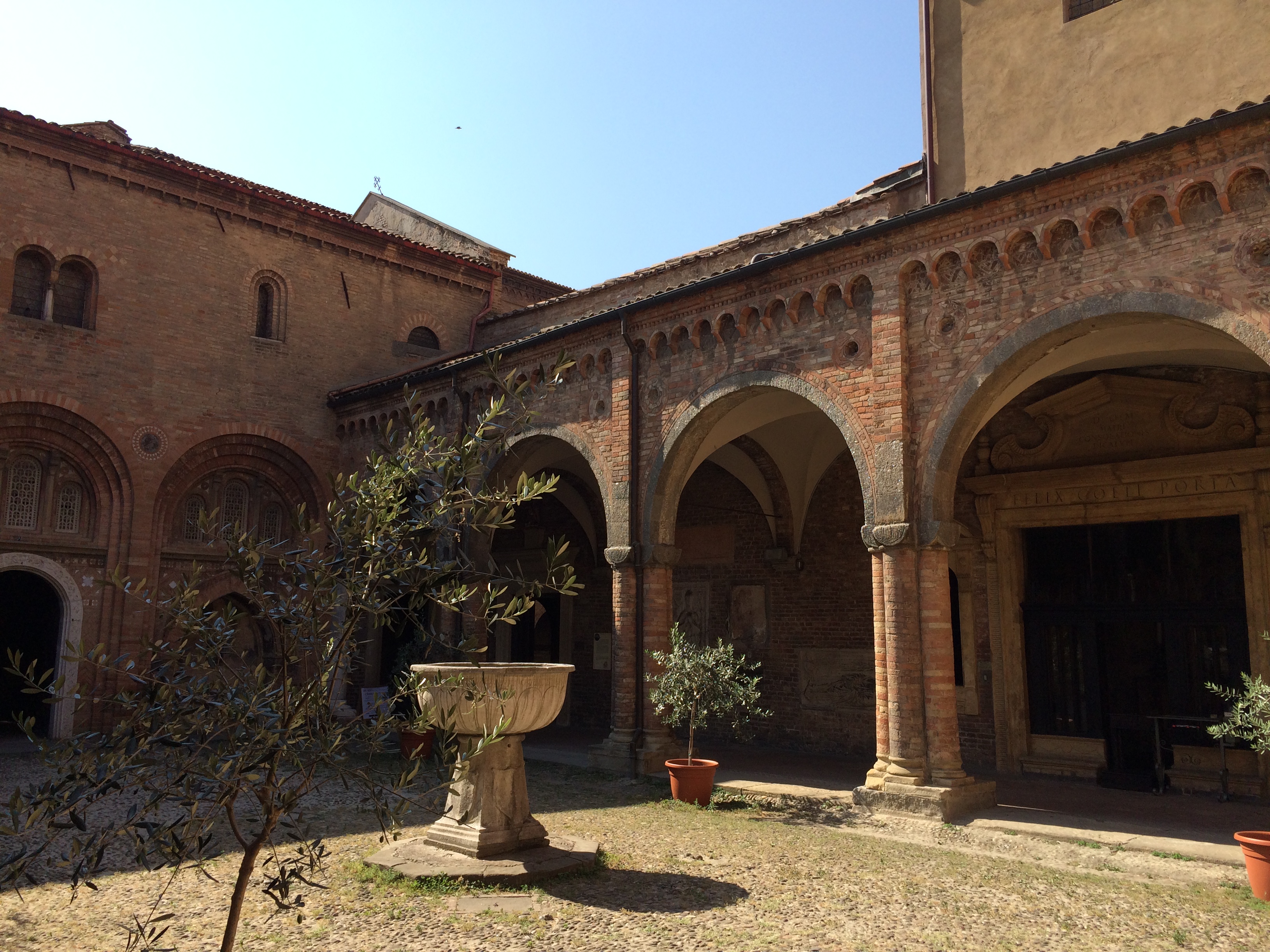
The inner courtyard of the Basilica di Santo Stefano.

The inner courtyard of the Basilica di Santo Stefano.

One of the seven old churches in the Basilica di Santo Stefano complex.

One of the seven old churches in the Basilica di Santo Stefano complex.

Entrance to the Chiesa del Martyrium in the Basilica di Santo Stefano.

Entrance to the Chiesa del Martyrium in the Basilica di Santo Stefano.

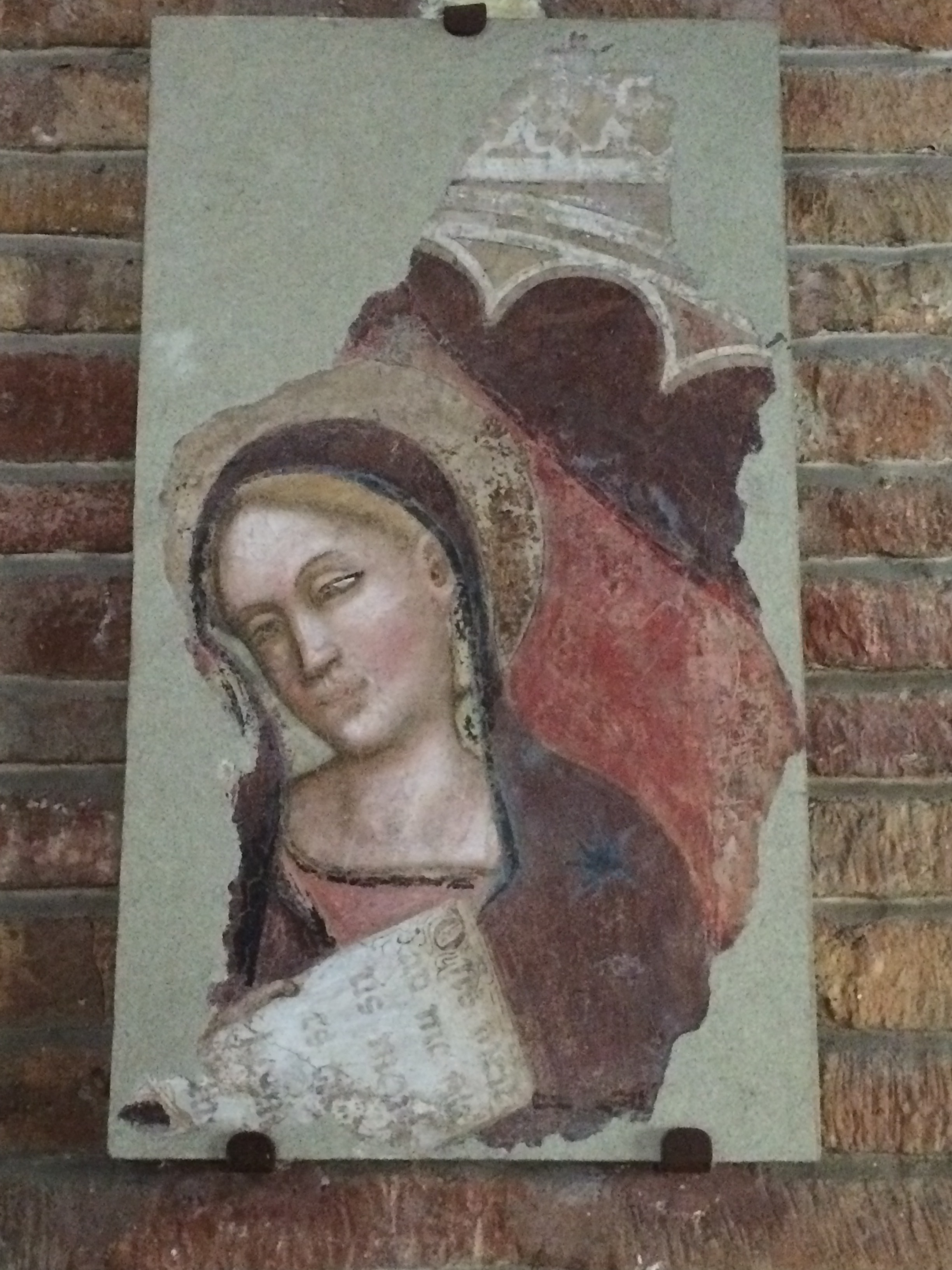
An old fresco in the Basilica di Santo Stefano.

An old fresco in the Basilica di Santo Stefano.

Gianfranco at the Sensa Benzo cycle shop gives Flavio's bike a bit of TLC.

Gianfranco at the Sensa Benzo cycle shop gives Flavio’s bike a bit of TLC.

IMG_4550


IMG_4547

Wednesday 22nd July – Verona

Standard

Entering Verona under the Roman gate Porta Borsari we were astonished at how beautiful Verona was, a city well deserving of its World Heritage status.  It has an amazing Roman Amphitheater Arena, second-largest after the Collosseum, which hosts regular musical events.  It has medieval buildings, Juliet’s house being a small medieval palace, (disappointingly, we discovered the balcony was added in the 1930’s), beautiful Renaissance buildings, a Venice without the canal.  That such a beautiful city could have a dark past was surprising.  Verona became a fascist centre during the Second World War, a key interrogation centre of resistance fighters and a transit point for Italian Jews sent to Nazi concentration camps.

Walking around unsurprisingly we found ourselves surrounded by throngs of tourists. It was after all the city in which Shakespeare set Romeo and Juliet.  We shuffled along with a large crowd to see Juliet’s home and all dutifully took photographs of the balcony and then shuffled out.  The portico you entered through had graffiti and post-it love messages to Juliet.  It was hot and airless, the temperature was around 43 C and we found ourselves, not exactly ‘star-crossed lovers’ but very definitely hot-cross lovers.

The Porta Nuova, at the entrance to Verona's old centre

The Porta Nuova, at the entrance to Verona’s old centre


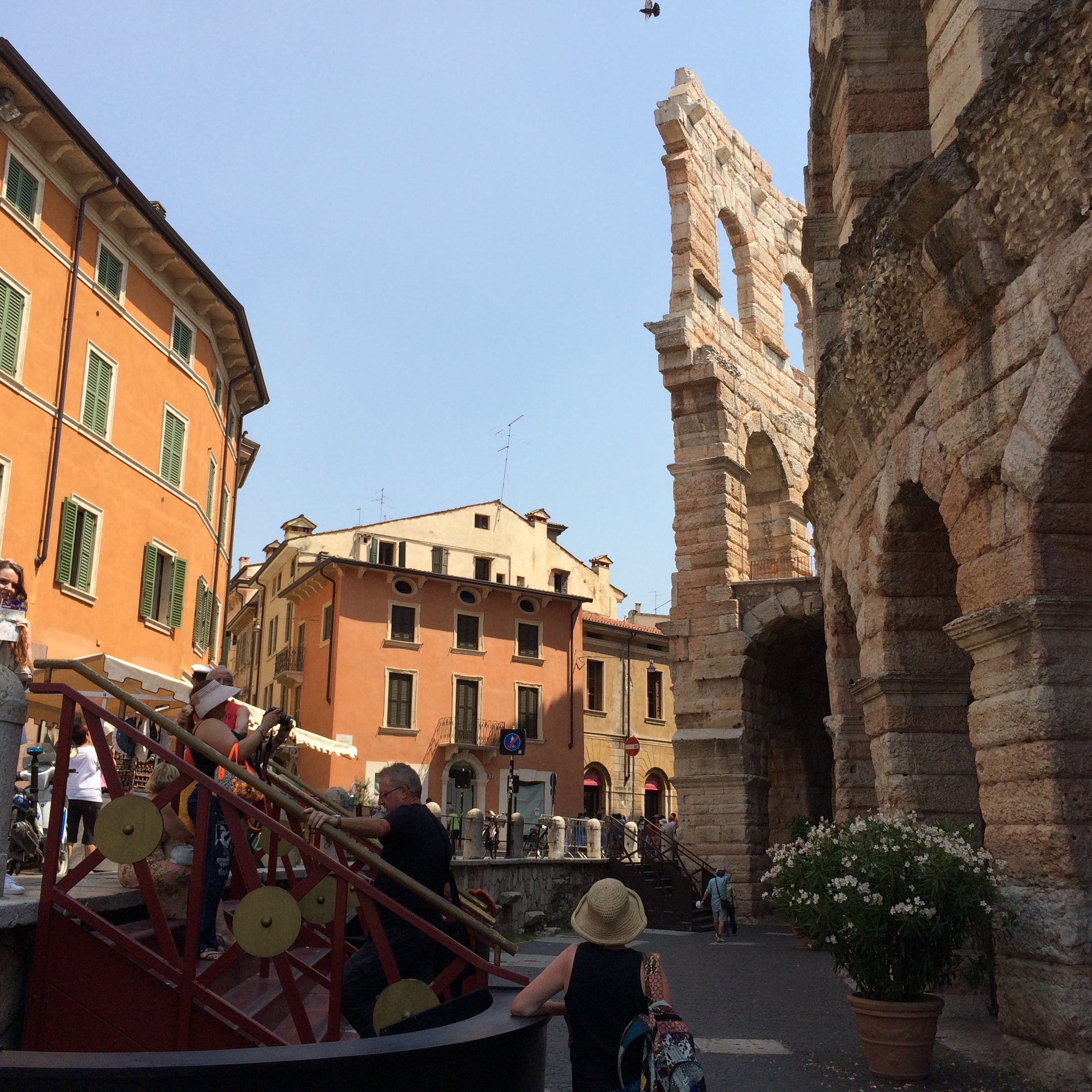
Verona's Roman remains and its Renaissance past blend in well together.  Here part of the Amphitheatre is visible.

Verona’s Roman remains and its Renaissance past blend in well together. Here part of the Amphitheatre is visible.


Verona - Centro Storico

Verona – Centro Storico


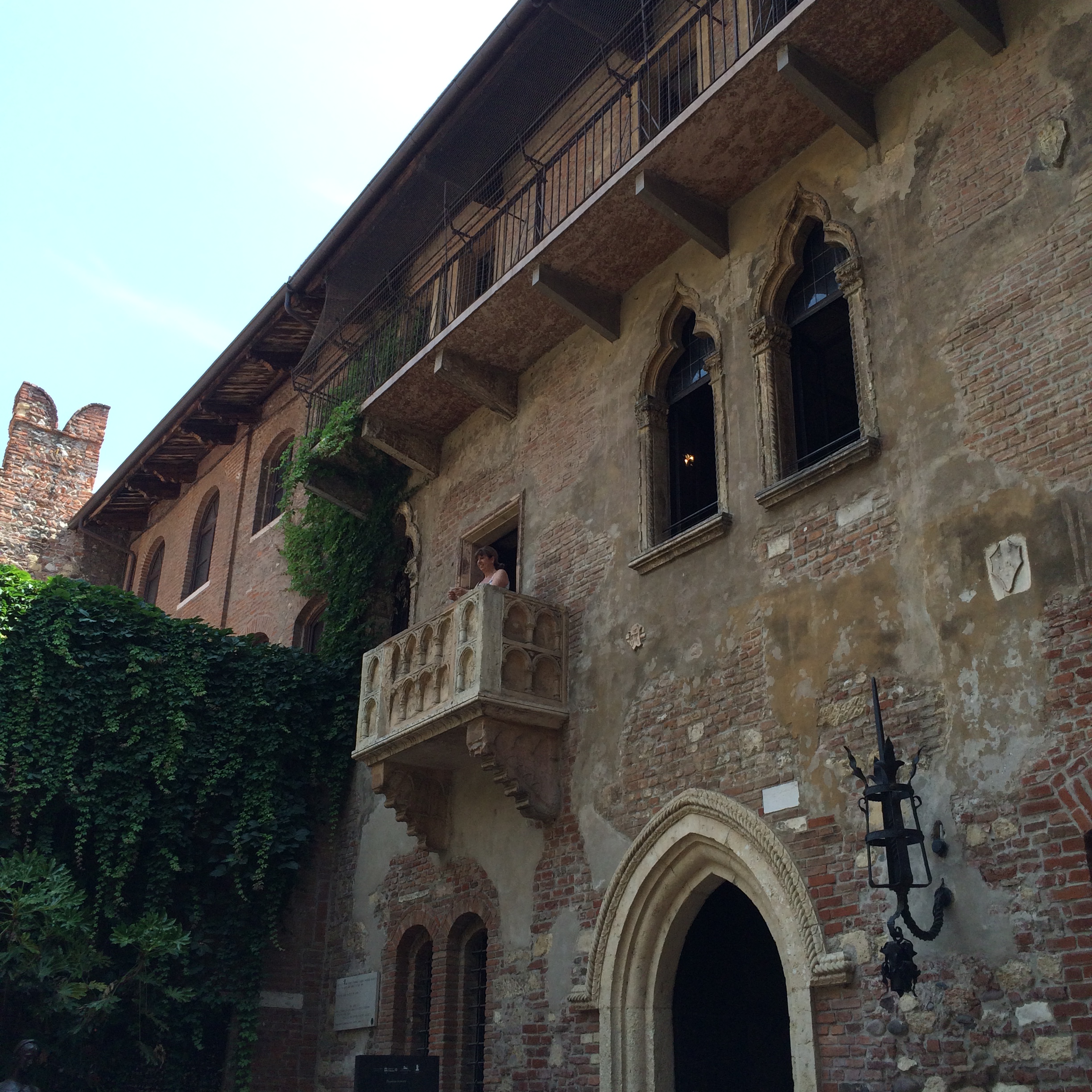
Juliet's balcony at the House of the Capuleti (actually added later) but a major tourist attraction.

Juliet’s balcony at the House of the Capuleti (actually added later) but a major tourist attraction.

Just a few of the thousands of messages to Juliet left by tourists.

Just a few of the zillions of messages to Juliet left by tourists.


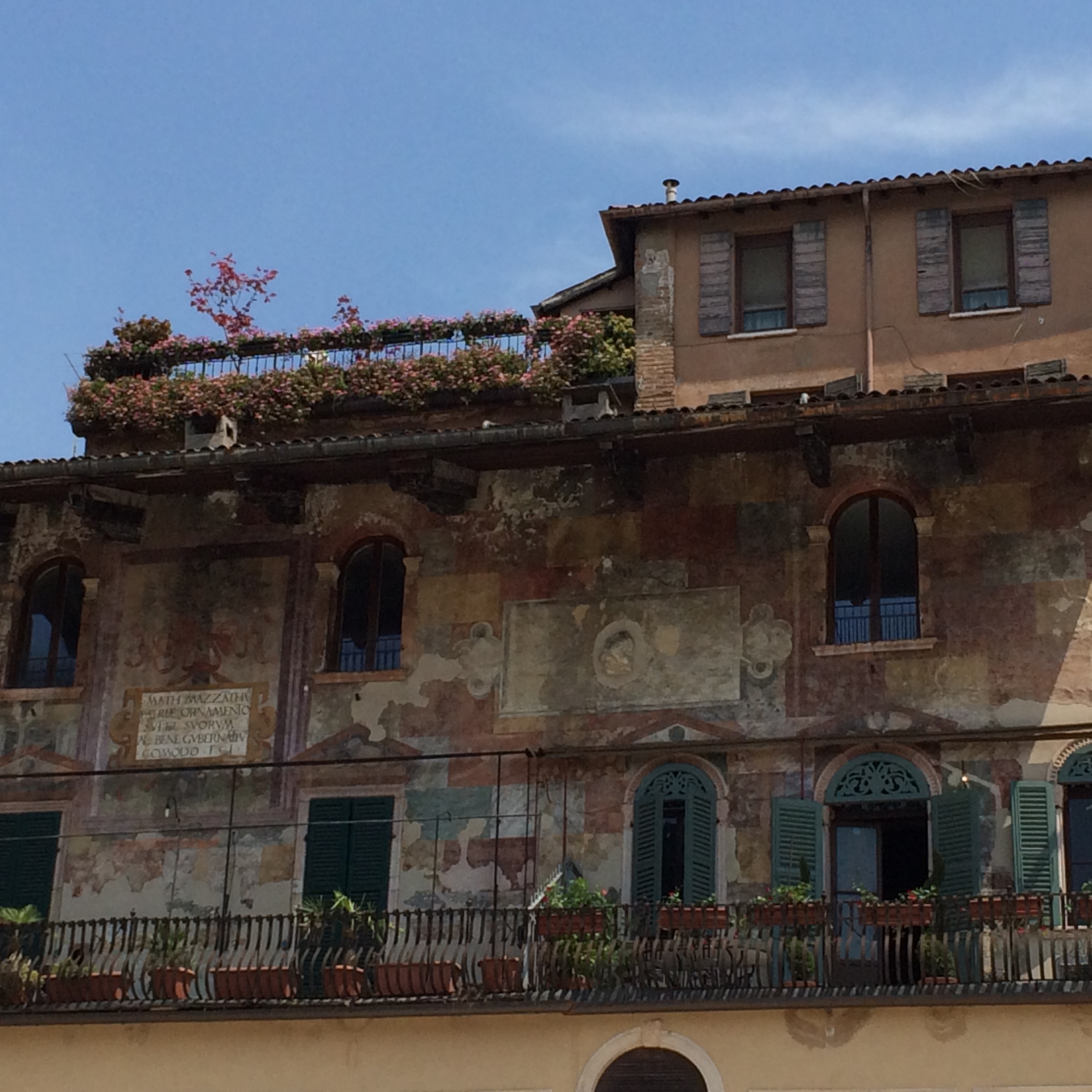
Near the 'Mercato Vecchio', Verona.

Near the ‘Mercato Vecchio’, Verona.


The Piazza dei Signori, Verona.

The Piazza dei Signori, Verona.


"Dal luogo sacro la civiltà Italica arra di Liberta e Giustizia tende la spada".

“Dal luogo sacro la civiltà Italica arra di Liberta e Giustizia tende la spada”.


Via S. Rocchetto, Verona.

Via S. Rocchetto, Verona.


IMG_4453


Monday 20th and Tuesday 21st July – Lake Garda, Lombardy via Asti and Alessandria

Standard

Struggling with temperatures of 40C+ we headed in the direction of Lake Garda which we mistakenly thought would provide some respite from the heat and some fresher air.  How wrong we were!

On the way, we decided to take a quick look at Alessandria for the simple reason that Flavio felt sentimentally compelled to visit it as an Italian Alexandrian from Egypt. First, our route took us through Margarita, Moglia Nera (meaning ‘Black Wife’!), Pollenzo and Asti, where we stopped for a light lunch.  Asti was pleasant enough, though not remarkable, but by the time we got to Alessandria it was the hottest time of the afternoon and we could see from our weather App that Alessandria had clocked up some of the highest temperatures in the whole of Italy – and this during a heatwave.  We were physically only able to give it a cursory look but in any case, when we asked to be directed to the most interesting part of town, there really wasn’t anything of any note. Stopping at a pharmacist, we were told that (unlike the Egyptian Alexandria) Alessandria got its name from its founder, Pope Alexander II.  Parking the car at the open-air car park (essential for our Brenda being a ‘high-top’ and not always easy to find) we saw an old man standing in the sun next to the payment machines, hunched over and looking as though he was about to faint.  We went over to ask if he was alright and if we could ring someone to come and pick him up.  He said he was OK and that he was suffering from an ulcer.  He refused to move out of the sun and sit on a bench in the shade but accepted some water.  When we came back after our visit (must have been an hour or so) we were amazed to find him still hunched over in the same spot in the unbearable heat.  A man sitting across the way in the shade explained that he was there every day hoping people paying for the parking would spare some ‘spiccioli’.

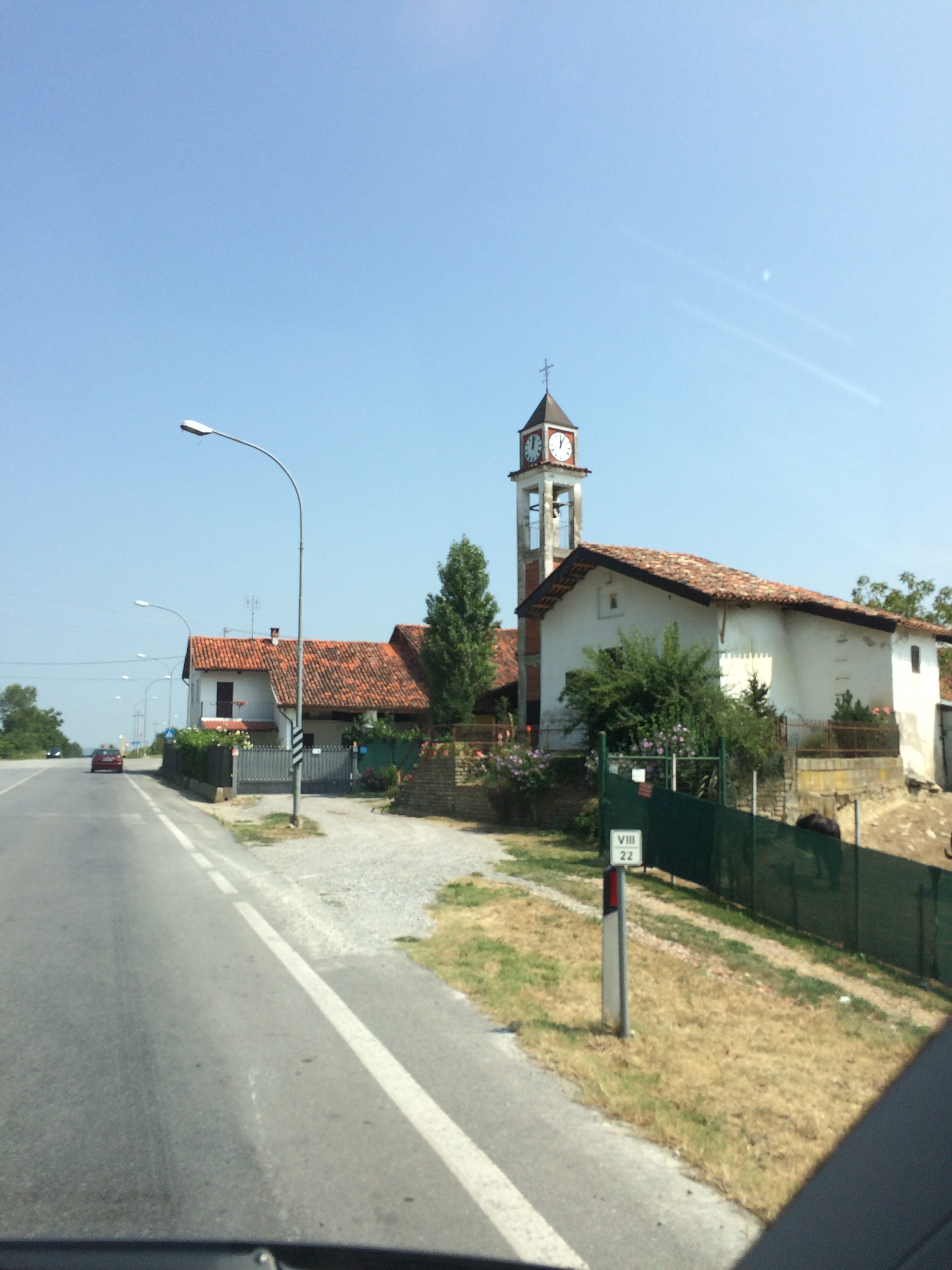
The little town of Margarita.

The little town of Margarita.

The castle at Pollenzo.

The castle at Pollenzo.

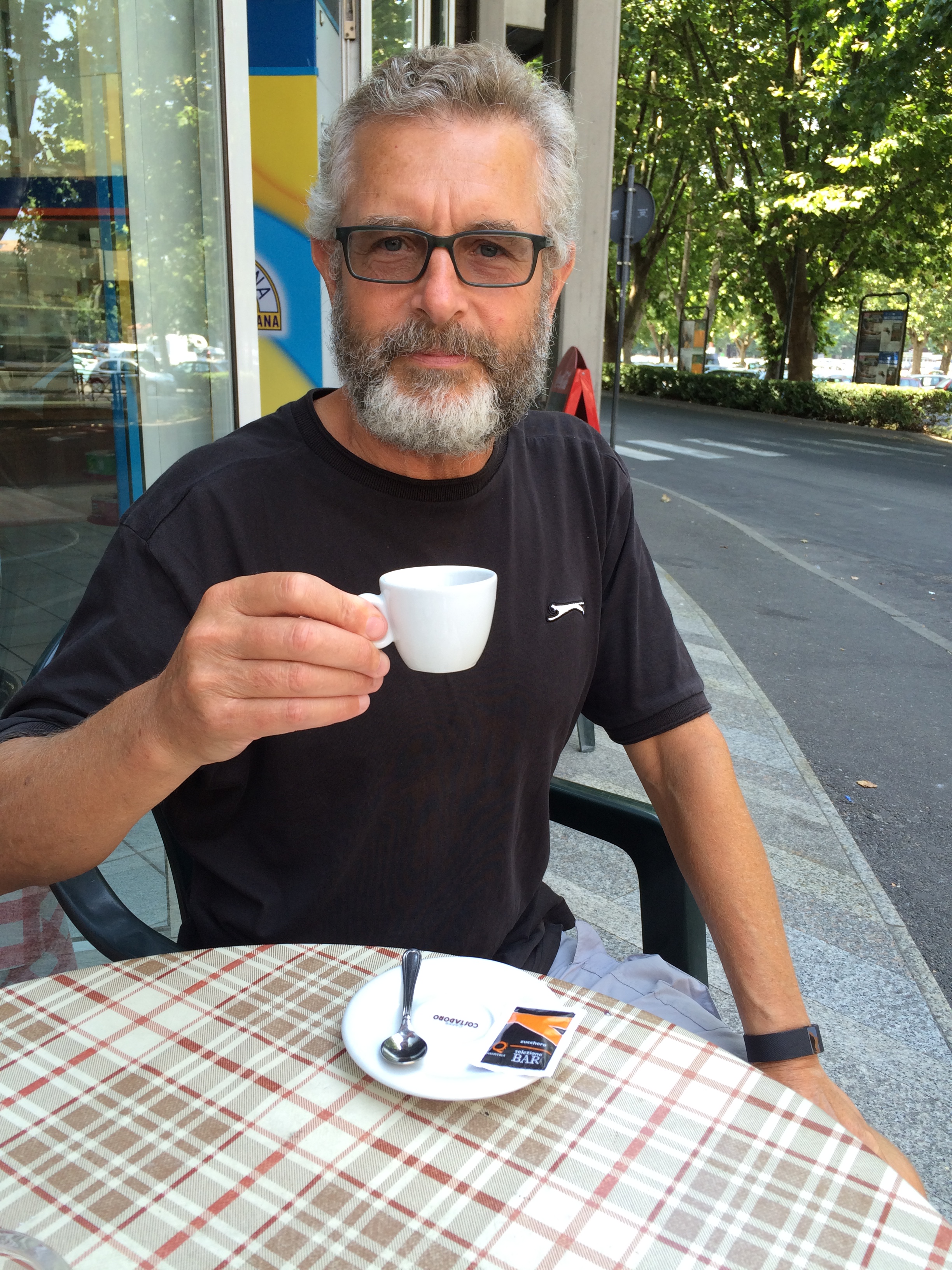
First 'caffe' in Italy - in Asti.

First ‘caffe’ in Italy – in Asti.

The central piazza in Asti.

The Piazza Medici in Asti.

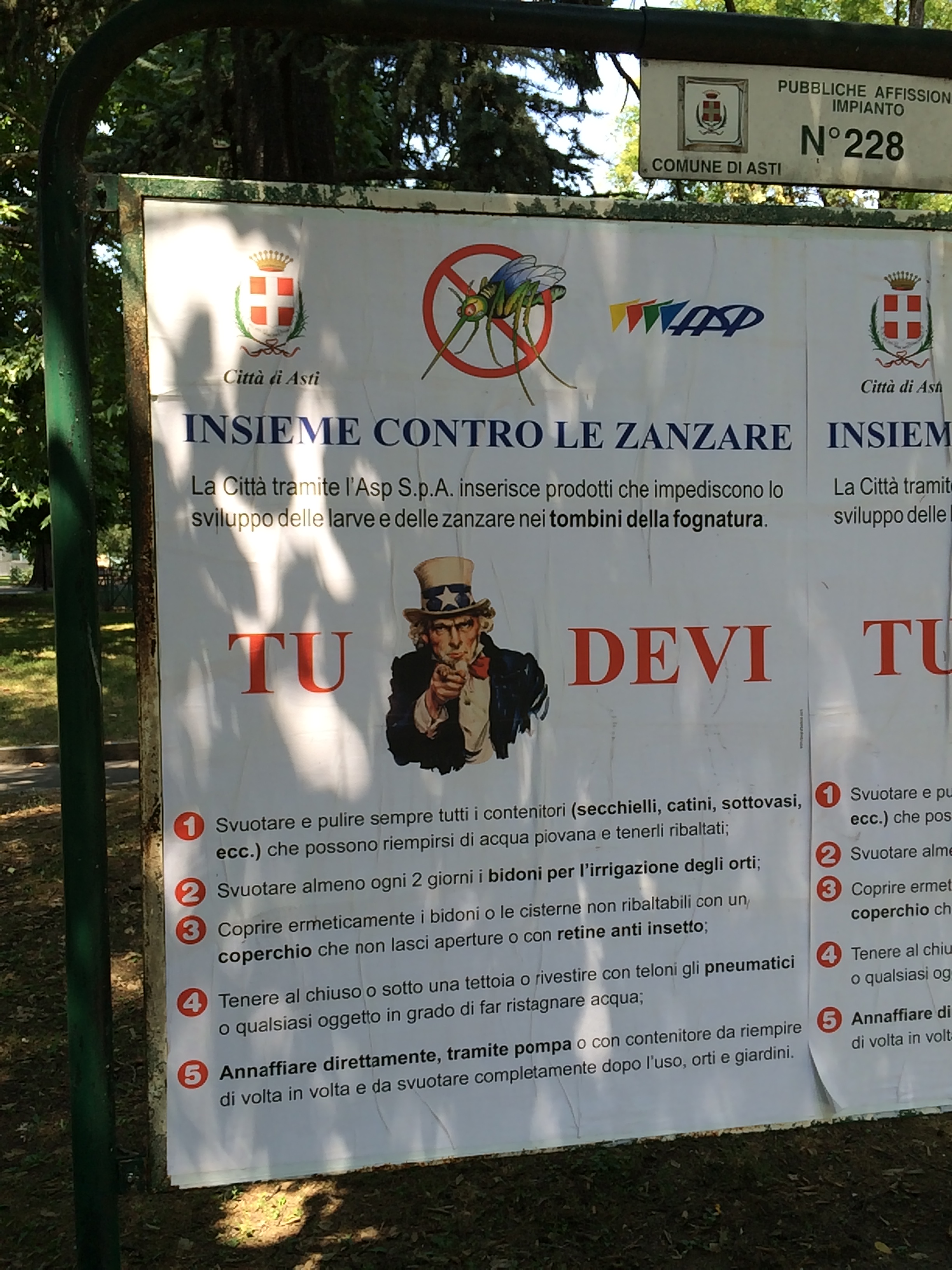
Poster advising people of Asti what they can do to combat mosquitoes.  Seems to be a serious problem in Asti.

Poster advising people of Asti what they can do to combat mosquitoes. Seems to be a serious problem in Asti.

Asti was a pleasant town to walk through - somewhat marred by the intense heat though.

Asti was a pleasant town to walk through – somewhat marred by the intense heat though.

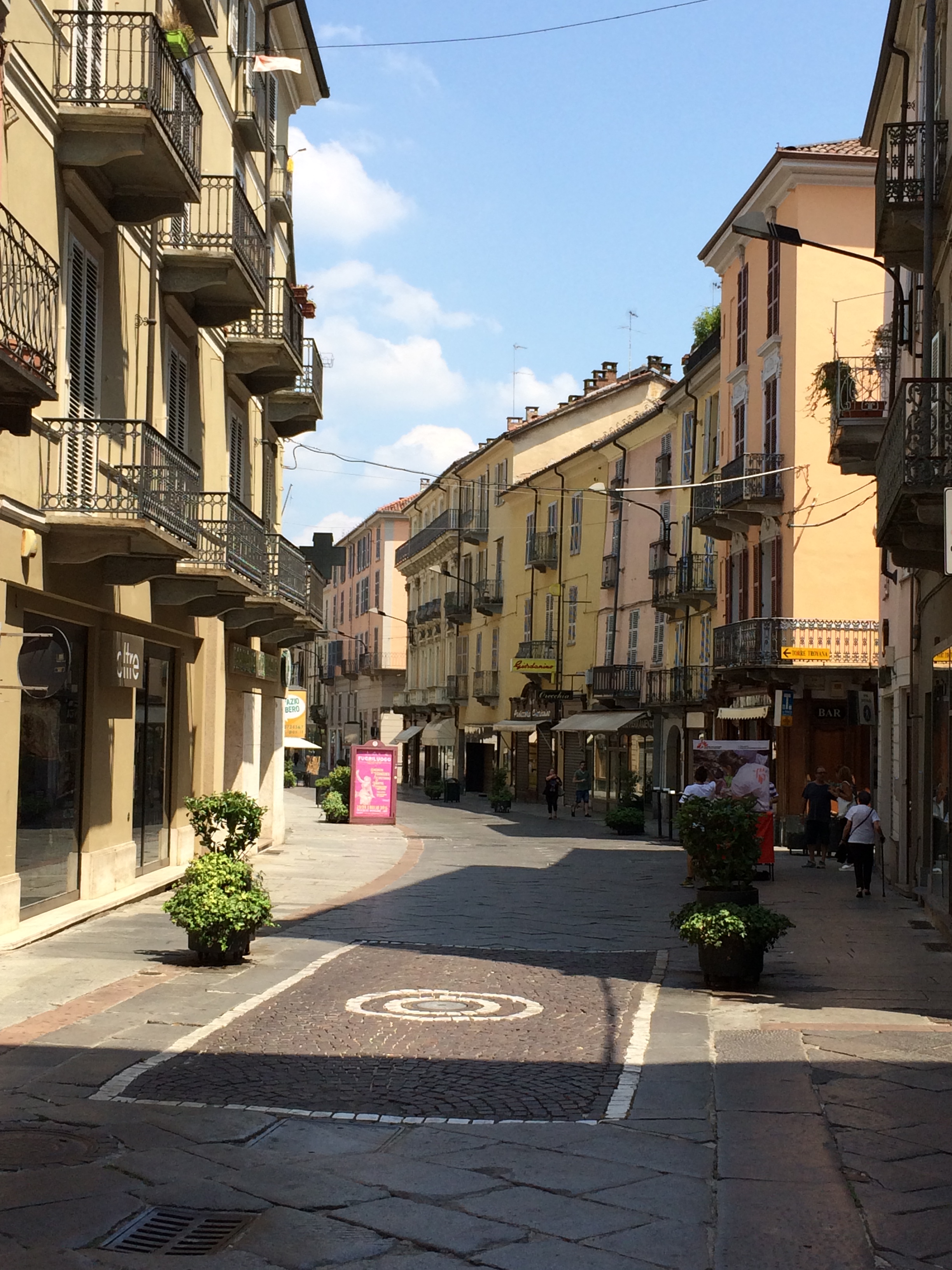
A typical street in Asti.

A typical street in Asti.

Arrival in Alessandria.

Arrival in Alessandria.

The Corso Roma in Alessandria.

The Corso Roma in Alessandria.

Monument to 'Alexandria and its sons who died for the unity and independence of the fatherland.

Monument to ‘Alexandria and its sons who died for the unity and independence of the fatherland.

Banner outside the 'Cinema Moderno' in Alessandria saying

Banner outside the ‘Cinema Moderno’ in Alessandria saying “Alessandria resists” – closure perhaps?

A building that looks like it could have been a former synagogue in Alessandria.

A building that looks like it could have been a former synagogue in Alessandria.

Engraving outside the building that reads:

Engraving outside the building that reads: “Love your neighbour as you love yourself. Between 1939-1945 some 6 mil Jews were deported, martyred, suppressed. This tribute to so much innocent blood spilt – atrocious offence against humanity – has inspired in every heart feelings of justice, brotherhood and love. The community of Alessandria remembers its victims.”

Vegetable seller in Alessandria.

Vegetable seller in Alessandria.

Flavio in Alessandria, Italy not his native Alexandria.

Flavio in Alessandria, Italy not his native Alexandria.

Lake Garda was a popular destination for Romans as it is now for modern-day Italians as well as German and Dutch holiday-makers, especially Germans.  The campsite was lovely but large, quite pricey and very full.  The heat and humidity were oppressive, with no respite and not a whiff of air when you most needed it at the end of the day – it was as if the lake hit the doldrums at around 6pm and though the temperature eventually went down a few degrees by the small hours, it was very difficult to sleep.  Flavio even ended up lying down at the end of the pontoon over the lake at 3am to try and catch a hint of cool air. The only respite was our swims in the lake which mercifully was still cool, being quite deep – they became quite frequent out of sheer necessity.

Lake Garda which provided some respite from the intense heat and humidity.

Lake Garda which provided some respite from the intense heat and humidity.

Keeping cheerful despite the heat.

Keeping cheerful despite the heat.

On the second night walked to the local village, Manerba del Garda, for an ‘Italian experience’ only to find the village full of German and Dutch tourists and the market full of stalls run by Africans selling mostly goods from China and India.  Surprisingly, we were having trouble finding any place to eat so we stopped to ask a couple of sophisticated-looking elderly local women sitting and chatting outside their homes for advice.  In a manner which seemed vaguely familiar they answered in a lengthy, sceptical and grumbling but ultimately not terribly helpful sort of way and finally suggested a place that had changed management recently down the road but whether it was any good or indeed whether we’d find it open or not, they really couldn’t say – in fact everything pointed to them having serious doubts, both about this and very probably pretty much anything else we might have asked them about – it all felt so familiar!  (Never expect a short answer in Italy!)

On the walk to the village of Manerba del Garda.

On the walk to the village of Manerba del Garda.

A heavy olive as well as wine-growing area.

A heavy olive as well as wine-growing area.

We walked to the edge of town until we found the restaurant.  Mercifully, it had air conditioning, which is surprisingly difficult to find. The homemade pasta was superb and Matteo the chef came out to greet us and explain that he was trying to keep alive the local cuisine of the region.  The wine too was a new experience – a white Lugana from the village of Desenzano (the next village along) which was was very pleasant indeed and matched our pasta dishes of ‘ravioloni with a chicken and rabbit filling’ and ‘tagliatelle al pomodoro’ perfectly.

The ravioloni con farcia bianca, burro di malga and 24 month old Grand Padano cheese.

The ravioloni con farcia bianca, burro di malga and 24 month old Grand Padano cheese.

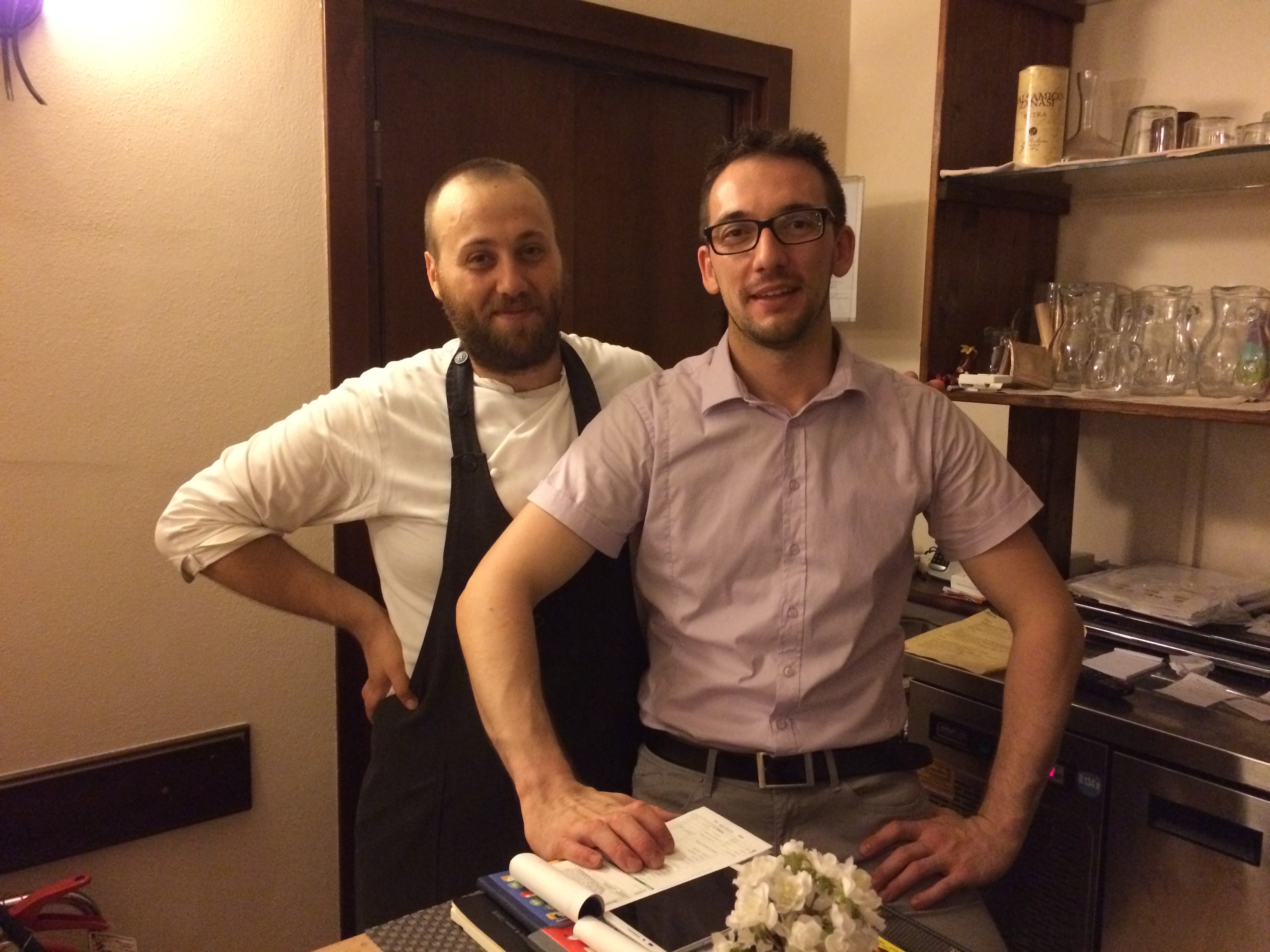
Great service from Matteo the chef and Simone.

Great service from Matteo the chef and Simone. Trying to keep alive local cuisine.

Booked ferry to Dubrovnik as we decided we would drive to Greece via Croatia, Bosnia and Herzegovina, Serbia and Macedonia (cautiously bypassing Albania although we were tempted).

IMG_4406

Sunday 19th July – to Italy

Standard

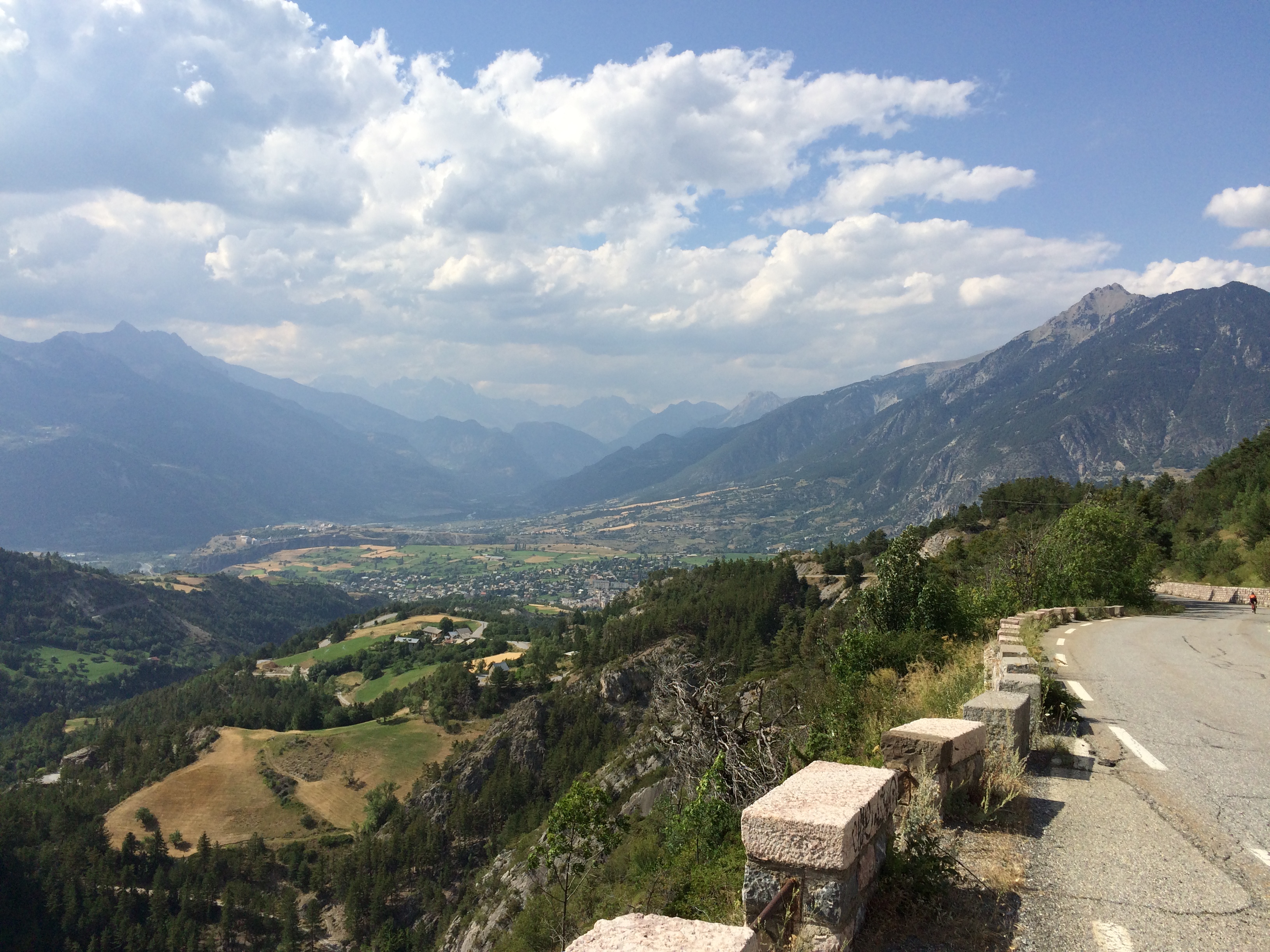
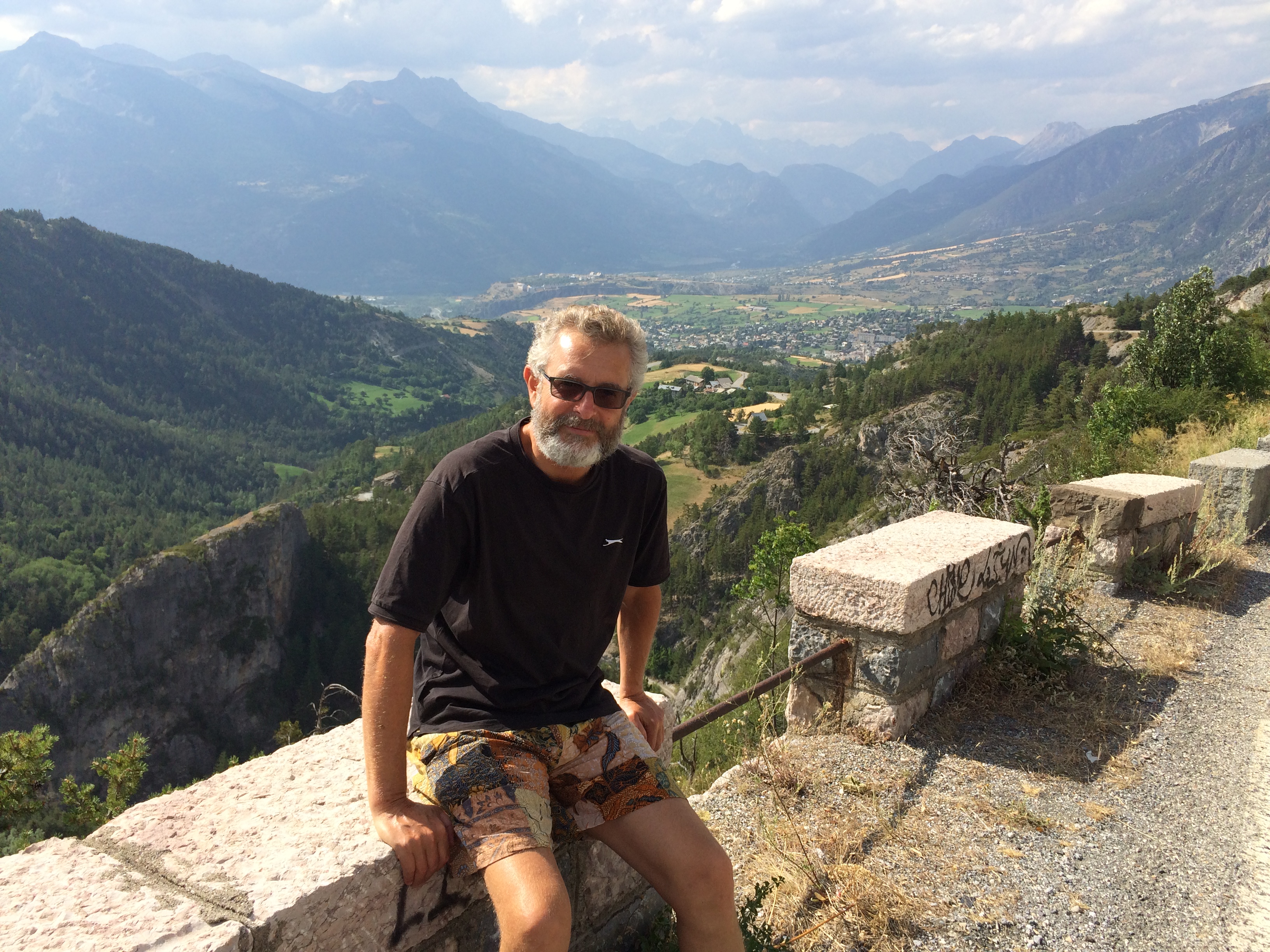
Leaving Guillestre, we climbed higher and higher still, through the ski resorts of Saint-Marcellin-de Vars and Les Claux until we reached the summit of the Col de Vars at Saint-Paul-sur-Ubaye, 2109 metres above sea level.   The views were staggering.  The temperature was dropping rapidly as the altitude increased, from 38 C to just 19 C at the top, which came as a great momentary relief, and we even had some rainfall.

Climbing up from Guillestre, the views were staggering.

Climbing up from Guillestre, the views were staggering.

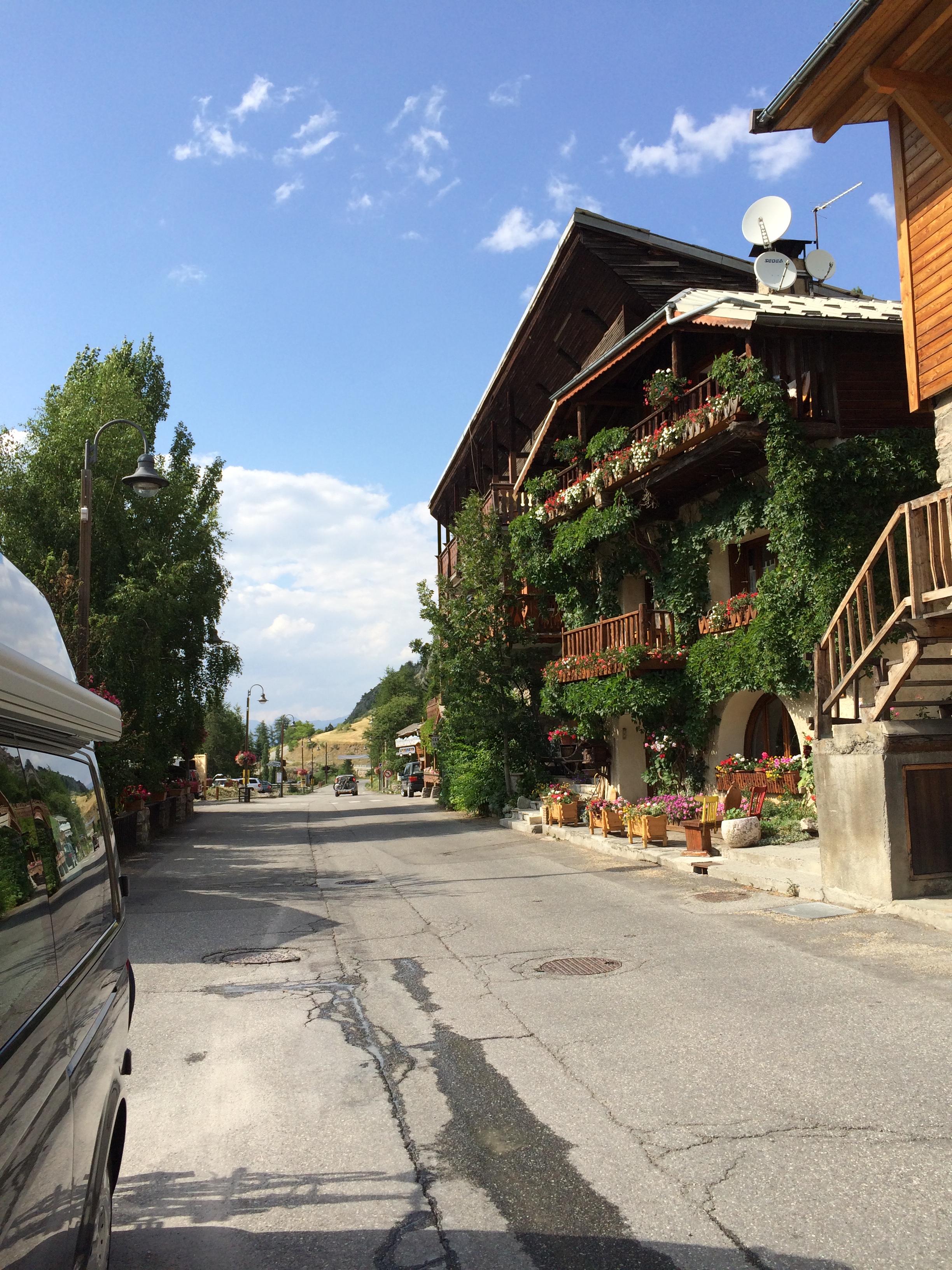
Saint-Marcellin-de-Vars

Saint-Marcellin-de-Vars

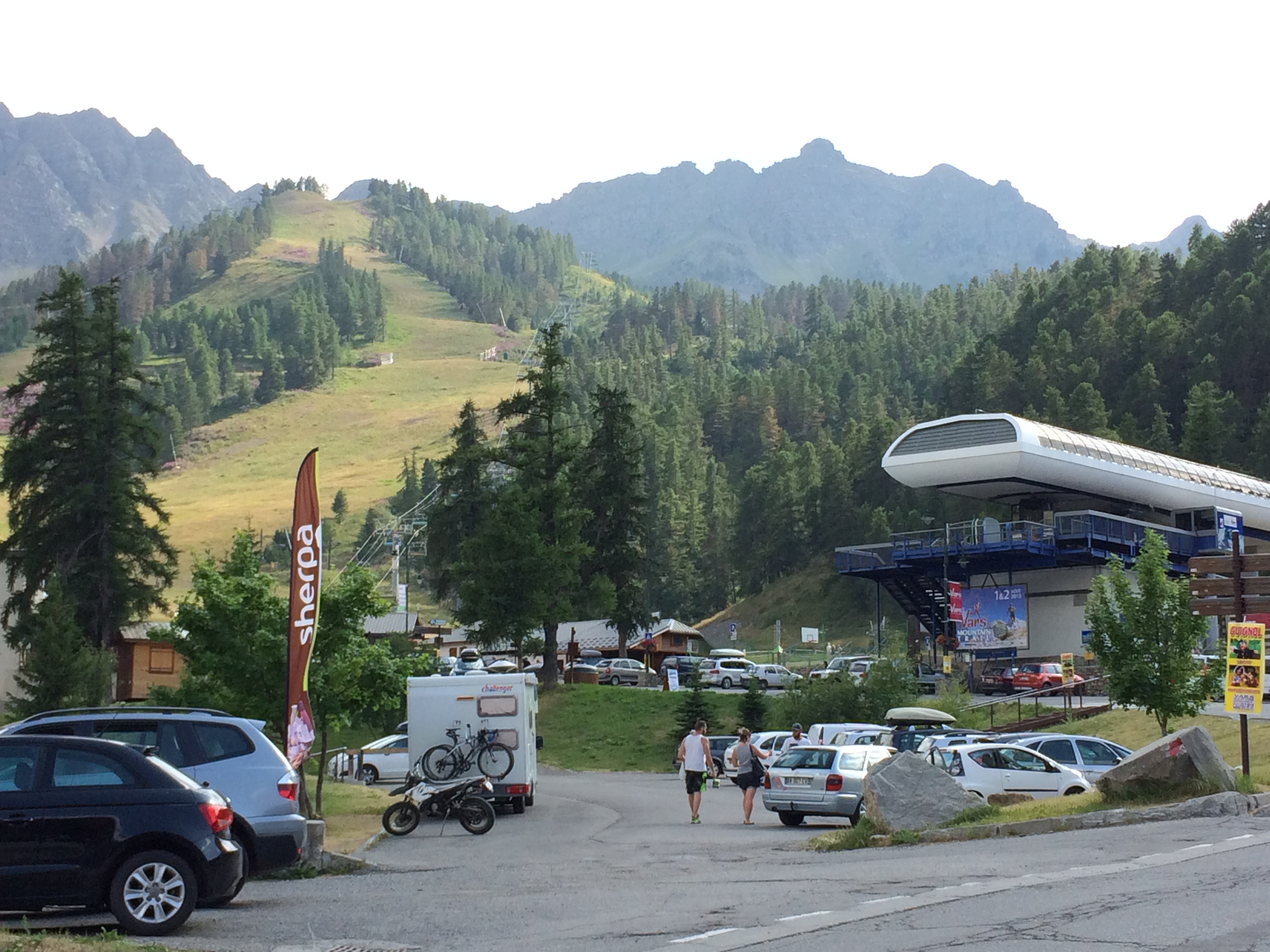
The ski resort of Les Claux with the 'piste' visible on the left and the ski-lift station on the right.

The ski resort of Les Claux with the ‘piste’ visible on the left and the ski-lift station on the right.

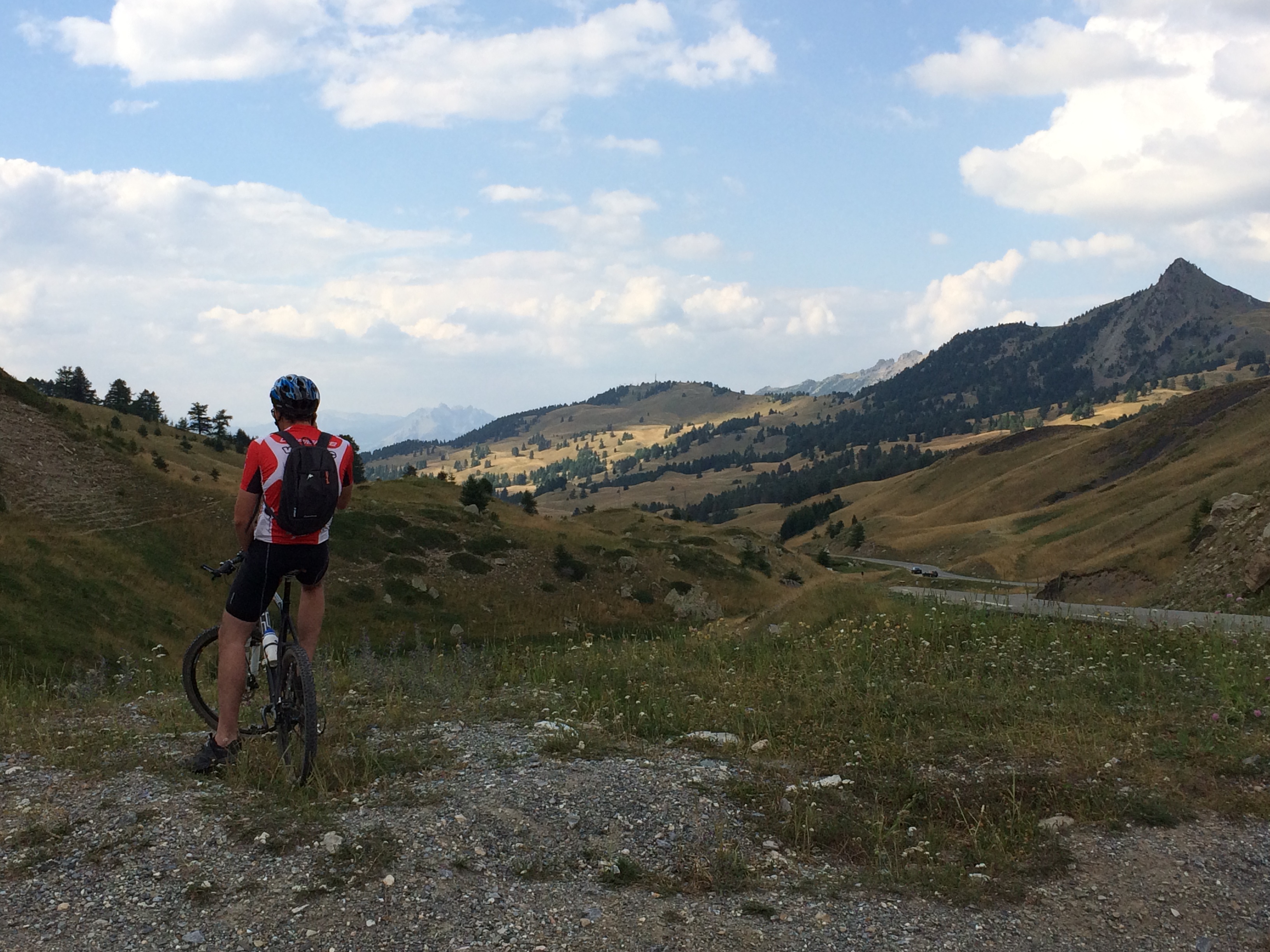
The 2109 m summit of the Col de Vars.

The 2109 m summit of the Col de Vars.

IMG_4309

On our way up, as well as when we reached the summit and on the descent, we came across athletic and determined-looking lycra-clad cyclists taking on the mountain.  Some were teenagers (one boy we asked was 12!) and others much older, and some were no doubt taking on the ‘Brevet des 7 cols Uboyens’ cyclotourism challenge – conquering the 7 peaks in the area and getting a certificate!

One of several cyclists we saw tackling the 2109 m Col de Vars.

One of several cyclists we saw tackling the 2109 m Col de Vars.

These two had reached the summit - they were 15 and 18 years old.

These two had reached the summit in 35 minutes, they said – they were 15 and 18 years old.

IMG_4307

Approaching the border with Italy our journey was delayed by a landslide – that is, there had been a landslide because of heavy rain the night before and the road was temporarily closed.  Speaking to some of the other French and Italian motorists, it was better to wait until the road opened again rather than take the alternative, much longer and more tortuous route. So this is what we did. The rain had resulted in tons of greyish mud running down the mountains over the roads.

Tons of grey mud cleared away after the landslide that closed dangerous mountain roads approaching the Italian border.

Tons of grey mud cleared away after the landslide that closed dangerous mountain roads approaching the Italian border.

Road maintenance services still at work clearing the mud.

Road maintenance services still at work clearing the mud.

On entering Italy we were surprised to see the Cathar cross displayed on flags and posters. Looking this up, we realized that part of the Piemonte region on the Italian side of the Alps is referred to as Occitan where Oc is spoken and has been recognised and is protected by the Italian government as a minority language!

This part of Italian Piemont is known as Occitan.

This part of Italian Piemont is known as Occitan where the Oc language is recognised and protected by the Italian government.

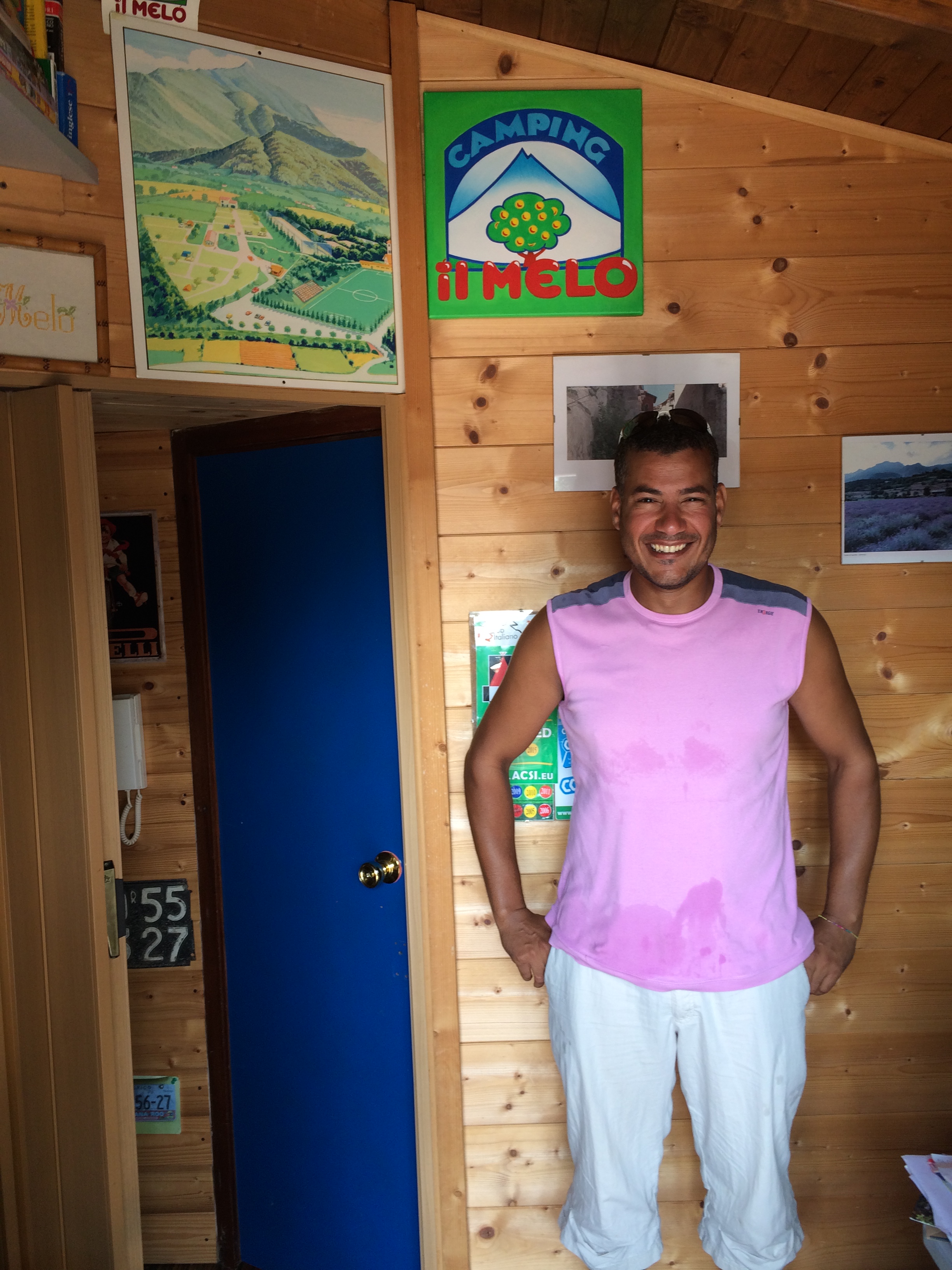
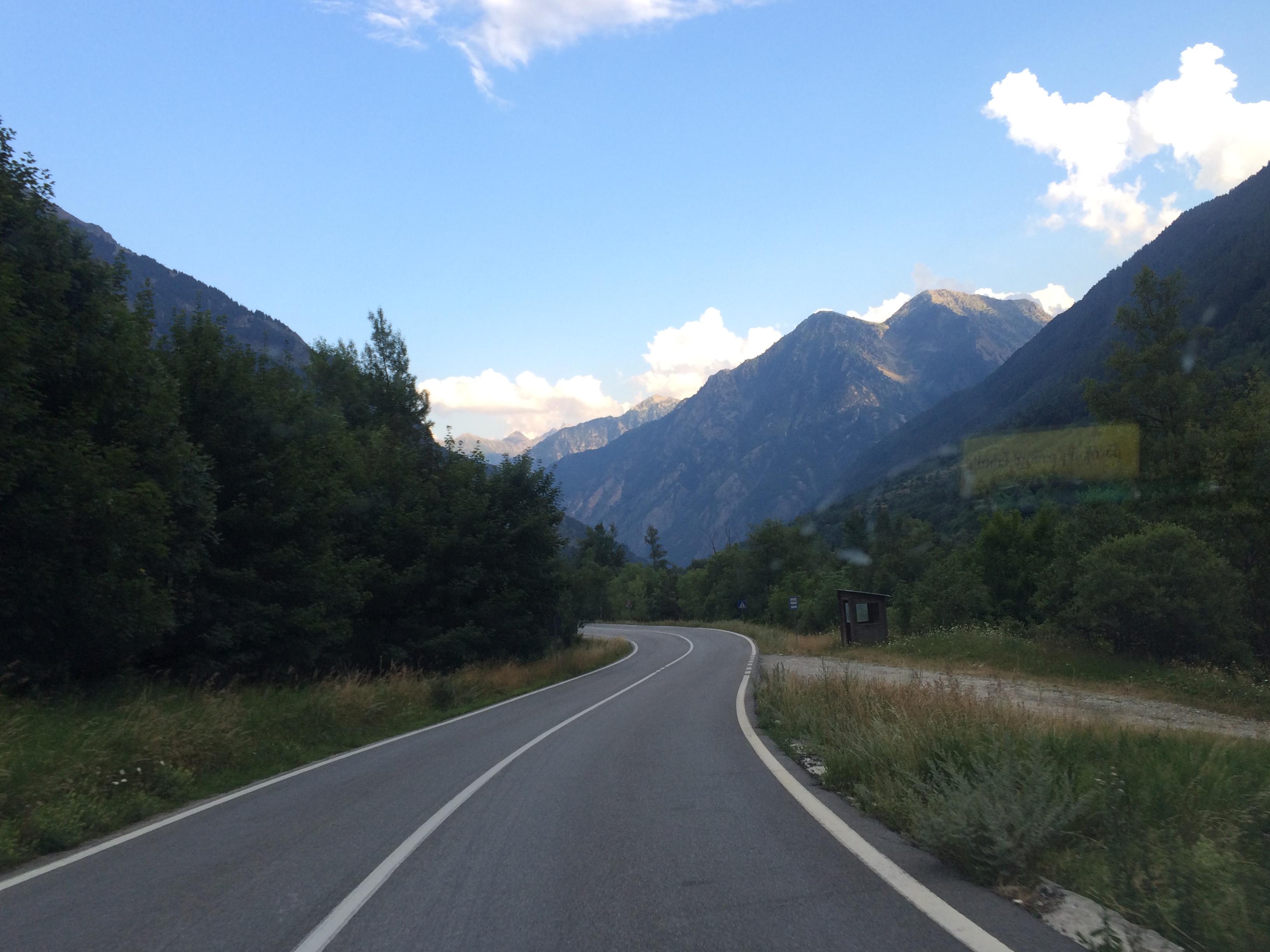
We drove on through Argentera, Pietraporzio, Sambuco and Vinadio (which looked very old an intriguing).  But it was late so we headed for one of the nearest campsites we could find – the ‘Il Melo Camping’ in Cuneo.  After an introductory chat with the owner in Italian, it didn’t take long for us to realise there was something very familiar about him, in terms of his general appearance and manner that is.  ‘Abdu’ turned out to be a ‘Saeedi’ Egyptian from Luxor who met his Italian wife while he was working and she was holidaying in Safaga on the red sea!  He had come to Italy and bought the campsite 5 years ago, and again, as for Mahmoud in Guillestre, managed to turn it around through sheer hard work and meeting the customer’s needs.  We chatted in Arabic as though we were old friends and it felt reassuring, though slightly incongruous!  It seems we’re destined to come across reminders of the Middle East wherever we go.  Abdu also bore an uncanny resemblance to Ayman, Flavio’s hairdresser in Cairo!

Abdu from Luxor, owner of the 'Il Melo' (the apple tree) campsite in Cuneo, Piemonte.

Abdu from Luxor, owner of the ‘Il Melo’ (the apple tree) campsite in Cuneo, Piemonte.

Pietraporzio, just inside the Italian border in Piemonte.

Pietraporzio, just inside the Italian border in Piemonte.

Vinadio - looked old and intriguing.

Vinadio – looked old and intriguing.

Judith half-way up the Col  de Vars.

F
F
IMG_4332

17th and 18th July – Guillestre in the Hautes-Alpes

Standard

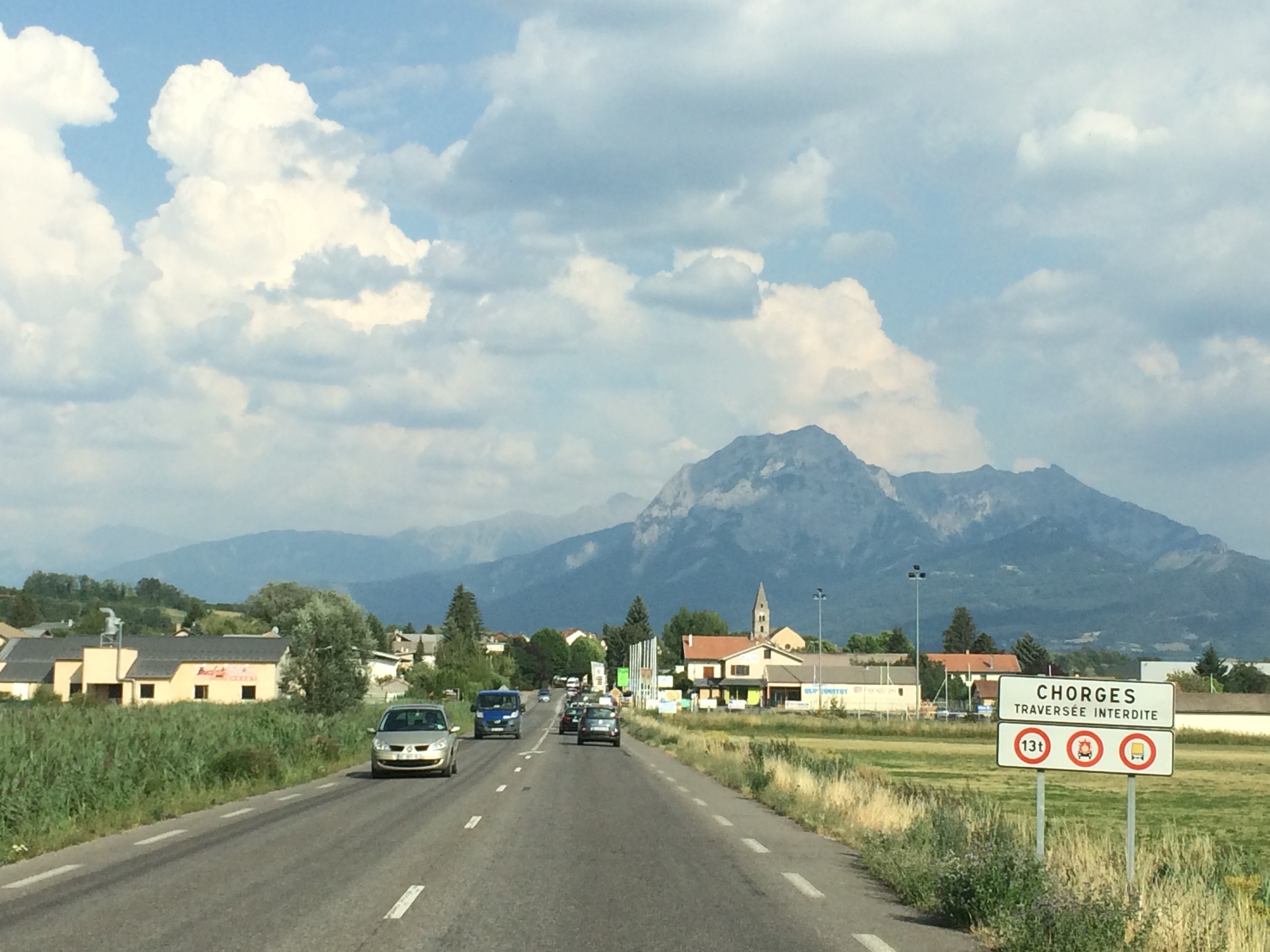
The Lac de Serre-Poncon at Rousset was amazing but the campsite was one of these large holiday-camp types which we’re not enamoured with (we may already have mentioned this!). We wanted to spend a couple more days in France before crossing into Italy in more tranquil surroundings. Driving higher up still and more north east towards Briancon, past Chorges, Clamensane, Embrun, Chateauroux-les-Alpes and Risoul, we chanced upon the Camping Villard, 2kms from the picturesque Alpine village of Guillestre.  It’s amazing how even in summer Alpine villages make you think of Christmas – something about all those Christmas trees.

Chorges with the Col de Vars looming in the distance.

Chorges with the Col de Vars looming in the distance.

Clamensane.

Clamensane.

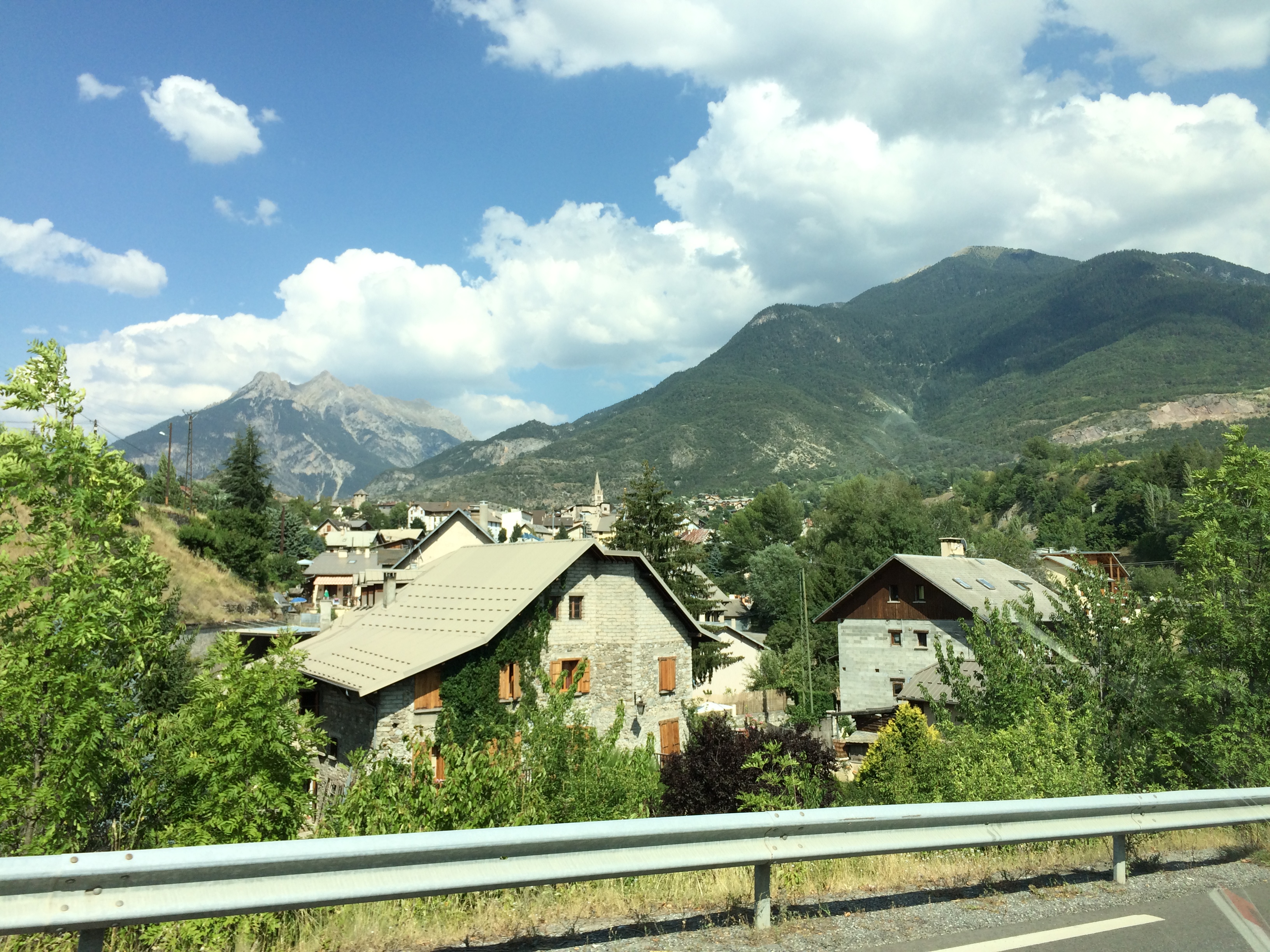
The picturesque village of Guillestre - looks a bit Christmassy even in summer.

The picturesque village of Guillestre – looks a bit Christmassy even in summer.

Another view of Guillestre.

Another view of Guillestre.

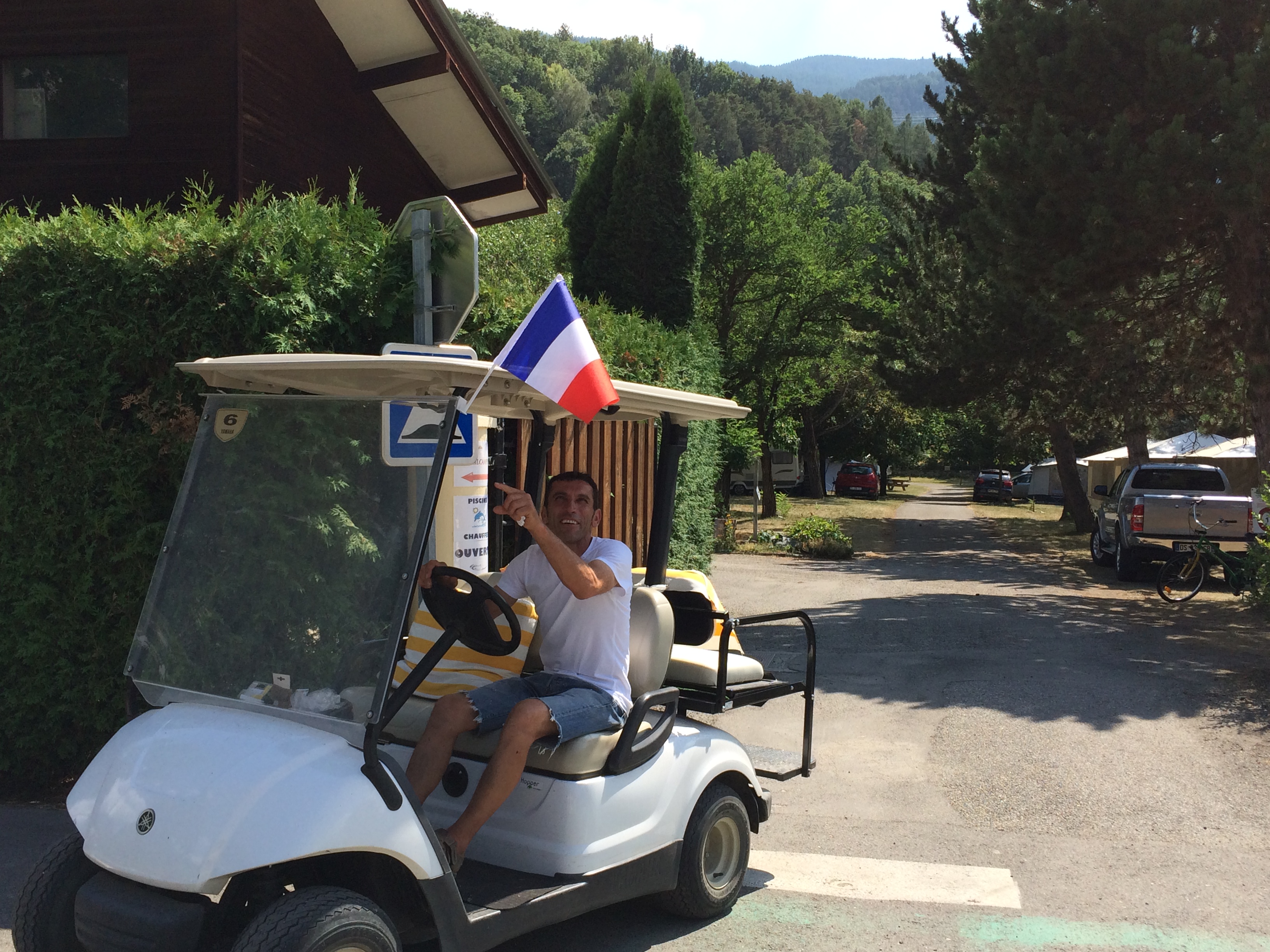
We were aiming for another campsite along the same road but something about Camping Villard attracted us.  An extremely energetic and affable man welcomed us and made us feel immediately at home and when we said we’d stay two nights he said he hoped we’d like it so much we’d stay two weeks (I almost heard the phrase ‘inshallah’ sotto voce!) He introduced himself as ‘Mam’ and when we looked puzzled he said it was actually short for ‘Mahmoud’ in a way which suggested he hadn’t had to explain this for a while. Mam and his wife Domininique had bought the failing site 5 years ago and had turned it around.  Running a campsite involves a great deal of hard work, staff is expensive and for people like Mam and Dominique who are prepared to put in a major part of the work themselves it can be a rewarding and profitable enterprise. Mahmoud had travelled to Paris 30 years ago at his father’s insistence to join his older brother for studies but had soon started working as a mechanical engineer and it was his wife Dominique who had come up with the idea of buying a campsite.  They and their lovely staff have worked very hard to turn the site into a charming, relaxing and very welcoming place and one we would highly recommend.

Mam (Mahmoud) and Dominique standing outside the Reception of their charming and superbly-run Camping Villard near Guillestre.

Mam (Mahmoud) and Dominique standing outside the Reception of their charming and superbly-run Camping Villard near Guillestre.

Staying at Camping Villard was a joy - Mam and Dominique made us feel completely at home.

Staying at Camping Villard was a joy – Mam and Dominique made us feel completely at home (and the fantastic pool was an extra bonus)..

Mahmoud was constantly on the go - he never stopped.

Mahmoud was constantly on the go. He had forgotten it was the Eid when we arrived and was going to have to spend an hour on the phone congratulating everyone at home in Damsacus.

With Alain Iemmi a fellow estranged Italian with whom Flavio had several animated conversations and saw eye to eye with on a number of burning issues of the day!

With Alain Iemmi, a fellow estranged Italian with whom Flavio had several animated conversations and saw eye to eye with on a number of burning issues of the day!

We even had our own little mountain stream flowing at the side of our pitch!

We even had our own little mountain stream flowing at the side of our pitch!

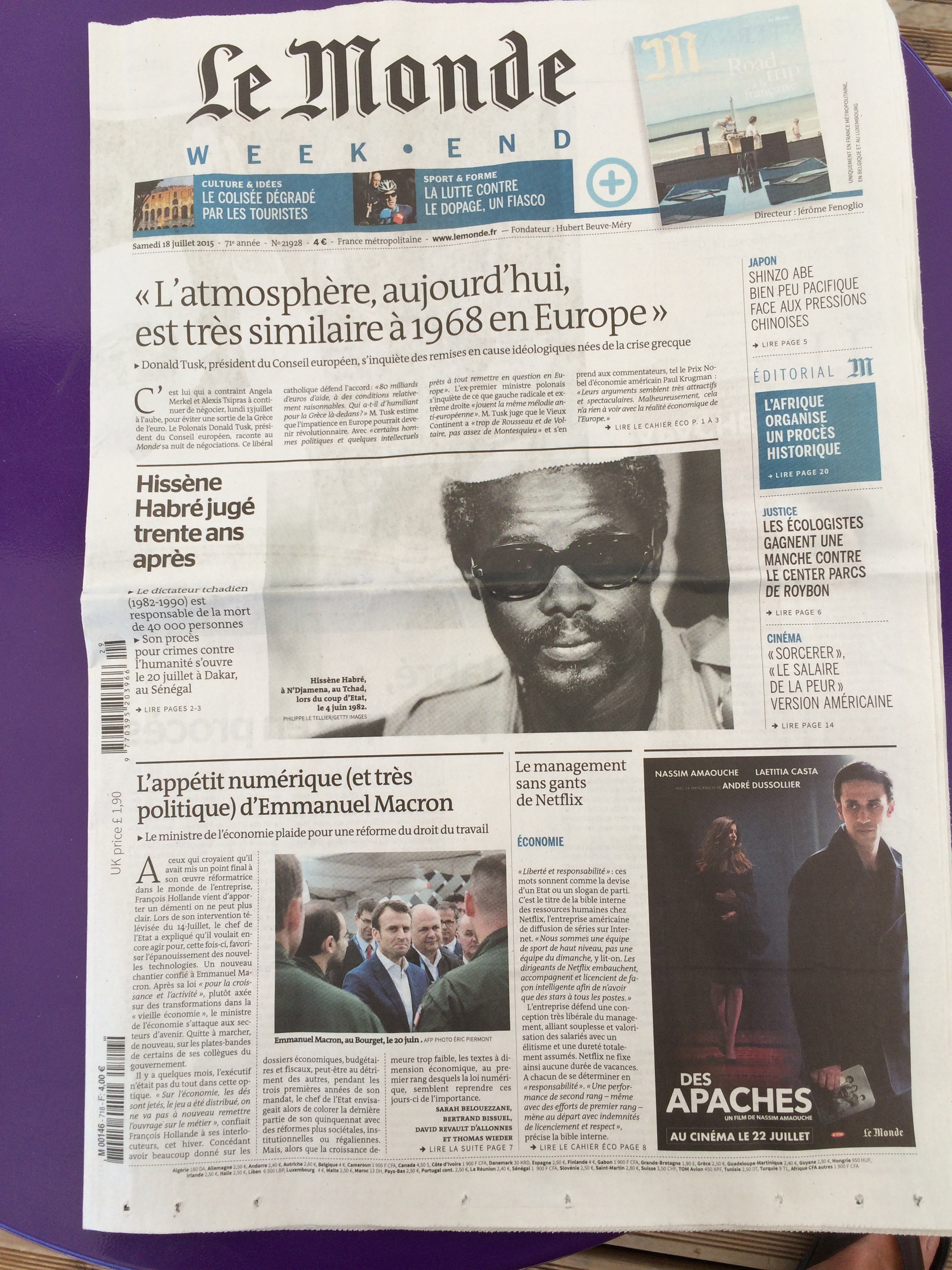
Talking of issues of the day, a quick look Saturday the 18th’s issue of Le Monde featured the following:

– Donald Tusk, President of the Council of Europe saying that the political and economic conditions we’re currently going through are very similar to Europe in 1968.

– A leader on the real implications of the ‘Greek tragedy’ and Donald Tusk again saying ‘there’s nothing humiliating about an 86 bn Euro loan.

– Hissene Habre on trial in Senegal 30 years after he was held responsible for the death of 40,000 people.

– An article on Ramadan not necessarily meaning the end of fasting.

– An leader on the Vienna Accord with Iran representing a real chance for peace in the ME.

– Something on indignant locals in Vallauris campaigning against the Saudi Royals and 500 people retinue persuading the authorities to close a local beach for them.

– Something on the ‘secret radicalisation’ of the extremist who killed 4 soldiers in Tenessee.

– A double-page spread on the art of efficient packing your holiday bags!

Donald Tusk: "Conditions in Europe are similar to those of 1968".

Donald Tusk: “Conditions in Europe are similar to those of 1968”.

It was here we decided to get rid of surplus items/assorted clutter we thought we couldn’t live without!  This meant going uphill to Guillestre centre and catch the post office before it closed at midday.  We’d strapped the two boxes on the back of Judith’s bike (which has a rack) but Dominique saw us struggle and promptly rescued us by dropping what she was doing to kindly give us a lift.  We then spent a an hour or so taking a look at Guillestre.  Someone we got talking to told us she had been made redundant from the hotel she’d been working in because times were hard and the trend was now moving towards camping (or ‘glamping’ as the new expression goes) as people were feeling the pinch.

Guillestre advertises itself as a very ‘sporty’ place.  That was clear from the procession of keen cyclists we saw heading for the hills while we were sipping our ‘allonge.

Guillestre centre.  The area is popular with keen and athletic cyclists.

Guillestre centre. The area is popular with keen and athletic cyclists.

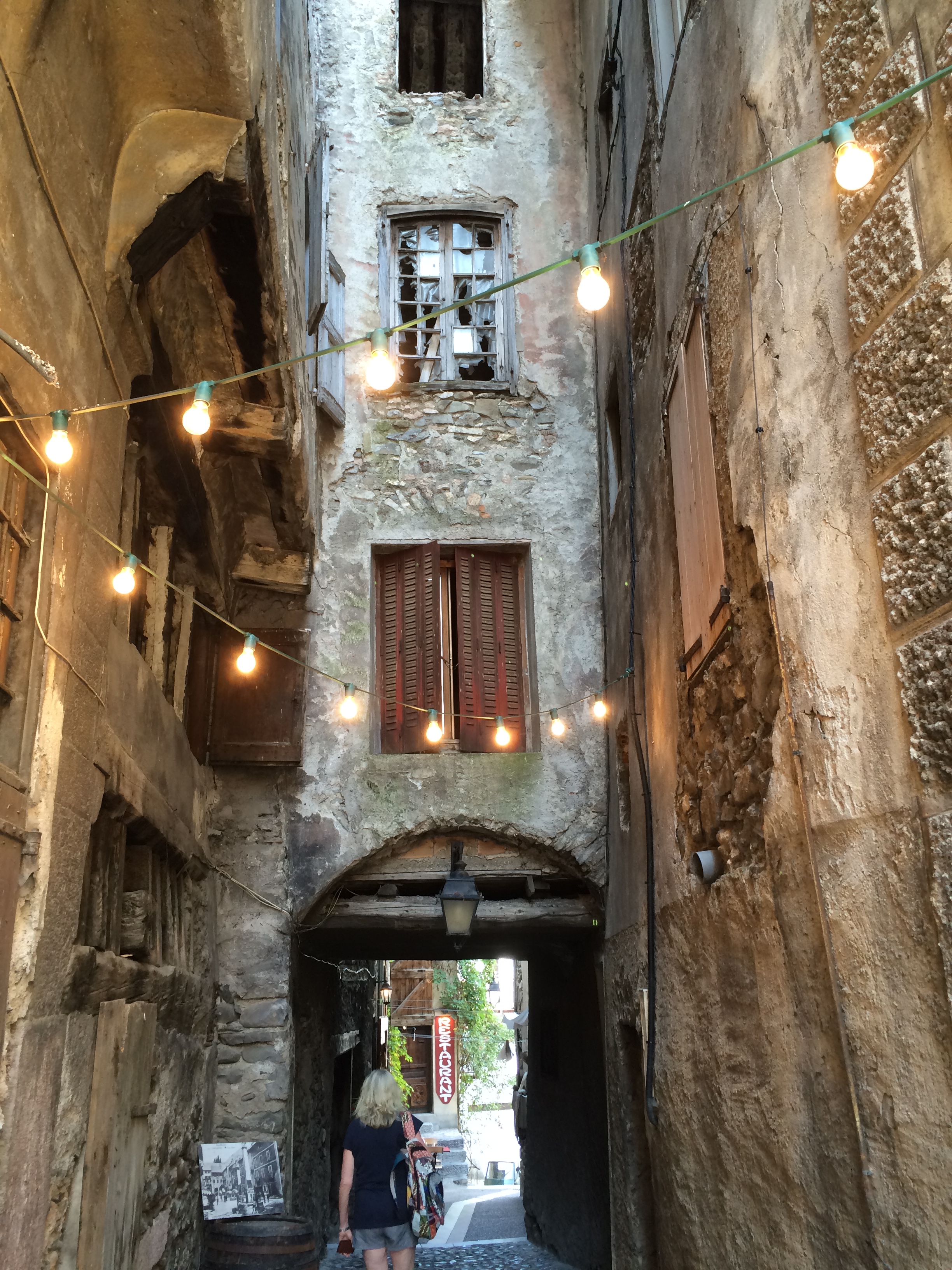
A narrow alley-way in Guillestre.

A narrow alley-way in Guillestre.

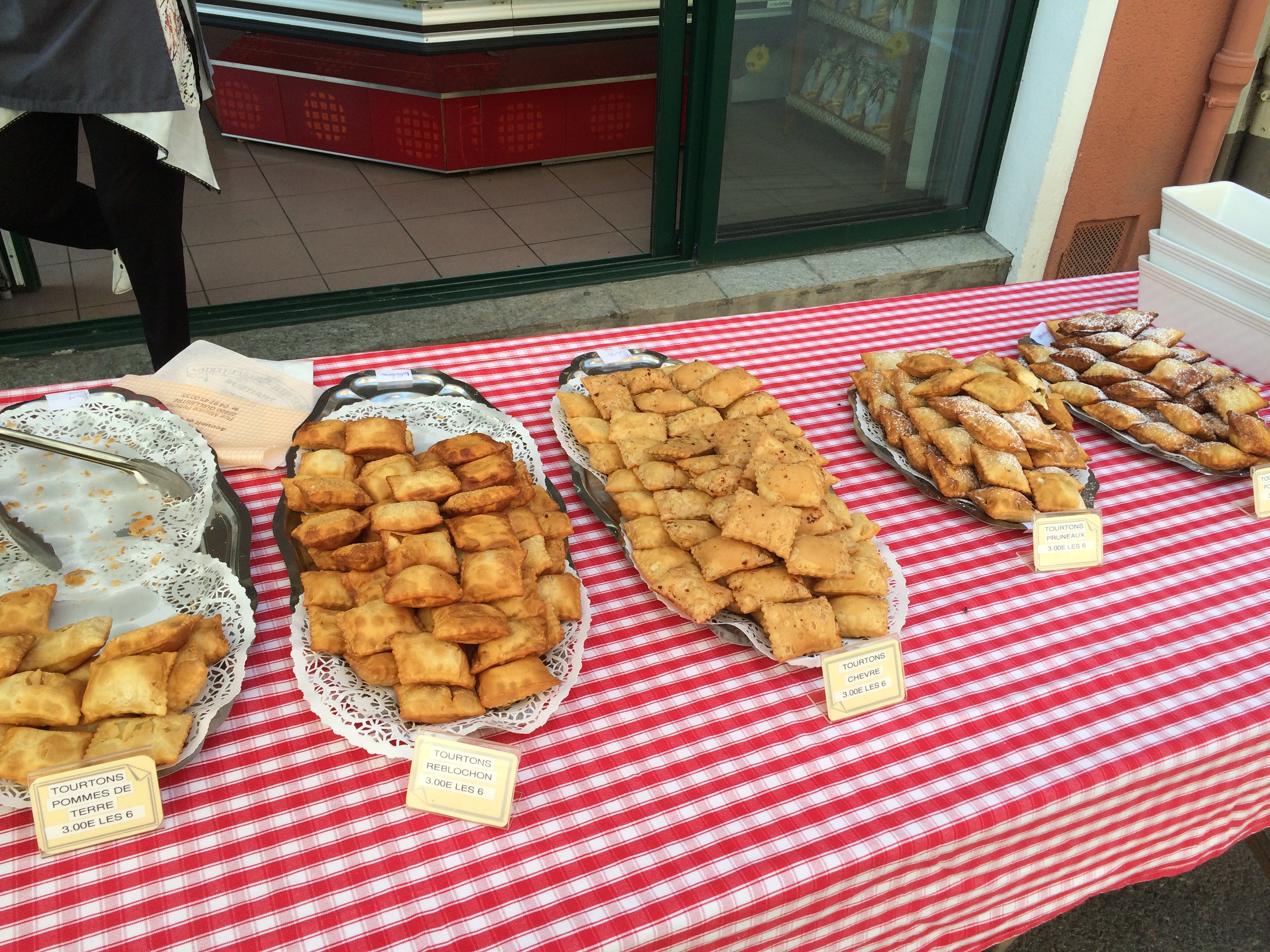
Specialities of the region -  'Tourtons' stuffed with potatoes, Reblochon or goat cheese or prunes. We forgot to buy some.

Specialities of the region – ‘Tourtons’ stuffed with potatoes, Reblochon or goat cheese or prunes. We forgot to buy some.

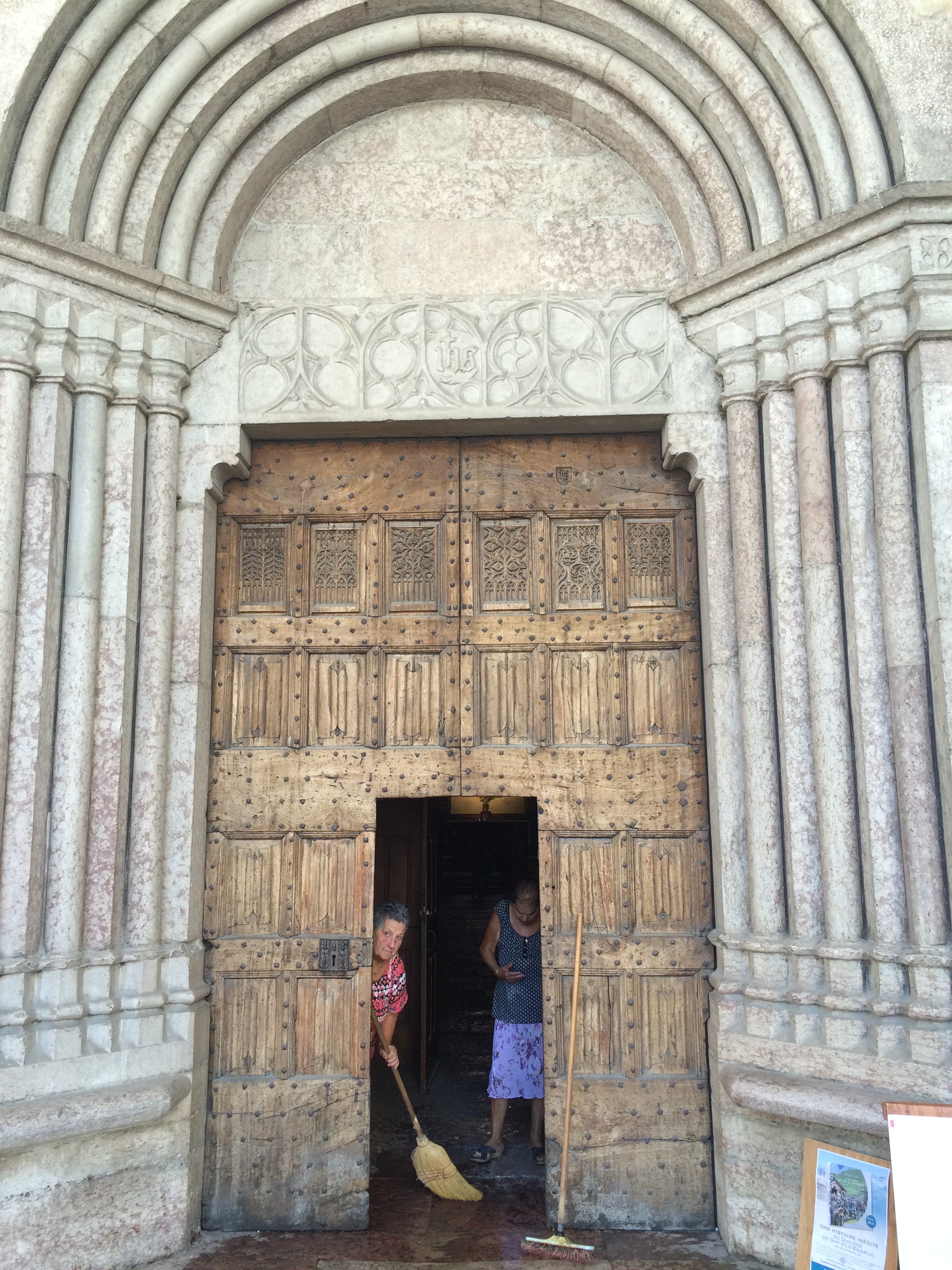
Keeping the front of the local church at Guillestre clean.

Keeping the front of the local church at Guillestre clean.

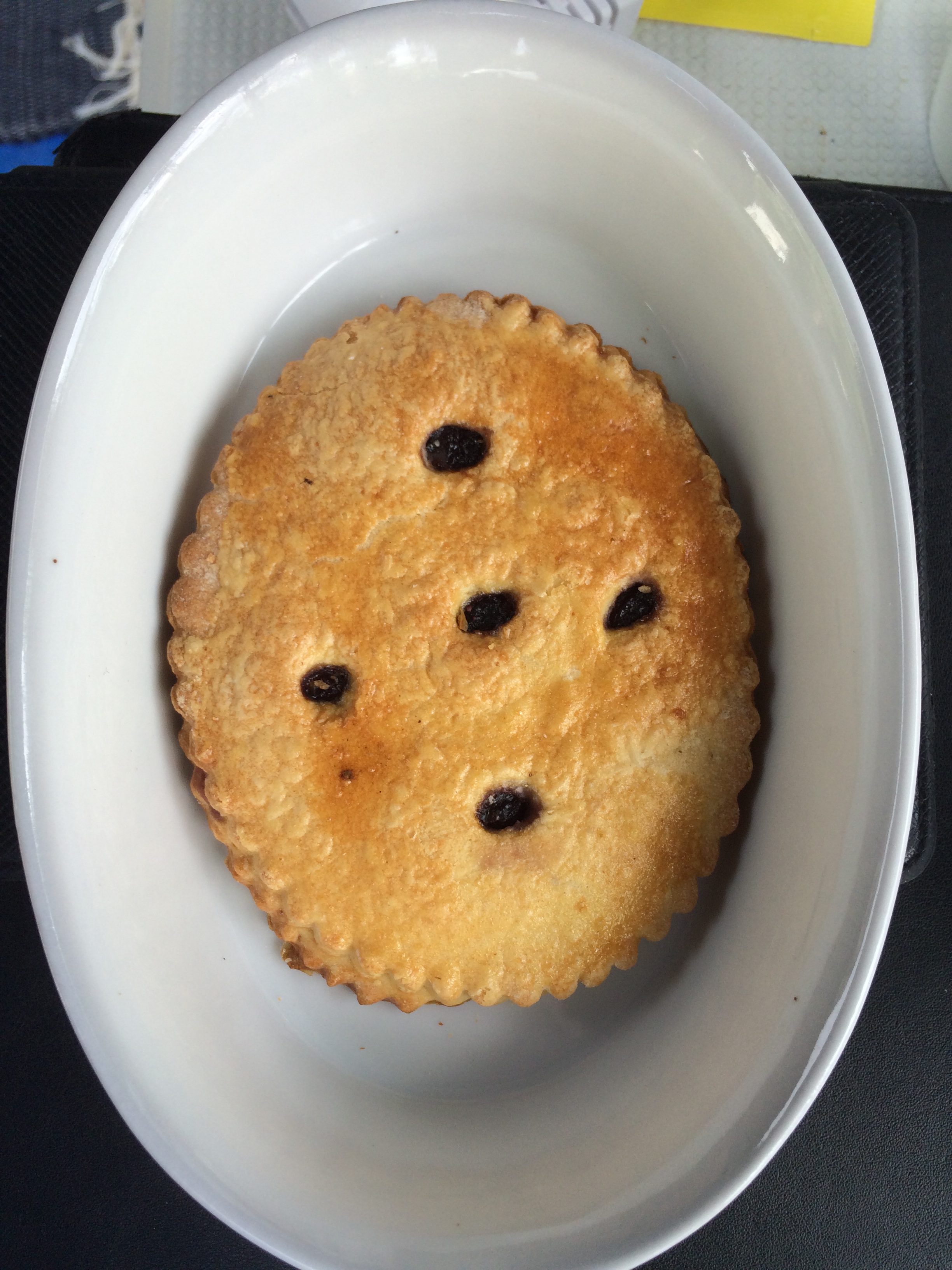
We did have one of these though - a typical jam tart from Guillestre.

We did have one of these though – a typical jam tart from Guillestre.

IMG_4234

15th and 16th July – Haute-Provence and Hautes-Alpes

Standard

After leaving Marseille we were faced with two choices – continue down the Cote d’Azur and into Italy via the Alpes-Maritimes or head north east for the Hautes-Alpes entering Italy through Piemonte. It was hot and humid, Christian had warned us the coast would be heaving and we felt mountain air was what was needed. So off we set for a place called Rousset near the town of Gap in the Alps only to find it was still hot but at least there was a large lake without the crowds one would find on the coast.  On the way, we passed Peyrolles-en-Provence, Oraison, the striking town of Sisteron, Upaix and Tallard.  Evidence of the ‘secheresse’ (drought) was everywhere.

Giant sprinklers in action in Oraison to combat the widespread drought in the whole region.

Giant sprinklers in action in Oraison to combat the widespread drought in the whole region.

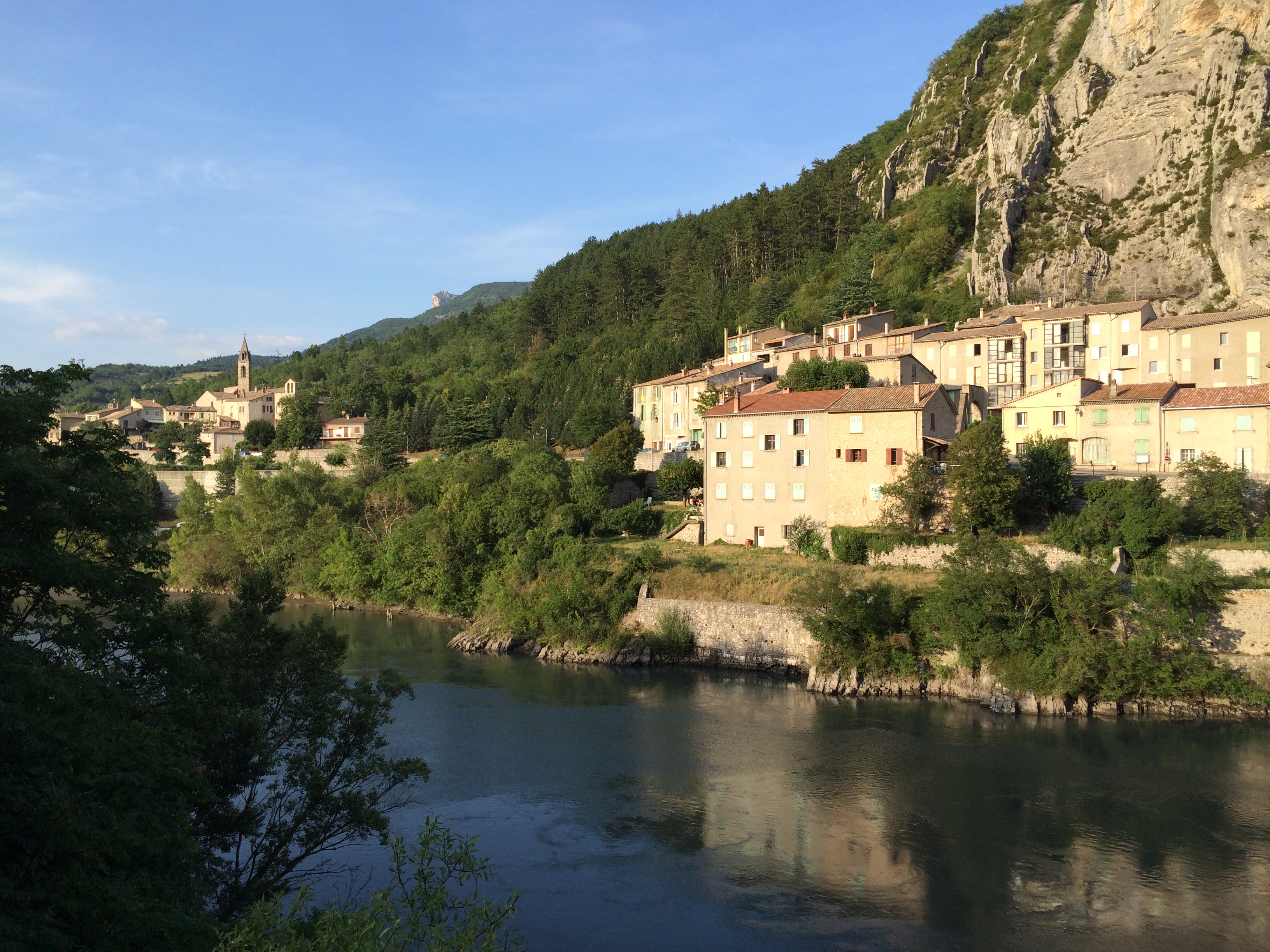
The striking village of Sisteron in Haute-Provence.

The striking village of Sisteron in Haute-Provence.

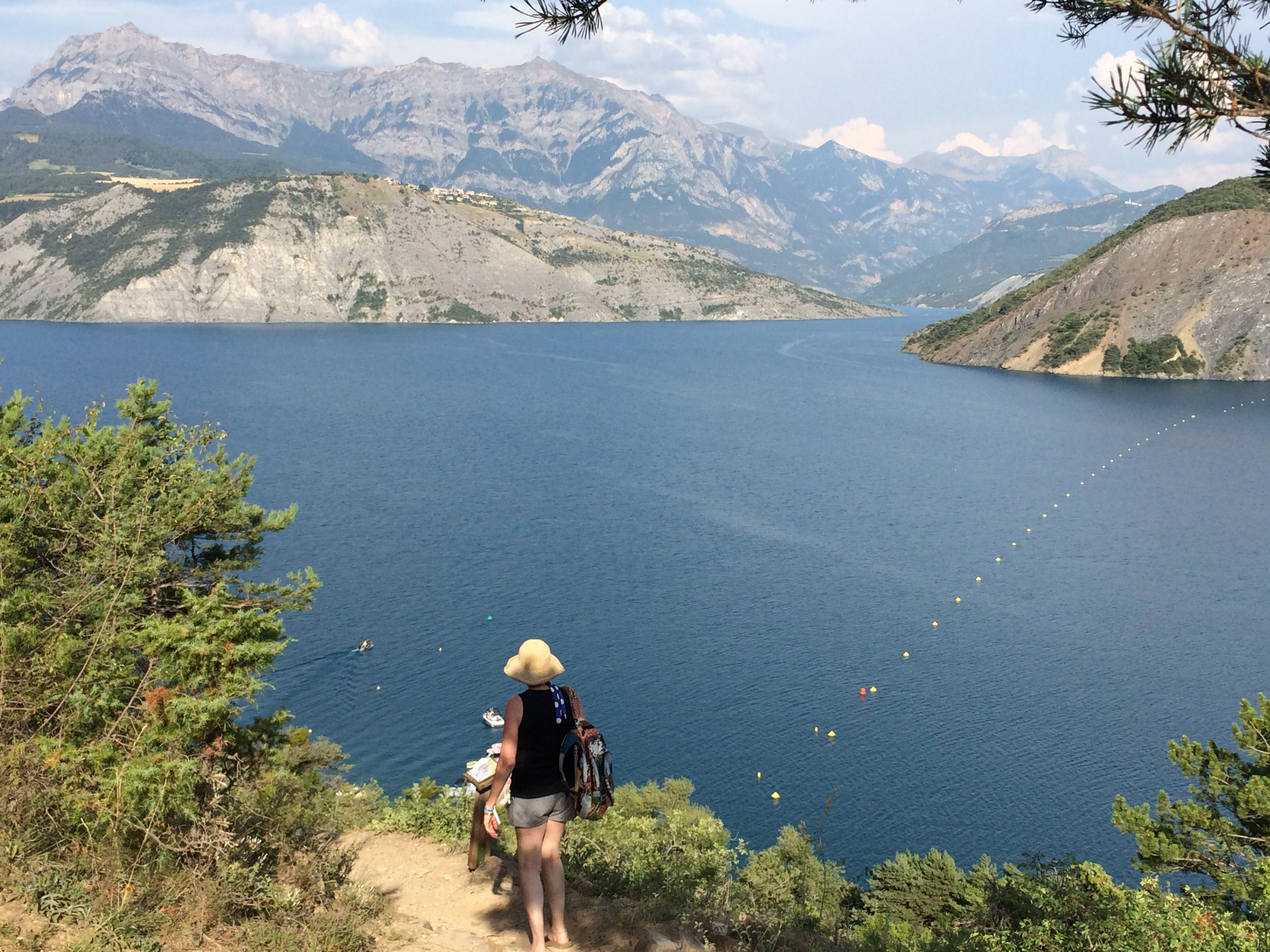
We camped by Lac De Serre-Poncon, a huge artificial and quite spectacular lake which is fed by the rivers Durance and Ubaye. Waters from the lake also drive the largest hydro-electric dam in Europe. Swimming in the lake was bliss but also available if one was so inclined were wind-surfing, water-skiing, diving and boating.

The impressive man-made Lac   and hydro-electric dam. Flowing into it are the rivers Ubaye (right) and Durance (left).

The impressive man-made Lac de Serre-Poncon and hydro-electric dam. Flowing into it are the rivers Ubaye (right) and Durance (left).

It was still very hot and humid even at this altitude and so a refreshing swim in the lake was very welcome

It was still very hot and humid even at this altitude and so a refreshing swim in the lake was very welcome.

We took the footpath down to the lake for extra exercise!

We took the footpath down to the lake for a bit of extra exercise!

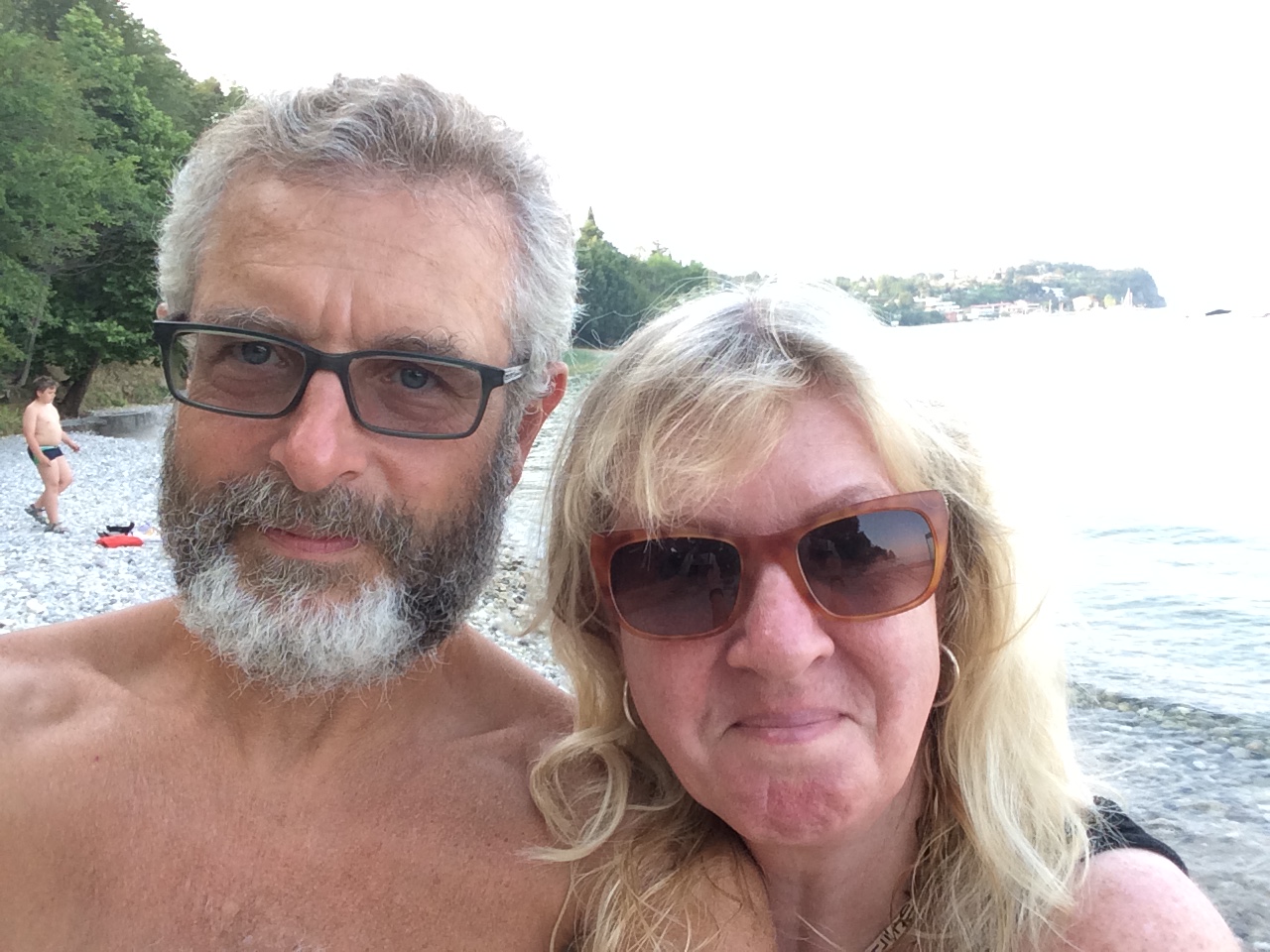
Back up, a selfie seemed in order!

Back up, a selfie seemed in order!

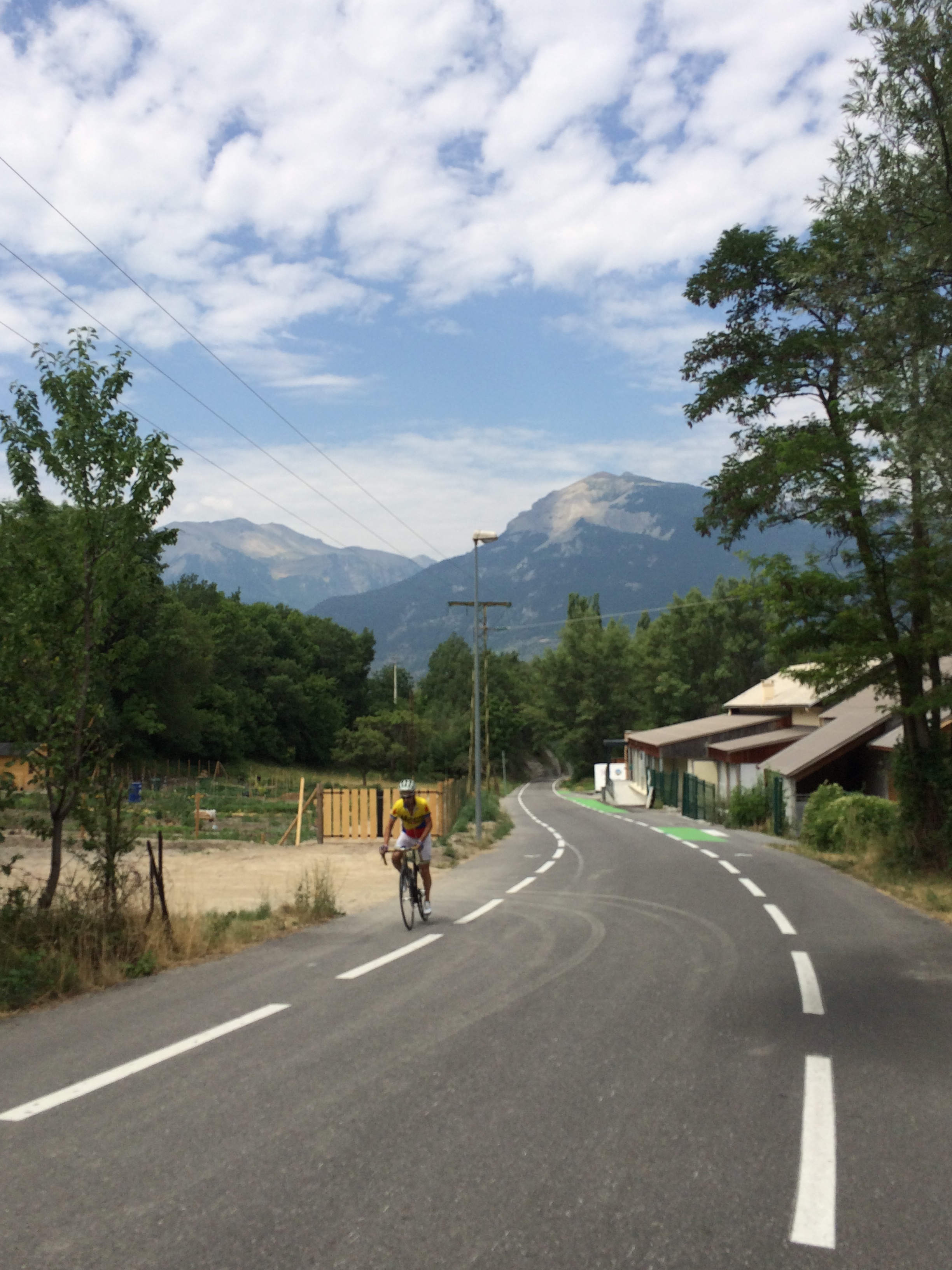
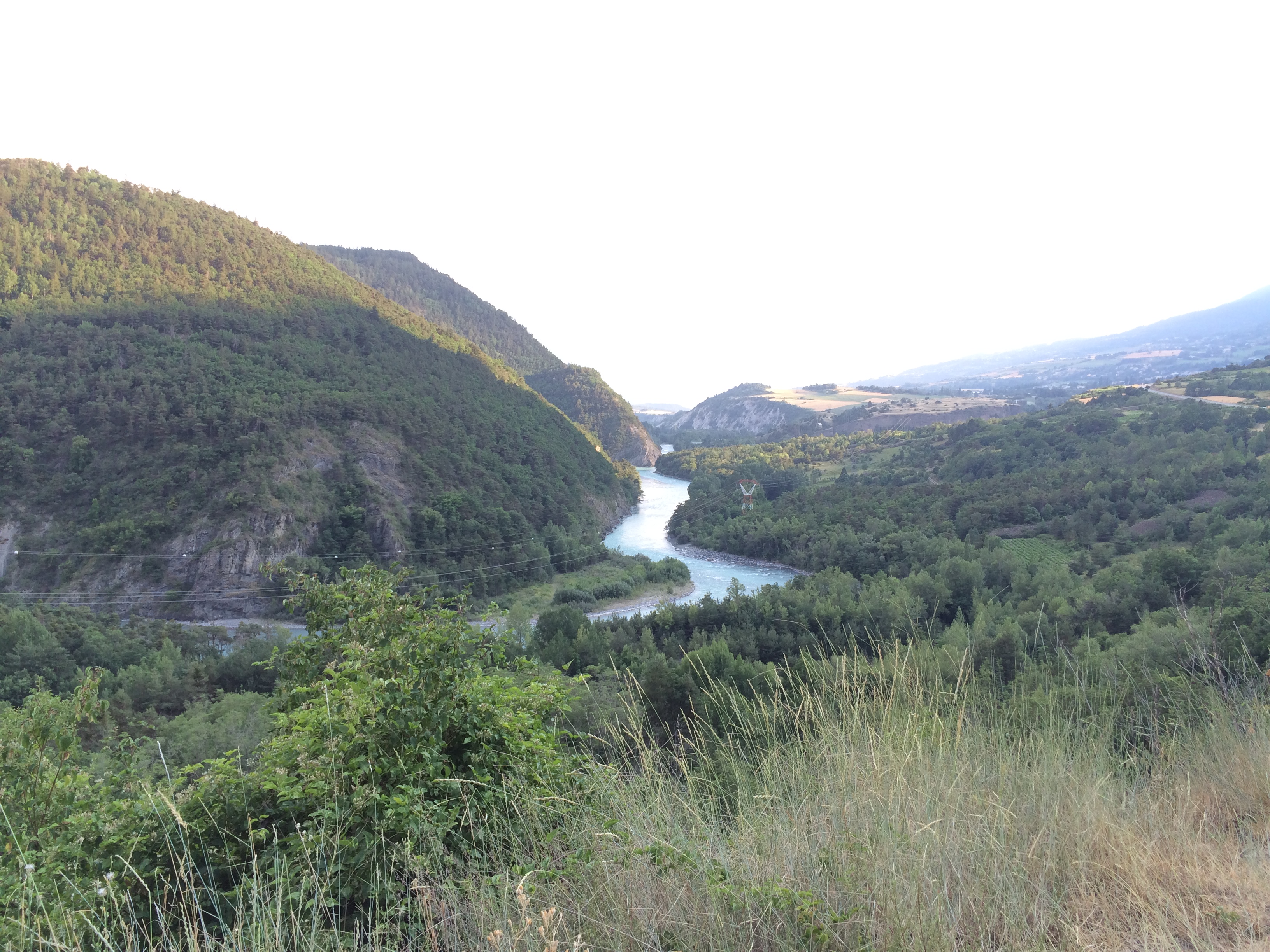
Thinking Brenda needed an infusion of brake fluid we set off with mild alarm for Gap, the nearest large town which had a VW garage. After a quick inspection however it was a bit embarrassing to be told that we were looking at the wrong side of the chamber – i.e. the front where the thickness of the plastic doesn’t show the real level – and the actual fluid level was perfectly normal.  And by the way, we should remember that lights and alarms come on at the first sign of anything untoward so we shouldn’t question VW efficiency. So off we set again, this time to a campsite higher up near the Alpine village of Guillestre next to the fast-flowing Durance river where we spotted white-water rafting whilst extreme cyclists could be seen tackling the endurance climb to the nearby 2100m Col de Vars.

IMG_4182