Let’s take a step back at this stage and take a look at the fascinating history of Muslim rule in Spain. After the fall of the Western Roman Empire in AD 476 the whole of the Iberian Peninsula (present-day Spain and Portugal) fell under the domination of the Teutonic tribe of Visigoths. At the start of the 8th century AD, this started to fall apart due to internal divisions. Under the leadership of Tariq Ibn Ziyad, the Ummayad Muslim armies landed in Gibraltar in 711 and after an 8-year campaign defeated and killed the last Visigoth king on the battlefield.
Historical sources say that the Islamic Caliphate had not specifically targeted Spain for conquest but the disarray in the ranks of the Visigoths created an opportunity that Ibn Ziyad exploited successfully. Muslim forces then tried to press their advantage by moving north-east across the Pyrenees towards France but were defeated by the Frankish Christian Charles Martel at the Battle of Tours in AD 732. So they reached as far north as Tours!
Retreating to the Iberian Peninsula, Islamic rule there lasted for varying periods ranging from 30 years in Galicia in the north west to 780 years in the area of Granada, the last remaining stronghold (the Emirate of Granada) after the ‘Reconquista’ began under the Catholic armies of Queen Isabella I of Castille and King Ferdinand II of Aragon.
Muslim history in the Iberian Peninsula passed through around 9 stages starting with paying direct allegiance to the Caliph in Damascus (711-756) to the Kingdom of Granada (1212–1492) and finally to the Alfujarra revolts against increasing discrimination by the new Catholic rulers (1568-1571).
Throughout most of this time, there was said to be a peaceful co-existence of Muslims, Jews and Christians known as the ‘Convivencia’ – the 3 religions borrowed from each other, benefiting by the blooming of philosophy and the medieval sciences in the Middle East. Other scholars have questioned to what extent the ‘convivencia’ represented true pluralism. But significantly, Muslims only constituted a majority of the population by the end of the 14th century. Muslims came not only from North Africa but from the Middle East and Iran. The appearance of Sufis is especially important because Sufism’s greatest sheikh, Ibn Arabi was himself from Murcia.
Today there are around 1 mil Muslims in Spain, the majority being immigrants from North Africa.
Granada (paraphrasing from Lonely Planet)
Now in Granada itself, Muslim forces took over from the Visigoths in 711 with the aid of the Jewish community around the foot of Alhambra in what was called ‘Garnata al Jahud’ (Jahud meaning Jews) from which the name Granada derives.
After the fall of Cordoba in 1236 and Seville in 1248, Muslims sought refuge in Granada where Mohammed Ibn Yusuf Ibn Nasr had set up and independent emirate. This ‘Nasrid’ emirate became the final remnant of Al-Andalus, ruled from the Alhambra Palace for 250 years.
Granada became one of the richest cities in medieval Europe, flourishing with its population of traders and artisans and 2 centuries of artistic and scientific splendor followed.
As the 15th century wore on, a power struggle for the succession and a civil war set the stage for Christian armies taking advantage and in 1491, laying siege to the city.
The Muslim ruler Boabdil surrendered in return for concessions on religious freedoms and 30,000 gold coins. But after a period of tolerance, religious persecution eventually ensued, the Jews were expelled and revolts by the Muslims also led to their eventual expulsion from Spain in the 17th century.
Granada sank into decline until interest in it from the Romantic movement revived it as a national heritage in the 1830s.
Another black period was when the Nationalists killed an estimated 4000 ‘Granadinos’ with left or liberal connections at the start of the civil war.
Apologies for the lengthy historical background but that is first and foremost what Granada epitomises – an important c700 years of Spain’s history, and seeing the place requires a basic appreciation of the whole of Spain’s Islamic past.
We had not been able to pre-book a visit to the Alhambra Palace in the morning and had therefore only obtained a slot for 2pm onwards. We arrived at 11am. Our plan, as we had been advised to do, was to park Brenda at one of the relatively expensive but convenient car parks adjoining the Palace, strategically situated atop Granada’s highest vantage point. Then walk round the side of the Palace walls down the steep descent to the bottom of the valley where the old part of town was, with its narrow alleyways and souk then up the other side of the valley, through even narrower labyrinthine cobbled alleys in the Albaicin Quarter and up to the San Nicolas hill-top which afforded a wonderful view of the Citadel. All of which we did.

Down San Matias Realejo leading to the old town centre from Alhambra Palace.
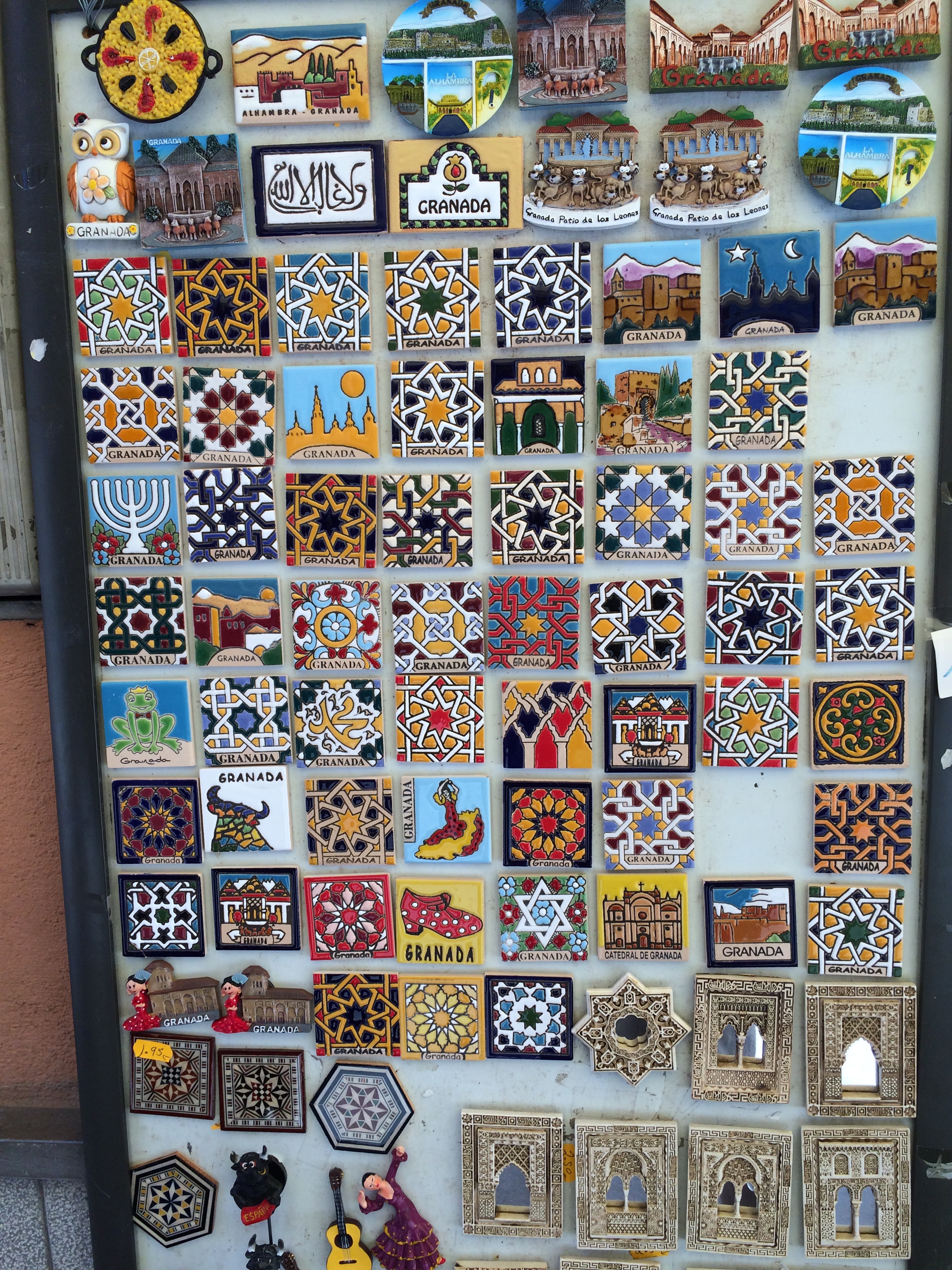
Fridge magnets for sale on San Matias Realejo.
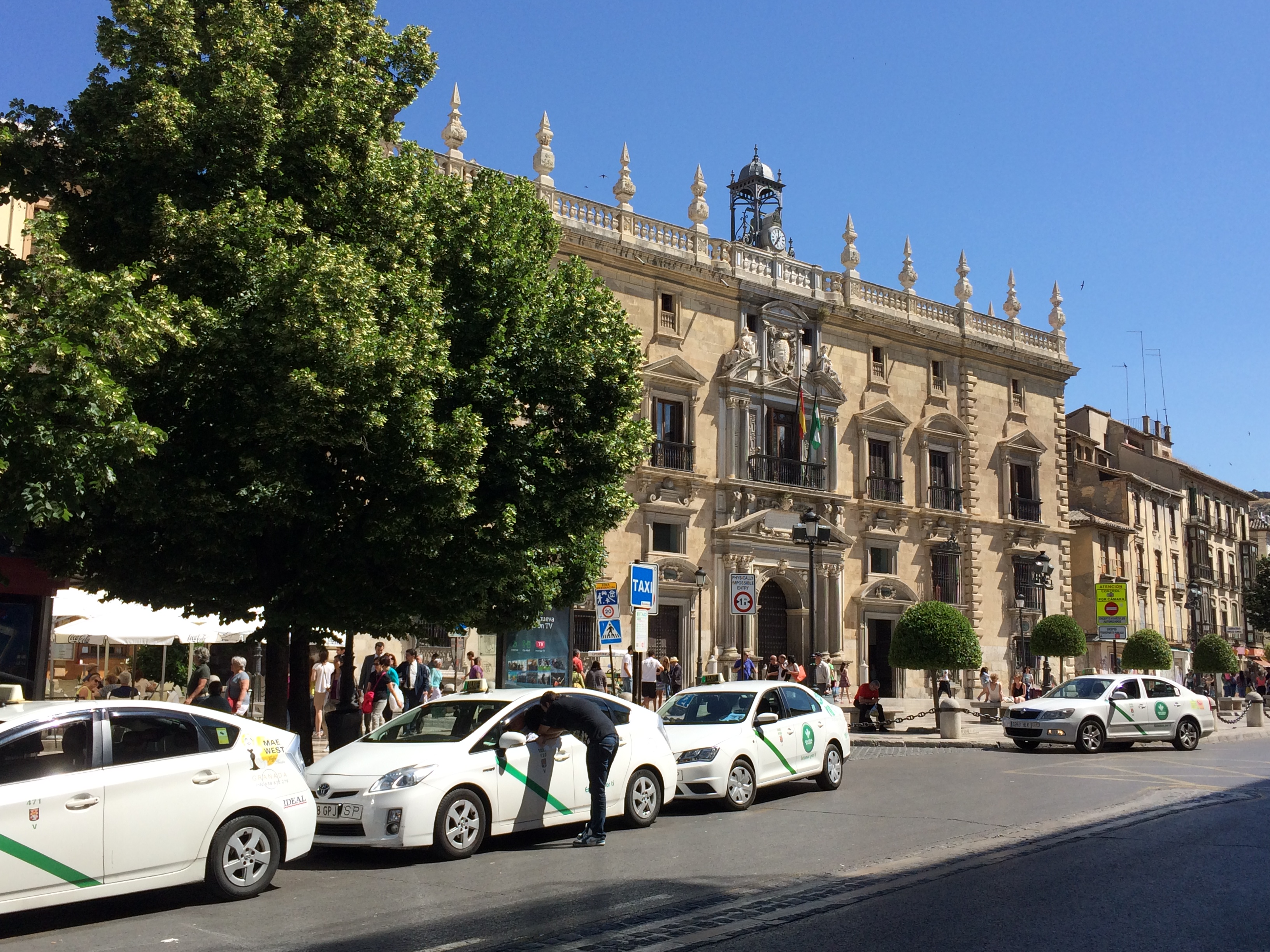
Granada Plaza Nueva.
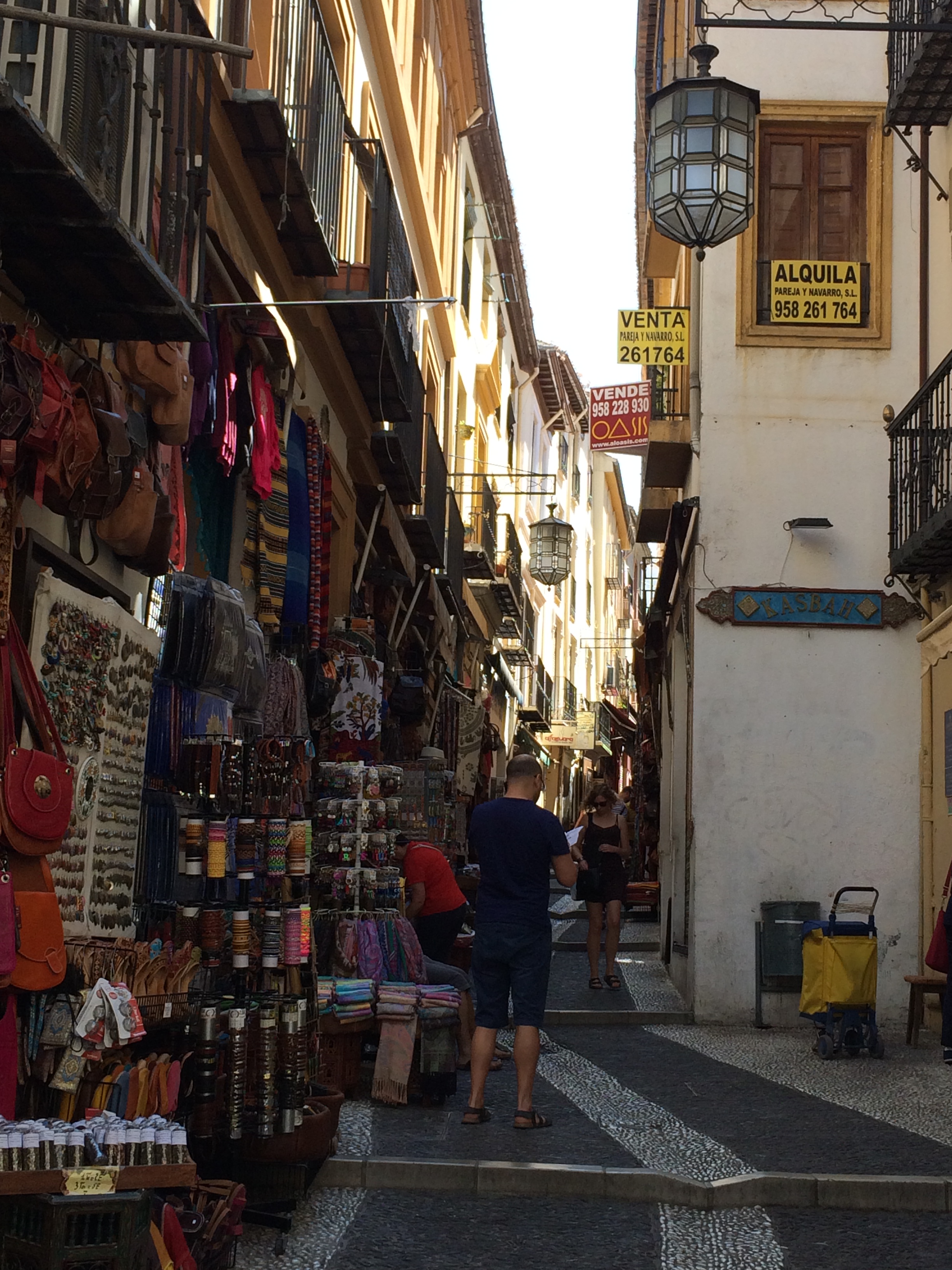
Calle Elvira – the souk in old Granada.
Half-way up, we stop briefly for a coffee outside the church of San Gregorio Betico on the spot where two Franciscan priests had allegedly been martyred for preaching in the doorway of the mosque in Alhambra. The coffee came in glasses and tasted more like watered down Turkish coffee than americanos. Juan, who served us was chatty. He was a native of Granada. Asked about any vestiges of Muslim ancestry, he said yes, he believed 30% of Granada’s inhabitants were Muslim. His own half-sister was called Jamila and her father, his step-father, was called Najib. Somehow we found that 30% hard to believe.

The Albaicin Quarter, going steeply back uphill to San Nicolas.
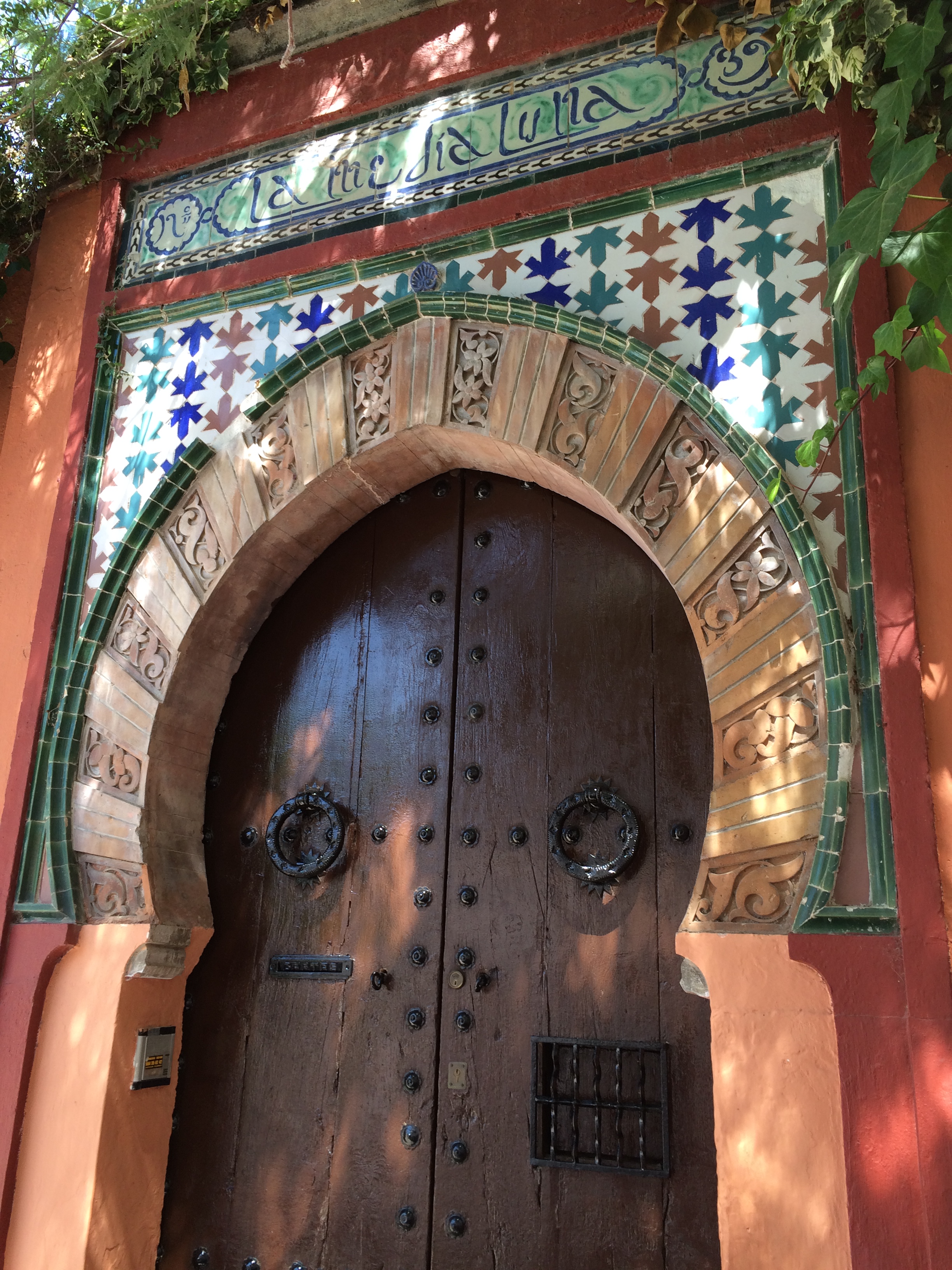
A splendid old gate in the Albaicin Quarter. The inscription above looks lie it’s Arabic but it’s not. It reads “La lue dia luna” which must mean “moonlight”.

Juan the waiter offers to take a photo of us. Behind, the Church of San Gregorio Betico.
A bit higher up, we run into a oldish man playing a guitar and singing a melancholy tune. It seems to say something like “Every moment that I’m away from you my dear Galicia, my heart weeps”. Interesting that Galicia is the area in Spain where Muslim rule lasted the shortest time – 28 years, compared to Granada’s 720!

“Every moment I’m far from you my dear Galicia my heart weeps”.
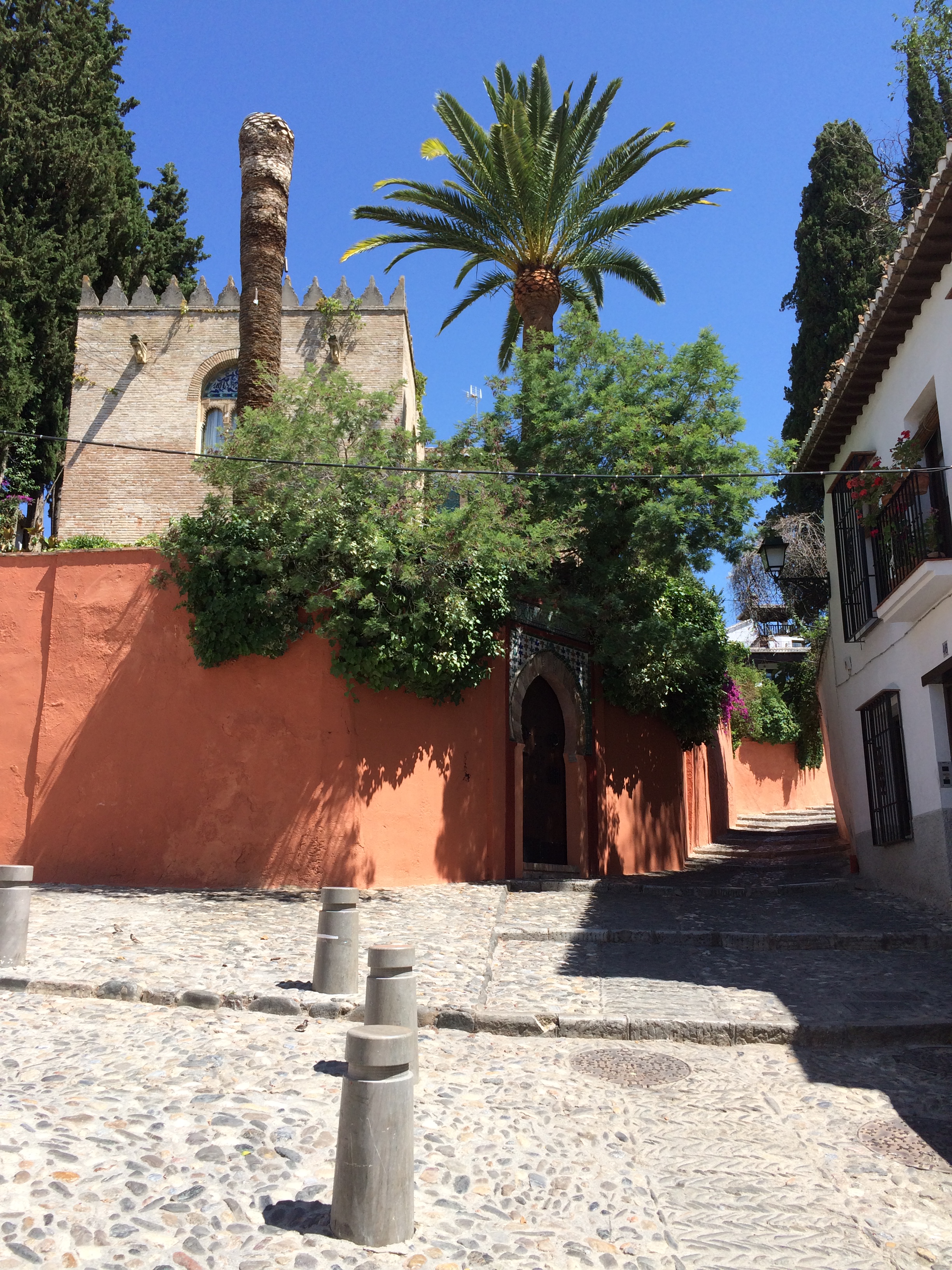
Still climbing in the Albaicin Quarter, it’s looking quite Middle Eastern.
So far, all of this has been a physical feat in itself. The trouble was, after grabbing a ‘jambon’ and tomato sandwich on San Nicolas, we needed to retrace our steps and do the whole thing all over again in reverse – and get there half an hour earlier than our allotted slot of 2pm to collect our pre-bought tickets. It was a hot day and by the time we reached half way up the other side of the valley on the return walk, we were feeling well and truly flaked out. And we had yet to visit the Palace and grounds. By the end of our visit, we felt we had performed a considerable athletic feat and we clocked some very good mileage on our Fitbits!
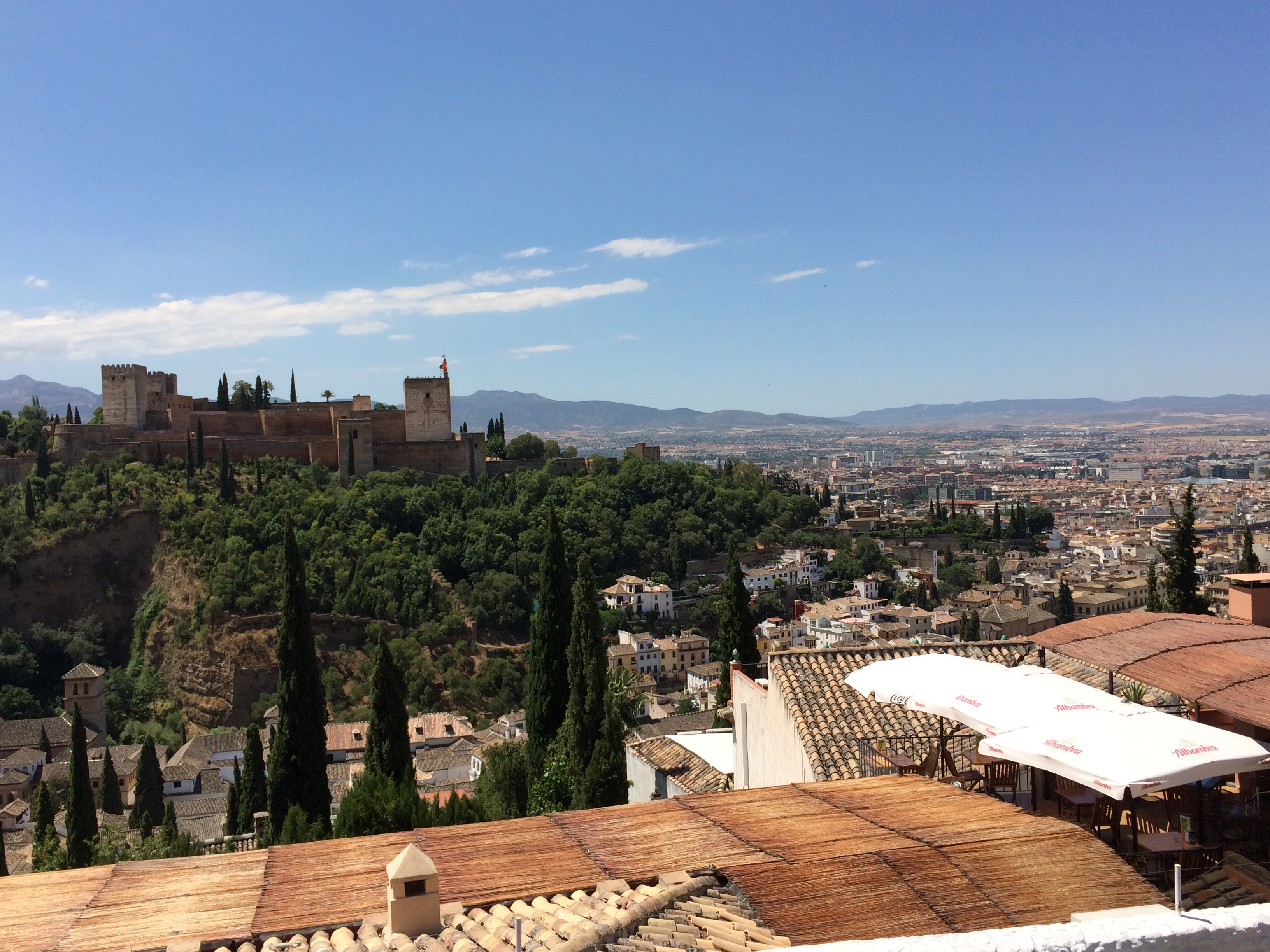
View from San Nicolas with Alhambra Palace visible on the adjacent hill.
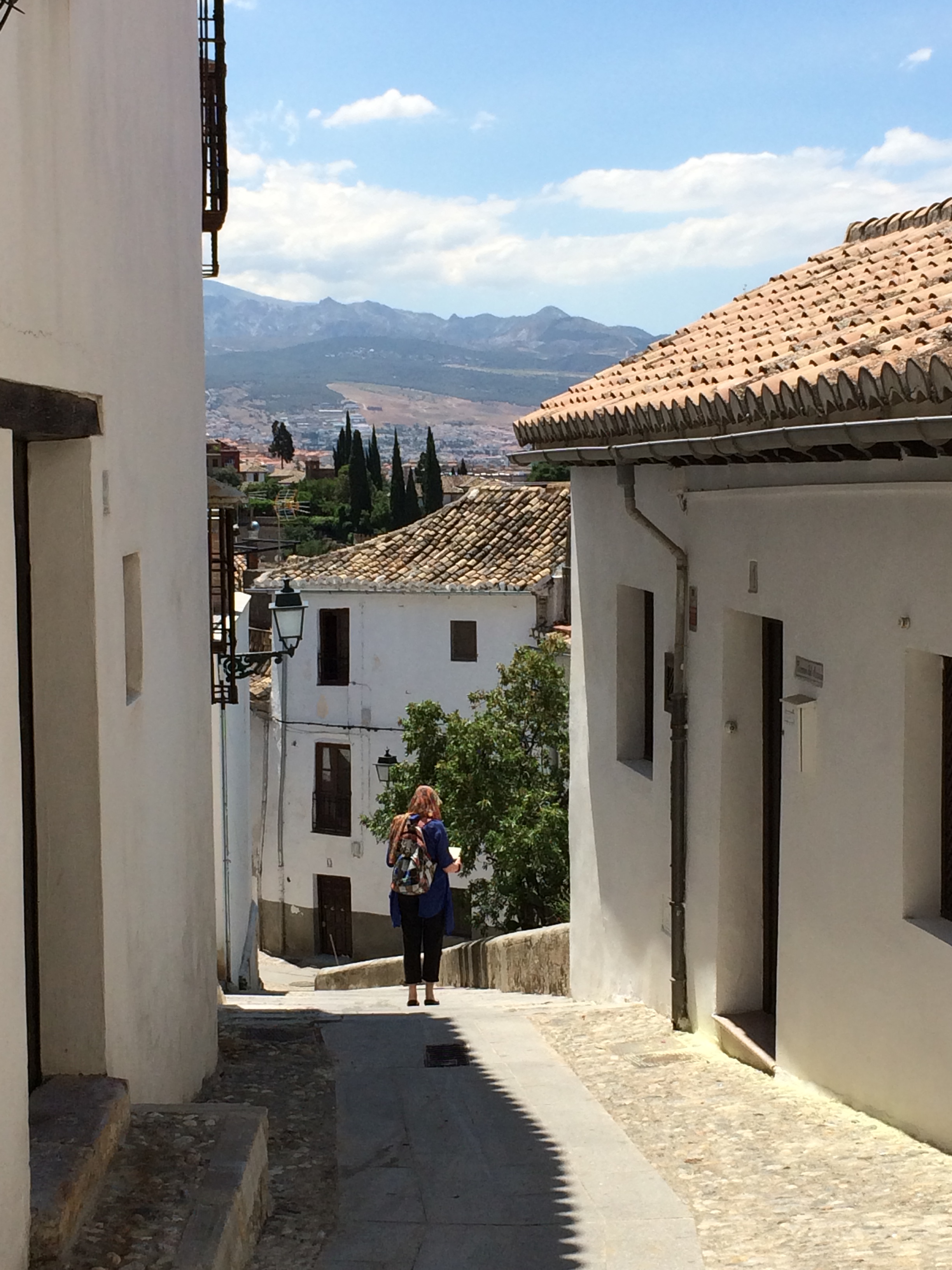
Making our way back down the valley.
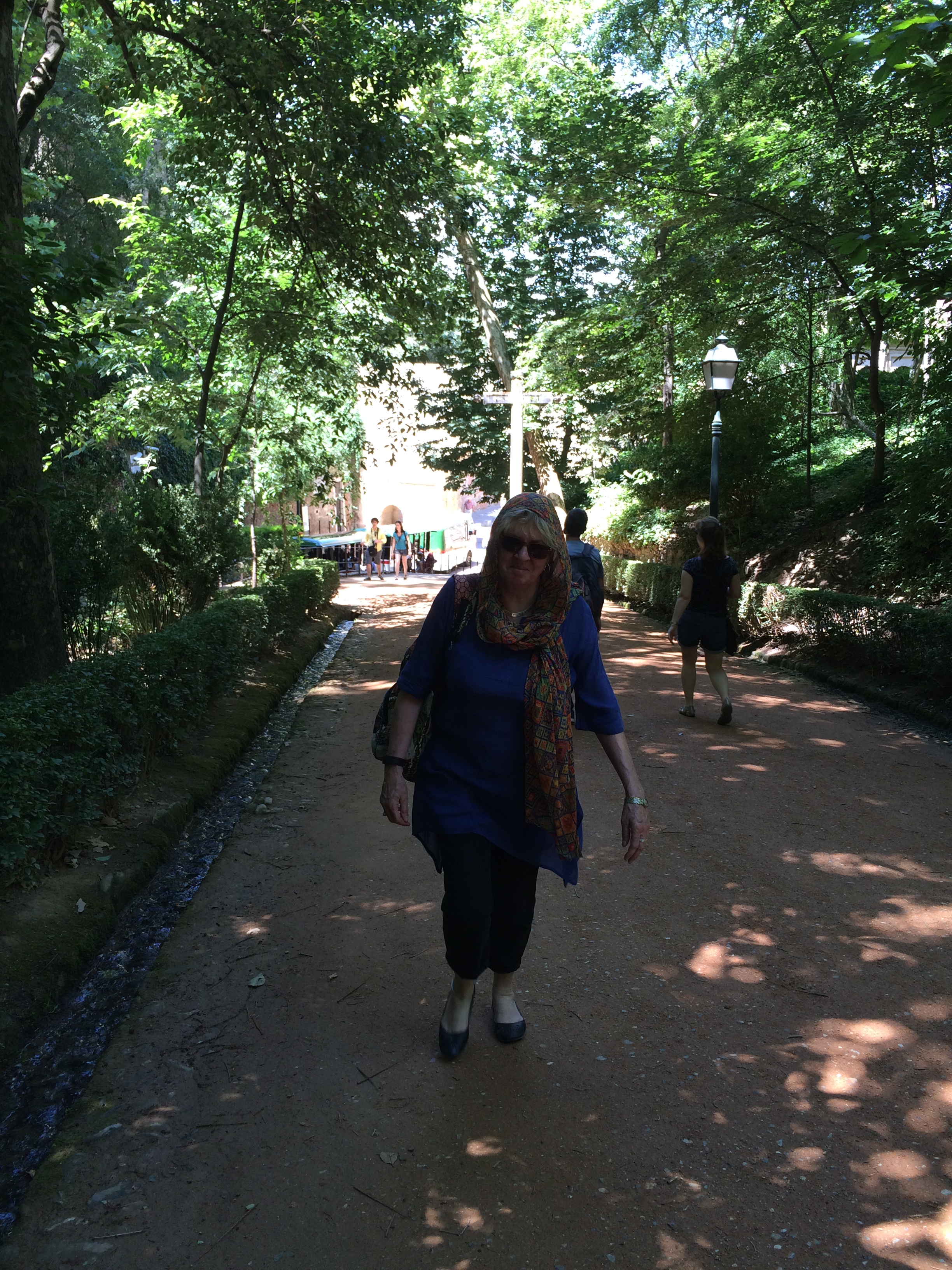
And back up again on the other side to the Palace.
One great help in all of this was Granada’s wonderfully temperate climate. Despite the high temperatures, the area around the Palace lies 750 m above sea level and in addition, still has the old Arab system consisting of water running down the sides of walkways and fountains to create natural cooling wherever one goes. Shade is also provided by the abundant vegetation. The freshness of the air reminded me a bit of parts of Jerusalem or Bloudan and Zabadany in Northern Syria or the Shouf mountain above Beirut.
There is not much more to say about our visit to Granada and the Alhambra Palace except that we liked the place very much but were shattered by the end of the day. It was touristic but not excessively so. We were pleasantly surprised by the number of young people who were there, admiring the splendour and this remnant of a unique part of Spain’s (and Europe’s) history.
One thing that did puzzle us slightly was the absence of visitors from the Arab world (or at least any that looked obviously like they were from the Arab or Islamic world or who spoke Arabic for instance – the majority looking like Europeans and people from the Far East).
The rest of the story of our visit can be told through some of the photos we took.
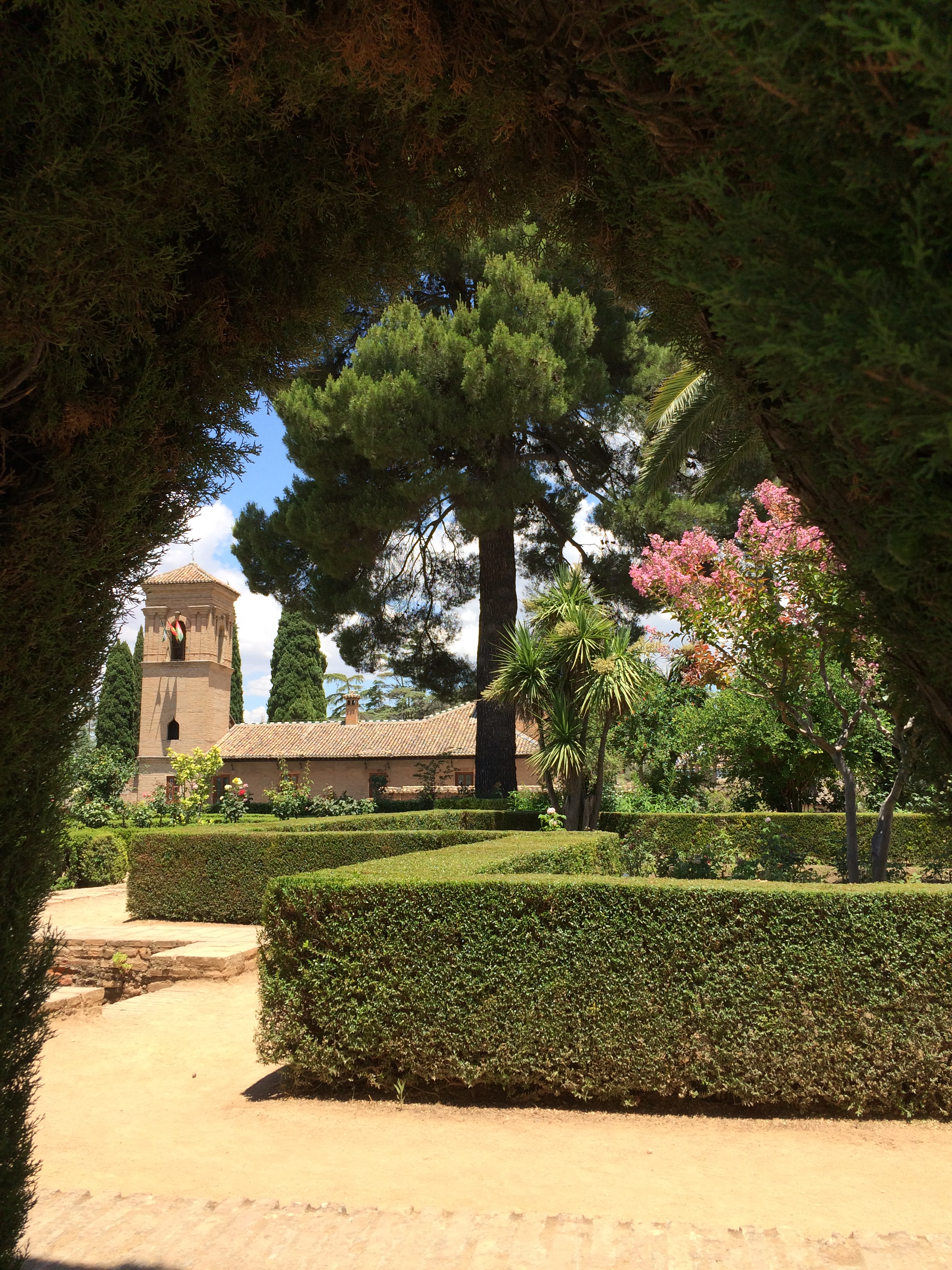
Alhambra Palace gardens.

Alhambra Palace as one enters the grounds.

Inner courtyard in Nasrid Palace. Surprised to see animal sculptures under fountain dating back to earlier period but kept by Nasri.
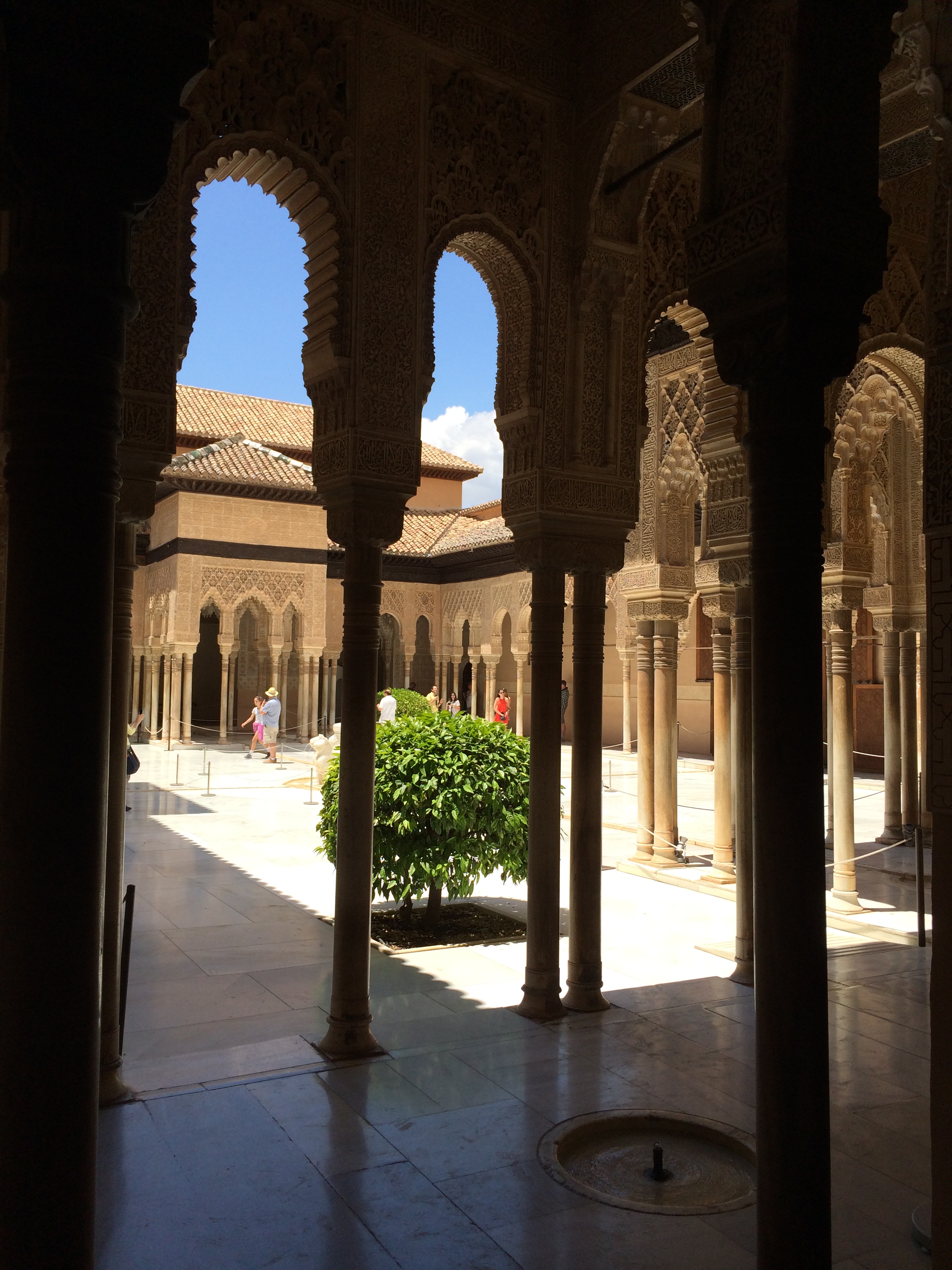
View to inner courtyard in the Nasrid Palace.

Every square inch has been sculpted and engraved.

Incredible intricate geometrical design on walls of every room in the Nasrid Palace.

Nasrin Palace.
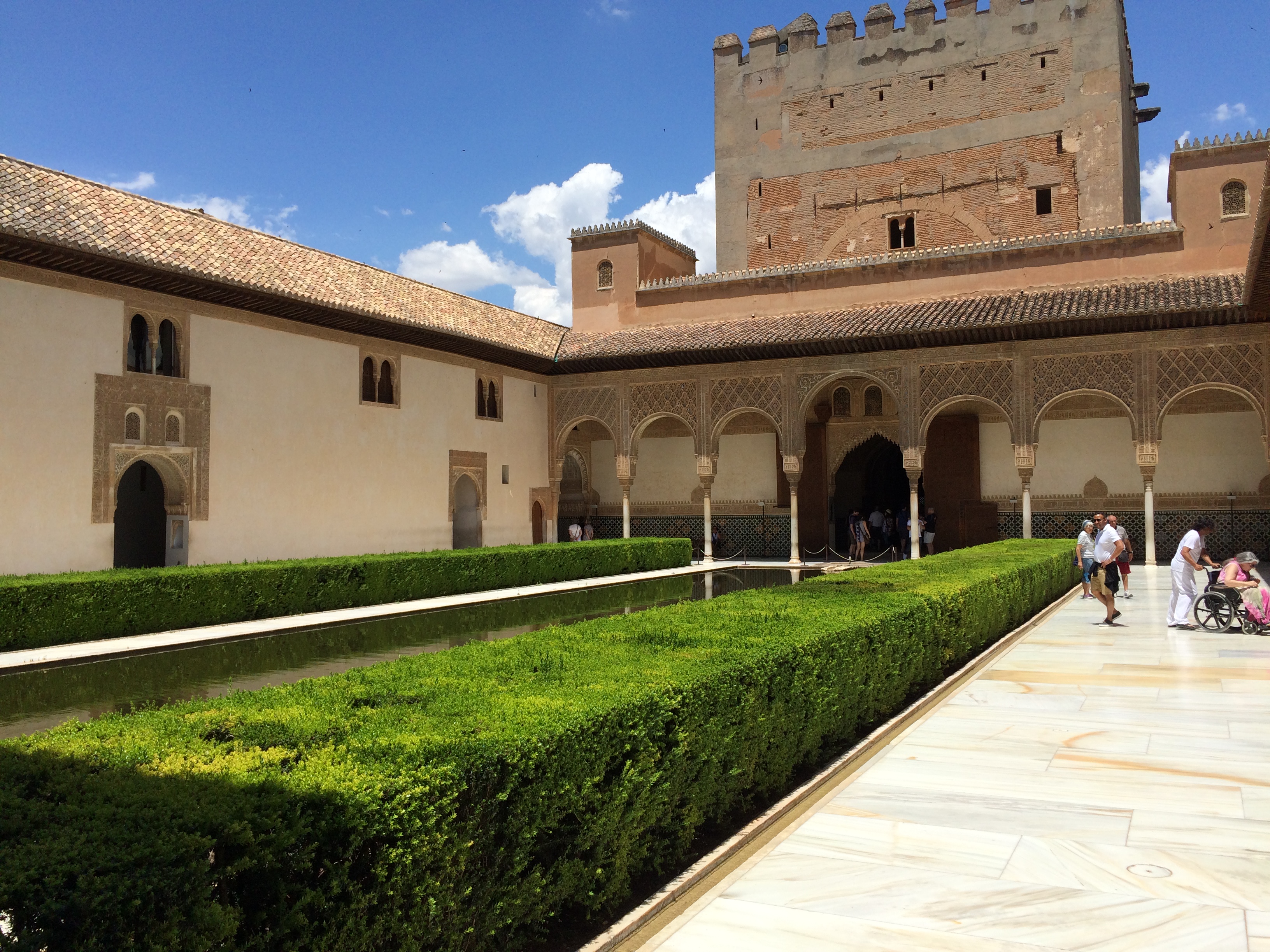
Pool in Nasrin Palace.

Perfect geometrical forms.
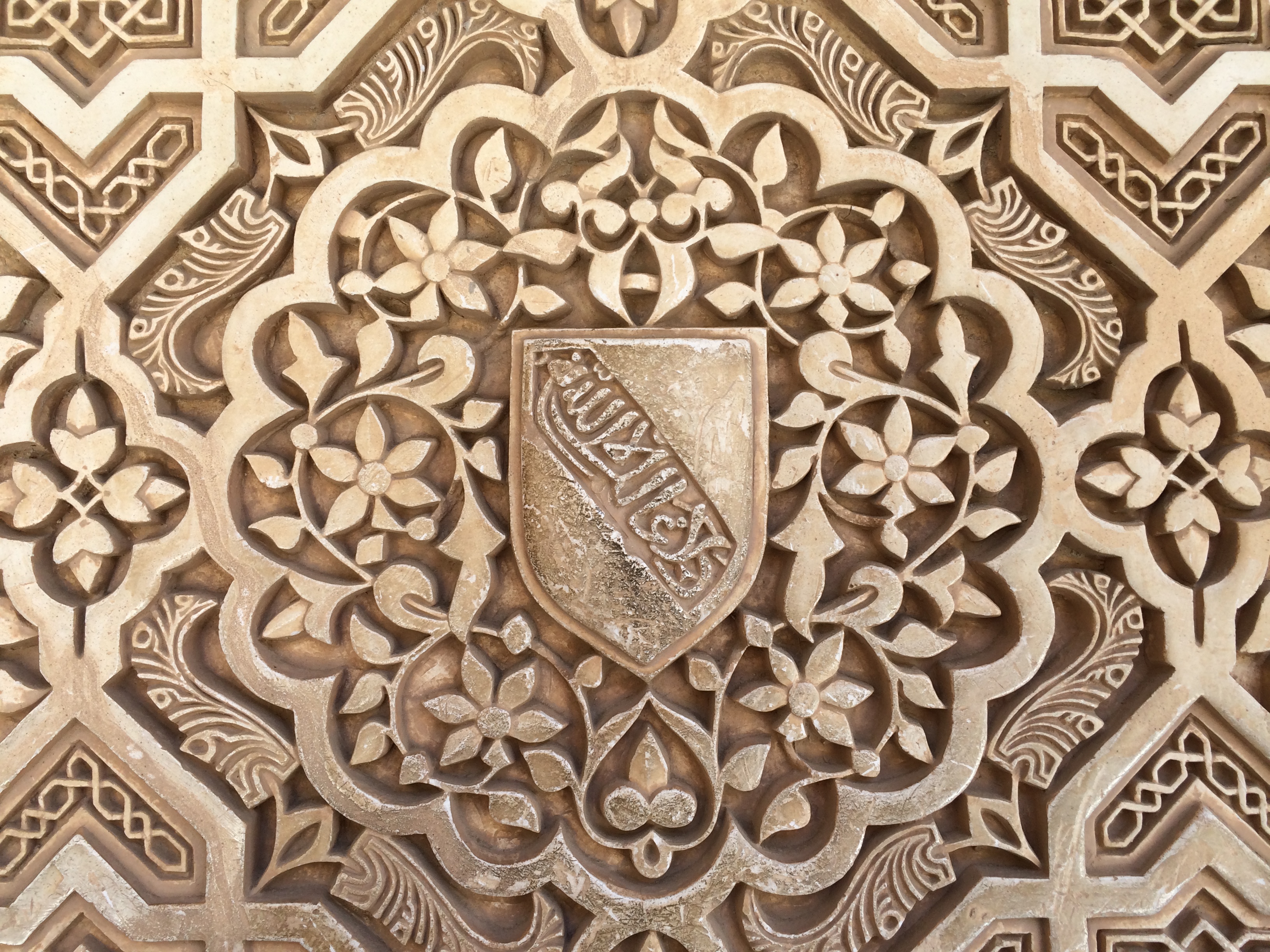
The inscription “La ghalib illallah” was everywhere. It means “God alone is omnipotent”.

It’s been a fascinating visit but exhausting and we realise we’ve overdone it a bit. We’d planned to drive all the way to Seville but decide that we haven’t got the strength for a long drive so opt for a campsite about half of the way there near a place called Olvera. It’s a little high up so we’re hoping will be a little cooler, as we’d been warned it starts to get seriously hot around Seville. Bright sunflower fields light up the sides of the road as we pass Campillos and Canete la Real. We overtake a splendid old white Chevrolet gliding decadently along at Pinos Puente. “Slow down, you move too fast … looking for fun and feeling groovy” say Simon and Garfunkel.
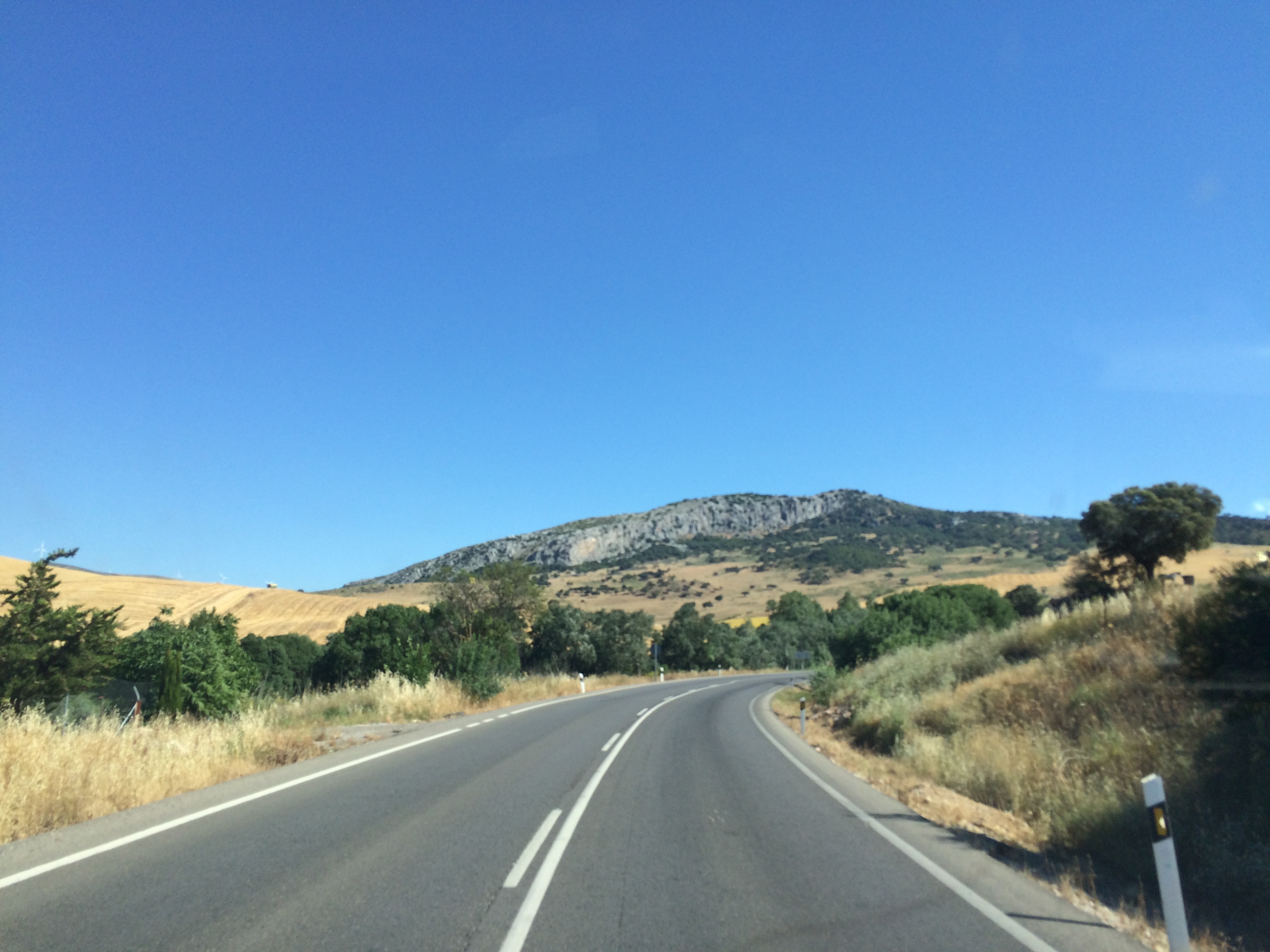
Canete la Real

Sunflower fields light up the sides of the road around Campilos.
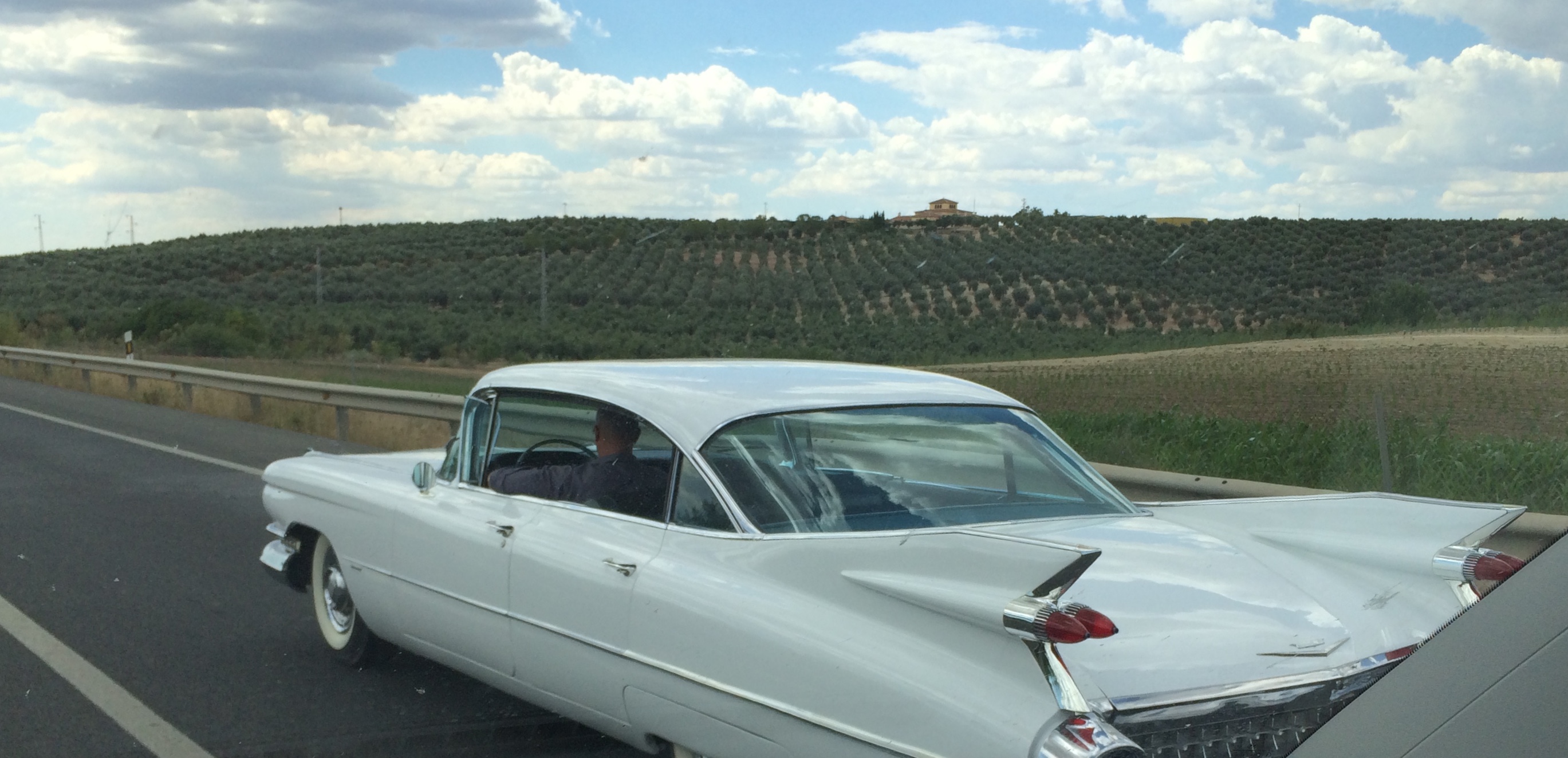
We pass an old white Chevrolet gliding decadently along.
The campsite is a real disappointment. It’s new and has been badly designed, with no shade at all and most pitches on uneven ground. Although high up, it’s in the middle of deforested agricultural land with a pig farm nearby, a strong smell of manure and insects of every description galore. We’re both exhausted but somehow muster the energy to make a Spanish omelette before collapsing. After an uncomfortable night we wake up more tired than the night before and I’ve developed another crippling back-ache. We decide that we have been moving too fast and must indeed slow down. There is no way we have the strength to visit Seville, so agree to book ourselves into a last minute cheap deal hotel in Seville and sleep it off. Hotel Al-Andalus Palace Sevilla, foam bath and comfy bed here we come.

Impromptu Spanish omelette.
 Travels with our van