Post-script from last post:
We had bought a small tent in France in preparation for our daughter Catherine joining us. We’d used it once in Lake Garda. It was a lovely little pop-up tent, orange, blue and white and very easy to put up (it just pops open ready to use as the name implies) but proved impossible to fold up and get back into the bag. Seeing that we were camping amateurs two Dutch fellow-campers rushed over in an impulse of solidarity to give us a hand. After a marathon struggle involving a good deal of twisting, wrestling, kneeling, head-scratching, almost giving up but then a final last-ditch double-twist tackle designed to catch it off-guard the mother and daughter super-campers somehow succeeded in getting it into the bag. Much appreciation and gratefulness all round. At Molinella it was still hot and as we were staying 2 nights we decided to put the tent up again. On opening up the bag, we quickly realized that whilst obtaining the desired result of getting the tent folded and forced into the bag, our altruistic fellow-campers had unwittingly inflicted multiple fractures on both poles of the tent and rendered it quite unusable. Attempts by Judith to fix the poles with plasters from the first aid box proved futile so sadly our lovely tent ended its days in the Molinella camping village recycling bins. We wouldn’t hazard to infer a moral from this story but there were no hard feelings! Honestly.

The discarded pop-up tent can be seen in a heap on the ground after attempts at reconstructing it had been abandoned.
From Vieste and the Gargano we continued following the coastal road down the Golfo di Manfredonia past Monte Sant’Angelo and Cerignola until we started seeing signs to Trani just after Barletta. All around us were hundreds upon hundreds of acres of olive groves insterspersed with the occasional vineyard. This really was a very different landscape from the north, flat if slightly undulating, very arid and Mediterranean, with seemingly enough olive trees to supply the whole world with olives and olive oil. It was nearly 9pm when we drove into Trani’s Porto Vecchio and the orange glow of the sunset reflected beautifully against the water-front and the old fishing boats.

Around Barletta – acres of olive groves and rows of vines everywhere you looked.

Finally, arrival in Trani.
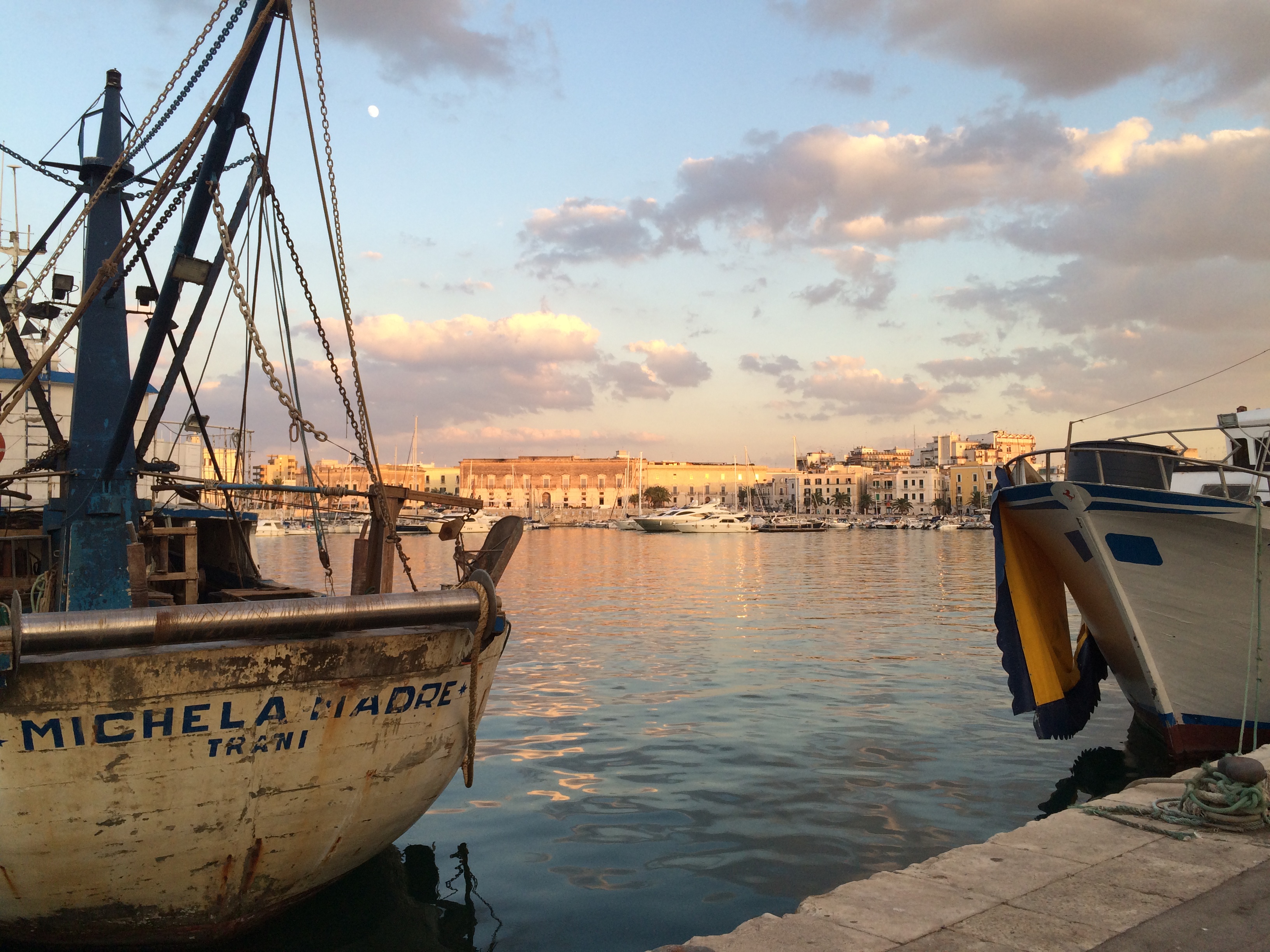
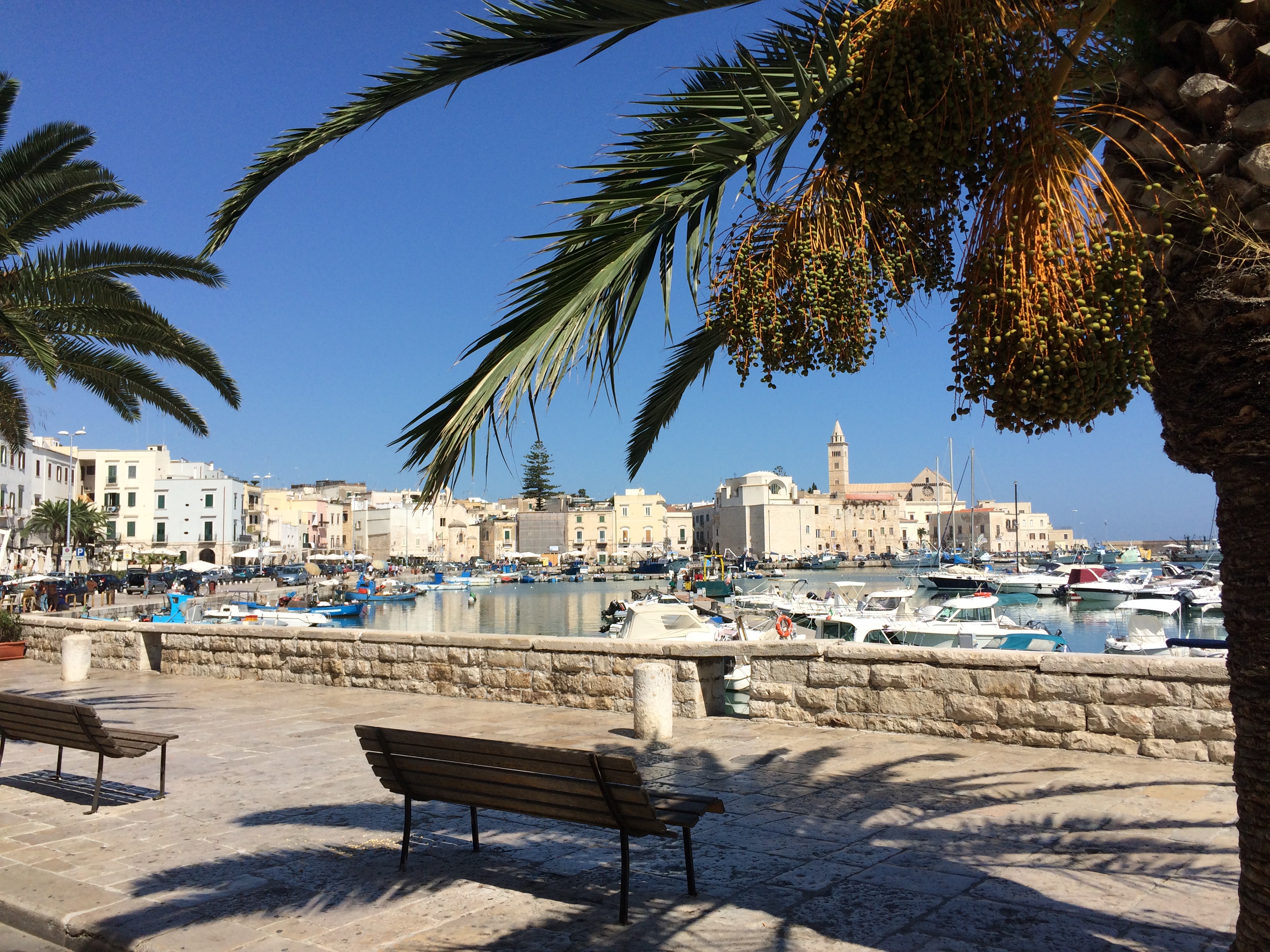
Standing at the point where the Adriatic and Ionian seas meet, Trani was once the Adriatic’s most famous sea port, carrying crusaders to the Holy Land, a famous trading post during the Middle Ages and much later the port southern émigrés leaving Italy went to to join the great Italian diaspora. Indeed, in the year 1063 Trani issued the ‘Ordinamenta et Consuetudo Maris’, the oldest surviving maritime law code in the Latin West and Frederick II built one of his many castles here, which still stands today. Trani is now still a busy fishing port but its main economic activity, as it has been for a long time, is quarrying the ‘marma di Trani’ (Trani stone). A beautiful example of this is Trani’s lovely Romanesque cathedral, situated right on the edge of the sea and almost seeming to rise from it, which has become one of the symbols of Puglia.

Trani’s beautiful cathedral, one of the symbols of Puglia.
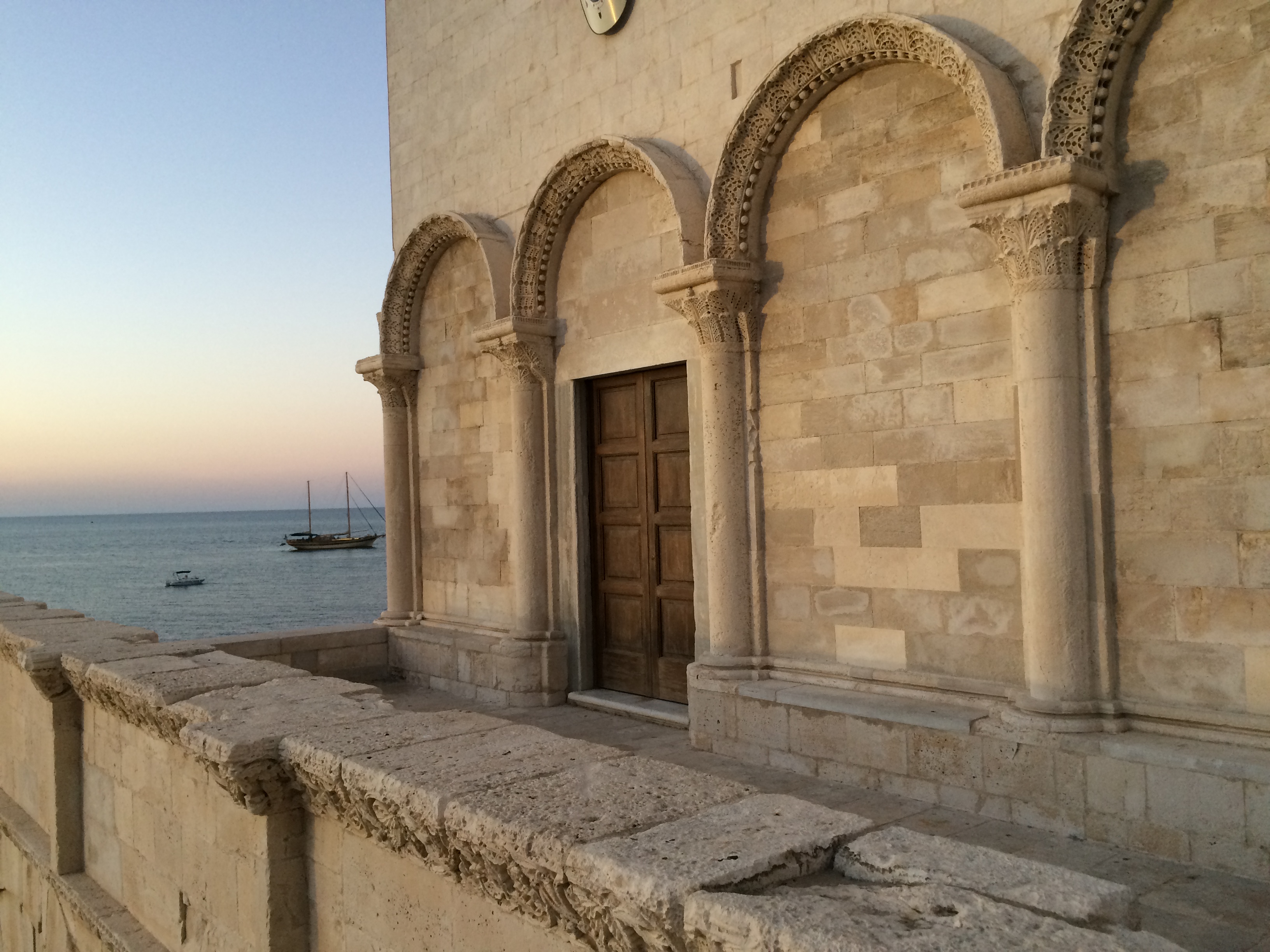
Made of Trani’s famous stone, it seems to ‘rise out of the sea’.

A typical street in old harbour area of Trani

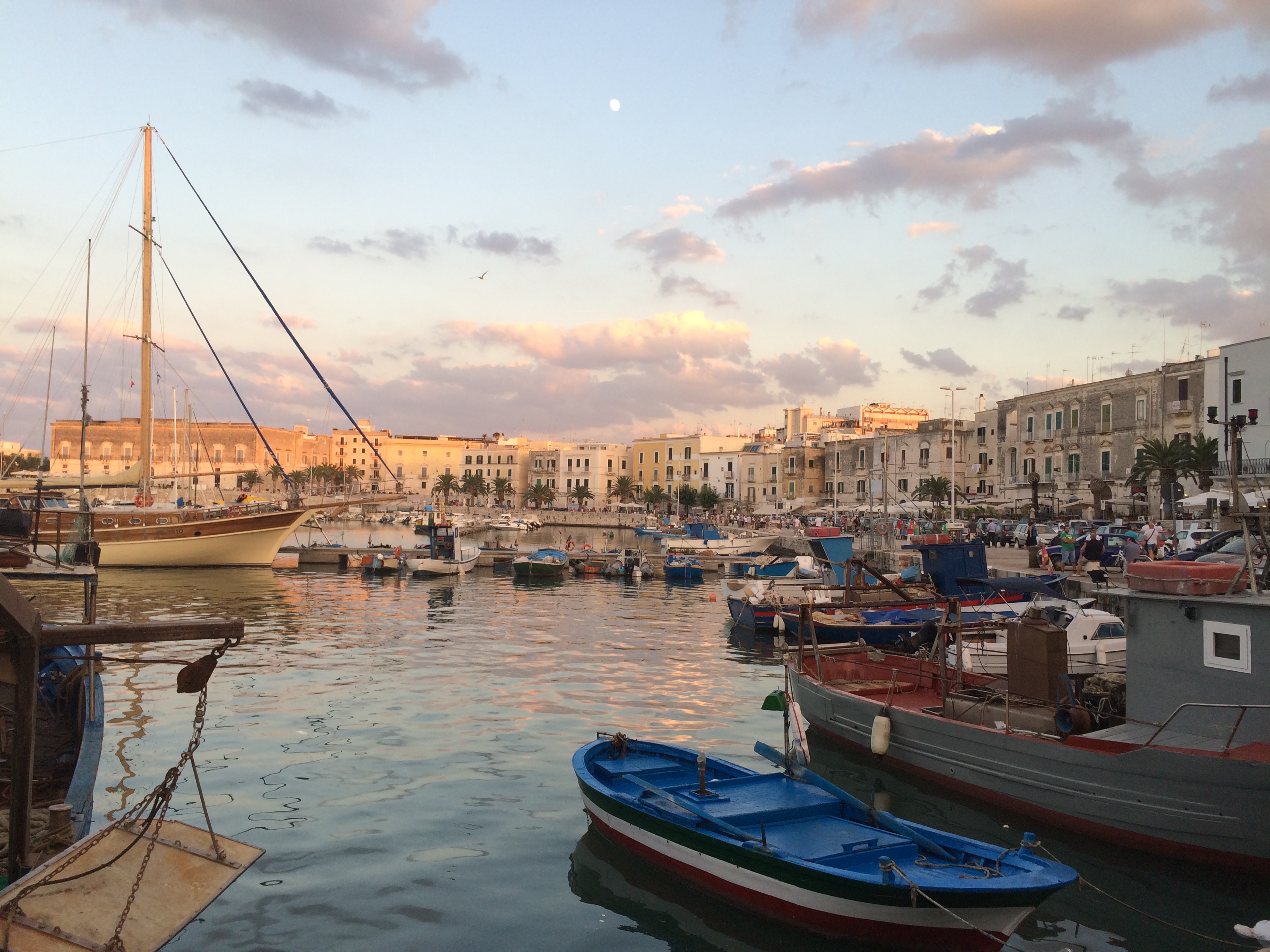
The old harbour at sunset.

Train train station
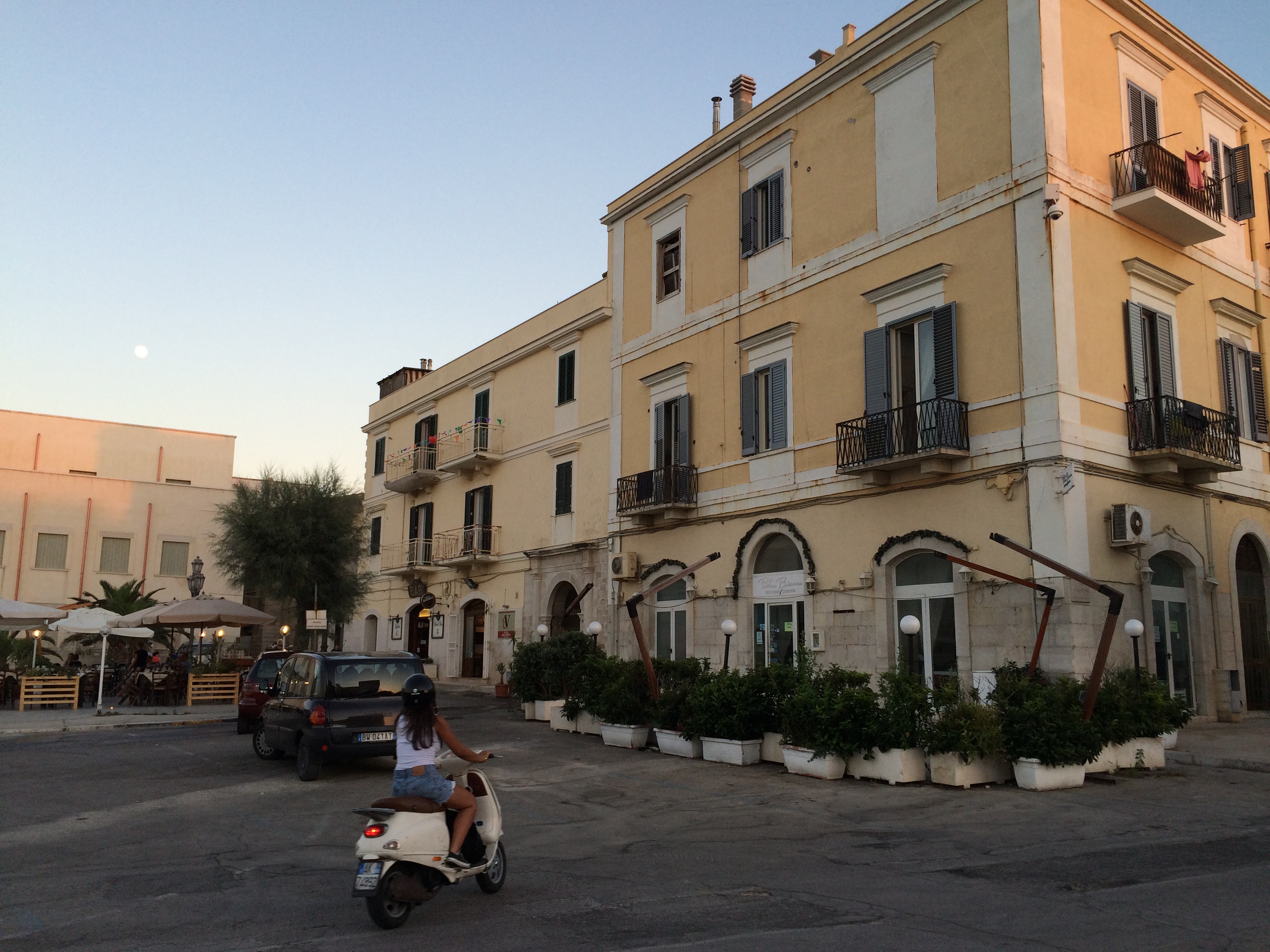
The piazza off the Via Ogni Santo.
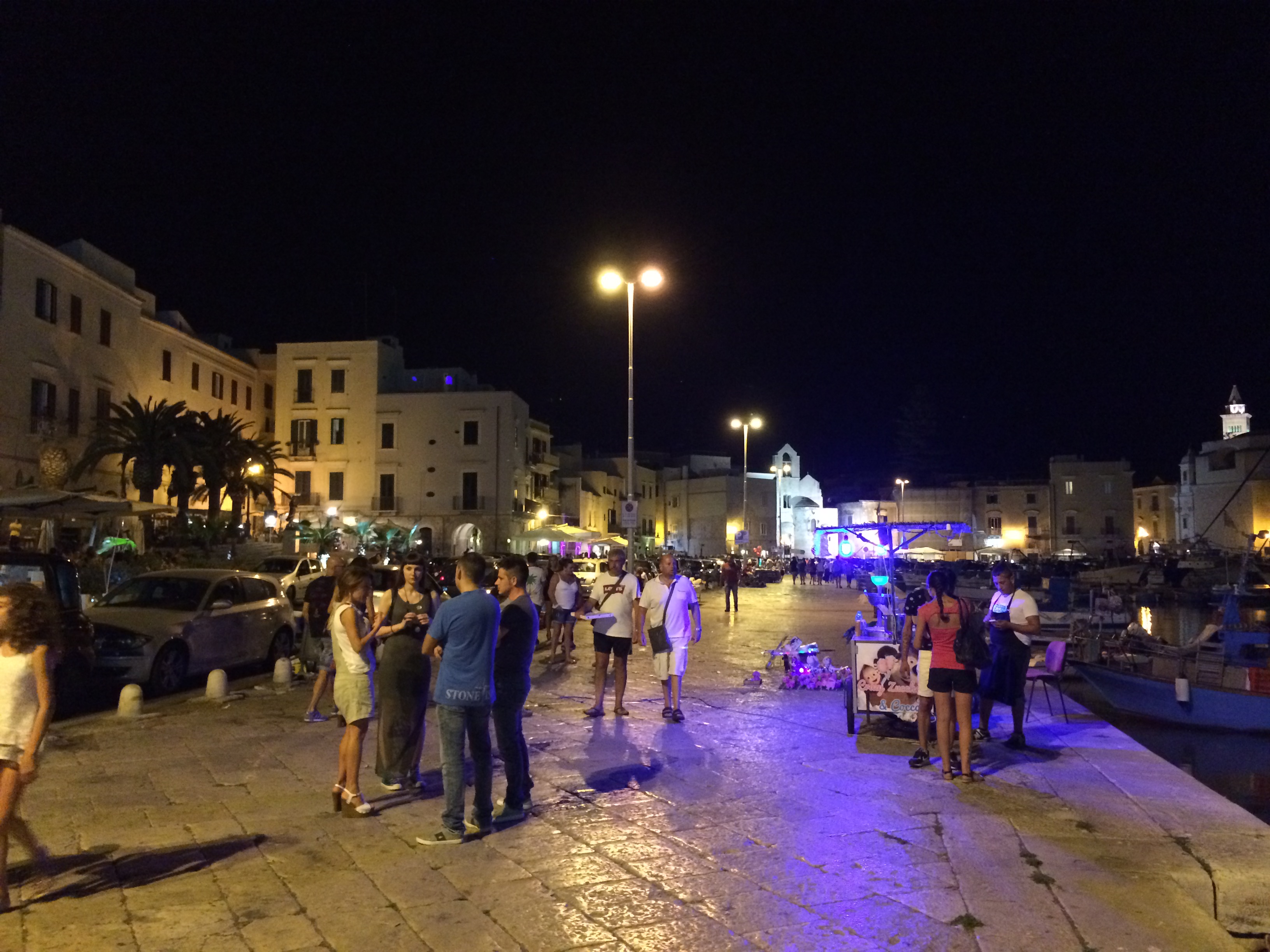
Trani has a lively night-life at least in summer and during feast days.
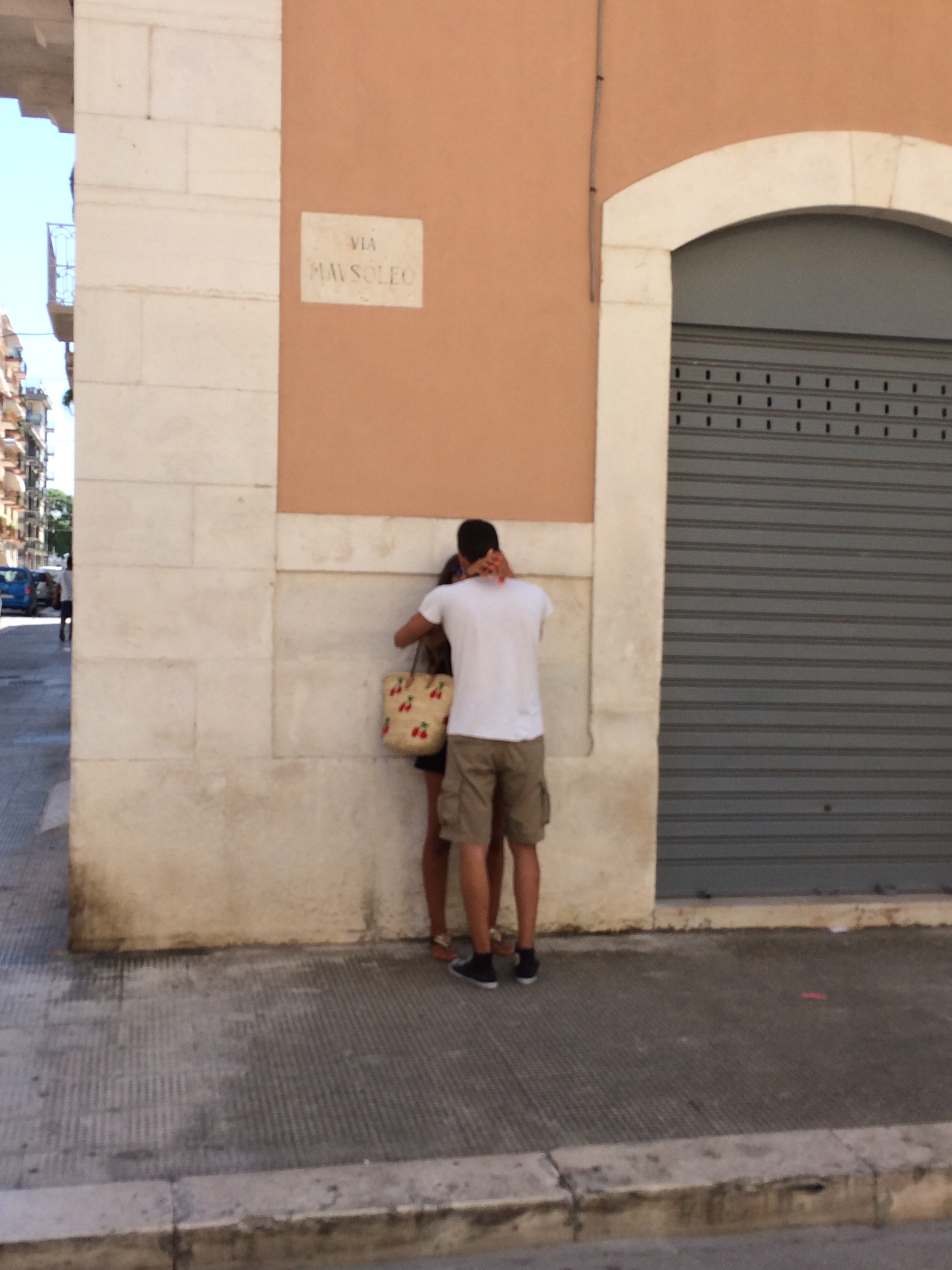
Romance Tranese-style on the Via Mausoleo, Trani.

The ancient entrance to our B&B, Porto Trani.
Notwithstanding all the above, Trani is also famous for being the ancestral home of the Centofantis and it was here we would begin our search for information on the origins of Flavio’s family. We checked into the very friendly and welcoming Porto Trani B&B on the harbour which in the evening transforms from fishing port to an attractive hub of restaurants and promenades.
Our first evening was spent in one of the many harbour restaurants with Brenda safely parked, or so we thought, in the Cathedral car park. Chatting to the waiters after a lovely supper of salcicie and Orechiette con frutta di mare, and ‘Tomaresca’ white wine made principally from the local Minervino Murge grape variety which was a very pleasant discovery for us, we were alarmed by their insistence that we move Brenda to a spot in front of the restaurant as she was not safe. From what or whom no one would say but the exchange of knowing looks and nods and raised eyebrows were enough to convince us to move her to a spot ‘guaranteed’ by the restaurant would be OK as long as we paid a little something which they would pass to the night watchman! When in Trani, do as the Tranese do, vero o no?

Brenda ‘safely’ parked near to the restaurant on the water-front.

The orecchiette with seafood and salcicie.
Next morning we set off for the ‘Palazzo di Citta’ of the Commune of Trani and were referred to the ‘Capo Settore of the Servici Demografici’, Dott. Vito Luciano Preciosa. Disappointingly, he told us he hadn’t come across the Centofanti name and that we would need to make a request in writing providing as much information as possible to justify them spending the time on it but that in any case, the person in charge of doing any genealogical research was on holiday and would be back until mid-August. (Later we were told by the owner of the Giudica souvenir shop that he had actually lost his mind and wouldn’t be coming back! Curiouser and curiouser!) Despite this everyone was very helpful and made suggestions for a way forward. We had two problems though: all public offices closed at 12 noon for the day and things being as they are here, only one visit a day was possible; the second was that we didn’t have the full name and details of Flavio’s great grandfather who left Italy to work in Alexandria, Egypt. We therefore decided to research Flavio’s grandfather, Galileo Centofanti as his passport application should include his parents’ details.
On the way back, Flavio seeks out a ‘parruchiere’ (literally, a wig provider) for a hair and beard trim he’s finally decided to have for at least some measure of relief against the continuing relentless heat. As well as being a very good barber, Francesco who’s 58 talks interestingly about the history of Trani. “Yes Trani is famous for its marble but the local industry has all but been destroyed. The Chinese were buying large quantities then realized that they could simply buy entire quarries, ship the blocks of stone to China and pay the Tranese stone cutters three times their salary to transfer their skills in China.” “There’s a reason why manyTranese emigrated to Egypt and to Argentina – to Egypt to work on cutting the banks of the Suez Canal (something Flavio had suspected for a long time) and to Argentina to work on the National Palace, which was entirely made of Trani stone.” “As well as its Muscato wine, Trani is also known for its eating grapes, which are better than anyone else’s in Puglia.”
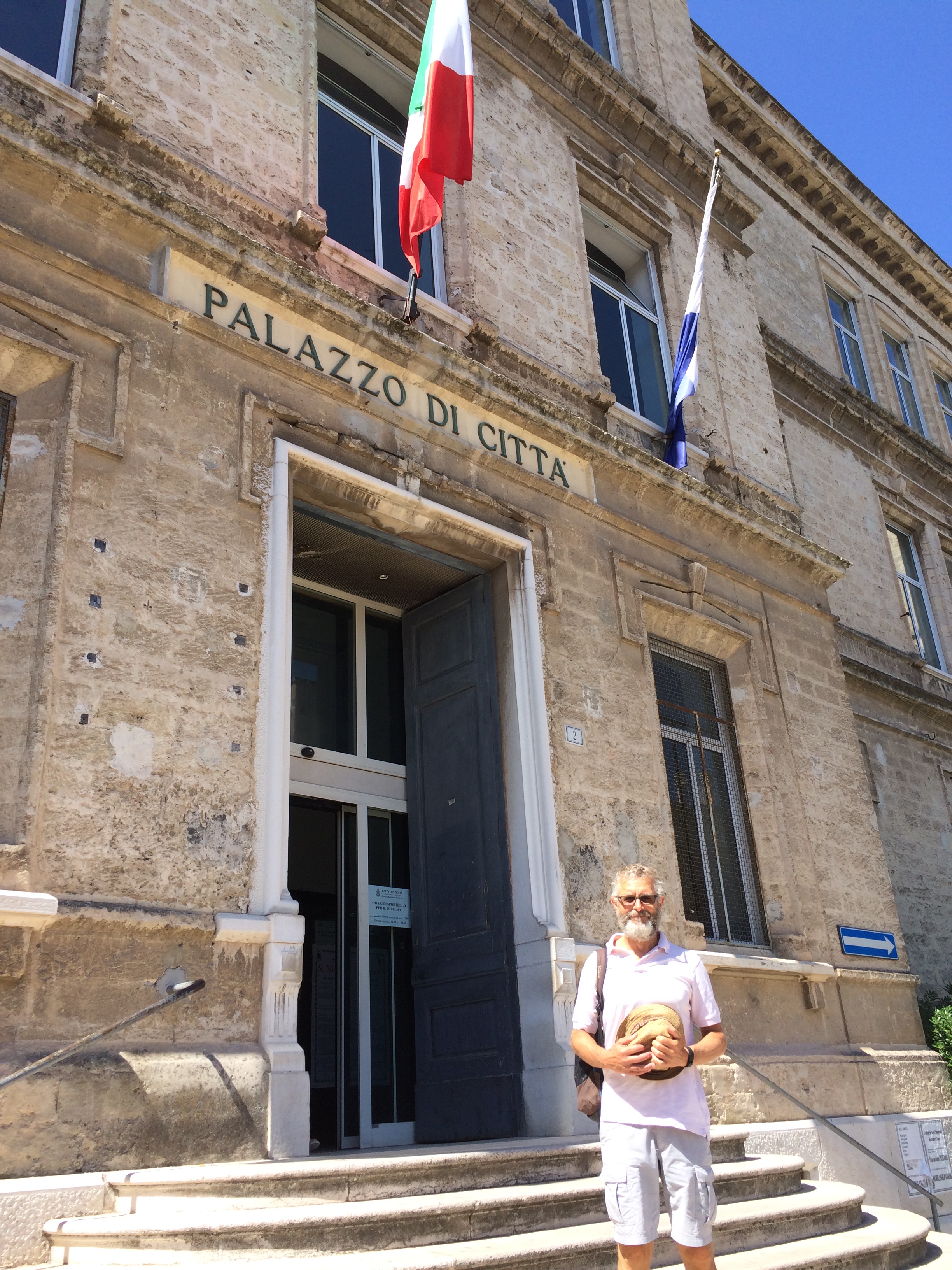
About to enter the ‘Palazzo di Citta’ of the Commune of Trani, a little nervous without knowing why.

The Capo Settore, Dott. Vito Luciano Preziosa’s name plate.
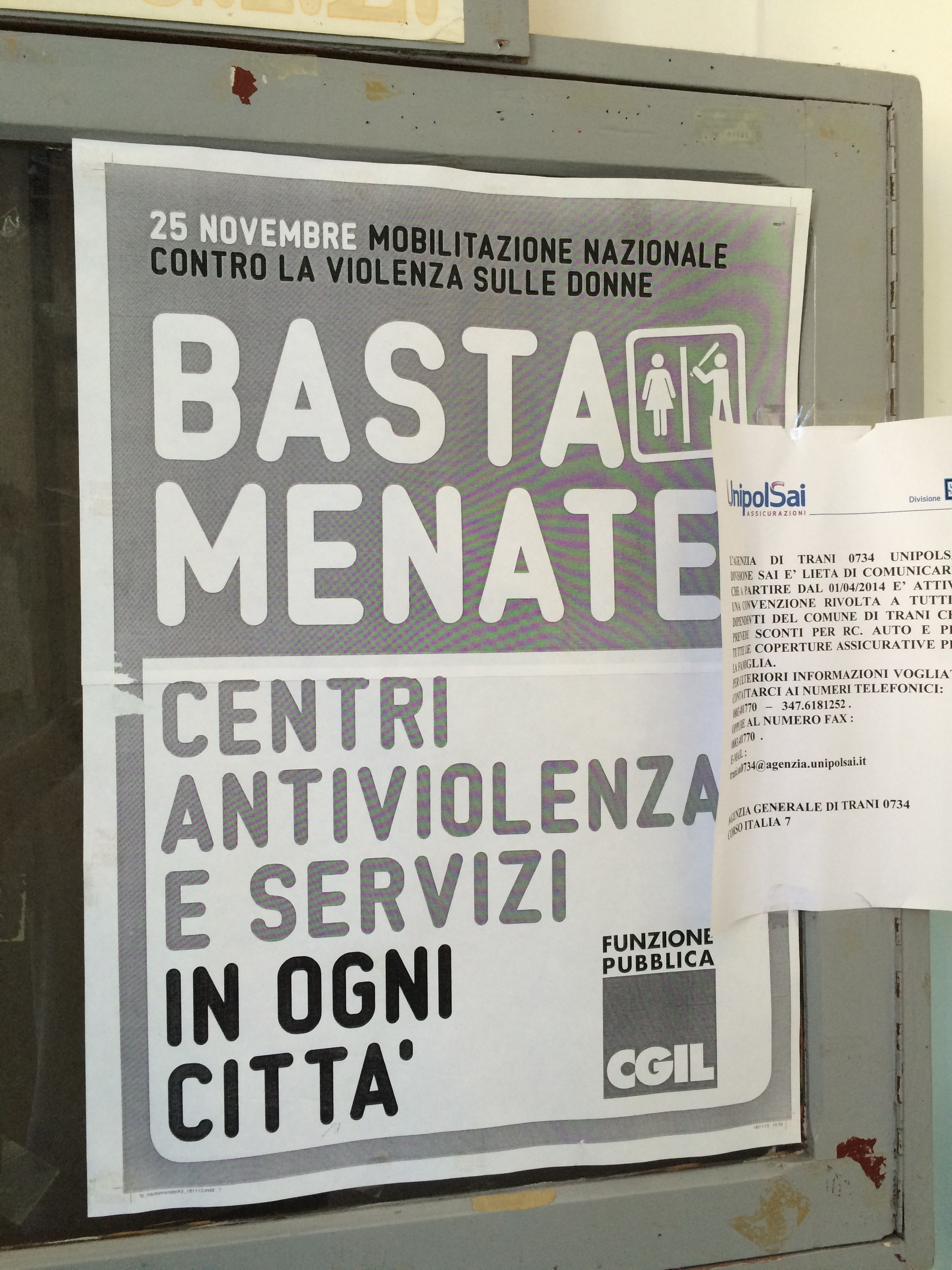
A poster in the Commune raising awareness about violence against women – “Stop the threats”.

On the way back, Flavio finally decides to have his first beard and hair trim in 11 weeks. Francesco is 3 years younger, a very good barber and talks interestingly about Trani.
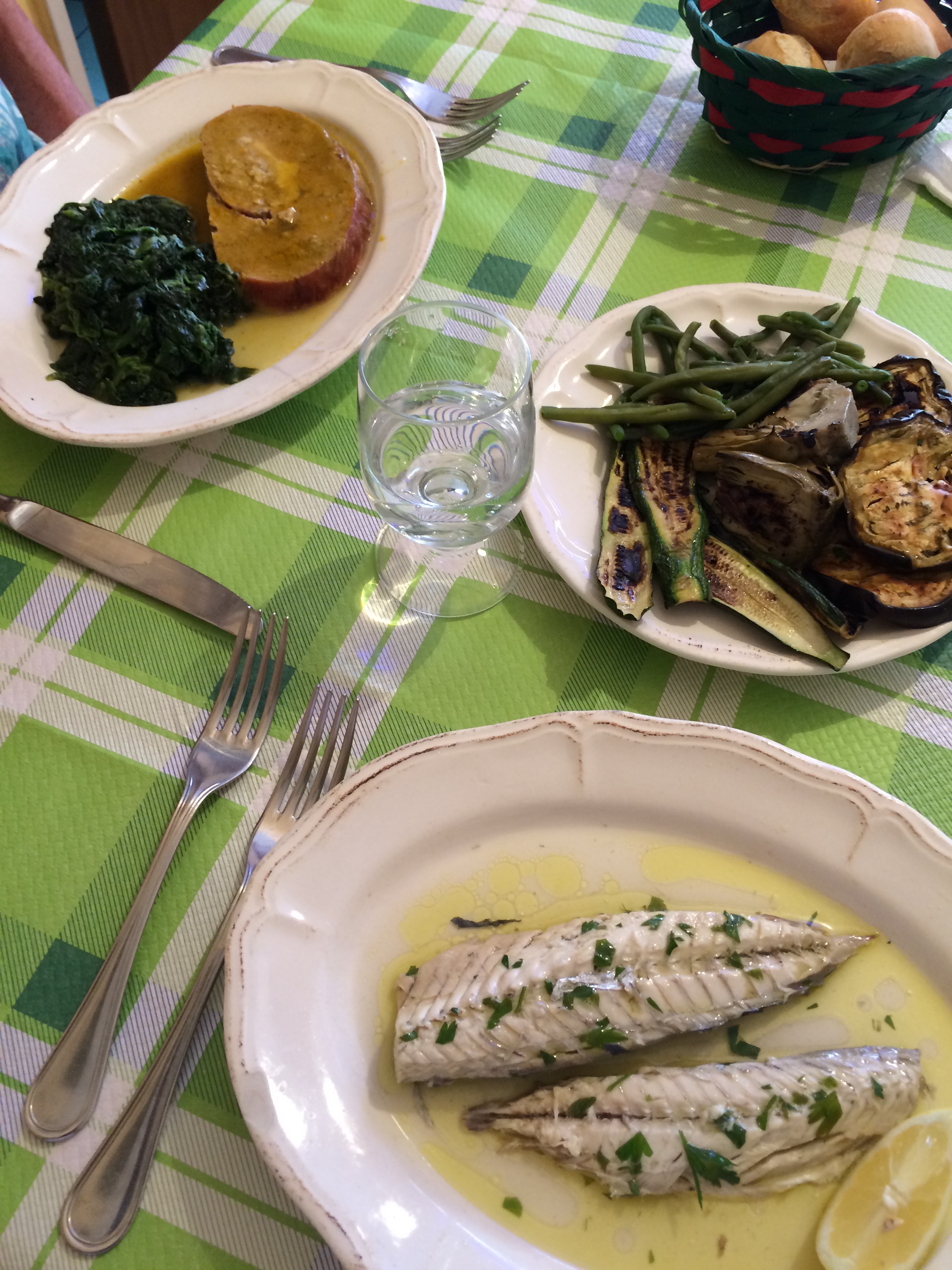
We also stop at a very reasonably-priced canteen next to the station for a light lunch.

Posters of ‘Toto’, the hilarious old Italian comedian of our childhood on the walls.

Mocking fascism.
The afternoon was spent exploring Trani’s medieval town, a labyrinth of narrow streets and alleys which remain a living community despite the gift shops, artisans workshop and tourist sites. The medieval town has a Jewish quarter which houses the oldest Jewish temple in Europe. There is a church and hospital once belonging to the Knight’s Templar along with many ancient churches. Every so often the streets would open onto a piazza with coffee shops and restaurants. Our tour ended at the cathedral on the harbour. Walking through Trani we decided to approach local, mainly older people, to see if they recognised the Centofanti name. It was quite disheartening to keep coming up with blanks. Later in the evening we stopped in a gift shop and Flavio began chatting to the owner about our reasons for being in Trani. He was fascinated with our search and said there was a book about old Trani families which he would try and get us a copy of.
Later that evening, walking past a small unprepossessing cafe/restaurant out of which classical music was blaring, Flavio was stopped by the owner almost as though he had had prior knowledge that he’d pass by and of his search. “Where are you going? Stop. Let me make you a coffee, or have a bichiere on me. Who are you?” “Centofanti? ma come no ci sono Centofanti? Come back tomorrow and I’ll take you to some Centofantis.” His name was Marchese and Flavio wasn’t sure whether to be fascinated by or slightly suspicious of his eccentricity. “Ma si che conosco i Centofanti, they were like us, the Fabiano family. We both had the best fishing boats.” “I could have guessed you were a Centofanti. You’ve got a Centofanti face and Centofanti mannerisms.” “Come back tonight, or tomorrow and I’ll tell you some more.” Flavio’s sister Laura, who knows Italy better than the rest of us, had told us not to be gullible and always believe what people said and so we were accordingly wary. He had some interesting old framed photos on the wall and claimed to have met Prince Charles and Lady Di when they stopped in Trani to visit the cathedral shortly after they were married – their first port of call in Italy.

A group of older citizens of Trani chilling out in the late afternoon – they were happy to have their photo taken.
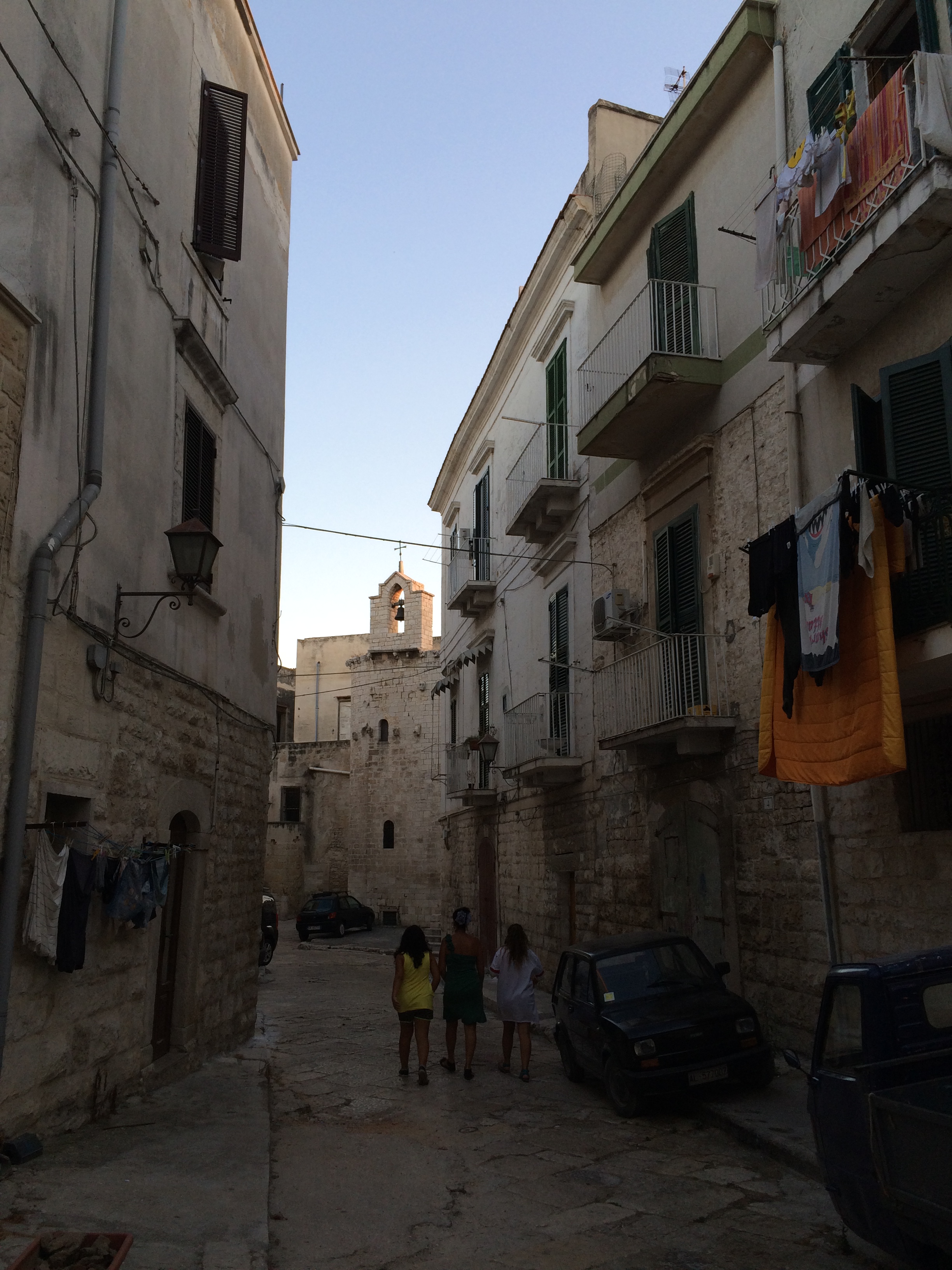
The Via Sinagoga – Trani once had a thriving Jewish community. Jews still come every year to celebrate Hanukah.

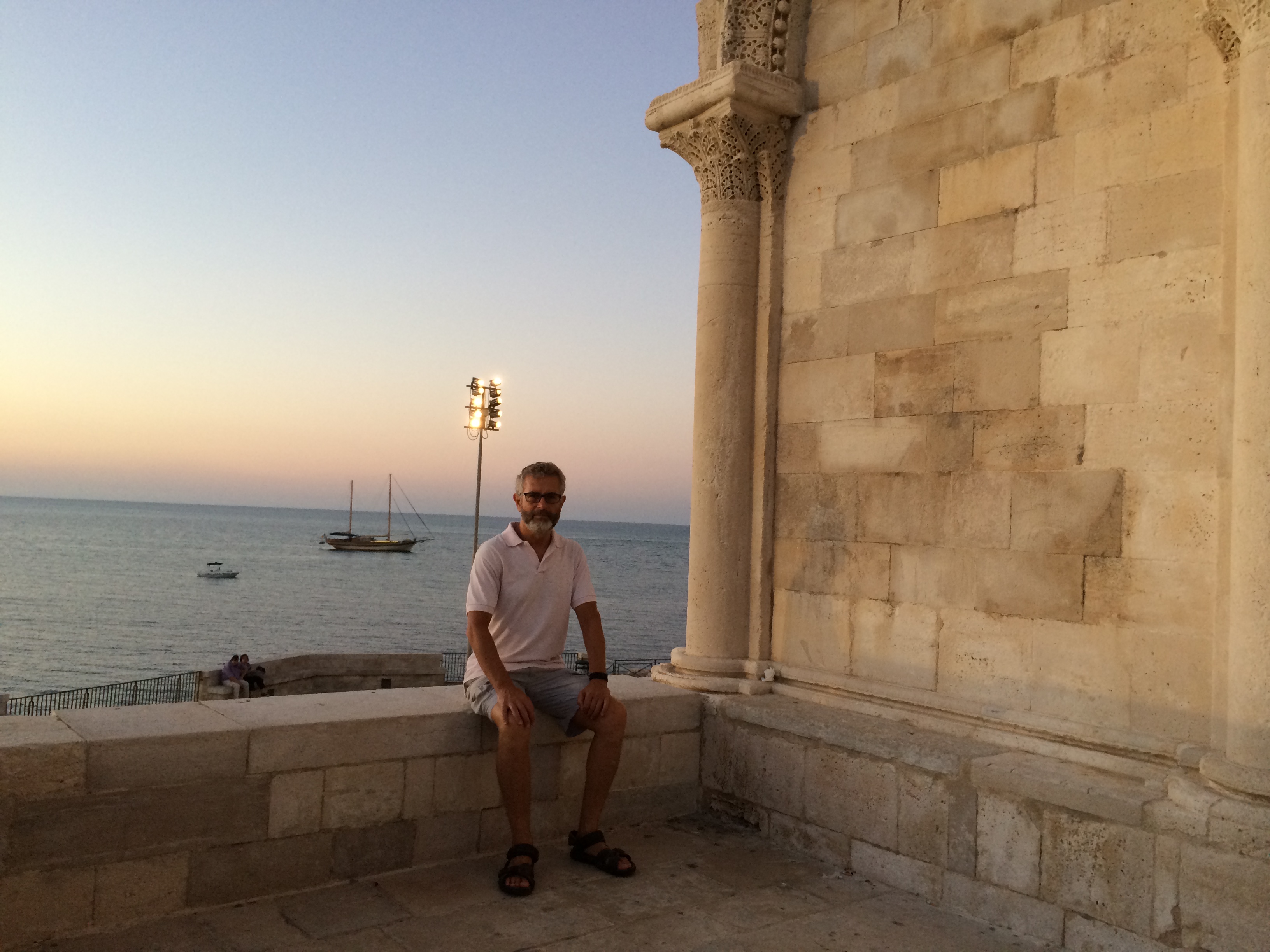
In front of Trani’s magnificent cathedral.

Sandro, the friendly and helpful owner of the Giudeca souvenir shop – interested in helping us with our quest.

Marchese Fabiano: “You’ve got a Centofanti face and Centofanti mannerisms”.
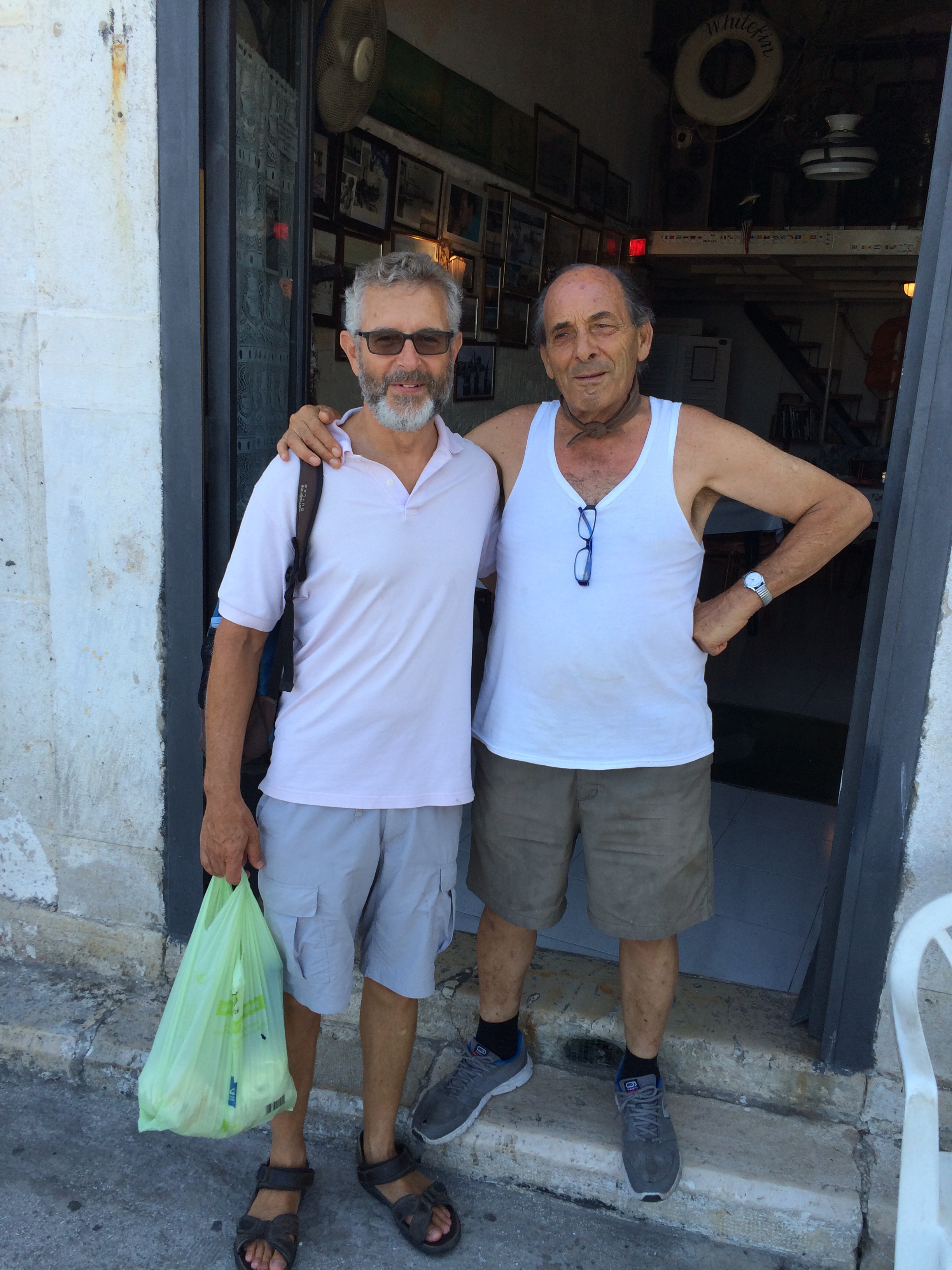
“Ma come non ci sono Centofanti?”

“I Centofanti avevano una barca” said this old Tranese sitting outside the Porto Trani B&B.
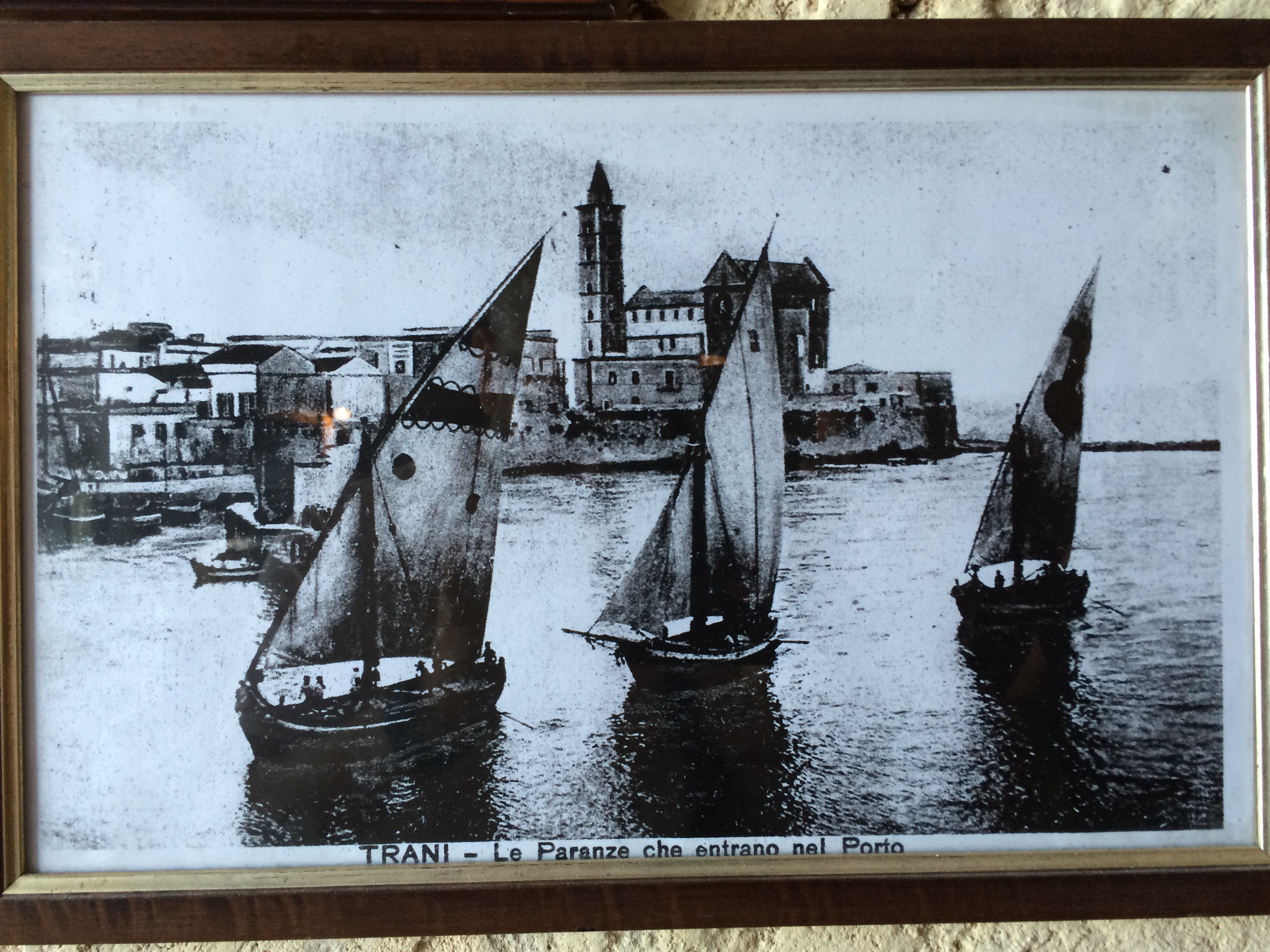
One of the old photos on Marchese’s walls showing old 19th century fishing boats in Trani.
True to his word, the next day Sandro had a copy of the promised book for us and it turned out that Centofanti was an old Trani family. One chapter in the book details a massacre in Trani carried out by France’s Nepoleonic army. Listed amongst the names of the dead was a Centofanti.
The next morning we went to the Ecclesiastical Records office and had a long chat with Monsignor Savino Giannotti, Vicario General (effectively the Deputy Bishop). He was very helpful and confirmed immediately and without hesitation “ma si, come non ci sono Centofanti? Ansi, e una famiglia famosa e nobile” (who says there aren’t any Centofantis. Of course there are – indeed it’s a famous and noble family!) He took our details and promised, as soon as he received a request from us in writing, to begin his research and get back to us, though nothing would happen until September as the office was about to close for the summer vacation. He was a lovely amiable chap and gave us a present of a book about St Nicola il Pellegrino, the patron saint of Trani. Not to be confused with St Nicola of Bari who was an old man like me said Monsignor Giannotti pointing at my grey beard! “St Nicola il Pellegrino came from Greece and was passing through Trani on his way to doing a pilgrimage in Rome. Being a very simple and devout young man, he spent his time preaching holiness and purity of lifestyle but died in Trani and became our patron saint. ” What did he die of? “Of repeated ‘colpi’ (blows) he got from people for getting up their nose.” How old was he? “18.”

The Vicario General’s residence.

Monsignor Savino Giannotti, Vicario General. “Centofanti e una famiglia famosa e nobile”.

Monsignor Giannotti signing a copy of a book on St Nicola il Pelegrino, Trani’s patron saint.

The crypt of cathedral where San Nicola il Pellegrino is buried.
Meanwhile Flavio had emailed his cousin Mario in Australia to see if he had any information about their mutual great grandfather. Mario spoke to his mother and got back to us to confirm that his mother couldn’t remember the name of her grandfather as the ‘family’ didn’t talk about him. It seems he could have had a partner and child in Italy and a wife and six children in Italy and/or Alexandria, Egypt.
When we married the Italian Consulate in London insisted on taking our original marriage certificate and sending it to Bari. Whenever Flavio had to renew his passport Judith had to go to the Italian Consulate with proof of marriage and sign the application forms. When questioned they said it was to prevent Italian men having ‘a wife in each port’. So maybe it was a problem and Flavio’s great grandfather was just keeping up with tradition?
Leaving Trani for Bari we were informed by the very same waiters we met on the first night that Bari was dangerous and we should be vigilant but they again failed to say why or from whom. So off to Bari we went, praying to the two Saints Nicola to watch over us!
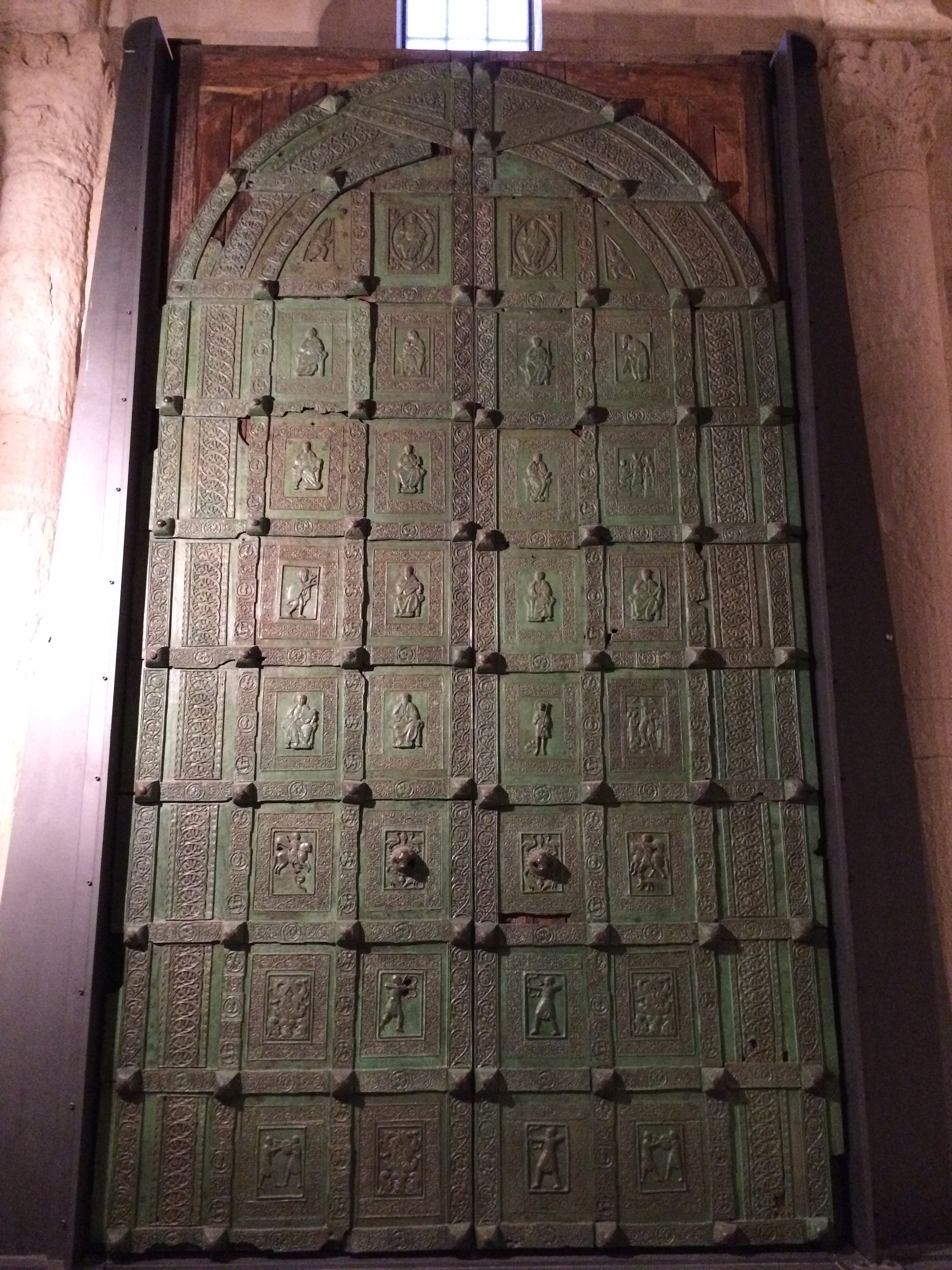
The medieval bronze door of the cathedral.

A very old fresco in the crypt of the cathedral.
H
F
 Travels with our van