Our plan was to visit Bordeaux then head for Bergerac for the night. The town of St Emilion was roughly on the way and we were intrigued by the reputation of the wine to see what that would be like. As it turned out, it was such a lovely place, despite it clearly being a popular destination for wine enthusiasts looking to get a good deal on good vintages as well as tourists generally, perhaps on the Camino on their way to Spain, that we decided not to rush it and make the most of our visit and aim to arrive in Bergerac at a reasonable time.
The landscape changes quickly. No sooner have I said to Judith “where are all the vineyards?” than we’re suddenly surrounded by them everywhere we look. As we approach St Emilion we come to a fork in the road with a sign pointing to no less than 15 different chateaux, all within the St Emilion appellation.
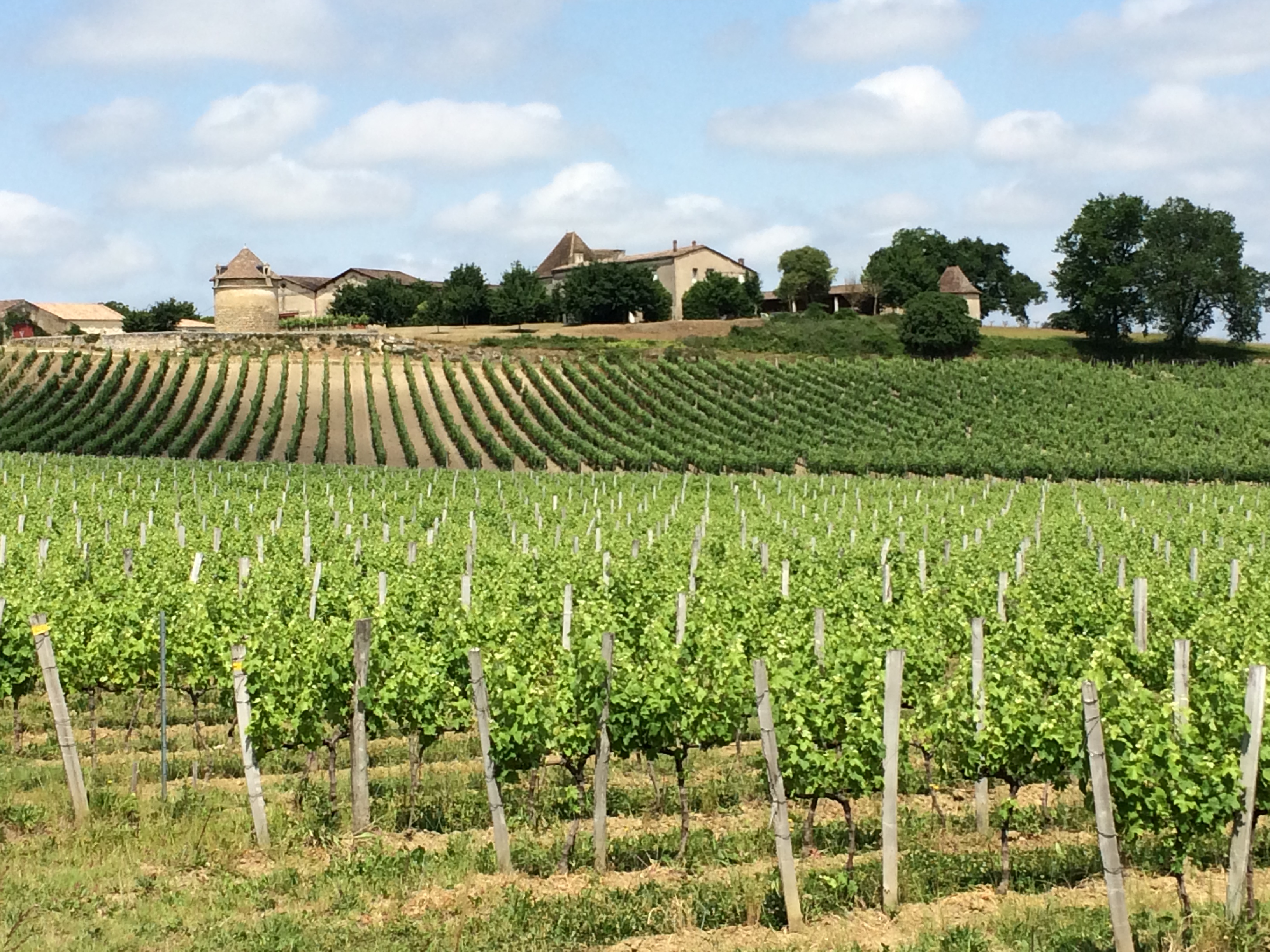
Chateaux and vineyards surround us – here, Chateau Puy-Fromage in the background.
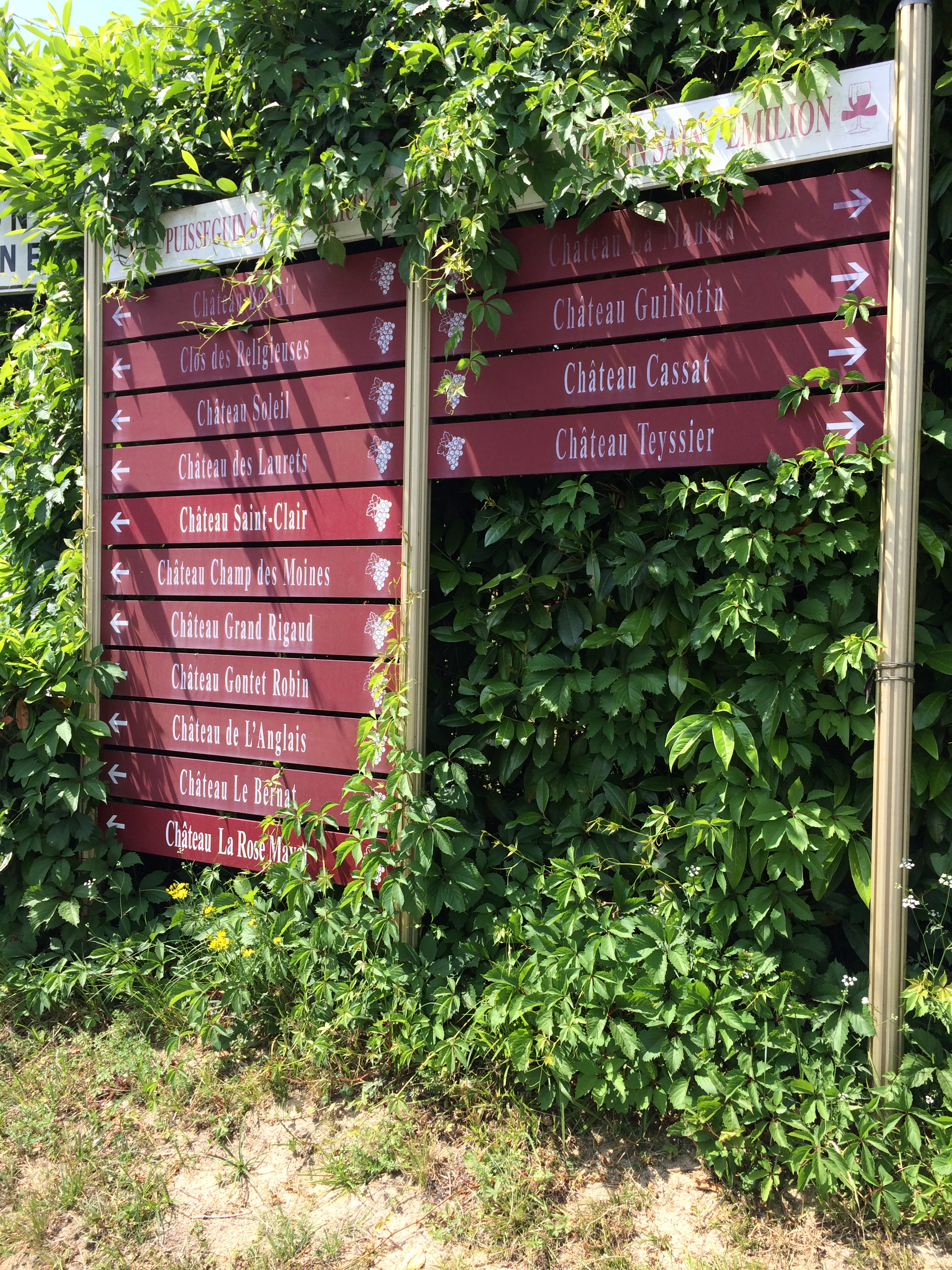
We come to a fork in the road where a sign points to 15 chateaux.
As we enter St Emilion, it’s immediately apparent that it’s a popular spot and the car park we’re directed to is nearly full. Judith makes sandwiches with the ‘baguettes tradition’ (the farmhouse type which looks like it’s better for you) we bought before leaving Menesterol, and the two slices of ham, half tomato and half avocado we have left in the fridge. We sit in the shade in a nearby park to eat them, joining a few other people doing the same and realizing as we’re doing this that we’re picking up the French habit of stopping wherever you are between midday and 1pm to have your lunch whatever it takes as this is absolument ‘de rigueur’. Another thing we realize is that the combination of baguette ‘tradition’ and mushy avocado and tomato isn’t a very happy one as the bread, while undoubtedly good for you, is chewier and thus results in some of the contents getting squeezed out and ending up where they weren’t intended to.
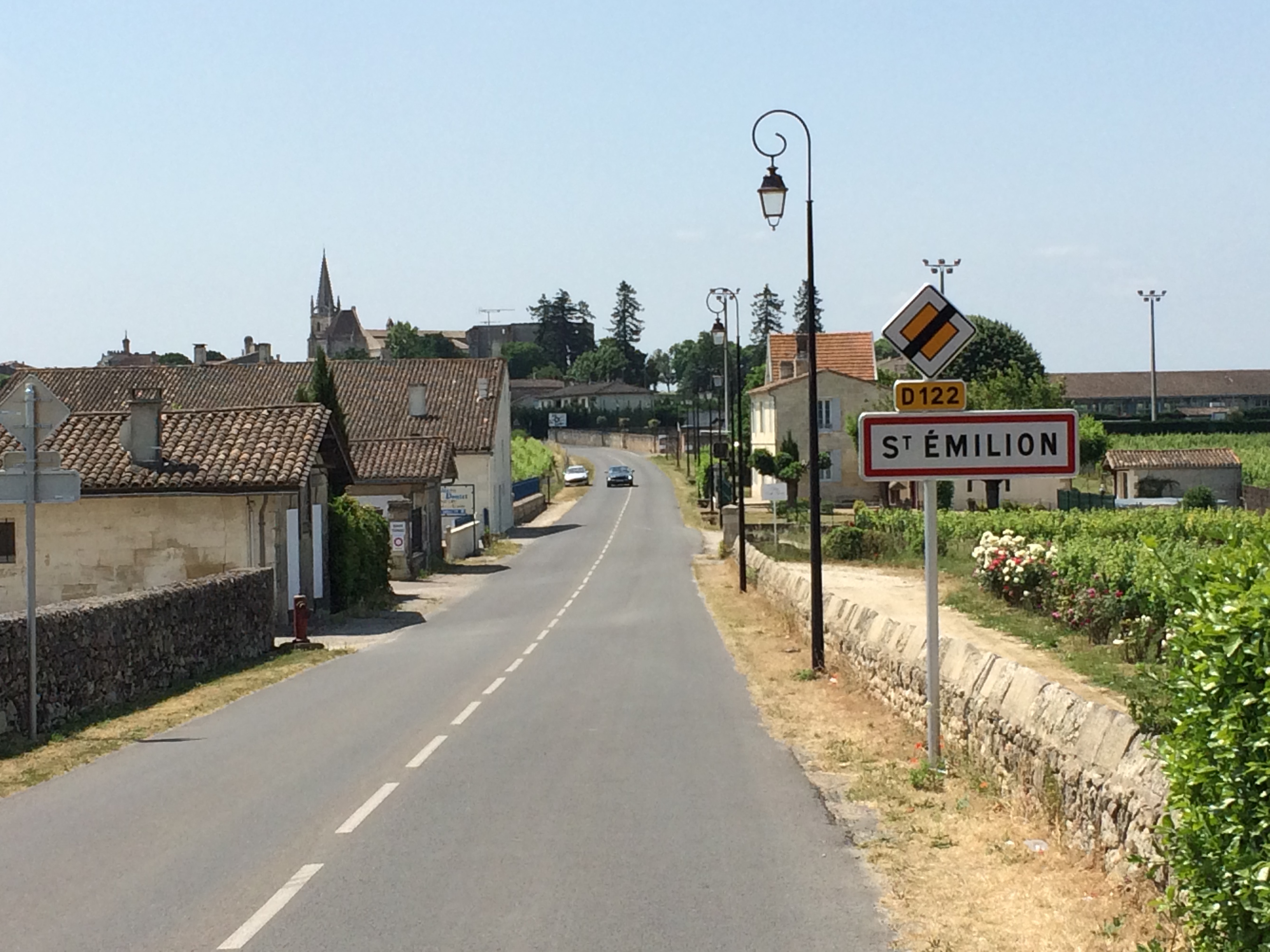
Arrival at St Emilion.

St Emilion rests on a limestone plateau. The stone contains a great many fossils dating back 32 million years!
Saint Emilion takes its name from a Breton monk who settled there in the 8th century and founded a monastic centre. The valley’s limestone-rich soil, enriched by the waters of the Dordogne and unique micro-climate turned the town and its surrounding 8 communes into a rich wine-producing ‘terroir’ or ‘Jurisdiction’ (created by the English Crown under the Anglo-Gascon Union!) In 1999, the cultural landscape of the communes comprising the Jurisdiction was listed as a World Heritage Site by UNESCO and the 100 or so winegrowers who currently make up the Jurisdiction still wear bright red robes on special occasions that look very ecclesiastical. Further proof of the traditional link between wine-growing and monasticism.
After seeing the cathedral, a wander into town soon takes us into the labyrinthine cobbled alleys or ‘tertres’ that make up the small town. Now we understood what the reference to ‘… des Tertres” was on those wine bottle labels. St Emilion has 4 cobbled tertres, each steeper and more potentially lethal than the other. No one we saw seemed to manage to handle them without difficulty, whether going up or down!

Wine cellars lining the cobbled ‘tertres’.

Steep cobbled alleys.

More steep alleys. Some women were taking their shoes off for a better grip.
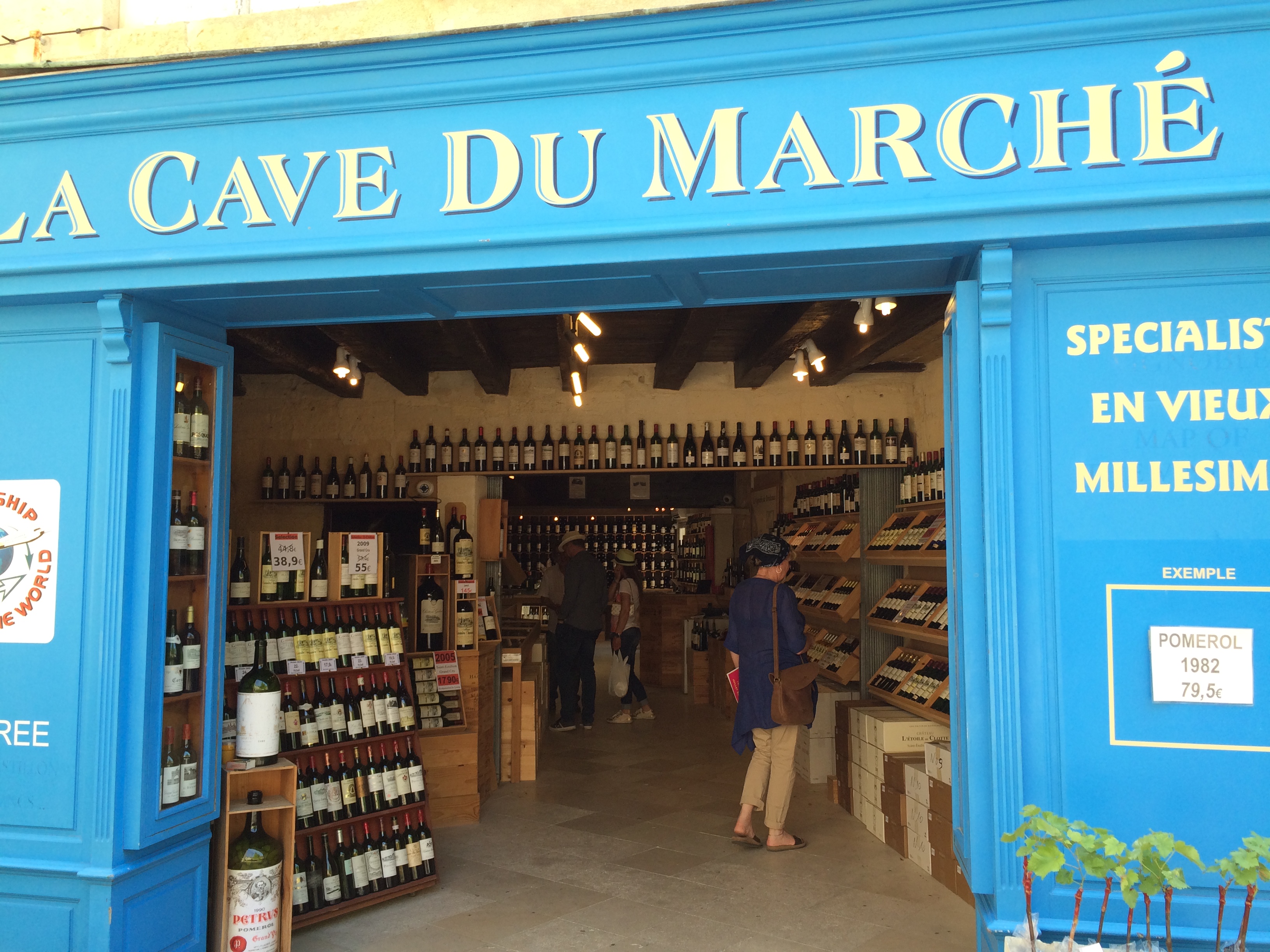
More ‘celliers’ and ‘caves’.
Lining the roads are wine merchants offering the best deals as well as the occasional cheese shop and restaurants. We are lured first by the dazzling array of cheeses in a formagerie and buy a heavenly semi-soft cheese infused with walnut liqueur by the local nuns as well as a small ‘chevre’ from the region. Opera music is playing in the shop – “I find it goes well with choosing cheese” says the owner who has the air of someone who’s wondering how long he can keep this lark up. I ask if it’s true that a Cornish cheese was actually voted the best cheese in the world, half expecting a physical assault. “Even if that’s true, no one has more cheeses than the French or the most widely eaten cheese in the world – the Conte.” How many exactly, I ask. “More than 500. Didn’t De Gaule say: “How can I govern a country that has more than 500 cheeses?”

Fantastic array of cheeses including the world’s favourite, the Conte.
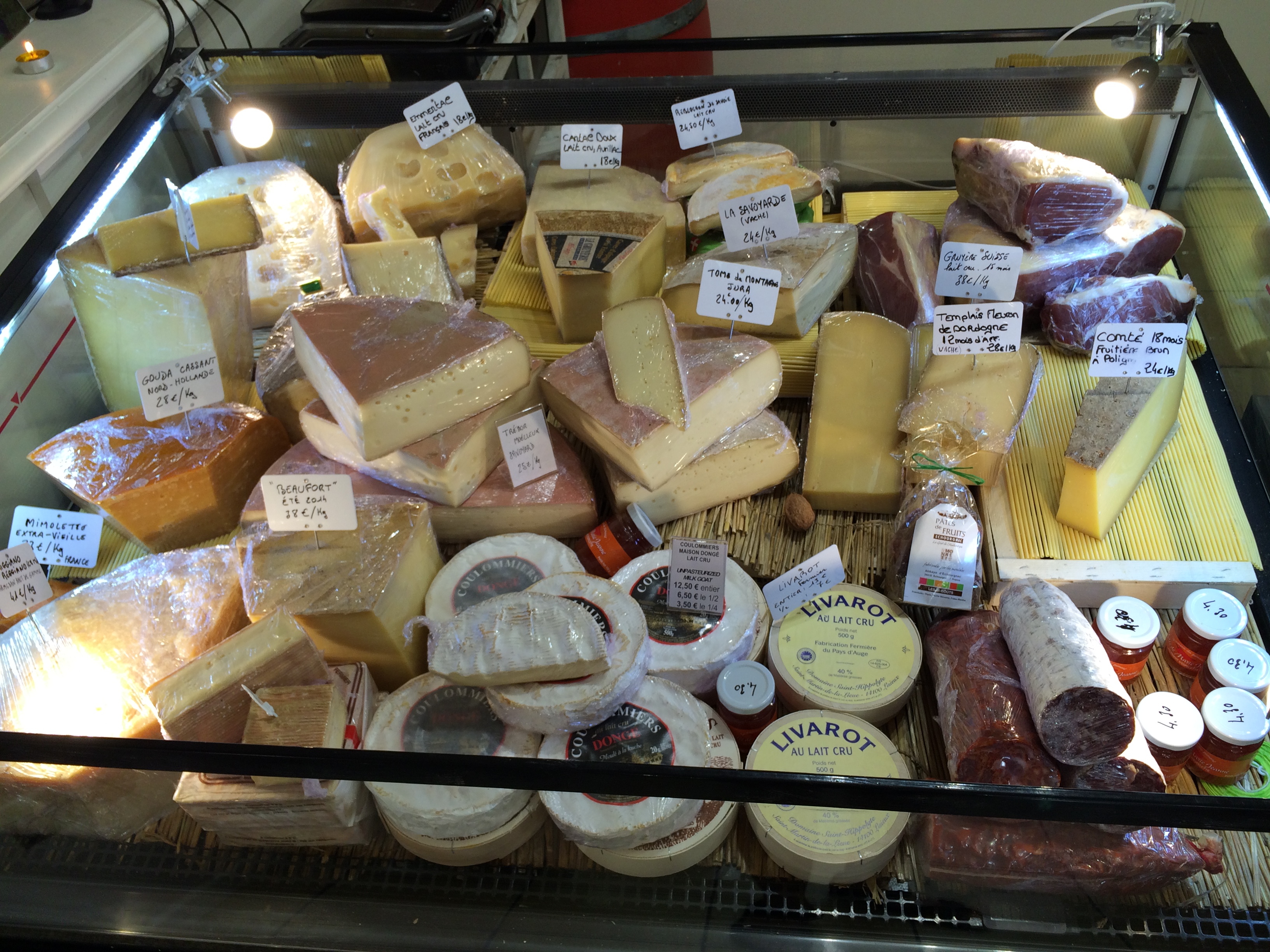
‘How can you govern a country that makes more than 500 cheeses?’
We then have to purchase our two obligatory bottles of St Emilion (2012 Chateau Les Cabannes with good balance but little structure, the young shop assistant admits, which makes it highly drinkable straight away). We also buy a half bottle of 2010 Chateau Loupiac dessert wine – not too ‘moelleux’ so can be drunk as an aperitif too.
On the way back to the car park, we take a quick look inside the wine museum and learn a bit more about the many stages that go into the making of wine including, most surprisingly towards the latter stages the addition of egg whites for the ‘lees’ (impuretes) to cling to and drop to the bottom.
Back at the car park we see a display of old French cars in the park where we’d eaten our sandwiches earlier. They appear to be there for no other reason than for the sheer pleasure of seeing people admire them. Ah, c’est ca etre Francais!

A display of vintage cars – for the sheer pleasure of it! “On aime tout ce qui est beau et c’est tout”.

Remnants of the old walls at St Emilion.
We make our way to Bergerac which we were attracted to by photos we saw of it and arrive at the Camping La Pelouse right on the bank of the Dordogne across the river from the old town and the local rowing club. Once again, it’s another beautiful spot but with more people this time, mainly Dutch it appears. As soon as we’ve freshened up, we take a stroll along the bank of the river then over the bridge and into old Bergerac. We’re instantly entranced by the magnificent and well-preserved Elizabethan buildings, and so many of them. The old quarter is like a museum.

Bergerac – the old medieval town.
We decide to have an aperitif and are tempted by an ‘assiette de gourmandises’ which turns out to be mainly the local delicacy – ‘geziers’ or duck/goose gizzards with some foie gras and chevre on toast. We try a few but find the geziers a little too rich or ‘ecoeurants’ for our taste.
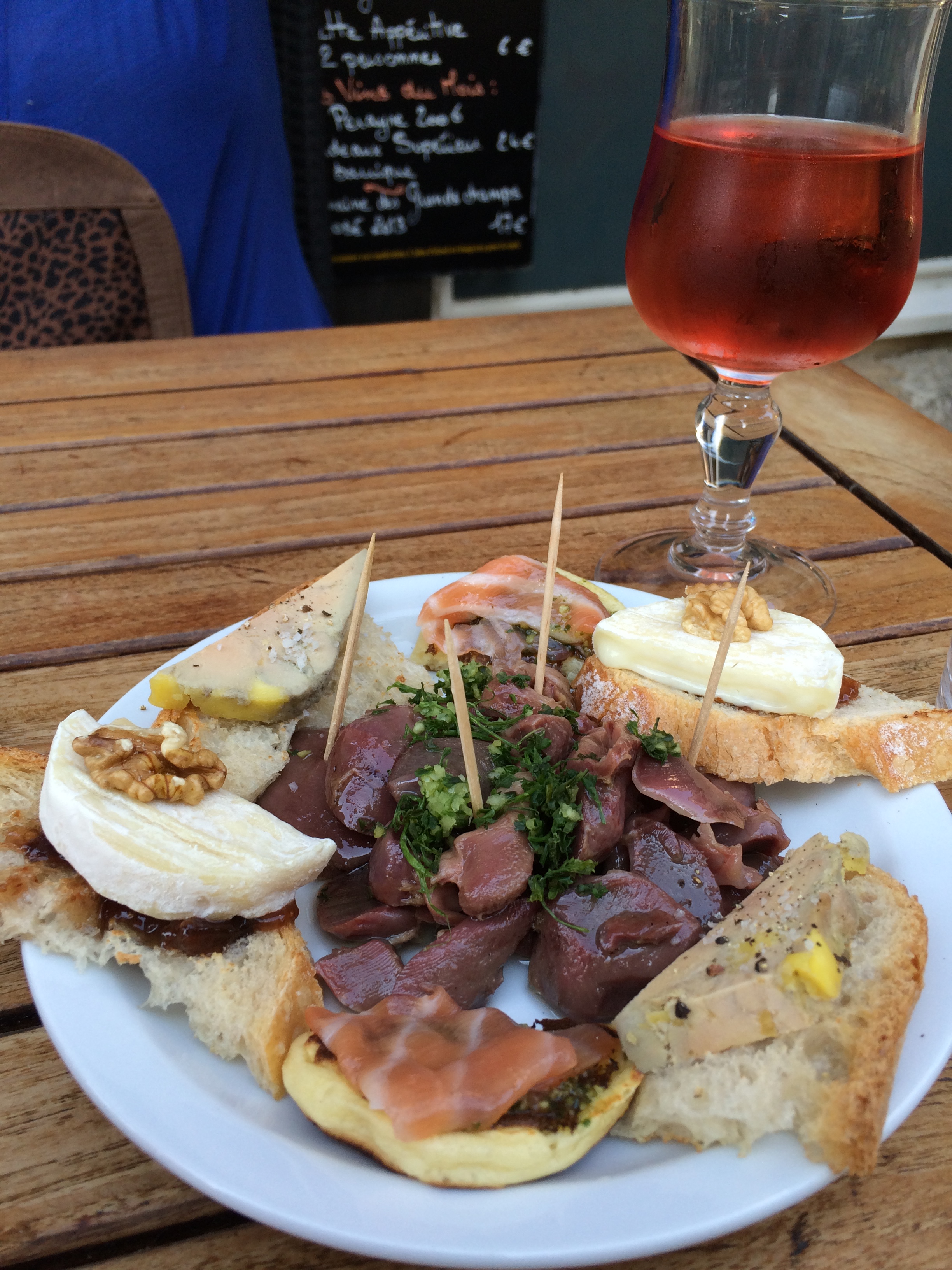
Dish of local appetizers including ‘geziers’ which we weren’t too keen on.
Impossible to avoid also were the two statues of Cyrano de Bergerac, the brash poet, musician and duelist plagued by self-doubt because of his large nose and immortalized in Edmond Rostand’s play which is a fictionalized version of his life. There’s again something very French about an at once dazzling and talented as well as self-doubting and unattractive man being revered as a hero. Without him we wouldn’t have had the word ‘panache’.
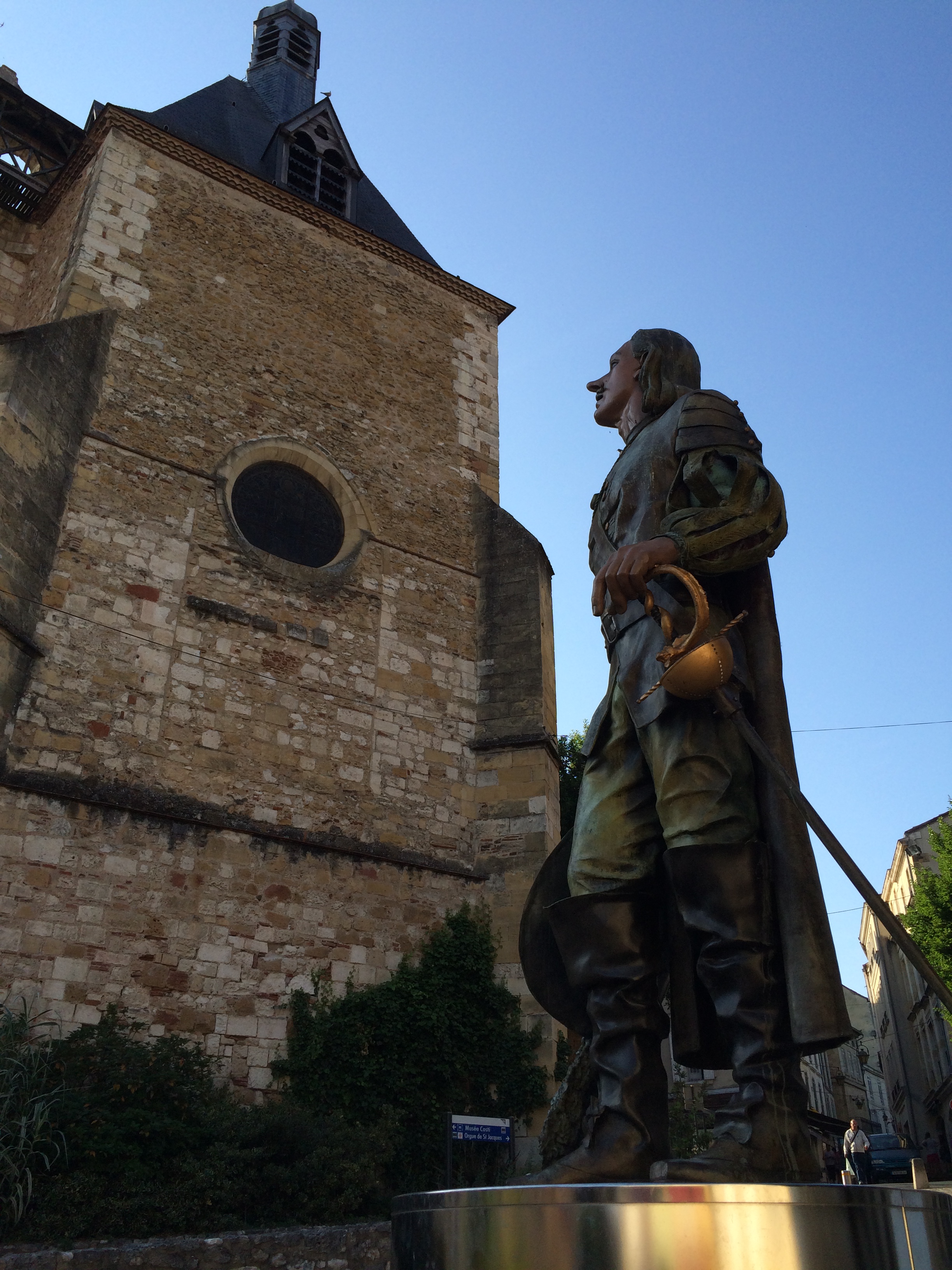
Cyrano de Bergerac – local hero.
On the way back to the campsite, a large and noisy motorcade is crossing the bridge blowing their horn, ululating and waving Algerian flags. We smile and wave. It looks slightly incongruous but is another aspect of ‘La Nouvelle France’.

The beautiful bridge over the Dordogne at Bergerac.
 Travels with our van
I really enjoyed that, I look forward to the next instalment.
LikeLike
Hi Jane, really nice to hear from you and thanks very much for your encouraging comments, which are appreciated and badly needed as it’s tough sometimes. We overdid it slightly in Granada and had to book into a last minute cheap deal hotel in Seville to recover, which isn’t a bad place to do it in I suppose! We hope all is very well with you and look forward to seeing you when we’re back. lol,F&J
LikeLike
Flavio, the detail, enhanced by the photographs, is such that I really feel that I could follow your footsteps and enjoy the same pleasures and interests – thank you for jotting these and sharing them with us your readers.
LikeLike
That’s so kind of you Richard – you’re one of our most avid supporters and we appreciate it. All the best, F&J
LikeLike
Goose gizzards? In big hunks? I cook turkey gizzards and chop very finely for Thanksgiving dinner gravy, but i think you were smart to leave the goose on the plate. Thanks for all the news (not just the food). Enjoying it very much!
LikeLike
Thanks Bonnie. We’ve steered clear of the gizzards since! But anything fishy or seafoody, I’m going for!
LikeLike