We must confess straight away to the title here being a little misleading, because shamefully, we didn’t give Seville enough time. We were still feeling shattered from our exertions in Granada and our bad night in Olvera the night before and my back was playing up again – all I could think of was of finding somewhere comfortable and cool to lie down and rest my back. And, it was getting very hot.
On the way, we stopped briefly in the little town of Olvera to buy some bread. In the bakery, we’re tempted by some doughnut-like sugar-dusted pastries which we’re told are called ’empanadillas’ (little ’empanadas’). We buy four and have them later with a cup of tea – they’re quite tasty, if no doubt cholesterol-heavy. Olvera seems livelier than any other small town we’ve driven through so far and there’s an old fort at the top of the hill.

‘Empanadillas’ – tasty cinammon-flavoured little doughnuts.
Beyond Olvera, the road to Seville is fairly flat though around El Coronil we appear to be going through Teletubby land as Judith says as well as sunflower fields where the sunflowers oddly seem to be facing away from the sun and drooping downwards.
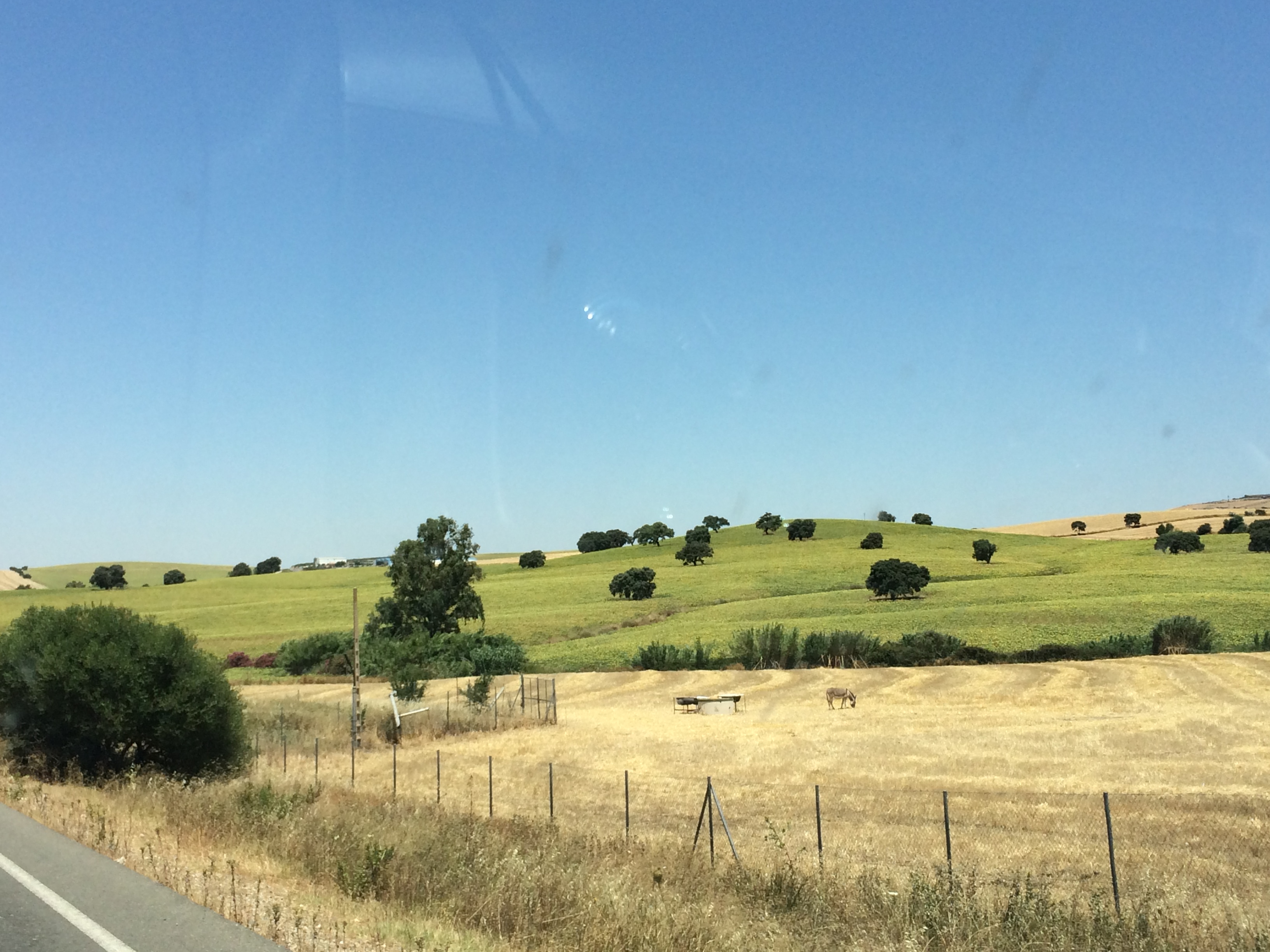
‘Teletubby’ land near El Coronil.

Sunflowers facing away from the sun.
There seemed to be no decent campsites in or around Seville. Judith found a good offer at the Andalusia Palace Hotel in a district of Seville called ‘Heliopolis’ – we clearly gravitate naturally towards Heliopolises – and by 5pm we had parked (abandoned?) Brenda round the corner and checked into the quite large, very busy and non-descript modern hotel.

The Andalus Palace Hotel in Heliopolis, Seviile.
Seville’s history follows a by now familiar pattern. It was an important river port for the Romans lying on the Rio Guadalquivir which was navigable to the Atlantic 80 kms away. In Muslim Spain, it was called ‘Ishbiliyyah’ and became the most important of the small Muslim kingdoms (‘taifas’) following the collapse of the Cordoba caliphate. For a time, the poet-king Al-Mutamid presided over a tolerant and hedonistic court in the Alcazar Palace. The strict Almohads took over in the 12th century and made Seville their capital. The city then fell to Fernando III of Castille in 1248. It thrived when it was granted the monopoly of all commerce with the Americas and in the 16th century became a rich and cosmopolitan city. Tragically, a plague hit the city in 1649 and killed half the inhabitants. The river also became silted up and Seville lost the trade with the Americas to Cadiz after which it fell into decline. In the 1980s it became the capital of the new autonomous region of Andalusia and the Expo 92 exhibition brought it millions of visitors. It’s now Spain’s 4th biggest city and has a varied economy based on tourism, commerce, technology and industry.
After a restorative 3-hour rest (and in Judith’s case, a refreshing dip in the pool), we summon our energies and take the bus into the centre of town to take a quick look around and for a bite to eat. It’s 9.30 by the time we arrive in the old and most touristic quarter of Santa Cruz and all we have time for is a short stroll to soak in the atmosphere. The entire area is sensibly pedestrianized with the exception of trams and splendid-looking horse and carriages with large bright yellow wheels, that look like something out of ‘Gone with the Wind’.
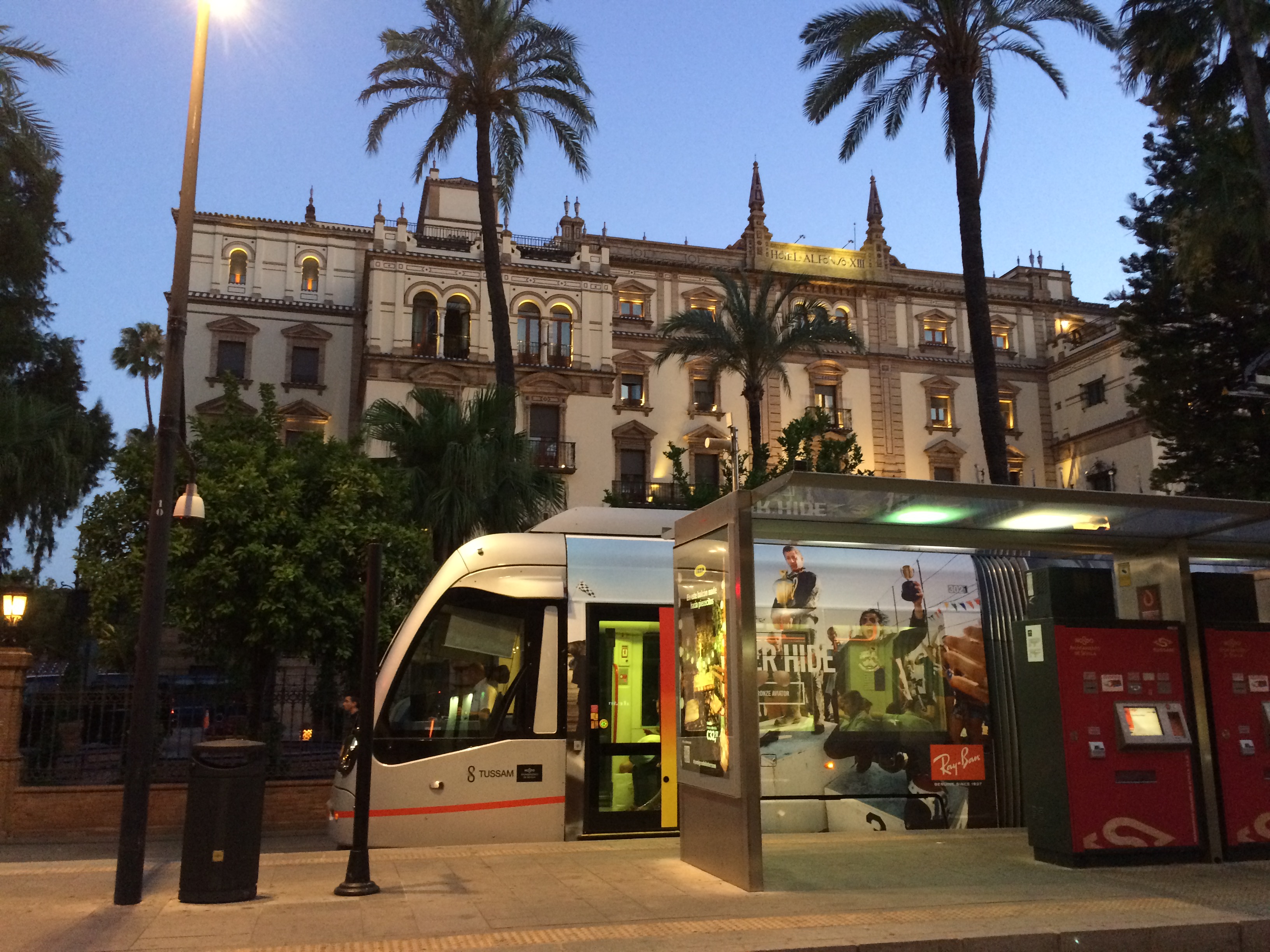
One of the grand palaces in the pedestrianized quarter of Santa Cruz plus tram.
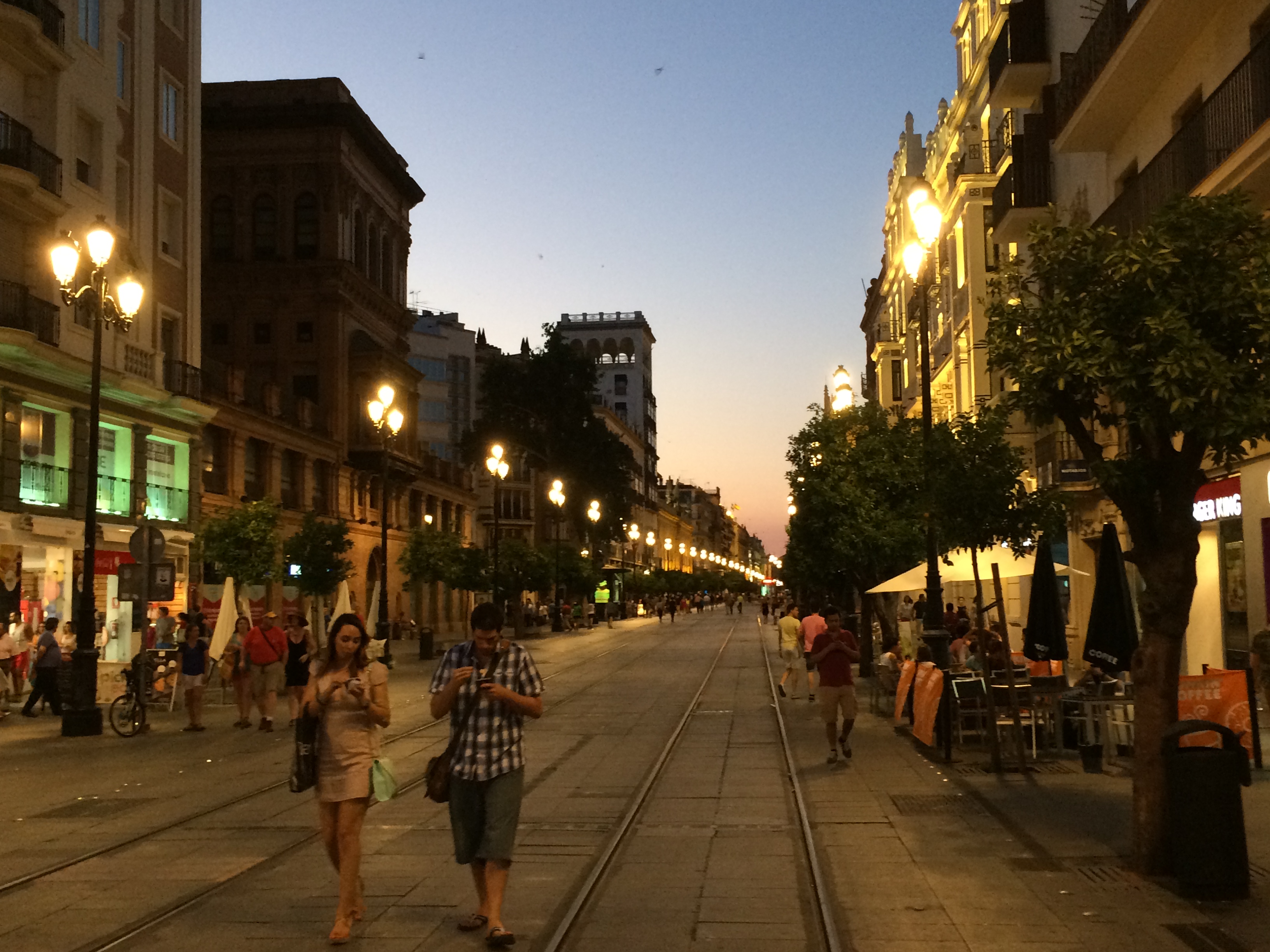
Pedestrianized quarter of Santa Cruz.

Horse-drawn carriages outside the ‘Archivo de Indias’, the administrative building that dealt with all commerce with the Americas.
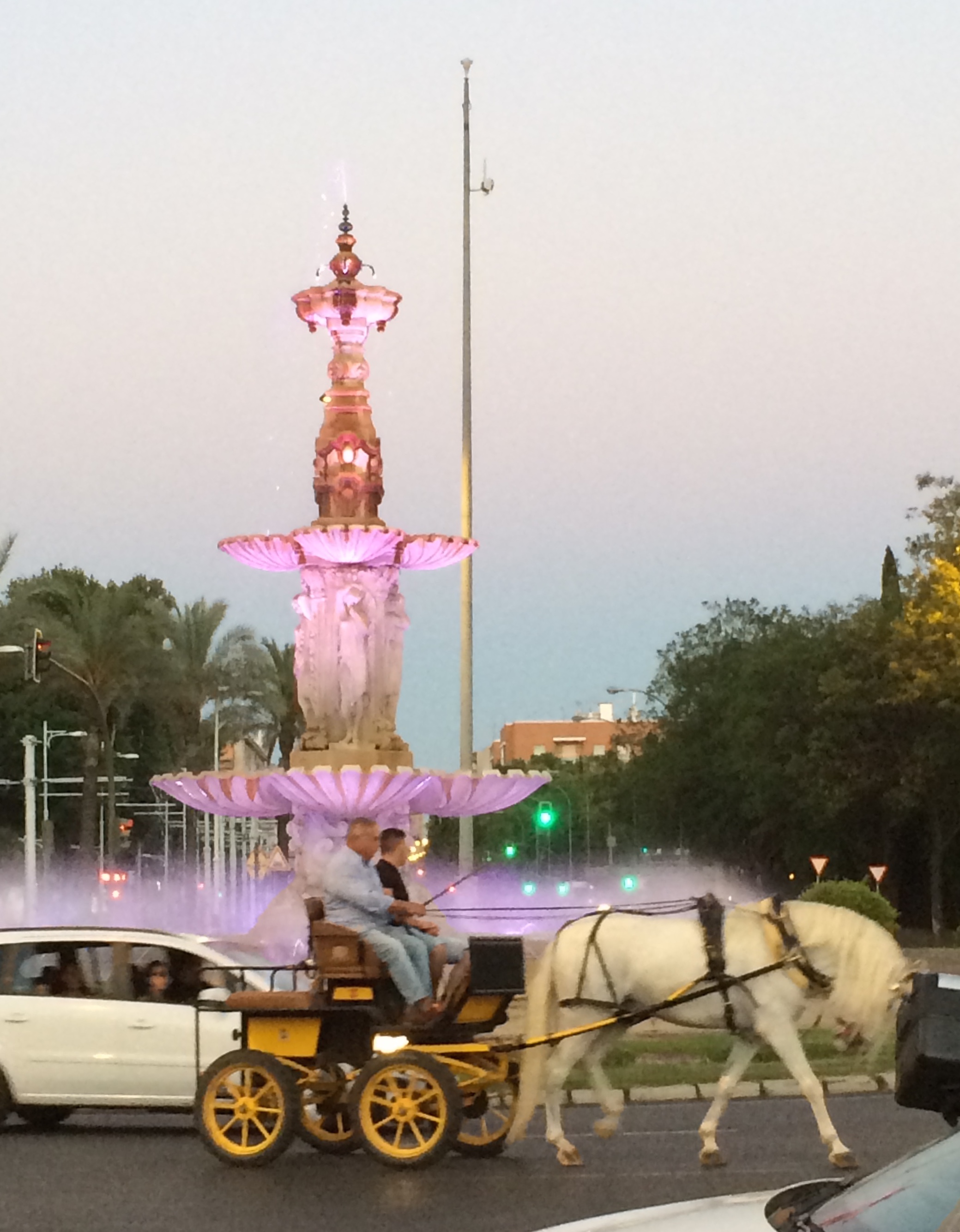
Pink fountain in Santa Cruz.
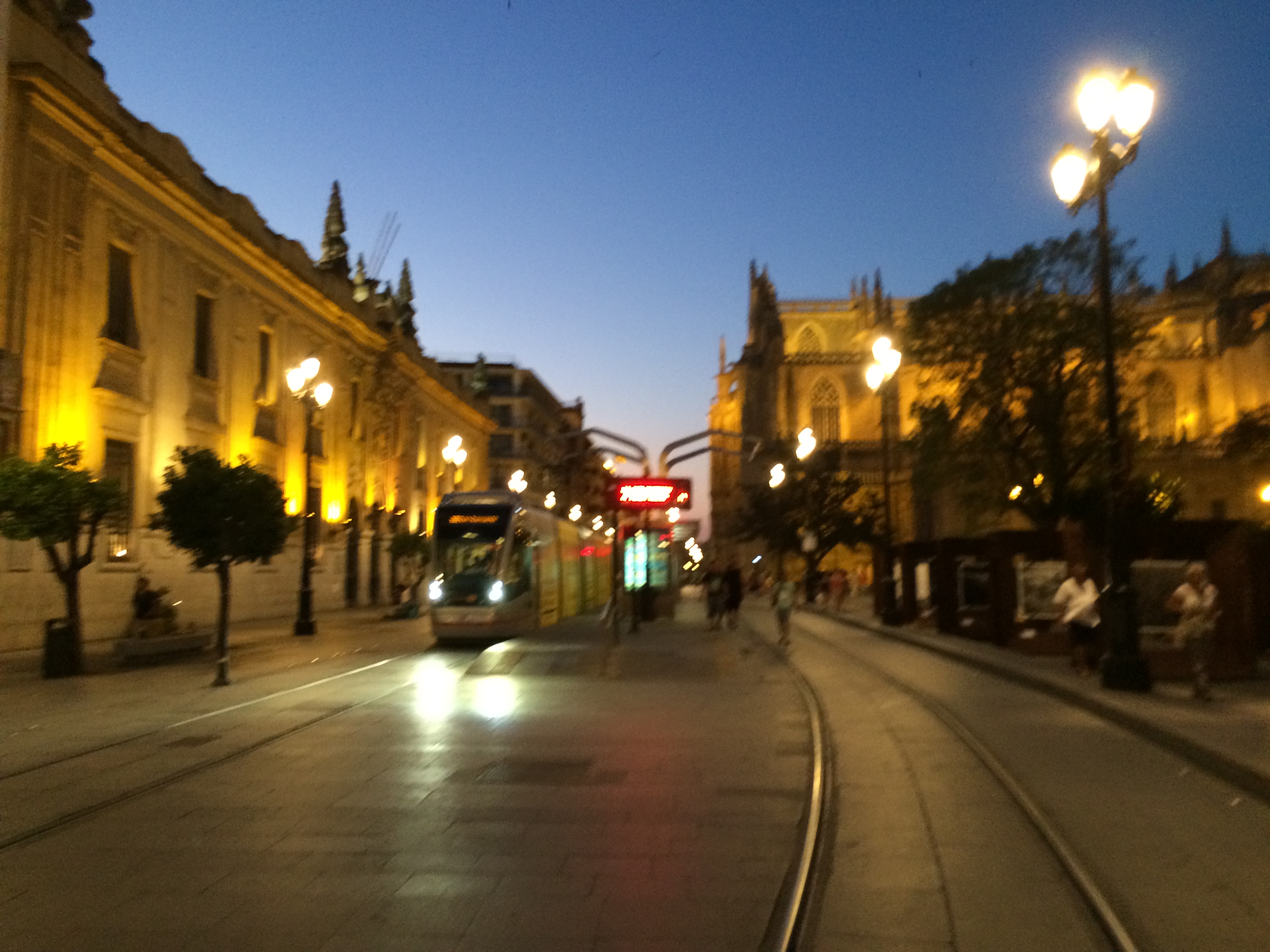
Santa Cruz.
We eventually move a little away from Santa Cruz and into a grid of narrow passages in neighbouring Arenal where we’d been told we’d find authentic Sevillian food. The place we plump for turns out to be a tapas restaurant which is fine as it’s already 10.30. The selection of cold and hot tapas is OK but not especially memorable, the mackerel and tomatoes and potato and aioli probably being the tastiest but the white verdejo at least is from the Seville area and very refreshing.

The district of Arenal.

Tapas in Arenal, Seville.
As we make our way back at 11.30 it looks like the evening is just getting started. The restaurants are full, the noise levels are rising and the eating and drinking is in full flow. Here and there, someone’s playing a guitar. We wait at the bus stop for our bus back to the hotel and realize just across the road is the Arena del Toro, the Royal Bullring, which seems slightly surreal – so they really do exist!


The Royal Bullring of Seville.
Seville is certainly a lively, vibrant city and a larger metropolis than we’d expected it to be. It is touristic, but it’s also a place full of joie de vivre, as we imagine all Spanish cities are at night.
As we left the next morning after an excellent café and croissant, which in Seville they put a light sugar glaze on top of, we drove past the port and it also brought home to us what a busy commercial hub Seville is as well, which again, is something we hadn’t expected.
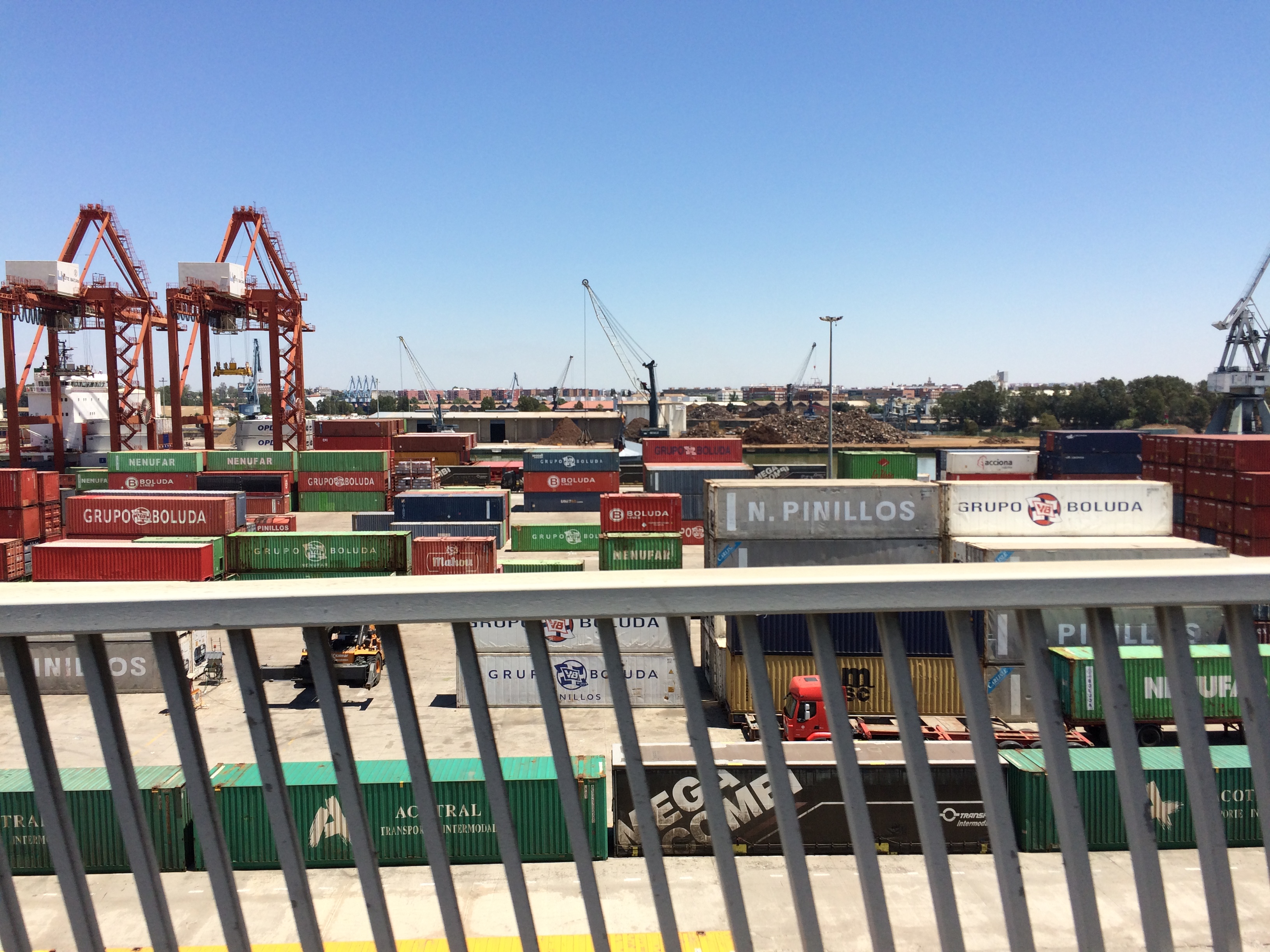
Seville is Spain’s only river port and its 4th biggest city.

Much-needed sustenance before hitting the road again.
 Travels with our van
Odd about the sunflowers turning their backs on the sun. But again, I can again imagine the experiences you’ve been going through (although glad that I don’t have those back problems – hope you’re relieved of them now, Flavio).
LikeLike
Thanks very much Richard. Yes back much better now but I think it might have something to do with the fact that i’m not doing regular exercise and my muscles are not as toned up. That combined with the long periods in the driving seat and the hard bed. I must discipline myself to do gentle exercises on a daily basis – I just feel a bit self-conscious on campsites where people are often cheek by jowl! Best, F.
LikeLike
Rather belatedly catching up on your blog – lovely to read it, am making mental note of places I must see. I’ve never ‘done’ Granada or Seville despite numerous visits to Spain and wanting to explore the Moorish heritage more deeply. Guadalquivir means El Wadi El Kebir; any Guad is a Wadi…
LikeLike
Thanks Suzi. Good to hear from you. We didn’t give Seville enough time as you will have noticed. Spoke to a French camper afterwards who also told us the palace at Cordoba is more impressive than anything in either Granada or Seville so we’re sorry to have missed that too – will have to be for a future occasion! He also said Salamanca is very worth visiting – we hadn’t thought of it at all. Thanks for the interesting note about derivations from Arabic. We were also told there’s something people say in both Spain and Portugal that’s very similar to insha’allah. And interested to see the word for exit or departure in Portuguese was ‘saida’ – from ‘saada’, to go up? I’m sure there are a lot more. Hope all well with you all.
LikeLike