After climbing a gentle hill above the Alentejo plain, we arrive at the town of Evora, where we were staying for the night, at the very comfortable Orbitur Campismo (one of a chain and very well-run).
Evora was a Celtic settlement before becoming an important centre of Roman Iberia. It declined under the Visigoths (them again!) but flourished as a centre of trade under the Moors – at which time it was called Yabura. It enjoyed a golden age in the 14th-16th centuries, became an archbishopric and and got its own Jesuit university. It was plundered by French forces in 1808 and suffered another decline which ironically protected its fine old medieval centre from development. Its population today is smaller than it was then.
It’s now one of Portugal’s most beautifully-preserved medieval towns. The 14th century walls surround narrow lanes, an elaborate medieval cathedral and cloister, columns of the Templo Romano and a pretty town square – the Praca do Giraldo, which witnessed some gruesome scenes during the Inquisition.
It’s now a lively university town again and the restaurants serve Alentajan specialities.
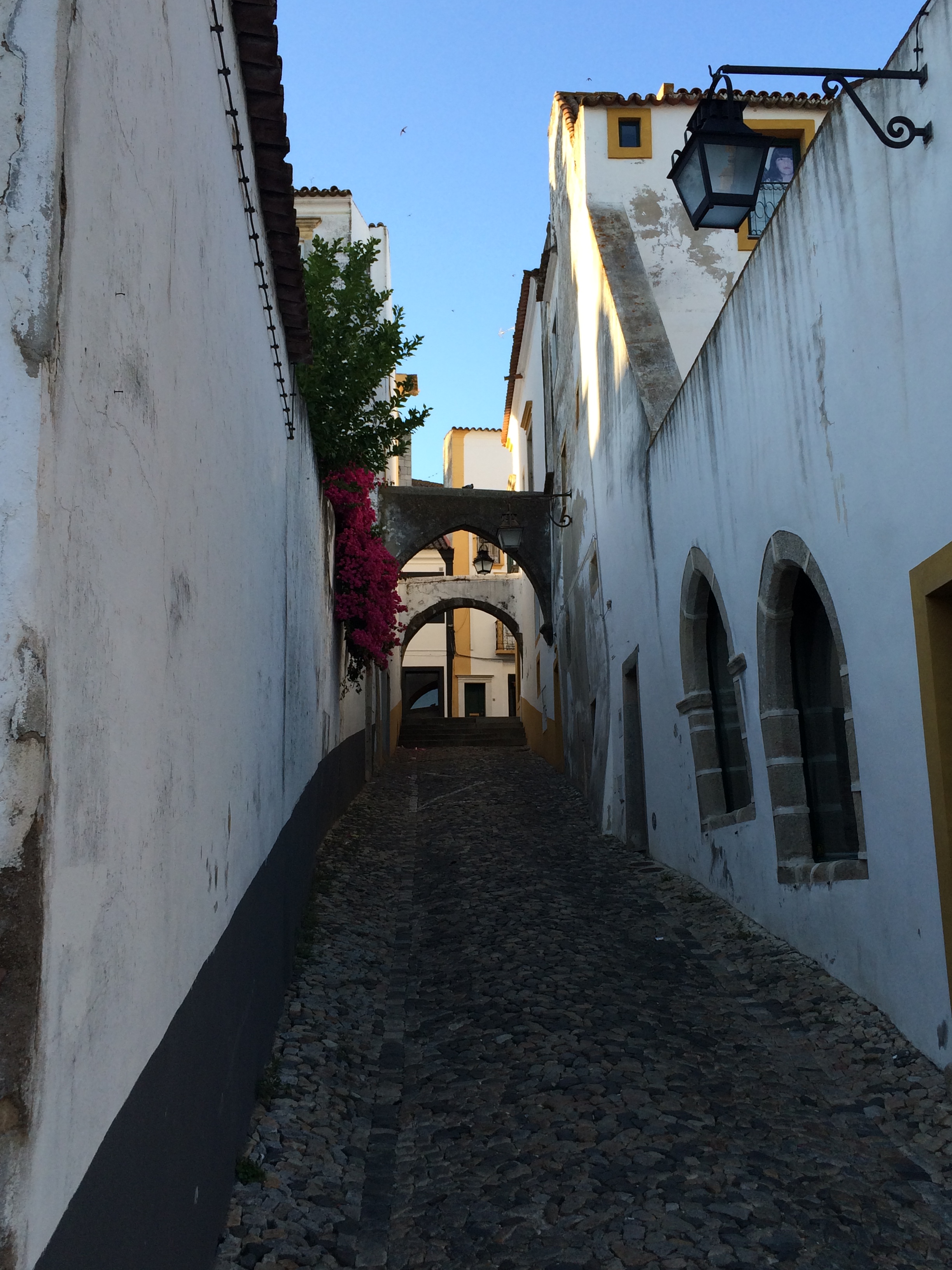
Narrow medieval winding lanes.

The medieval Se e Sao Pedro Cathedral and cloisters in Evora.
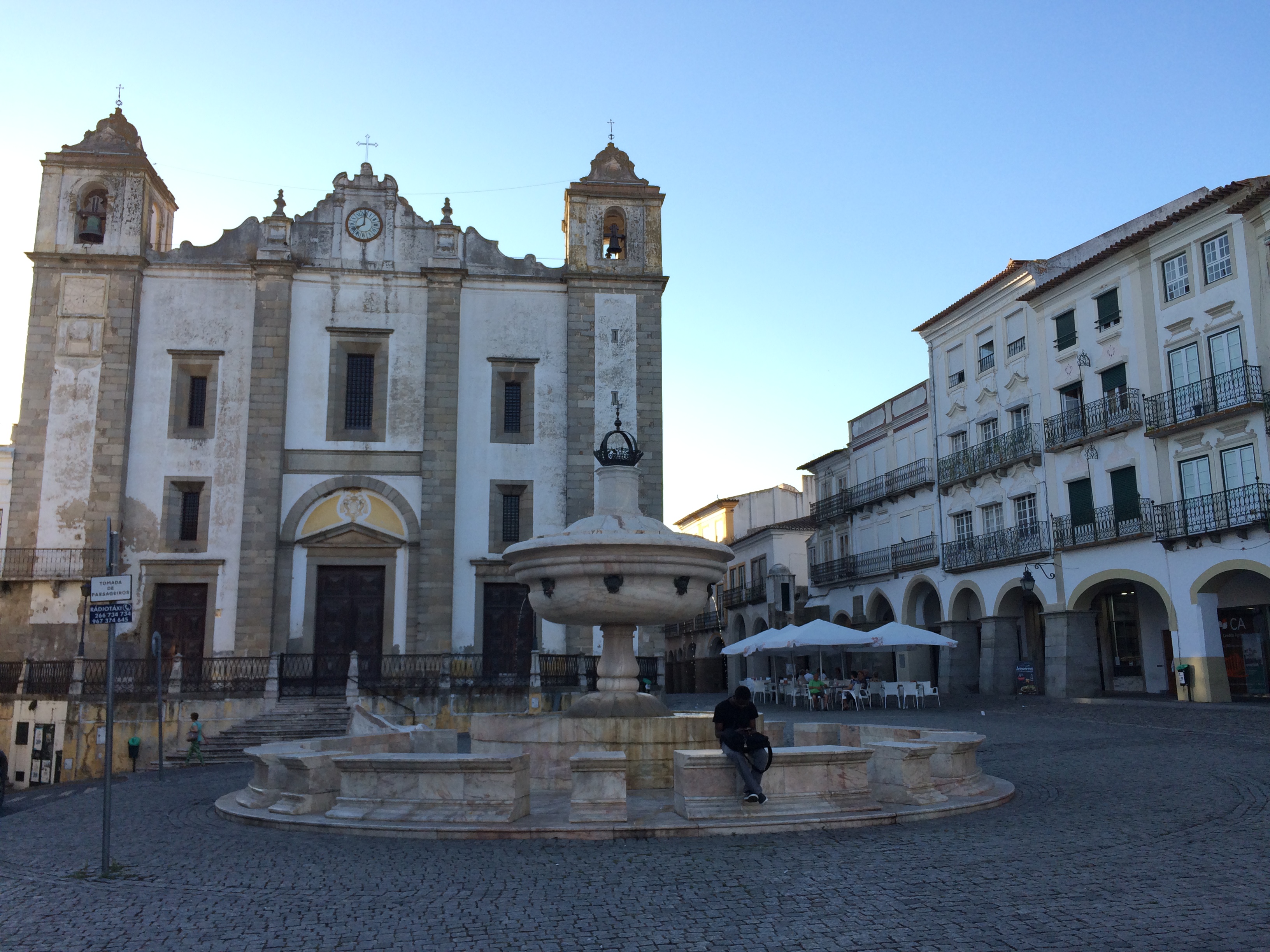
Despite its beauty, the Praca de Giraldo was once the site of gruesome events during the Inquisition.

The medieval town square – Praca do Giraldo – with the ‘Agencia do Banco de Portugal in the background.

Remnants of the columns of the Templo Romano – Evora became an important centre for the Romans.
The town is not too far from the campsite so we cycle into town for a ‘shufti’. A Fair is being held in honor of St Juan, the patron saint of this area so we cycle through but see nothing of particular interest so carry on climbing up the hill. We happen upon the old cathedral and convent which are closed. On the steps are gathered a group of young women full of youthful exuberance and laughter. No doubt students. We arrive at the large square (Praca do Giraldo) and have an aperitif. Our waiter is very sweet and doesn’t mind being quizzed. His name is Nunu Rafael Barbosa-…. (didn’t catch the second part of his double-barrelled name but he said it was traditional for everyone to have two Christian names and two surnames, from each side of the family). He was from Figuera, a large seaside town further north but had moved down to support his separated mother and 8 brothers and sisters (he was the eldest). The situation in Portugal had improved but was dire 2-3 years ago. There was no work, cafes and restaurants were closing and people were being thrown out into the street. He went to France to find work but 6 months later his friends said things had picked up. He didn’t complete his studies because he needed to work to support his mother and brothers and sisters. On his left forearm were two tatoos – on one side was Barbosa, his mother’s maiden name and the other, Claudia, his mother’s name. How sweet – what would be the chances of seeing such demonstrable devotion elsewhere?
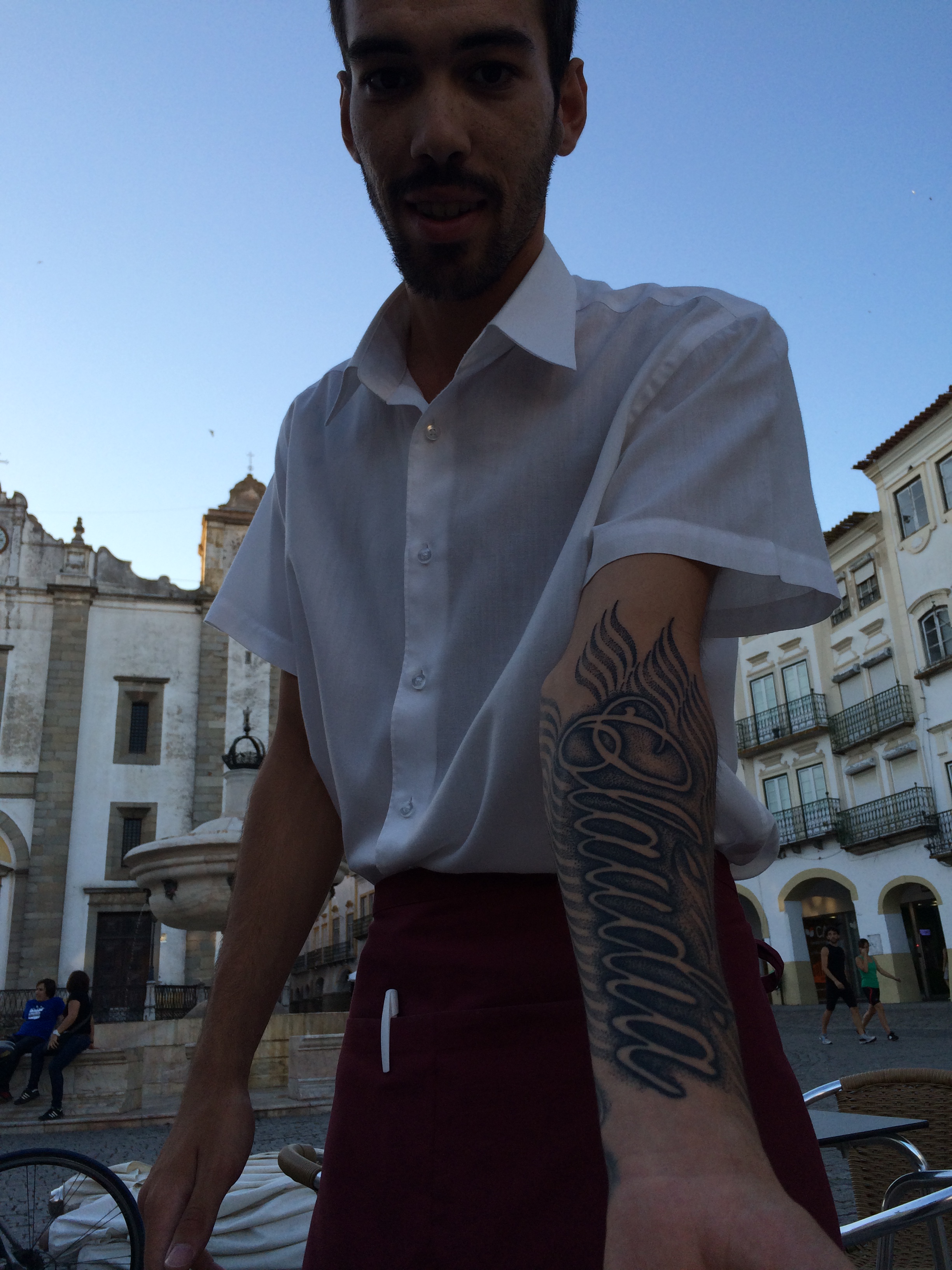
Nunu Rafael, with his mother’s name, Claudia, tattooed on his left arm.
After climbing higher up still to see the old Roman columns where the old baths once were, we wander around the old winding cobbled lanes and find a restaurant offering Alentejan cuisine. The Ebora Megalithica is charmingly hidden away and opens up onto a wonderful little inner courtyard. It’s staffed entirely by students who are now on their summer vacation. They’re extremely sweet and helpful. They’re both from the region. One is studying Landscape Engineering and the other Tourism and Hospitality. The special Alentejan roasted chicken is off as it was so popular so we go for the ‘Bacalhau a Gomes de Sa’, which is basically a fisherman’s pie but with lots of things added to it to make it much more tasty. As a starter we have antipasti that include ‘farinheira’, a dip that tastes a bit like hummus but is made with flour and ground sausage. We go for a red wine (a Syrah) from Alentejo called Monte Velho which is excellent.

The Alenteyan fisherman’s pie – ‘bacalhau a gomez de sa’.

Octopus salad and ‘farinheira’.
Next morning, the weather has turned a little overcast and quite cool, almost chilly. It’s not unwelcome though it’s cooler than I expected for my swim in the campsite’s impressive pool, which of course, I can’t resist.
We set off for our next destination in the Costa de Caparico on the outskirts of Lisbon, ready to spend a good day in Lisbon the next day. Brenda has only had one wash since we left almost exactly a month ago now and as we turn into a Brico-Marche for a gas-jar refill (they seem to last about 3 weeks) we take advantage of the jet-wash to give Brenda a good spray. A little apprehensively as the last time we did this in Bayonne it rained for a whole week practically non-stop.

Brenda gets her second jet-wash.

Coming back from the car wash, we spot a great little 2 CV.
The road to Lisbon again features the northern Alentejan plain, cork tree forests, the odd line of stork nests, some vineyards and olive groves. We pass through Montemor-o-Novo, Vendas Nova, Palmela, Corrojos and Almada (another name of obviously Arabic origin) until we arrive at the Campismo Orbitur on the other side of the mighty Rio Tejo that from here looks like the ocean.
When we arrive, it’s time for tea for two with the ubiquitous ‘pastel de nada’, very tasty Portuguese custard tarts made with flaky rather than shortcrust pastry.
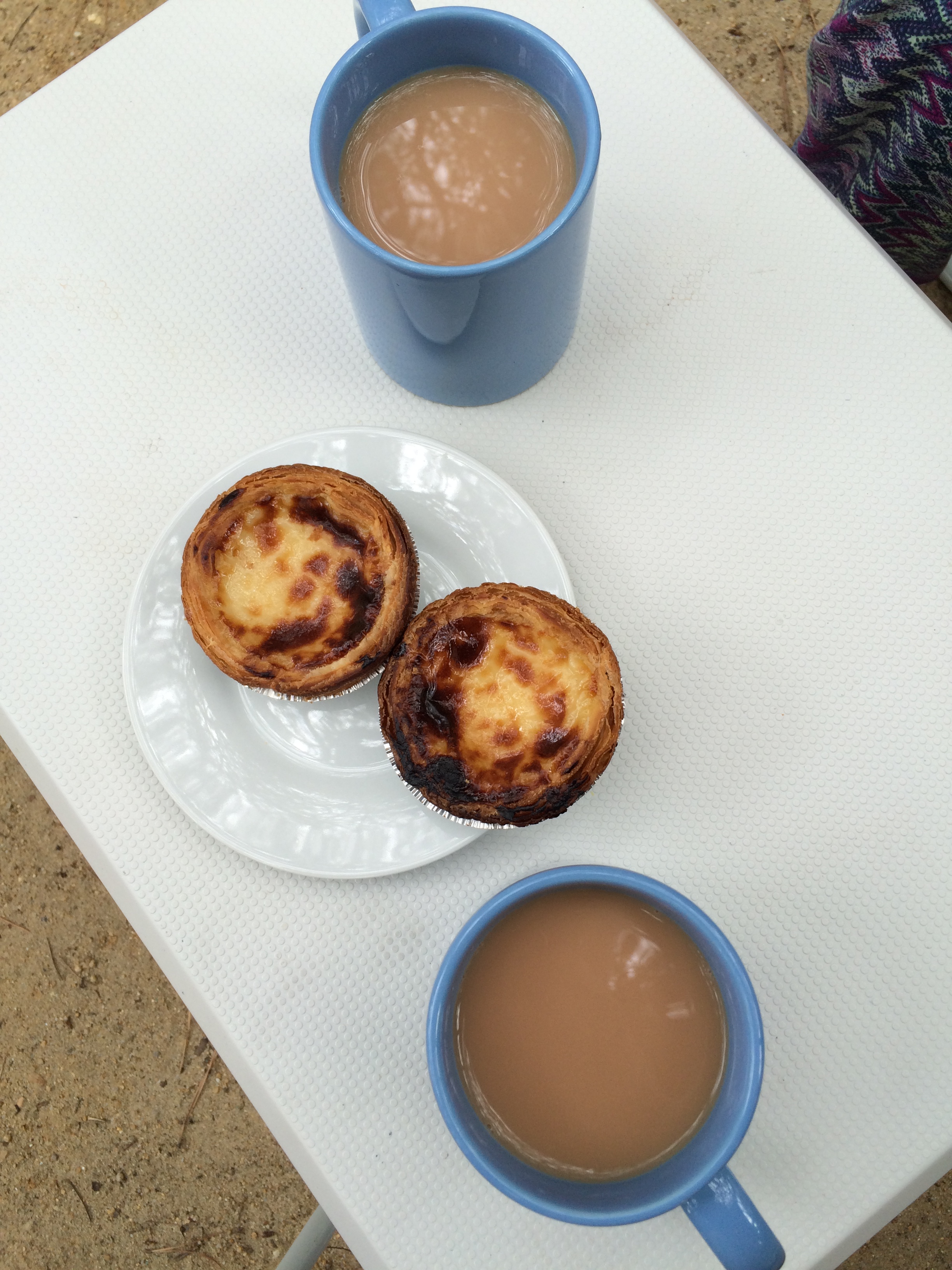
Tea and pastels de nata for two.
 Travels with our van
Another step of the journey, and such a mixture of past cultures resulting in the present heady mix.
LikeLike
Thanks Richard. It’s going to be difficult to distill everything we saw in Lisbon into something concise!
LikeLike