From our base in Costa Caparica, we readied ourselves for a day’s visit to Lisbon. Costa Caparica is on the other side of the vast inland sea that is the mouth of the Rio Tejo (Tagus), the longest river in the Iberian Peninsula. Including the bus ride to the ferry and a quick and efficient ferry crossing the whole journey took an hour or so.
What’s immediately obvious is why Lisbon is one of the world’s longest-founded cities and became so important. Its massive sheltered natural harbour made it an important seaport for trade between the Mediterranean Sea and northern Europe. Its proximity to southern and extreme western Europe as well as Africa and access to the Americas made it ideally placed for exploration and commerce. The waterfront is lined with miles of docks, wharfs and drydock facilities that can accommodate the largest oil tankers.

It was immediately obvious why Lisbon became such a strategic, rich and important city.
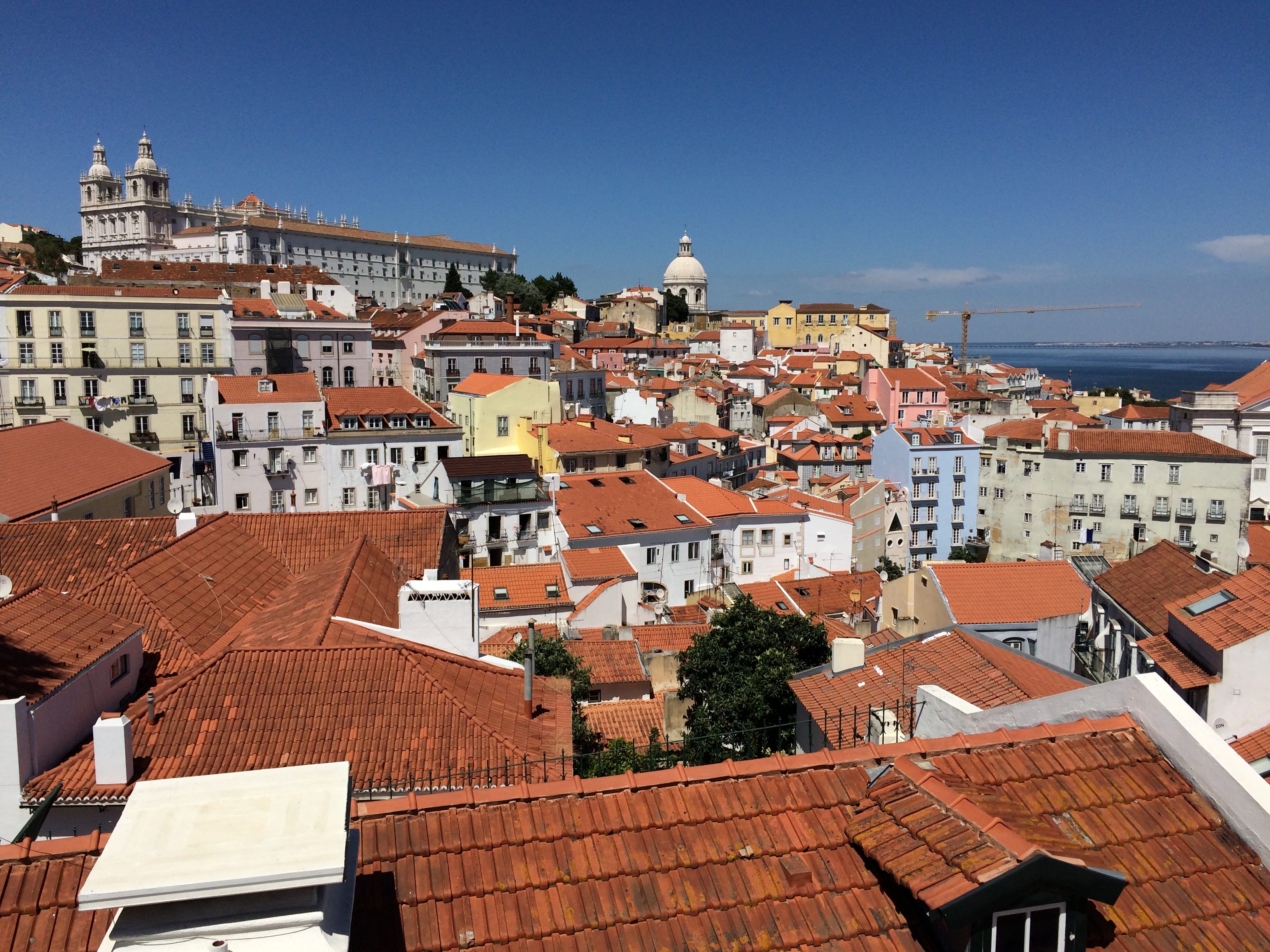
The enchanting city of Lisbon or “Allis Ubo” as the Phoenicians called it.
But what intrigued us was how a small country of c 90,000 square kms (roughly the size of Ireland if you include Northern Ireland), with a population of no more than 2 mil at the height of its power, could become such a great imperial power to rival Spain, England and France. It’s as if Ireland had become a great colonial power in the 15th and 16th centuries. It’s true Holland is smaller but it didn’t have anything like the reach and global spread throughout all continents that Portugal had.
Since early times, fishing and overseas trade have been Portugal’s main economic activity. But for centuries it was under the thumb of succeeding occupiers and was often ruled from neighbouring Leon or Galicia or Cordoba in Spain. It became an independent country under Alfonso I in 1128 but it was still not a powerful nation. But by the 15th and 16th centuries it became a leading European power which while not dominant in European affairs, had an extensive colonial trading empire.
The answer seems to lie with the genius of legendary figures like Prince Henry the Navigator, Nunu Alvares Pereira (hence our waiter’s name in Evora!), Vasco de Gama, Alfonso de Albuquerque and other visionary naval explorers. That coupled with Portugal’s strategic location and great advances in geographic, mathematical, scientific knowledge and above all, naval technology. All that combined therefore made Portugal a powerful ‘thalassocracy’ (from ‘thalassa’ meaning sea and ‘keratin’ meaning to rule) which enabled it to build up a vast empire in South America, Africa, Asia and Oceania.
It was the first to capture a foothold in Africa and bring back African gold from the Gold Coast bypassing Arab caravans in the Sahara. In 1499 Vasco de Gama discovered a route to India. In the next decade China, Japan, Madagascar, Goa, Ceylon and Mauritius were reached. In 1515, Portugal seized Hormuz and established relations with Persia. Did you know that in 1521 Portugal even captured and occupied Bahrain for 80 years?!
Portugal’s golden age of discovery lasted 2 centuries. But gradually, it lost wealth and status as the English, French and Dutch surrounded and conquered its widely scattered trading posts and territories.
It declined further after its defeat at Alcacer Quibir in Morocco in 1578 and was then was devastated by a terrible earthquake, fire and tsunami that destroyed a large part of Lisbon and killed a third of its inhabitants. It was weakened further during the Napoleonic wars and with the loss of its largest colony, Brazil, in 1822.
In 1910 a revolution deposed the monarchy. A military coup in 1926 installed a dictatorship that lasted until 1974, when it was ousted by a new government that brought in sweeping democratic reforms and granted independence to most remaining colonies in 1975.
But the fact remains that Portugal’s moment in history was in the 15th century and early 16th century. At a time when England was engaged in a bitter division between the houses of Lancaster and York and the persecution of heretics; when France was also drawn into the Hundred Years War and civil unrest between the Armagnacs and the Burgundians; and Spain had just started the Inquisition ordered by Ferdinand and Isabella, Portugal was developing ocean-going skills and starting a new age of discovery.
But like the Phoenicians before them who opened up the Mediterranean for the Romans after them, they were bound to eventually lose control of their colonies to more powerful and militarily ruthless powers. Clearly, that’s not to condone their or other colonialists’ plundering of the places and peoples they colonized of course!
We got off the ferry at Belem, a few kilometers south of the historic centre. The name is derived from Bethlehem and it’s historically very significant in itself as it was from here that Vasco de Gama set sail to discover the sea route to India and other naval expeditions left from. It therefore symbolizes the golden age of the Voyages of Discovery. It has for instance, the Mosteiro dos Jeronimo, the construction of which was ordered in honour of Vasco de Gama in 1501 and was completed a century later. Also the Padrao dos Descombrimento which commemorates the 500th anniversary of the death of Henry the Navigator. And the Belem Tower, a military outpost built to protect the Tagus estuary.
We stopped at the Pateis de Belem patisserie to try their famous pateis de Belem – very similar to the pateis de nata we’d had the day before but more creamy!
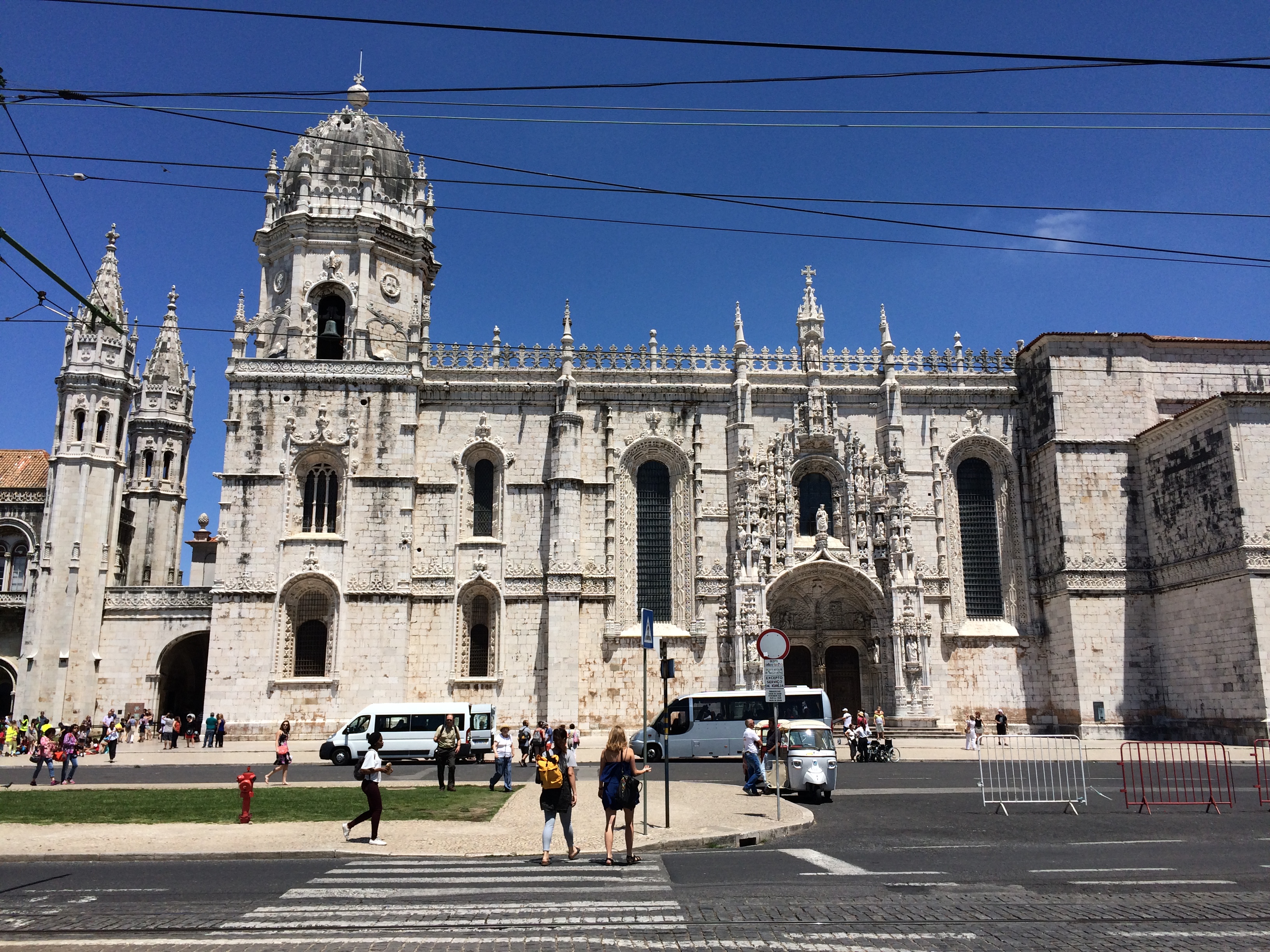
The Mosteiro dos Jeronimo in Belem.

The famous Pateis de Belem patisserie.

A large statue of Jesus overlooks the port of Belem arms outstretched protectively.
From Belem we took a modern tram into the centre of town and arrive in the main square where we’re advised by some French visitors to avoid the touristic restaurants and look instead in the side streets. This is exactly what we do and order what everyone else in the restaurant seems to be eating – a kind of mixed ‘pot-au-feu’ of lots of slightly overcooked different things, or a Portuguese stew. We were OK with the lean bits of meat and potato and cabbage but couldn’t quite handle everything on the plate.
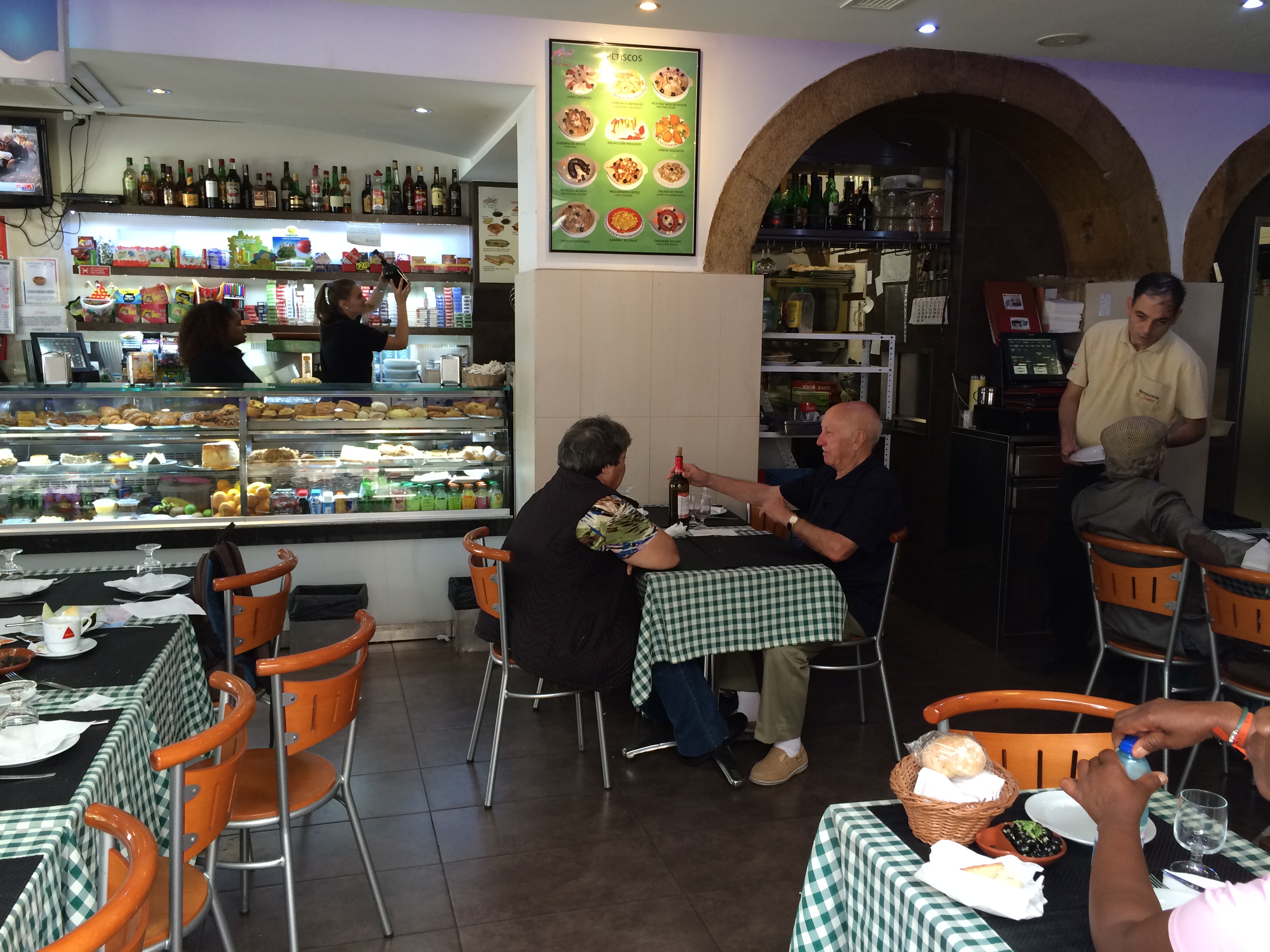
Little non-touristic restaurants in the side-streets are best, we were advised.

Portuguese ‘pot-au-feu’ – not entirely to our taste.
The Tourist Information kiosk in Belem had advised us to take the No 28 old tram that did a complete tour of the old centre. The queue for this was so long however that we decided to go for an alternative though more expensive tourist tram doing a similar tour.
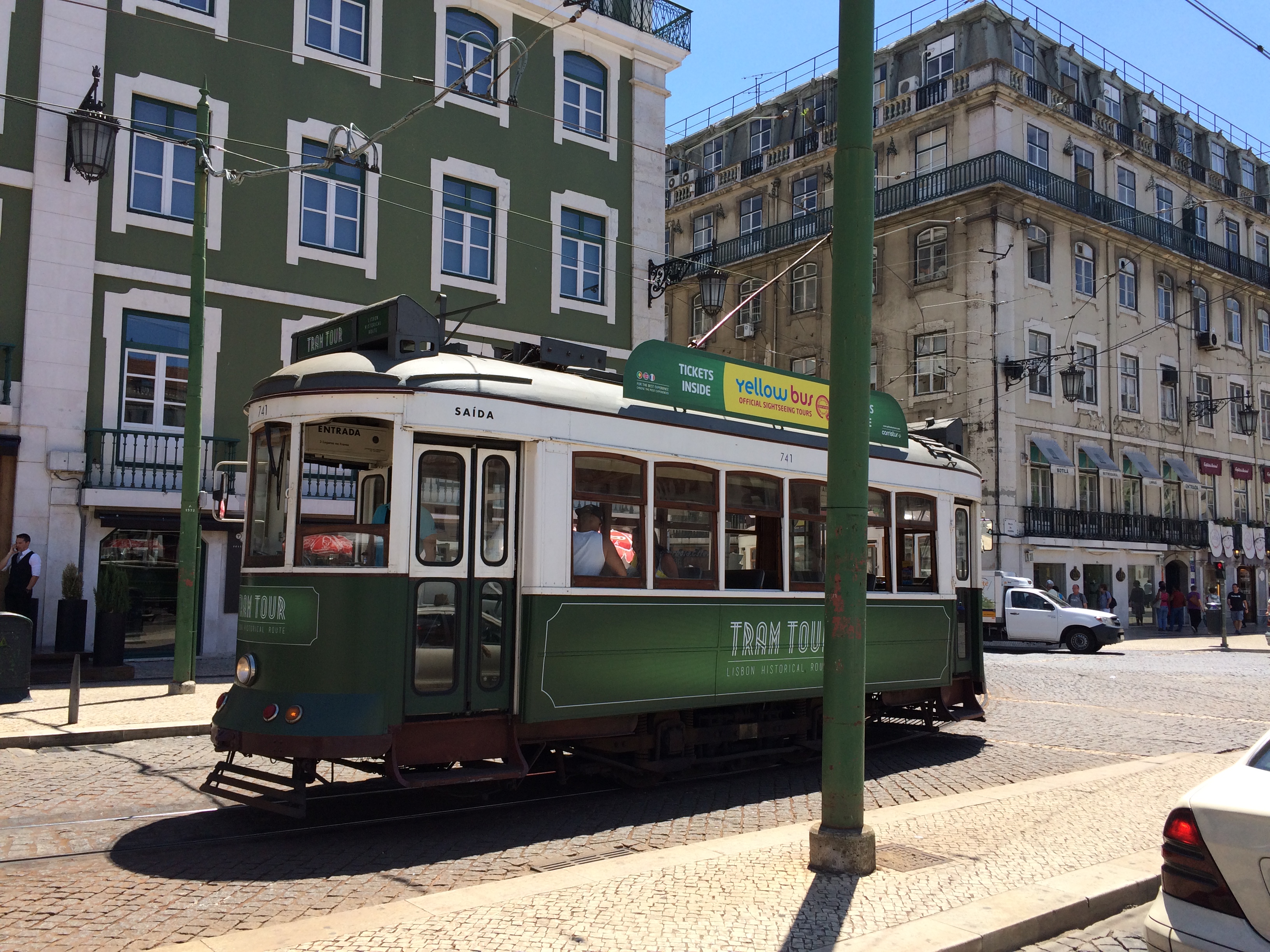
Taking one of the quaint old-style tramcars is the most exciting way to see the old town.
It’s hard to believe how these tramcars have survived labouring up and down the hilly narrow roads in fierce competition with every other road user.
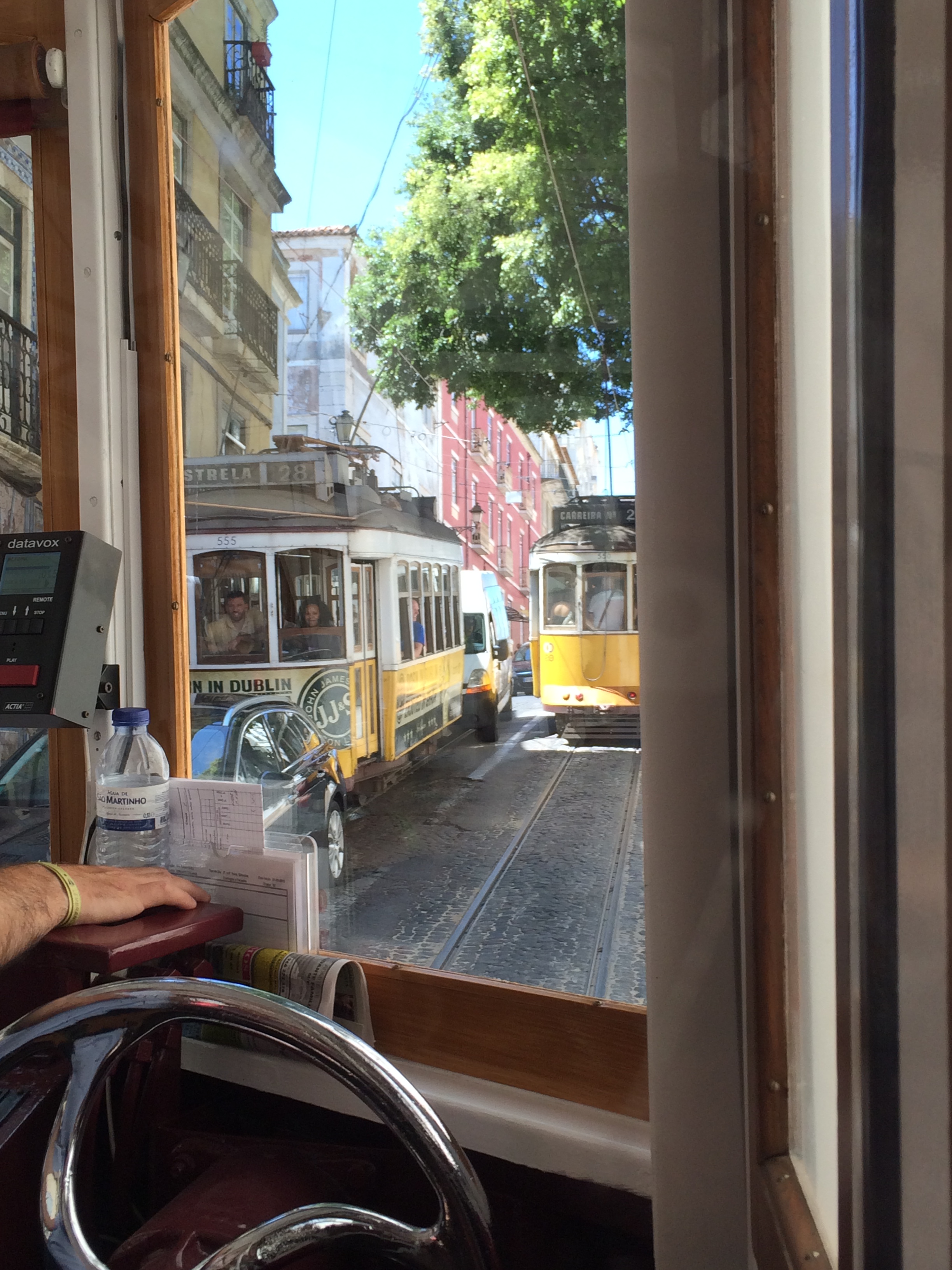
Hard to believe how these old tram cars have survived in modern Lisbon – they are in fact fighting for survival.
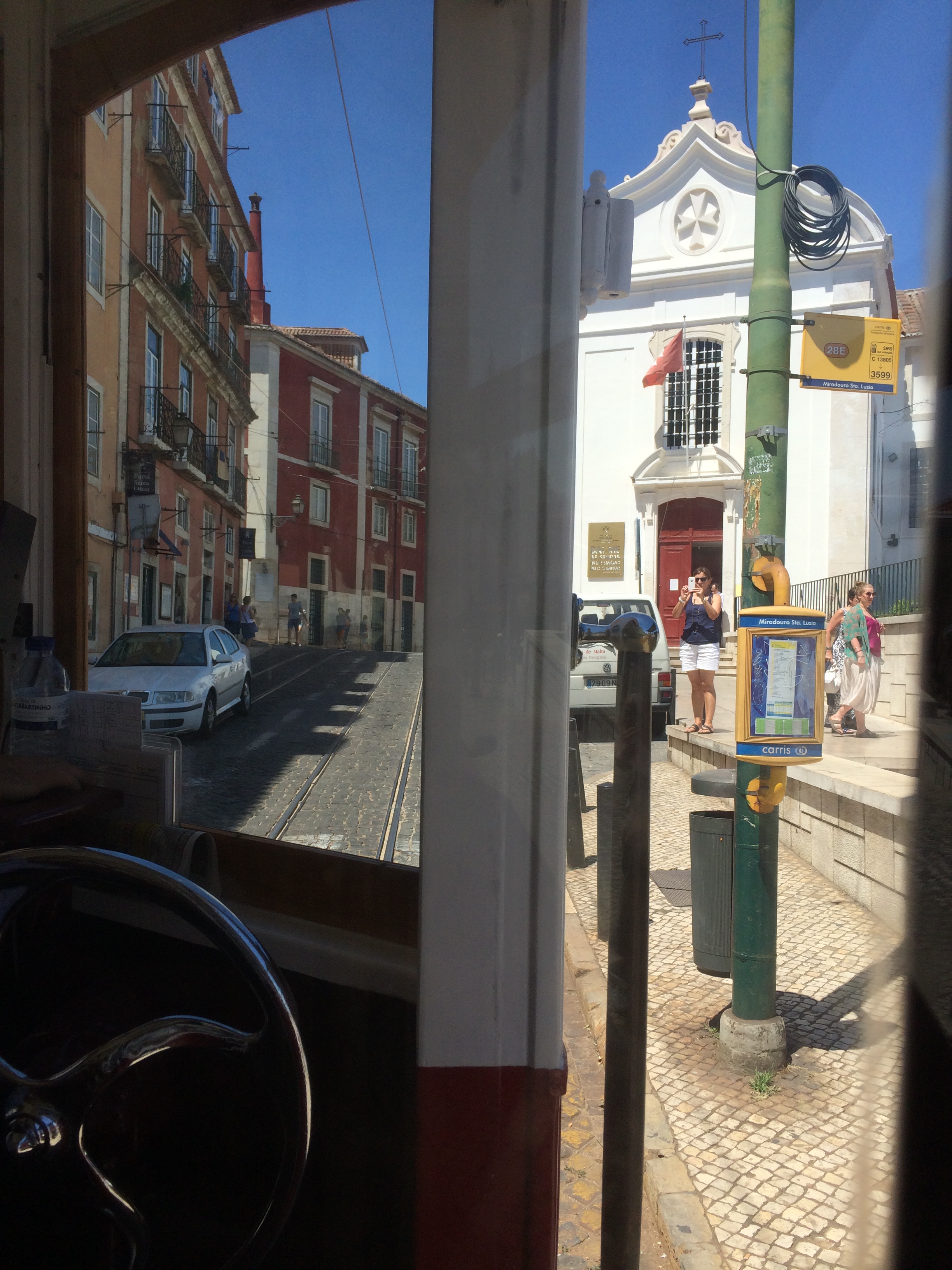
The drivers are superbly skilled.
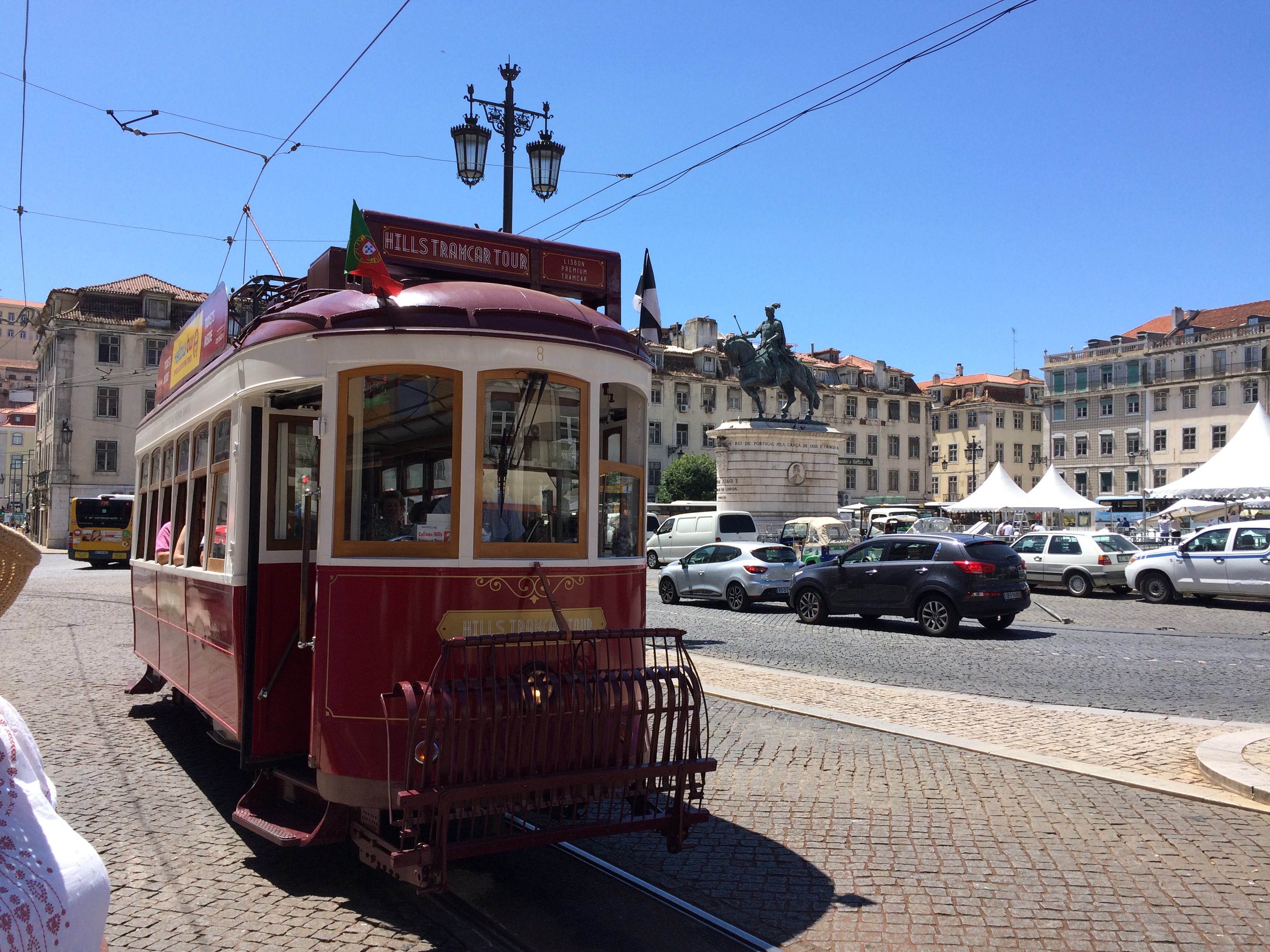
The old tams have become emblematic of Lisbon and are all part of its irresistible charm.
We reach a high point on our tramcar tour where we can’t resist getting off. It’s Sao Miguel square from which you can stand on a terrace giving a magnificent view of the old city, with the colourful and popular Alfama quarter below and the cathedral and pantheon in the distance. On the square is a statue of the benevolent figure of St Vincent, the patron saint of Lisbon. We pay a seller from Monte Verde to take some photos of us.

The magnificent view of Lisbon from Sao Miguel.
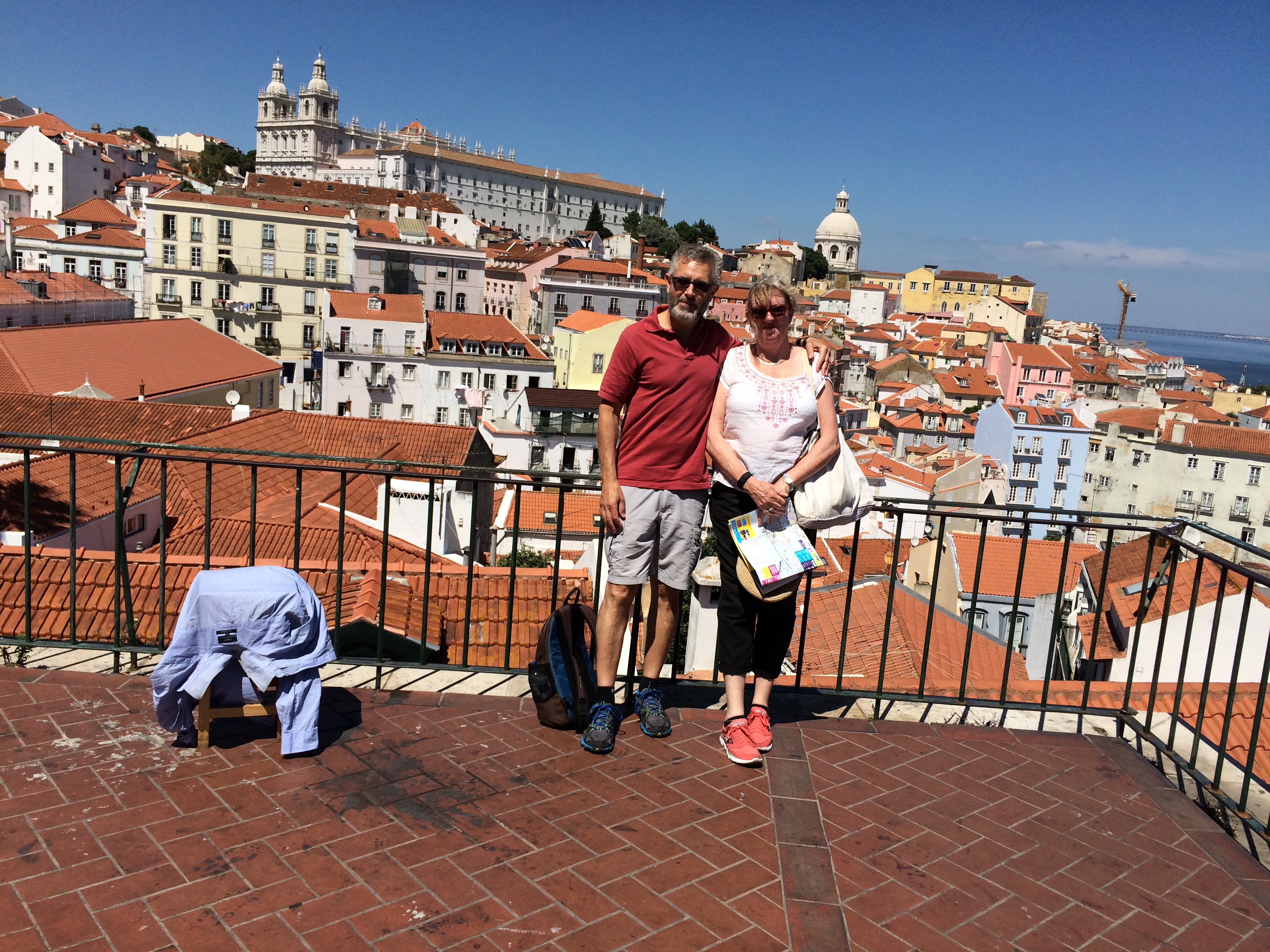
A seller of iPhone selfie holders kindly takes a photo.
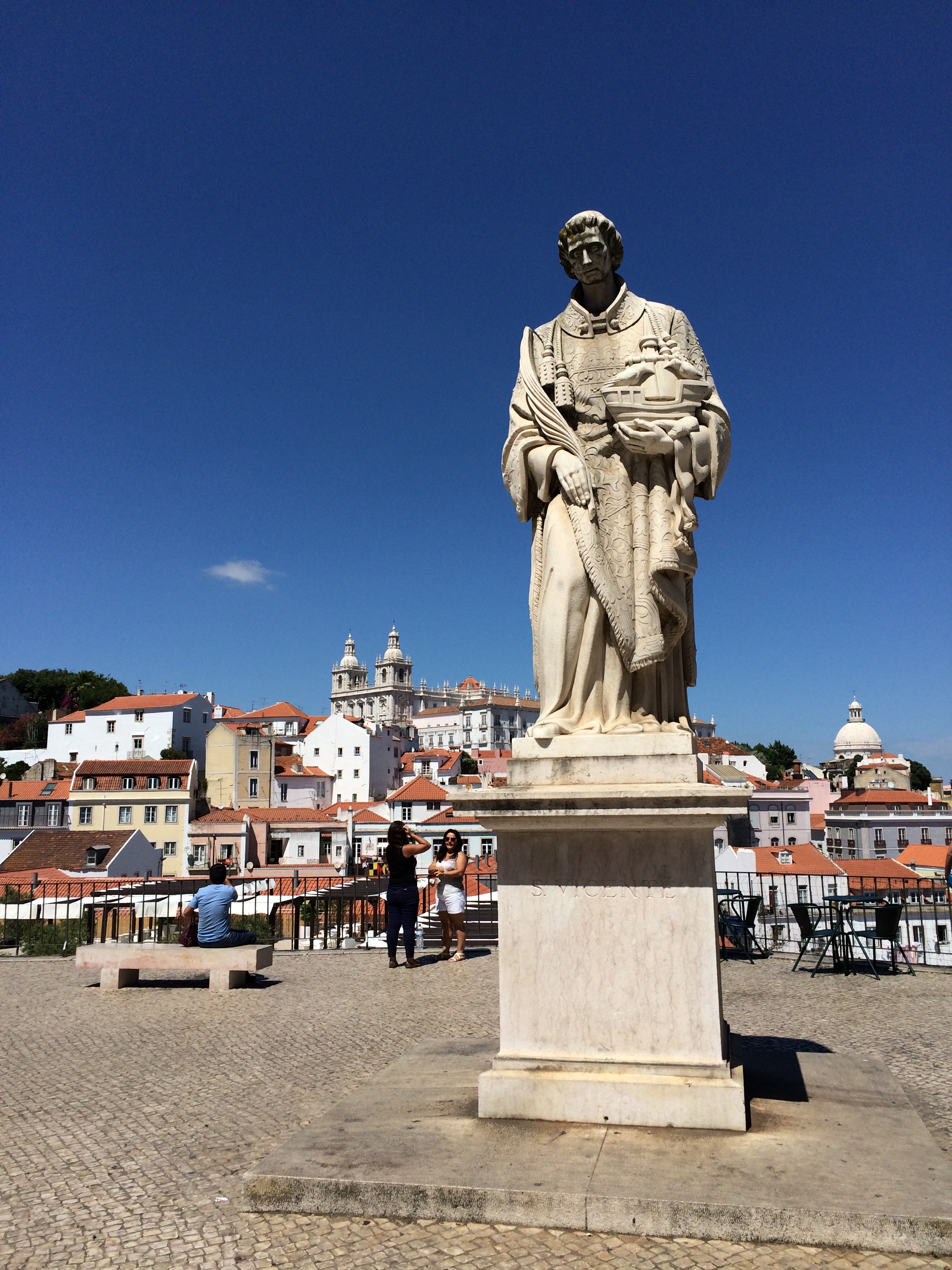
The benevolent figure of St Vincent, Lisbon’s patron saint.
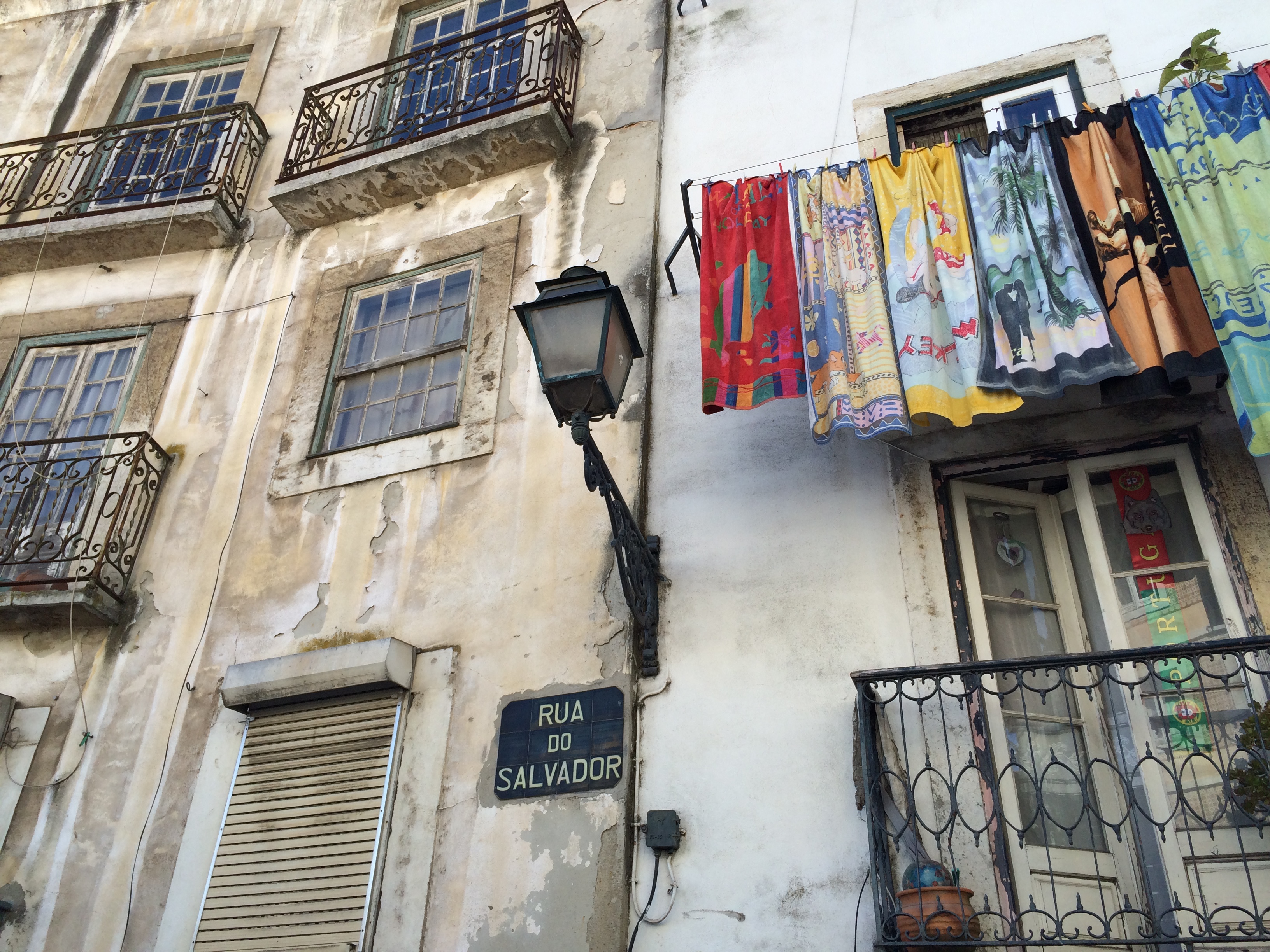
We spend most of the rest of the afternoon strolling through the colourful narrow lanes of the old Alfama district dating back to Arab times. The lanes are so impossibly narrow it’s hard to see how any form of vehicles can pass through them and yet they do try nonetheless. We were mesmerized by the sight of a truck trying to pass then getting hopelessly stuck and spending a good 20 minutes maneuvering back again, whilst another motorist was blocking the way behind! Felt a bit like Cairo!
The lanes of Alfama were all bedecked with multi-coloured ribbons and garlands in preparation for the final culmination of a month-long celebration of the feast of St Anthony.
Every now and then, as people were lighting the charcoal and preparing the food for the barbecues that would be cooked in the evening, the melancholy sound of a ‘Fado’ singer would ring out and reverberate around the walls of the old quarter. ‘Fado’ is the characteristic music of Alfama and is the product of the rich variety of cultural and musical influences Lisbon absorbed through its cosmopolitan history. It sounded very much like Napolitan or Sicilian music, but apparently, it’s mostly much sadder as many of the themes revolve around the loss and grief experienced by women during Portugal’s naval explorations.
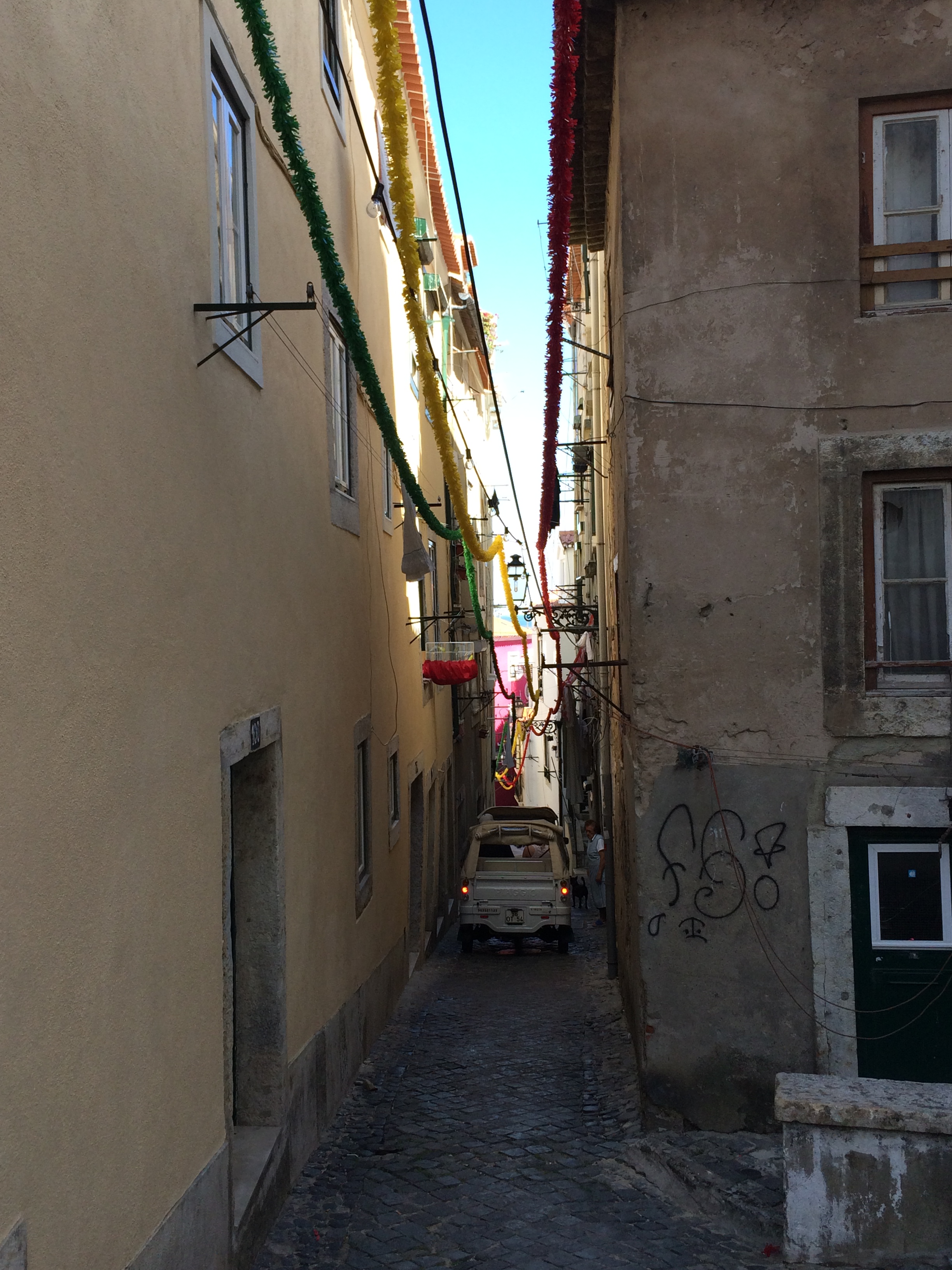
The lanes are impossibly narrow yet cars still try to pass through.
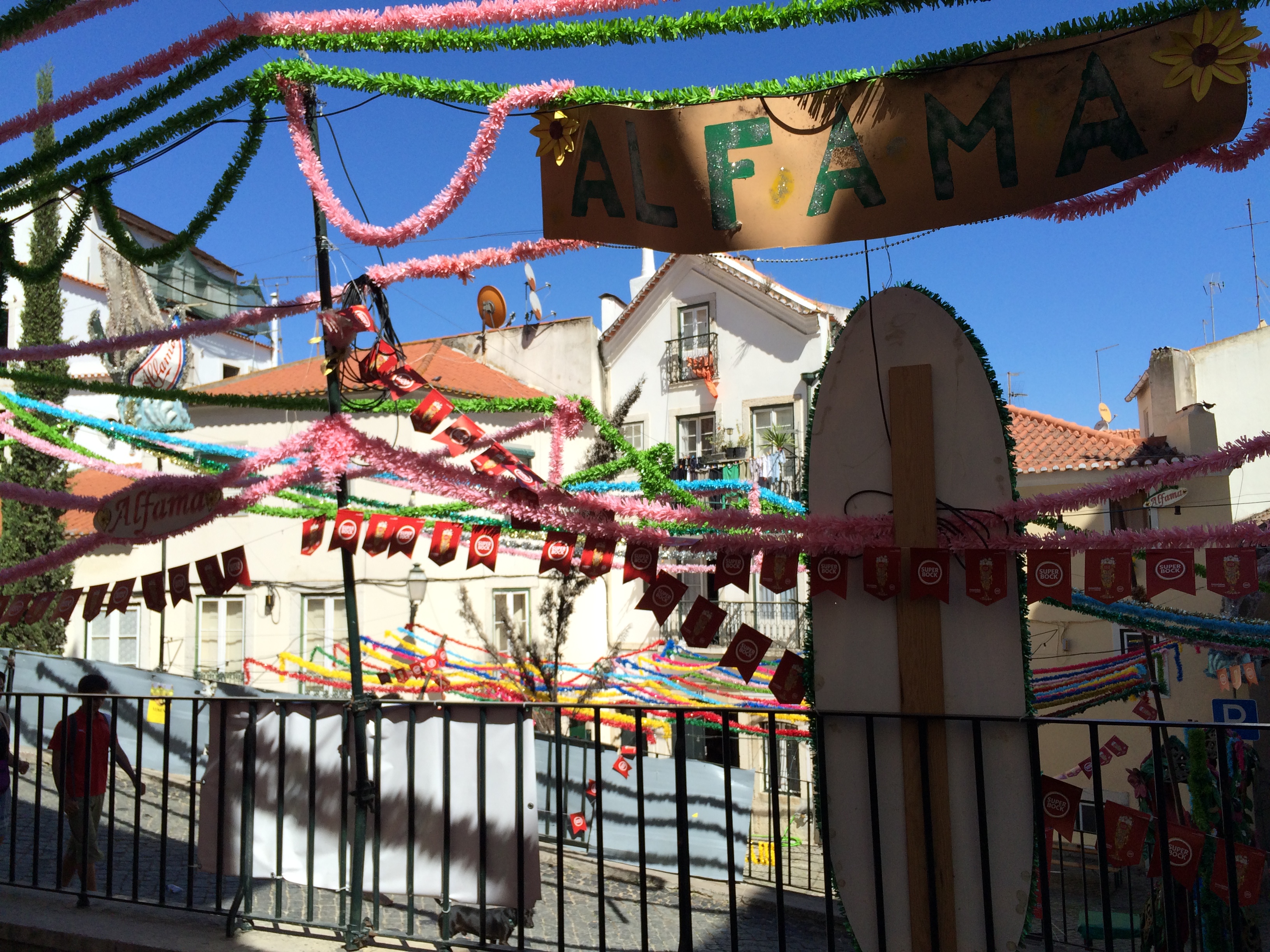
The colourful Alfama district – celebrations were in full flow for the feast of St Anthony.

As does religion.

A devotion to the arts features prominently.
We find a beautiful old house that’s now a hotel – the Palacete Chafariz d’el Rei – so go in to take a look. We’re greeted by a charming young man, Ivan, who tells us the house was built by a gentleman who made his riches in Brazil. It’s called The Fountain of Kings because it’s actually built on top of a fountain that no longer works. Ivan is very keen that we stay there the next time we come, but at prices ranging between 230 and 400 Euros a night we think it’s unlikely but we don’t rule it out completely so as not to disappoint him.
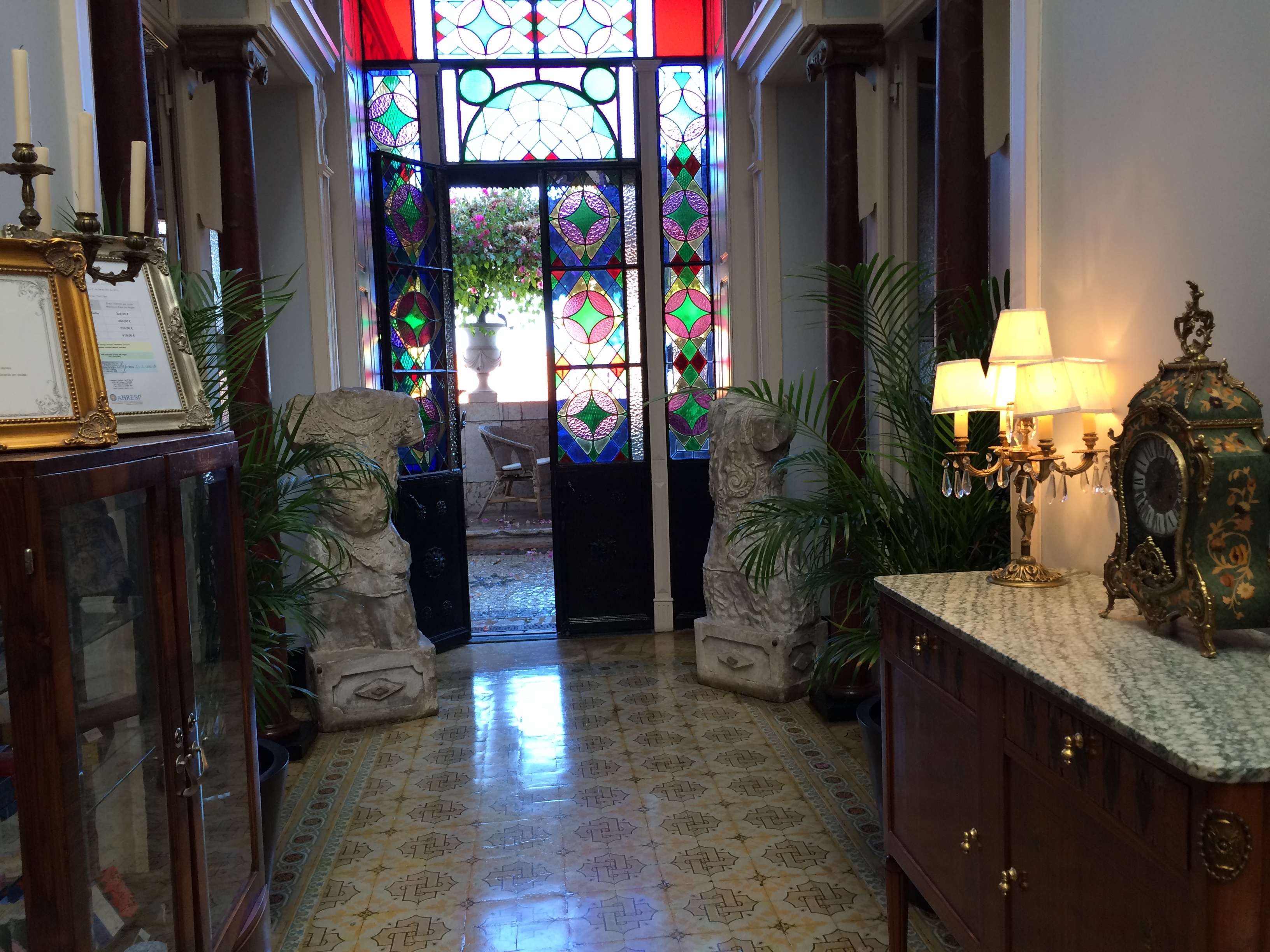
The beautiful hallway in the Chafariz d’El Rei.
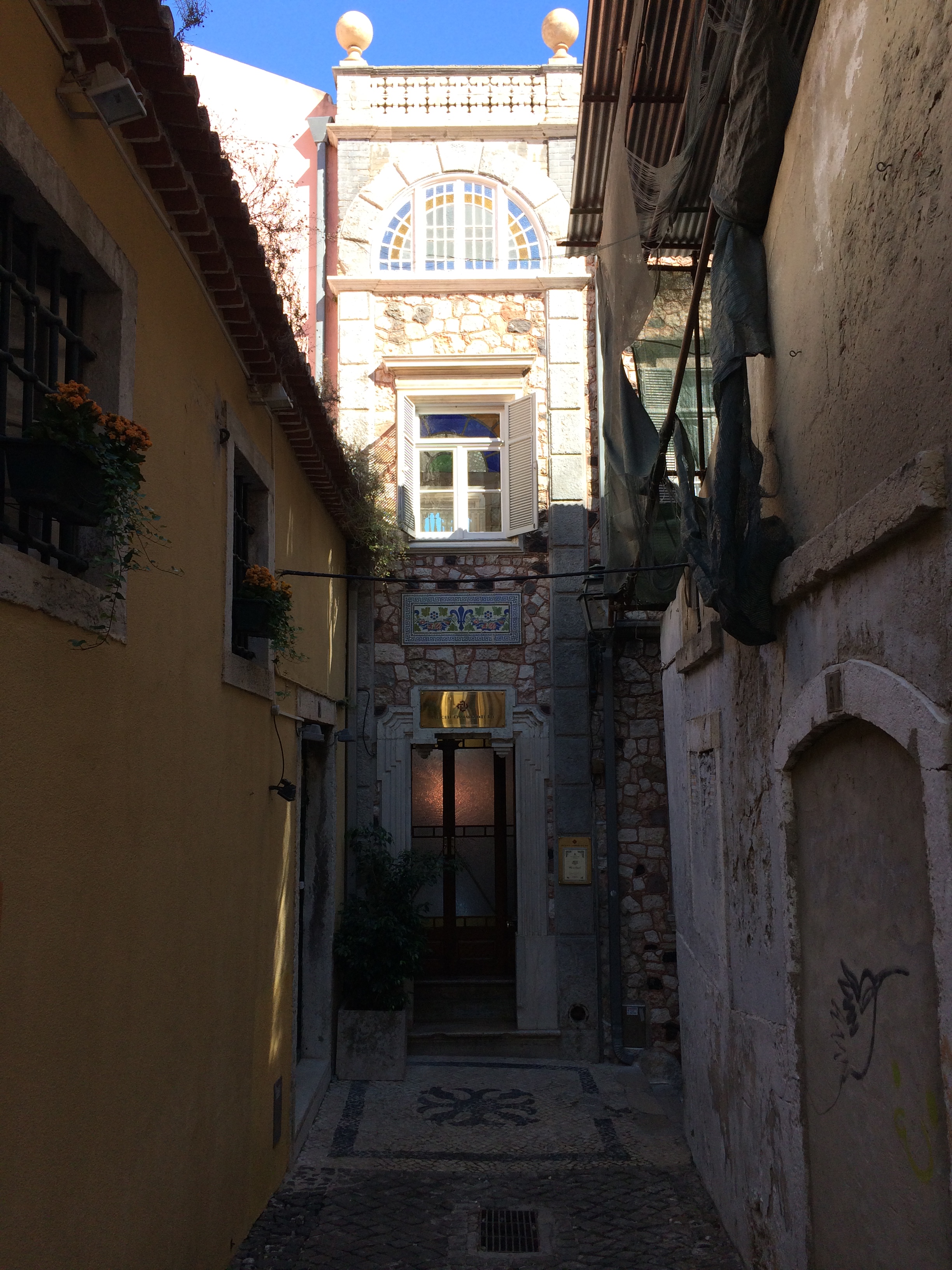
The elegant but unassuming entrance to the Chafariz d’El Rei Hotel in Alfama.

 Travels with our van
Mmm! Lucky both of you, enjoying those pateis de Belem. They immediayely made me think, not of Portugal (as you know I’ve never been there) but instead of Macau, which we were lucky enough to visit a couple of years ago. The casinos there are one thing (indoor Venetian canals complete with gondolas, life-sized replica of the campanile from St Marks Square, streets of Ancient Rome, the Potala, mechanical dragons, crystal chandeliers, gaming floors the size of football pitches, lights, lights, lights . . . ) but the old Portuguese quarter is something else. There are elegant colonial buildings, a gorgeous black and white mosaic paved piazza and the magnificent baroque facade of St Paul’s Church, built by the Jesuits and accidently burnt down in the early nineteenth century. Making your way up to the church, you meet hawkers mingling with the tourists and shoppers and bearing trays piled high with pateis. They slide them into brown paper bags for you, and you can eat them sitting on the church steps or while you visit the old fort and look over the border to high-rise China, stretching away into the distance. We were told that the pateis were originally made in monasteries. Convents apparently used large quantities of egg whites to starch the nuns’ habits, and the leftover yolks were passed to the local monks who made and sold these delicious little custard tarts.
LikeLike
Thanks Gill and sorry for the delay in acknowledging this. Macau sounds fascinating – an exotic mix of East and West by the sound of it, as is pretty much the case in so many places in the world where the West established a foothold in colonial times. Very interesting to think that the pastels de nata may have had their origins with the leftover yolks after the egg whites were used to starch the nuns’ habits!
LikeLike
We nearly went on honeymoon to Lisbon, so it was lovely to read and see the photos, too. The ‘pot-au-feu’ reminds me of the choucroute at Gurtlerhoft, Strasbourg.
LikeLike
I definitely recommend Lisbon – and Cintra too, which we missed this time unfortunately. I think given the choice I’d go for the choucroute!
LikeLike